
R. K. Narayan (1906–2001)
Author of The Ramayana: A Shortened Modern Prose Version of the Indian Epic
About the Author
R. K. Narayan was born Rasipuram Krishnaswami Narayanaswami in Madras, India on October 10, 1906. He graduated from Maharaja College of Mysore with a B.A. degree in 1930. He attempted to teach for a bit but then switched to writing full time. His first book, Swami and Friends, was published in show more Britain in 1935. During his lifetime, he wrote more than 30 novels and hundreds of short stories. His other novels included The Bachelor of Arts, The Dark Room, The English Teacher, The Guide, The Financial Expert, The Man Eater of Malgudi, The Vendor of Sweets, and The World of Nagaraj. He was one of the first Indians to write in English and gain international recognition. He received numerous awards including the Padma Bhushan, India's highest prize. He died on May 13, 2001 at the age of 94. (Bowker Author Biography) show less
Series
Works by R. K. Narayan
Swami and Friends / The Bachelor of Arts / The Dark Room / The English Teacher (1935) 244 copies, 3 reviews
Mr. Sampath: The Printer of Malgudi / The Financial Expert / Waiting for the Mahatma (1948) 165 copies, 3 reviews
The Indian Epics Retold: The Ramayana, The Mahabharata, Gods Demons and Others (1995) 94 copies, 2 reviews
Memories of Malgudi: The Dark Room, The English Teacher, Waiting for the Mahatma, The Guide and The World of Nagaraja (2000) 73 copies
The Magic of Malgudi: Swami and Friends, The Bachelor of Arts, The Vendor of Sweets (2000) 41 copies
The World of Malgudi: Mr. Sampath / The Financial Expert / The Painter of Signs / A Tiger for Malgudi (2000) 16 copies
Next Sunday 7 copies
Old and new: Eighteen short stories 4 copies
Mysore 2 copies
Short Story Collections by R. K. Narayan: Gods, Demons and Others, Malgudi Days, the Grandmother's Tale and Selected Stories (2010) 2 copies
Malgudi Days I 2 copies
ציפיה למהאטמה 1 copy
Todo malgudi 1 copy
Writing in modern India — Author — 1 copy
Guide 1 copy
MALAGUDI DAYS 1 copy
Rupiyal Hathara 1 copy
මගේ කල දවස 1 copy
Jest in Time: 175 Years 1 copy
No title 1 copy
HALWAI (Marathi) हलवाई 1 copy
Associated Works
The Art of the Tale: An International Anthology of Short Stories (1986) — Contributor — 381 copies, 3 reviews
Other Voices, Other Vistas: Short Stories from Africa, China, India, Japan, and Latin America (1992) — Contributor — 213 copies, 2 reviews
Tagged
Common Knowledge
- Canonical name
- Narayan, R. K.
- Legal name
- Narayan, Rasipuram Krishnaswami Iyer
- Birthdate
- 1906-10-10
- Date of death
- 2001-05-13
- Gender
- male
- Education
- Maharaja College of Mysore (B.A.|1930)
Lutheran Mission School, Purasawalkam, India
C.R.C. High School
Christian College High School - Occupations
- novelist
short story writer
translator - Awards and honors
- National Prize of the Sahitya Akademi (1958)
Padma Bhushan (1964)
AC Benson Medal (1979)
Member of Rajya Sabha (1989)
Padma Vibhushan (2000)
Honorary member, American Academy of Arts and Letters (1982) (show all 11)
Sahitya Akademi Award (1960)
Rajyotsava Prashasti (1986)
Honorary Doctorate (University of Mysore|1976)
Honorary Doctorate (Delhi University|1973)
Honorary Doctorate (University of Leeds|1967) - Nationality
- India
- Birthplace
- Madras, Madras Presidency, British Raj
- Places of residence
- Madras, India (now Chennai ∙ India)
Mysore, India - Place of death
- Chennai, Tamil Nadu, India
- Map Location
- India
Members
Reviews

As a reader of most every genre who has a "tolerance" and even an enthusiasm for outdated writing styles, really wordy literature, the requirement of a big initial investment to read through the beginning of a story, ideals & philosophies very different from my own, etc. etc., I feel my rare one-star rating (my first ever??) demands written justification.
I haven't read other works by R.K. Narayan, so I can't compare this story to his others. It was an issue of Bookmarks magazine that turned show more me on to this title by way of their highlighting a number of titles written with an unusual narrator. This one? Written by a tiger.
...full potential for a really great, original, even quirky and enlightening tale. But A Tiger for Malgudi just doesn't deliver. In fact, it GREATLY disappoints, even angers. It falls far, far below what it could've been with such a great premise to set off with.
First of all, it is easy to read... as "classic literature" it's not outdated, difficult, etc. It does get slow and repetitive in parts, covering day-to-day details at certain points in the narrator's life that... just aren't significant or meaningful enough to bother to include in the work as a whole. But, that's just the author's choice. The intro also starts off the reading with promise... Narayan's tale of what prompted his interest in writing about a tiger's life—and as a tiger—is compelling. Narayan writes "with a few exceptions here and there, humans have monopolized the attention of fiction writers. Man in his smugness never imagines for a moment that other creatures may also possess ego, values, outlook, and the ability to communicate, though they may be incapable of audible speech." Brilliant point. And so is "Man assumes he is all-important, that all else in creation exists only for his sport, amusement, comfort, or nourishment." As the reader, you're thinking "this is going to be one of those books EVERYONE on the planet should read... pointing out the things we humans ignore, how animals are mistreated, helps us to open our eyes, be kinder, etc. etc."
It's the story itself and its ultimate messages/philosophies that are gravely disappointing ...and even enraging.
...And that's completely aside from the very obvious fact that the author himself is not remotely familiar with cats as a species; he hasn't lived with them OR done his research. He frequently contradicts, in trying to "speak" for and as a tiger, the most basic, observable traits, motivations, and desires of cats themselves, as obvious to even the most complacent and inattentive human caretaker of a domestic cat. (yikes!)
The narrator/tiger proceeds to tell of significant parts of his life from roaming the jungle freely, feeling he's ruler of the animal kingdom, etc. to being captured by a circus owner, tormented and tortured in ways he actually comes to accept or even believe he deserves (yikes again!), and then his life after the circus.... all speaking kindly and reverently about his "Master" (yikes yet again!) who's a bit of a philosophical guru and enlightened being who's taught the tiger how to communicate with humans and many other ideas of life and our purpose, animals and humans alike. And though this Master is filled with true wisdom.... "If you are ready to hate and want to destroy each other, you may find a hundred reasons" or "Everyone is acting a part all the time, knowingly or unknowingly" ...he's also a very dubious character.
During the tiger's tale of his circus life, the tiger shares how his Master later justified that horrible part of his life—caged, beaten, confined, starved, and even driven to respect and admire his captor—in explaining that the tiger must've been punished so severely because he himself had done the same to another in a past life. Now, if that's not just a great excuse for ANY being, human or otherwise, to justify harming another, I don't know what is. Narayan writes the words of the Master: "You probably in a previous life enjoyed putting your fellow-beings behind bars. One has to face the reaction of every act, if not in the same life, at least in another life or series of lives. There can be no escape from it. Now you have a chance to realize how your prisoners must have felt in those days, when you locked them in and watched them day by day to measure how far you had succeeded in breaking their spirits." Frightening as that philosophy is, you, as reader, are still hoping that's not "really" the ultimate message...
As you read of the tiger's life, you're looking forward to the upcoming period of enlightenment, his meeting that wonderful human being, and being saved from his circus life, etc. And that point never really comes.
The story does continues after the tiger's circus stint, with meeting his Master, but...
*** SPOILER ALERT! ***
...Then it's quickly over—a VERY small percentage of the entire book. Meanwhile, the pages detailing when the tiger escapes the circus and is cornered by a man preparing to shoot and kill him make up 20% of the entire book. I was deathly bored; I counted the pages. And only then, at the very end of the book, do you realize what the true, final message is... that animals are inferior to humans, that their natural carnivorous inclination is inferior, that their ultimate purpose in life and most enormous gift they can grant to others is to live in captivity, be confined and force-fed, and bring joy to observing humans passing by their cage.
The Master's final conclusion—no, his dictated command—for his aging tiger friend and student: that the tiger is to check himself into the local zoo where he can live out his final days with ease, have the freedom to roam within an enclosure, and bring smiles to human children's faces.
I believe in creative freedom—strongly. If I didn't, I'd recommend this book be burned. Or at least, the ending. show less
I haven't read other works by R.K. Narayan, so I can't compare this story to his others. It was an issue of Bookmarks magazine that turned show more me on to this title by way of their highlighting a number of titles written with an unusual narrator. This one? Written by a tiger.
...full potential for a really great, original, even quirky and enlightening tale. But A Tiger for Malgudi just doesn't deliver. In fact, it GREATLY disappoints, even angers. It falls far, far below what it could've been with such a great premise to set off with.
First of all, it is easy to read... as "classic literature" it's not outdated, difficult, etc. It does get slow and repetitive in parts, covering day-to-day details at certain points in the narrator's life that... just aren't significant or meaningful enough to bother to include in the work as a whole. But, that's just the author's choice. The intro also starts off the reading with promise... Narayan's tale of what prompted his interest in writing about a tiger's life—and as a tiger—is compelling. Narayan writes "with a few exceptions here and there, humans have monopolized the attention of fiction writers. Man in his smugness never imagines for a moment that other creatures may also possess ego, values, outlook, and the ability to communicate, though they may be incapable of audible speech." Brilliant point. And so is "Man assumes he is all-important, that all else in creation exists only for his sport, amusement, comfort, or nourishment." As the reader, you're thinking "this is going to be one of those books EVERYONE on the planet should read... pointing out the things we humans ignore, how animals are mistreated, helps us to open our eyes, be kinder, etc. etc."
It's the story itself and its ultimate messages/philosophies that are gravely disappointing ...and even enraging.
...And that's completely aside from the very obvious fact that the author himself is not remotely familiar with cats as a species; he hasn't lived with them OR done his research. He frequently contradicts, in trying to "speak" for and as a tiger, the most basic, observable traits, motivations, and desires of cats themselves, as obvious to even the most complacent and inattentive human caretaker of a domestic cat. (yikes!)
The narrator/tiger proceeds to tell of significant parts of his life from roaming the jungle freely, feeling he's ruler of the animal kingdom, etc. to being captured by a circus owner, tormented and tortured in ways he actually comes to accept or even believe he deserves (yikes again!), and then his life after the circus.... all speaking kindly and reverently about his "Master" (yikes yet again!) who's a bit of a philosophical guru and enlightened being who's taught the tiger how to communicate with humans and many other ideas of life and our purpose, animals and humans alike. And though this Master is filled with true wisdom.... "If you are ready to hate and want to destroy each other, you may find a hundred reasons" or "Everyone is acting a part all the time, knowingly or unknowingly" ...he's also a very dubious character.
During the tiger's tale of his circus life, the tiger shares how his Master later justified that horrible part of his life—caged, beaten, confined, starved, and even driven to respect and admire his captor—in explaining that the tiger must've been punished so severely because he himself had done the same to another in a past life. Now, if that's not just a great excuse for ANY being, human or otherwise, to justify harming another, I don't know what is. Narayan writes the words of the Master: "You probably in a previous life enjoyed putting your fellow-beings behind bars. One has to face the reaction of every act, if not in the same life, at least in another life or series of lives. There can be no escape from it. Now you have a chance to realize how your prisoners must have felt in those days, when you locked them in and watched them day by day to measure how far you had succeeded in breaking their spirits." Frightening as that philosophy is, you, as reader, are still hoping that's not "really" the ultimate message...
As you read of the tiger's life, you're looking forward to the upcoming period of enlightenment, his meeting that wonderful human being, and being saved from his circus life, etc. And that point never really comes.
The story does continues after the tiger's circus stint, with meeting his Master, but...
*** SPOILER ALERT! ***
...Then it's quickly over—a VERY small percentage of the entire book. Meanwhile, the pages detailing when the tiger escapes the circus and is cornered by a man preparing to shoot and kill him make up 20% of the entire book. I was deathly bored; I counted the pages. And only then, at the very end of the book, do you realize what the true, final message is... that animals are inferior to humans, that their natural carnivorous inclination is inferior, that their ultimate purpose in life and most enormous gift they can grant to others is to live in captivity, be confined and force-fed, and bring joy to observing humans passing by their cage.
The Master's final conclusion—no, his dictated command—for his aging tiger friend and student: that the tiger is to check himself into the local zoo where he can live out his final days with ease, have the freedom to roam within an enclosure, and bring smiles to human children's faces.
I believe in creative freedom—strongly. If I didn't, I'd recommend this book be burned. Or at least, the ending. show less
Mr. Sampath, the printer of Malgudi ; The financial expert ; Waiting for the Mahatma by R. K. Narayan

With a writing career that spanned two thirds of the 20th century, R K Narayan used to be one of the best-known Indian writers internationally (there were several shelves of his books in our public library when I was growing up), but he’s rather faded off the map recently. As someone who grew up heavily influenced by writers like Thomas Hardy, Arnold Bennett and P G Wodehouse, was promoted by Graham Greene, and who produced dozens of well-made middle-class novels, most of them set in the show more imaginary South Indian small town of Malgudi, he doesn’t really fit the profile we look for in postcolonial writers, but he was extraordinarily good at what he did, and there seems to be a lot of value in his Balzacian project of chronicling the way Indian small town society fits together.
ThIs recent reprint, with an introduction from that great modern comic storyteller Alexander McCall Smith, brings together three short novels from Narayan’s middle period, all written shortly after Independence.
In Mr Sampath: the printer of Malgudi a young man comes to Malgudi to set up a new, socially-critical weekly magazine. The only printer he can find willing to take on the legal risks is the eccentric Sampath, whose ancient printing plant clearly isn’t quite up to the job, but who somehow gets the magazine going anyway. All goes well until Sampath is distracted by an opportunity to get into the movie business, and chaos ensues as the young editor finds himself scripting a Hindu epic instead of writing columns attacking slum landlords and town officials.
The financial expert, Margayya, is a middleman who when we first meet him is making a good living sitting under a banyan tree outside the Co-operative Land Bank helping farmers to fill in their loan applications. A humiliation makes him determined to rise in the world and make a career for his son, and a few years later he has made it to a city office and is running a wildly successful pyramid scheme, but of course the son isn’t interested in following in his father’s footsteps, and the pyramid collapses…
Waiting for the Mahatma is more directly historical — a young man with no real political convictions is drawn into the Independence campaign after being asked for donations by a pretty girl who turns out to be in Mahatma Gandhi’s entourage. The only way to get close to the girl is to join the movement himself. Narayan cleverly manages to convey both the enormous excitement of the Mahatma’s personal charisma and the difficulty normal humans face in trying to put his radical ideas into practice in their lives. show less
ThIs recent reprint, with an introduction from that great modern comic storyteller Alexander McCall Smith, brings together three short novels from Narayan’s middle period, all written shortly after Independence.
In Mr Sampath: the printer of Malgudi a young man comes to Malgudi to set up a new, socially-critical weekly magazine. The only printer he can find willing to take on the legal risks is the eccentric Sampath, whose ancient printing plant clearly isn’t quite up to the job, but who somehow gets the magazine going anyway. All goes well until Sampath is distracted by an opportunity to get into the movie business, and chaos ensues as the young editor finds himself scripting a Hindu epic instead of writing columns attacking slum landlords and town officials.
The financial expert, Margayya, is a middleman who when we first meet him is making a good living sitting under a banyan tree outside the Co-operative Land Bank helping farmers to fill in their loan applications. A humiliation makes him determined to rise in the world and make a career for his son, and a few years later he has made it to a city office and is running a wildly successful pyramid scheme, but of course the son isn’t interested in following in his father’s footsteps, and the pyramid collapses…
Waiting for the Mahatma is more directly historical — a young man with no real political convictions is drawn into the Independence campaign after being asked for donations by a pretty girl who turns out to be in Mahatma Gandhi’s entourage. The only way to get close to the girl is to join the movement himself. Narayan cleverly manages to convey both the enormous excitement of the Mahatma’s personal charisma and the difficulty normal humans face in trying to put his radical ideas into practice in their lives. show less
Swami and Friends, The Bachelor of Arts, The Dark Room, The English Teacher (Everyman's Library Classics & Contemporary Classics) by R. K. Narayan
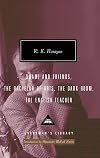
Swami and Friends
I'm not sure what I expected when I decided to read Narayan, but what I got was not it. What I got was a masterfully rendered little story of a boy and his friends in rural southern India in the 1920s. It possesses the kind of narrative pleasure that one comes across only rarely. The storyline is modulated beautifully. It is a traditional linear narrative; it doesn't jump around. The sequence is chronological. The boy, Swami, wanders here and there and we follow him. The show more story deals with his travails at school, at home, and when he is with friends: particularly two colorful fellows called Mani and Rajam. Swami's thoughts are very much a child's thoughts but this isn't a book for children. The emotional range is too rich, too complex. The ending is abrupt and powerful. Highly recommended.
The Dark Room Excellent too
The English Teacher
I am reminded of how John Gardner differentiated between sentiment and the sentimental. This book is high in genuine sentiment. It is based on Narayan's life when, after a period of prolonged bachelorhood after marriage, his wife came to live with him in the provincial town where he was a teacher of English. What fascinated, among other things, was all the detail about how Indians lived in the late 1940s. The writing is straightforward, the timeline chronological. There is no plot to speak of. The teacher's wife and child arrive at a large house the husband has selected for them. The lay out is rudimentary though spacious. I was astonished at how little they lived on, compared to the gluttonous West of that time. Narayan captures the smell of the place exquisitely, it dirtiness, its roads beaten down by the multitudes over millennia. Like Narayan's own wife, the professor here watches his die. It is a drawn out death though anything but predictable. In fact, it's gripping. The wife's parents show up to share the nursing duties. Later, the professor meets a soothsayer who channels his wife from "the other side." Highly recommended. show less
I'm not sure what I expected when I decided to read Narayan, but what I got was not it. What I got was a masterfully rendered little story of a boy and his friends in rural southern India in the 1920s. It possesses the kind of narrative pleasure that one comes across only rarely. The storyline is modulated beautifully. It is a traditional linear narrative; it doesn't jump around. The sequence is chronological. The boy, Swami, wanders here and there and we follow him. The show more story deals with his travails at school, at home, and when he is with friends: particularly two colorful fellows called Mani and Rajam. Swami's thoughts are very much a child's thoughts but this isn't a book for children. The emotional range is too rich, too complex. The ending is abrupt and powerful. Highly recommended.
The Dark Room Excellent too
The English Teacher
I am reminded of how John Gardner differentiated between sentiment and the sentimental. This book is high in genuine sentiment. It is based on Narayan's life when, after a period of prolonged bachelorhood after marriage, his wife came to live with him in the provincial town where he was a teacher of English. What fascinated, among other things, was all the detail about how Indians lived in the late 1940s. The writing is straightforward, the timeline chronological. There is no plot to speak of. The teacher's wife and child arrive at a large house the husband has selected for them. The lay out is rudimentary though spacious. I was astonished at how little they lived on, compared to the gluttonous West of that time. Narayan captures the smell of the place exquisitely, it dirtiness, its roads beaten down by the multitudes over millennia. Like Narayan's own wife, the professor here watches his die. It is a drawn out death though anything but predictable. In fact, it's gripping. The wife's parents show up to share the nursing duties. Later, the professor meets a soothsayer who channels his wife from "the other side." Highly recommended. show less

There is such a gentle spirit to R.K. Narayan’s Swami and Friends, which sentimentally looks back at the years of childhood in a way that reminded me of Jean Shepherd’s In God We Trust: All Others Pay Cash, the basis for the film A Christmas Story. The hero of the story, young Swaminathan Srinivasan, copes with strict school teachers, his father, and friends who come and go, dreaming of becoming the next Maurice Tate and cricket stardom.
As with other books I’ve read from Narayan, it show more focuses more on the foibles of human nature as opposed to politics, though through a demonstration he does prefetch India’s move towards independence (“England is no bigger than our Madras Presidency and is inhabited by a handful of white rogues and is thousands of miles away. Yet we bow in homage before the Englishman! Why are we become, through no fault of our own, docile and timid?”). As the book was written in 1935, I loved these little bits.
Narayan’s writing is simple and direct, but he pokes at emotions in subtle ways in telling what is also a universal story. It’s not a masterpiece but it feels wholesome and enjoyable. I’m also sucker for endings which have a parting at a railway station, so that worked for me too. show less
As with other books I’ve read from Narayan, it show more focuses more on the foibles of human nature as opposed to politics, though through a demonstration he does prefetch India’s move towards independence (“England is no bigger than our Madras Presidency and is inhabited by a handful of white rogues and is thousands of miles away. Yet we bow in homage before the Englishman! Why are we become, through no fault of our own, docile and timid?”). As the book was written in 1935, I loved these little bits.
Narayan’s writing is simple and direct, but he pokes at emotions in subtle ways in telling what is also a universal story. It’s not a masterpiece but it feels wholesome and enjoyable. I’m also sucker for endings which have a parting at a railway station, so that worked for me too. show less
Lists
Awards


You May Also Like


Associated Authors
Statistics
- Works
- 100
- Also by
- 23
- Members
- 10,419
- Popularity
- #2,279
- Rating
- 3.8
- Reviews
- 153
- ISBNs
- 392
- Languages
- 19
- Favorited
- 33
