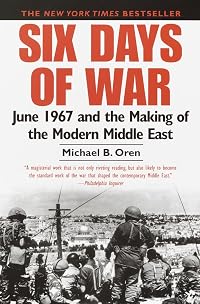
Six Days of War
by Michael B. Oren
On This Page
Description
Six Days of War is the most comprehensive history ever published of the six days of intense Arab-Israeli fighting in the summer of 1967. Oren spotlights all the participants--Arab, Israeli, Soviet, and American-involved in this clash that transformed the world.Tags
Recommendations




















Member Reviews
Six Days of War is a comprehensive, deeply researched, if not exactly unbiased account of the Six Day War. An Israeli academic (and subsequently Ambassador to America), Oren mostly reiterates the consensus Jewish position that the Six Day War was a righteous triumph for the Jewish state; one which secured its place on the global stage while failing to resolve basic issues such as Arab acceptance of Israel, or the future of the Palestinian people.
This book is a day by day, sometimes hour by hour account of the war and its lead-up. The basic story is one we know well: With tensions rising along the Sinai border and at the vital Straits of Tiran, and diplomatic efforts failing at the UN, the Israeli government launched a preemptive strike show more against the Egyptian air force, annihilating it on the ground, followed by bold attacks that in sequence captured the Sinai, Jerusalem, and the Golan Heights.
It's impossible to have much sympathy for the Arab states. Though Israel fired first, it was only after years of escalations and provocations. From public radio propaganda and private diplomatic cables, Arab leaders, especially Nasser, wanted a war but were unable to cope with the maelstrom of violence that they unleashed. Egyptian and Syrian commanders are both incompetent and brutal; daring war but breaking at the first reversal. Only Jordan's King Hussein comes off as halfway sympathetic. By contrast, the Israelis are decisive, diplomatic, and while flawed still heroic. Certainly, when faced with the ultimate test of statecraft they succeeded beyond all measure.
I'm not sure that I fully buy Oren's argument about contingency and chance. Sure, the fact that the war played out precisely when it did and how it did could not have been foreseen, but war would still have happened no matter what. Israel and Egypt had fundamentally different visions of the Middle East, and both believed that they would lose at any 'even' negotiating table. The quality of the armies was not a matter of luck, but of decades of building a military, and the fragility of authoritarian states compared to the resilience of pluralistic ones. show less
This book is a day by day, sometimes hour by hour account of the war and its lead-up. The basic story is one we know well: With tensions rising along the Sinai border and at the vital Straits of Tiran, and diplomatic efforts failing at the UN, the Israeli government launched a preemptive strike show more against the Egyptian air force, annihilating it on the ground, followed by bold attacks that in sequence captured the Sinai, Jerusalem, and the Golan Heights.
It's impossible to have much sympathy for the Arab states. Though Israel fired first, it was only after years of escalations and provocations. From public radio propaganda and private diplomatic cables, Arab leaders, especially Nasser, wanted a war but were unable to cope with the maelstrom of violence that they unleashed. Egyptian and Syrian commanders are both incompetent and brutal; daring war but breaking at the first reversal. Only Jordan's King Hussein comes off as halfway sympathetic. By contrast, the Israelis are decisive, diplomatic, and while flawed still heroic. Certainly, when faced with the ultimate test of statecraft they succeeded beyond all measure.
I'm not sure that I fully buy Oren's argument about contingency and chance. Sure, the fact that the war played out precisely when it did and how it did could not have been foreseen, but war would still have happened no matter what. Israel and Egypt had fundamentally different visions of the Middle East, and both believed that they would lose at any 'even' negotiating table. The quality of the armies was not a matter of luck, but of decades of building a military, and the fragility of authoritarian states compared to the resilience of pluralistic ones. show less
Fascinating study of the June 1967 Middle East War in which the author seeks to present a "fair and balanced" narrative, using both Arab and Israeli sources. In Oren's moment-by-moment account, he highlights the complexities of the politics behind the war (such as Johnson's weakness because of Vietnam; the Soviet fear factor; Nasser's love-hate relationship with his military commander Amer; Hussein's vulnerability and fear of Nasser; and the battles within the Israeli government among the strong personalities of Eshkol, Dayan, and Rabin). Oren also elaborates on many small elements of caprice that affected the outcome of the war (for example, when the American Ambassador Wally Barbour decided to take off for the weekend instead of show more conveying Hussein's letter of apology to Eshkol for a mine accident along the border in November 1966; or the crisis period after Nasser evicted the U.N. from the Sinai, and U-Thant postponed a trip to Cairo for three days because he wanted to wait until his horoscope said it was propitious to travel.) Oren recounts developments that even seem very humorous in retrospect, as when the Israelis confronted Chuvakhin, the Soviet Ambassador to Israel, in May 1967 about the lie that Israeli troops were massing on the border in Syria. Chuvakhin "replied simply that his job was to communicate Soviet truths, not test them." Or when the Israelis entered Nablus on day three of the war to find thousands of people lining the streets to applaud them: the citizens had believed the propaganda that the Arabs were winning, and mistook the Israelis for Iraqis.
Oren presents rich portraits of Nasser, whom he labels "a tragic figure" and Dayan, whom Oren claims in an afterword still not to understand. Although he feels Dayan "was a leader of a caliber virtually unknown in the Middle East today," Oren also calls Dayan "a man of utter contradictions - passionate and cold, creative and close-minded, fearless and fainthearted..." with a "prodigious ego" and enigmatic mind.
Oren posits that the greatest political change wrought by the war of 1967 was the collapse of Nasserism - or secular pan-Arabism - and its replacement by Islamic extremism. Israel also became "more Jewish" from the reclamation of its biblical homelands, while the Arab street became more anti-Zionist and anti-Semitic than ever. (In addition to Arab shame and anger over Israel's military hegemony, Oren attributes this increase to the propaganda that "dominates the Arab press and poisons Arabic school textbooks.")
The discussion of the American involvement (or lack thereof) will be particularly interesting to Americans. Johnson's incapacitation by Vietnam presaged Reagan's weakness after Iran-Contra, and even moreso, the perception that Clinton's impeachment battle affected his ability to respond to the growing terrorist threat from Al Qaeda.
Oren tries to shed light on the still unresolved circumstances surrounding the accidental Israeli attack of the USS Liberty on day four of the war. The Liberty was only thirteen nautical miles from the Sinai coast, in an area declared off-limits by Egypt. Johnson had told the Sixth Fleet stationed 240 miles away not even to turn around, so no one could charge the U.S. with collusion. Many aspects of the incident remain a [classifed] mystery.
Oren asserts that this war, "triggered by [Syrian-sponsored] Palestinian guerrilla raids and Israel's retaliations against them" and yet also due to a myriad of other issues, never really ended. As long as ignorance and falsehoods persist, and unless and until Arab societies develop strong middle classes with vested interests in stability, no real end to the conflict can be contemplated.
(JAF) show less
Oren presents rich portraits of Nasser, whom he labels "a tragic figure" and Dayan, whom Oren claims in an afterword still not to understand. Although he feels Dayan "was a leader of a caliber virtually unknown in the Middle East today," Oren also calls Dayan "a man of utter contradictions - passionate and cold, creative and close-minded, fearless and fainthearted..." with a "prodigious ego" and enigmatic mind.
Oren posits that the greatest political change wrought by the war of 1967 was the collapse of Nasserism - or secular pan-Arabism - and its replacement by Islamic extremism. Israel also became "more Jewish" from the reclamation of its biblical homelands, while the Arab street became more anti-Zionist and anti-Semitic than ever. (In addition to Arab shame and anger over Israel's military hegemony, Oren attributes this increase to the propaganda that "dominates the Arab press and poisons Arabic school textbooks.")
The discussion of the American involvement (or lack thereof) will be particularly interesting to Americans. Johnson's incapacitation by Vietnam presaged Reagan's weakness after Iran-Contra, and even moreso, the perception that Clinton's impeachment battle affected his ability to respond to the growing terrorist threat from Al Qaeda.
Oren tries to shed light on the still unresolved circumstances surrounding the accidental Israeli attack of the USS Liberty on day four of the war. The Liberty was only thirteen nautical miles from the Sinai coast, in an area declared off-limits by Egypt. Johnson had told the Sixth Fleet stationed 240 miles away not even to turn around, so no one could charge the U.S. with collusion. Many aspects of the incident remain a [classifed] mystery.
Oren asserts that this war, "triggered by [Syrian-sponsored] Palestinian guerrilla raids and Israel's retaliations against them" and yet also due to a myriad of other issues, never really ended. As long as ignorance and falsehoods persist, and unless and until Arab societies develop strong middle classes with vested interests in stability, no real end to the conflict can be contemplated.
(JAF) show less
The world was created in 6 days, and so was modern Israel. This paean to Jewish hardiness, perseverance, cunning and pragmatism is, at the blurb-level, about the shortest war during the Baby Boomer generation. But the heart and motivation of this book, by author [a:Michael Oren|4503505|Michael Oren|http://www.goodreads.com/assets/nophoto/nophoto-U-50x66-251a730d696018971ef4a443cdeaae05.jpg], the sitting Israeli ambassador to the United States, is about existential rights; i.e., who is the rightful owner, landlord and tenant of the dry and weary land which holds Jerusalem at its center.
This is the tale of a week's worth of confused and bloody war, a war that embodied many other regional and worldwide events leading up to it, and show more influences Middle East and international geopolitics 46 years later. ... And on the 7th day, instead of resting, this new-but-ancient, small-but-ferocious nation lies uneasy, vigilant against enemies that surround it.
One would have to recognize of course that this is written from the point of view of Oren, quoting diplomatic dispatches, eyewitness accounts and historical records for credibility, but a view that is certainly not unbiased, notwithstanding the attempts at fairness. In so many words, he presents Israel's argument as a form of subdermal apologetics. And either you will accept it or reject it, but seldom will the response be blah. Such is the way of the world when it comes to anything Israel.
The title war is also called the 3rd Arab-Israeli war, and it behooves the reader to find out about the first two wars (1948-9 and 1956) for context. It would also help to have a detailed map on hand as the war is prosecuted on three different fronts, with references to many place names that may not be commonly known.
The impact this book had on me was to spur research (thank you Wikipedia even if people think you are inaccurate!) about Middle East history and events, to understand, from several viewpoints why things are the way they, or at least have a sense of some of the nationalistic and religious motivations. If it does the same to you, then the book has perhaps made its best possible impression. I do not recommend this book if one is looking for military tactics and strategy as the writing is more intellectual and philosophical than nitty-gritty warfare. show less
Opera avvincente, ricca di particolari e di citazioni. Non ritengo sia un libro di parte, certo, vengono esaltate le Forze Armate israeliane, ma considerando i fatti ritengo decisamente normale. Non mancano note critiche nei confronti della marina israeliana e a politici estremisti israeliani. Giudizio molto positivo e consiglio la lettura a chiunque voglia farsi un'idea della polveriera Mediorentale.
The first 60% covers the chaotic political machinations leading up to the war. It is far too detailed and esoteric for the casual reader without some background in recent Middle East history. The war itself is pretty interesting but high level and not too personal. Battles go by quickly. In the end the author keeps impressing how important the war was for subsequent Middle East history, but doesn't really explain why or how except for about a dozen individuals who get a "where are they now" treatment - once again, it helps to be knowledgeable before arriving. This book was written by someone who was involved in the war and an important Israeli politician and public figure, he set out to write a definitive history of the war and it show more probably is. Does not adapt very well to audio, though doable for the attentive listener, 18 hours is a long slog and the mind wanders. Recommend an abridged version if you can find it, probably best read so you can absorb the material. show less
This history of the Six Day War is extremely well written. Based on extensive research, this tale of the war reads better than most thriller/suspense novels I've read. It also presents data from both sides of the equation, though it obviously has a more pro-American / pro-Israeli stance when opinion is interjected into the retelling of events. If you want to know about the Six Day War, though, this is the book to use to acquaint yourself with it.
While the Six Day War was forty-five years ago, I think an understanding of the events which led up to the hostilities, and its aftermath, is an essential element for understanding the current state of affairs in Israel and the Middle East.
And Michael Oren's book, "Six Days of War", appears to be an excellent source of information. Some books about military campaigns get bogged down in describing every platoon number, every company number, every battalion and regimental commander, adjutant, and every piece of ordinance and piece of equipment they used or had available. Oren's book seemed to contain the right mix of information on personnel, military, and political perspectives from the Countries involved, as well as for the regional show more major powers, i.e., the U.S. and Soviet Union.
While Oren is the Israeli Ambassador to the United States, and would naturally have a pro-Israeli perspective, I think he met his stated objective of trying to present a fair and even-handed perspective of this important part of MidEast history. show less
And Michael Oren's book, "Six Days of War", appears to be an excellent source of information. Some books about military campaigns get bogged down in describing every platoon number, every company number, every battalion and regimental commander, adjutant, and every piece of ordinance and piece of equipment they used or had available. Oren's book seemed to contain the right mix of information on personnel, military, and political perspectives from the Countries involved, as well as for the regional show more major powers, i.e., the U.S. and Soviet Union.
While Oren is the Israeli Ambassador to the United States, and would naturally have a pro-Israeli perspective, I think he met his stated objective of trying to present a fair and even-handed perspective of this important part of MidEast history. show less
Members
- Recently Added By
Lists

Best Military History Books
123 works; 21 members

The Emergence of the Modern Middle East
289 works; 13 members

r/History Recommended Reading List
603 works; 11 members

r/AskHistorians' Recommended Books
1,068 works; 19 members

Books Referenced by Khalidi's The Hundred Years' War on Palestine
181 works; 1 member

THE WAR ROOM
813 works; 24 members
Author Information

14 Works 3,152 Members
Michael B. Oren is an Israeli historian born on May 20, 1955. He is also an author, politician and former ambassador to the U.S. He has written books, articles, and essays on Middle Eastern history. His titles include the best-selling Power, Faith and Fantasy and Six Days of War: June 1967 and the Making of the Modern Middle East, which won the show more Los Angeles Times History Book of the Year Award and the National Jewish Book Award. He has been a visiting professor at Harvard, Yale, and Georgetown universities. In 2015 his title Ally: My Journey Across the American-Israeli Divide, made The New York Times Best Seller List. (Bowker Author Biography) show less
All Editions
Awards and Honors
Awards
Distinctions
Common Knowledge
- Canonical title
- Six Days of War
- Original publication date
- 2002
- Important places
- Israel; Syria; Egypt
- Important events
- Six-Day War
- Epigraph
- Each We seized for his sin and against some We unleashed a storm. Some were seized by the cry and some the earth swallowed and some we drowned. God would never wrong them, but they wrong themselves.
The Qur'an, 29:39
But though the roar like breakers on a beach, God will silence them. They will flee like chaff scattered by the wind or like dust whirling before a storm.
Isaiah, 17:37 - Dedication
- For my wife, Sally
and for our children - Yoav, Lia, and Noam
Classifications
- Genres
- History, Nonfiction, General Nonfiction
- DDC/MDS
- 956.046 — History & geography History of Asia Middle East Asia: Turkey, Iraq, Syria, Lebanon, Israel, Jordan Middle East 1945-1980; 20th Century
- LCC
- DS127 .O74 — History of Europe, Asia, Africa and Oceania Asia History of Asia Israel (Palestine). The Jews History
- BISAC
Statistics
- Members
- 1,745
- Popularity
- 12,679
- Reviews
- 25
- Rating
- (4.14)
- Languages
- 7 — Danish, English, French, Hebrew, Italian, Norwegian (Bokmål), Spanish
- Media
- Paper, Audiobook, Ebook
- ISBNs
- 25
- UPCs
- 1
- ASINs
- 16