On This Page
Description
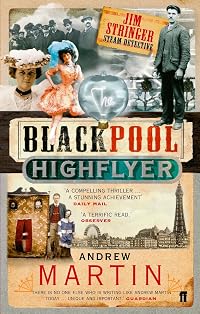
It is the summer of 1905 and Jim Stringer is copiloting a special train filled with overheated excursionists headed to Blackpool, the seaside resort on the English coast. At the moment when the train picks up speed, a huge rock comes into view farther down the tracks; it lies directly in their path. Full stop of the engine; full steam ahead with the mystery. As he did in The Necropolis Railway, Stringer doffs his railway hat and dons his detective's derby, assisted once more by "the wife" show more and her brilliant detecting skills. Capturing the world of railway stations and locomotives during the Edwardian Age, The Blackpool Highflyer carries readers to a place where dark shadows lurk behind innocence and the solution to the mystery waits at the end of the line. show lessTags
Recommendations











Member Reviews
I find this one to be slightly better than the first. The railway interest is still more of a plus than the detective story. He manages to create quite a good atmosphere - whether it's truly representative of Edwardian times I'm not qualified to judge, but it certainly feels OK. And in this volume we learn the answer to the old music hall riddle, "Why is a football round?"
The second in the Jim Stringer, railway detective, series and the one that shifts him back to his natural habitat of the North of England where he will stay for the next four books.
This is, in fact, a little superior to the much praised 'Necropolis Railway'[ https://www.goodreads.com/review/show/1006585502 ] - well written with plenty of red herrings to get ratiocinators going.
The main female character - Jim's wife - is no cypher but used to introduce a female perspective on life in 1905 with sensitivity and without the usual patronising ways of the retrospective liberal.
Jim often gets it wrong but is eternally inquisitive and she is strong and quite independent with flashes of insight that move the plot along. It is made to look like a show more genuine partnership.
The showy use of research has ended here. Martin has worked out the difference between 'literature' and entertainment without sacrificing the ability to write well. show less
This is, in fact, a little superior to the much praised 'Necropolis Railway'[ https://www.goodreads.com/review/show/1006585502 ] - well written with plenty of red herrings to get ratiocinators going.
The main female character - Jim's wife - is no cypher but used to introduce a female perspective on life in 1905 with sensitivity and without the usual patronising ways of the retrospective liberal.
Jim often gets it wrong but is eternally inquisitive and she is strong and quite independent with flashes of insight that move the plot along. It is made to look like a show more genuine partnership.
The showy use of research has ended here. Martin has worked out the difference between 'literature' and entertainment without sacrificing the ability to write well. show less
A near derailment of an excursion train starts this story,which is set in Edwardian England.
This is the second in this series which have as their lead character,Jim Stringer. In this book he is a driver's mate and takes his responsibility very seriously indeed. Therefore when he has the trouble with his train,he begins his own investigation as to just what is behind it.
For me the crime (for there is a crime) was of less importance than the way Andrew Martin has evoked the whole Edwardian era so well. He describes (for instance) the Music Hall and the Seaside as they were in those times,to perfection. His scenes on the various engines and in the rail stations cannot be faulted. Finally the way he writes about Stringer,his wife and their show more domestic life is just right. show less
This is the second in this series which have as their lead character,Jim Stringer. In this book he is a driver's mate and takes his responsibility very seriously indeed. Therefore when he has the trouble with his train,he begins his own investigation as to just what is behind it.
For me the crime (for there is a crime) was of less importance than the way Andrew Martin has evoked the whole Edwardian era so well. He describes (for instance) the Music Hall and the Seaside as they were in those times,to perfection. His scenes on the various engines and in the rail stations cannot be faulted. Finally the way he writes about Stringer,his wife and their show more domestic life is just right. show less
Having read books 1 and 3 in this series, this one came out of sequence. The character of Jim Stringer was at an earlier stage of development: even more naive and even quicker to leap to the wrong conclusion. Jim struggles throughout the book to identify the villain who has attempted to derail the train on which he was fireman. Rarely have such a wide range of individuals come under suspicion as Jim discovers almost everyone he knows could have had good reason to want to stop this particular train. As a character, Jim is well drawn because he is not especially endearing. He has his good qualities and a robust moral code but frequently gives needless offence, his judgement is unreliable at times and his impulsiveness costs a life. Set show more just over 100 years ago, the book describes a world where steam power is at its zenith and shapes almost every aspect of life in industrial Northern England. The descriptions of Halifax and the West Riding sweltering in an unaccustomed heat-wave are beautifully written and utterly convincing. The uncelebrated port of Goole has probably never been evoked in such loving detail as it is in the climax to this book. “Murder at Deviation Junction” has just been published so there is more to look forward to. show less
This is the second in the series and Jim Stringer has moved from London to Halifax to work as a fire man for the 'Yorkshire and Lancashire Steam Company'. On an excursion to Blackpool the train that Jim is working on is suddenly halted in its tracks by a gritstone placed on the tracks ahead of it and a young woman loses her life. Jim sets out to discover who tried to wreck the train.
Once again I should point out that I live in the North, work on the trains there, often even to Blackpool, have a friend who lives in Sowerby Bridge so know the area quite well and enjoy reading about social history. The author paints a vivid picture of Halifax in 1905, the great weaving mills with their Wakes Weeks holidays to a Blackpool in its heyday, the show more music halls and pubs of the era and of course, the Edwardian steam railway. I found this all fascinating and compelling. In particular I found the description of the first trip on the steam-engine thrilling: could imagine the landmarks I know flashing by, the heat and sweat of stoking the firebox, the almost dance-like nature of keeping your balance on the footplate whilst the engine was barrelling along at full steam- I almost felt I was there with them.
Unfortunately the whodunit element of this book just didn't work for me. It just wasn't particularly gripping. Jim seems to spend the whole book dreaming up tenuous scenarios to fit in each person. The authorities barely seemed to care – I didn’t either.
Jim is a likeable character, an intelligent, working-class railwayman but I saw little in the way of character development from the first in the series. I have several more of these in my possession so I don't intend to give up on them totally but it may be a while before I get to the next in line. show less
Once again I should point out that I live in the North, work on the trains there, often even to Blackpool, have a friend who lives in Sowerby Bridge so know the area quite well and enjoy reading about social history. The author paints a vivid picture of Halifax in 1905, the great weaving mills with their Wakes Weeks holidays to a Blackpool in its heyday, the show more music halls and pubs of the era and of course, the Edwardian steam railway. I found this all fascinating and compelling. In particular I found the description of the first trip on the steam-engine thrilling: could imagine the landmarks I know flashing by, the heat and sweat of stoking the firebox, the almost dance-like nature of keeping your balance on the footplate whilst the engine was barrelling along at full steam- I almost felt I was there with them.
Unfortunately the whodunit element of this book just didn't work for me. It just wasn't particularly gripping. Jim seems to spend the whole book dreaming up tenuous scenarios to fit in each person. The authorities barely seemed to care – I didn’t either.
Jim is a likeable character, an intelligent, working-class railwayman but I saw little in the way of character development from the first in the series. I have several more of these in my possession so I don't intend to give up on them totally but it may be a while before I get to the next in line. show less
The second installment of Andrew Martin's Jim Stringer series. Jim has moved back north and is working for the Lancashire and Yorkshire. Still not a driver, but working towards that, Jim's colleague is the rather dapper Clive, well-dressed, a hit with the ladies. The Stringers decide to rent out a room in their home to George, another up and coming lad, who works in the ticket office.
As the weather warms up, Clive and Stringer are to take mill workers on a jolly to Blackpool, unfortunately, this is when tragedy strikes. In the midst of turbulent times, socialist groups against mill owners and even the railway companys, who is to blame? Jim takes up the case when a split second decision leaves him emotionally involved.
I enjoyed picking show more up Jim's story, as well as the character of his wife being more fleshed out, she is no shrinking violet of a housewife. I look forward to reading more about her. Martin also does well to set the scene historically, the mills of northern England and the trips to the seaside towns.
As in The Necropolis Railway, there is a lot of train info here, Martin fairly peppers the text with trivia and jargon, but it never feels affected or as if it were getting in the way of the story. This is a light murder mystery, but the railway backdrop gives it its quirky edge. show less
As the weather warms up, Clive and Stringer are to take mill workers on a jolly to Blackpool, unfortunately, this is when tragedy strikes. In the midst of turbulent times, socialist groups against mill owners and even the railway companys, who is to blame? Jim takes up the case when a split second decision leaves him emotionally involved.
I enjoyed picking show more up Jim's story, as well as the character of his wife being more fleshed out, she is no shrinking violet of a housewife. I look forward to reading more about her. Martin also does well to set the scene historically, the mills of northern England and the trips to the seaside towns.
As in The Necropolis Railway, there is a lot of train info here, Martin fairly peppers the text with trivia and jargon, but it never feels affected or as if it were getting in the way of the story. This is a light murder mystery, but the railway backdrop gives it its quirky edge. show less
Having previously read 'The Necropolis Railway' and enjoyed it when I saw this on the shelf of the hotel I was staying in I dived in.
Continuing on from the first book we're in Edwardian England; Jim Stringer has landed his woman, moved into a house and started on a new railway line where someone attempts to derail his train. Naturally, amateur sleuthing ensues.
One thing to note is whilst these books are not fast paced or action filled they are very detailed and atmospheric so its a bit of a departure from many other modern books which seem to be constantly action filled lest the reader gets bored and turns on the television.
Overall an excellent picturesque Edwardian mystery novel.
Continuing on from the first book we're in Edwardian England; Jim Stringer has landed his woman, moved into a house and started on a new railway line where someone attempts to derail his train. Naturally, amateur sleuthing ensues.
One thing to note is whilst these books are not fast paced or action filled they are very detailed and atmospheric so its a bit of a departure from many other modern books which seem to be constantly action filled lest the reader gets bored and turns on the television.
Overall an excellent picturesque Edwardian mystery novel.
Members
- Recently Added By
Author Information

22+ Works 2,283 Members
Series

Common Knowledge
- Canonical title
- The Blackpool Highflyer
- Original publication date
- 2004
- People/Characters
- Jim Stringer; Clive Carter; John Ellerton
- Important places
- Blackpool, Lancashire, England, UK; Halifax, Yorkshire, England, UK
- First words
- The vacuum was created, and we were ready for the road.
- Last words
- (Click to show. Warning: May contain spoilers.)'Can she?' I said.
- Original language
- English
Classifications
Statistics
- Members
- 273
- Popularity
- 118,600
- Reviews
- 14
- Rating
- (3.29)
- Languages
- English, Italian
- Media
- Paper, Audiobook, Ebook
- ISBNs
- 9
- ASINs
- 5