Tokyo Fiancée
by Amélie Nothomb
On This Page
Description
"Why must pleasure always have a price?And why must one always pay for sensual delight with the loss of original lightness?" Amølie is a young language teacher living in Tokyo.Tags
Recommendations













































Member Recommendations

Member Reviews
I have no idea how much of this "highly autobiographical" work is supposed to be true, so I'm going to treat it like a novel. Amelie is a Belgian woman living in Japan in the early 1980s. Rinri, a Japanese man close to her age, comes to her for French lessons, and soon they begin dating. It's clear from the beginning that while Amelie likes Rinri very much, she harbors no romantic feelings for him. His personality is actually not very well defined; he seems to exist mostly in reaction to her antics. The whole situation is rather awkward and their inevitable split is heartbreaking. I did enjoy Amelie's somewhat spiritual adventures in mountain climbing, and her experiences with Japanese culture were charmingly familiar, but as a romance show more I found it largely disappointing. I don't like finishing a book disliking the main character, but up until that point it was kind of nice. show less
“It went without saying that a foreigner could enjoy such Japanese refinement, whereas he had already had his fill of all things Japanese.”
I was in two minds about picking this book up. Nothomb’s Fear and Trembling was a rather weird read for me. An interesting look into the life of an employee in an international company in Tokyo, sure, but not exactly something that would pull me towards her other books.
But with Tokyo Fiancee, I was taken, I was swept up in this little book about a Belgian woman in Japan, rather autobiographical, as was Fear and Trembling. She meets Rinri when she advertises her French lessons. Rinri is a university student, son of a wealthy businessman. She converses in Japanese, he in French, although his show more French is so atrocious that “If I had not known that Rinri was speaking to me in French, I would have thought I was dealing with a very weak beginning student in Japanese”.
So here we have a Belgian speaking Japanese and a Japanese speaking French. This is the first translated book that I’ve read – this month? ever? – in which language has come into play. For instance, as they discuss Mishima’s popularity among Europeans, Rinri askes: “His sentences are music. How can you translate that?”
And indeed, there are so many times when I wish that I could read these works in their original language. However, while I may have taken French classes in university, I probably wouldn’t be able to get through the first paragraph – nay, the first sentence – of this book in French. I might fare slightly better in Chinese, but really, the only language I feel comfortable in is English. Sad but true.
Nothomb, who was born in Japan to her Belgian diplomat parents and left at the age of five, has such a love for Japan. Yet it is an observant, honest view of this rather unique country.
When they travel to Hiroshima (largely to buy more plum sauce for okonomiyaki), she remarks that “it was as if people were living more intensely here than anywhere else. Living in a city whose very name symbolised death to the entire planet had exalted their living fibre; this in turn led to an expression of optimism, which recreated the atmosphere of an era where people still believed in the future.”
Or when she and Rinri scale Mt Fuji, along with children, the elderly and pregnant women (I too visited Mt Fuji. It wasn’t to climb, as we were not equipped for that, and neither did we know what we were doing, we just hopped onto the bus and when everyone got out, so did we. I just remember a group of weathered old women who got off the bus at its first stop, backpacks, walking sticks at the ready for the long climb to the top. And it is no easy feat, for a lot of it is volcanic soil),
“I joined the group. We stood watching for the star in the deepest of silences. My heart began to pound. Not a cloud in the summer sky. Behind us, the abyss of the dead volcano.
Suddenly, a red fragment appeared on the horizon. A shiver ran through the silent assembly. And then, with a speed that did not preclude the majesty, the entire disc rose from nothingness and overlooked the plain.”
This reminded me of the sunrises I have seen. From a mountain top in Hawaii where my mum and I shivered in the cold as we waited and waited for what seemed like ages. From a hot air balloon somewhere above Melbourne, the fire above melting our heads, the promise of a champagne breakfast coaxing our appetites, another hot air balloon in the distance. And the early early mornings when I used to work the morning shift as an online content producer and work started at 530am – the hush of the lamp-lit streets and the darkened office – and the very welcome breakfast break a couple of hours later.
Unfortunately the breakfast was not as amazing as these persimmons on Sado Island:
“The pulp of the fruit, exalted by frost, had the flavour of a sorbet of precious gems. Snow possesses extraordinary gastronomic powers: it concentrates sapid juices and sharpens taste. It acts like a miraculously delicate form of cooking.”
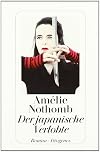
Now one of the problems I have with this book is its title – well and its cover too (I believe that is Nothomb on the cover, but really? Couldn’t something more interesting be on the cover instead?). Tokyo Fiancee doesn’t quite work as well as its French title Ni d’Eve ni d’Adam, or ‘not of Eve or of Adam’, which according to this review by the Quarterly Conversation is a shortened version of the French proverb “Ne connaitre ni d’Adam, ni d’Eve” which means, “didn’t know him from Adam (or Eve)”. And I have to agree, this title is so much better. Because theirs is a strange relationship. Odd, awkward at times, but also kind of cute. However, and this is a big However, the narrator is not all that easy to like. She’s rather self-centred and the ending won’t please everyone.
After Fear and Trembling I wasn’t sure if I would read more of Nothomb’s books, but after Tokyo Fiancee, I’m going to have to see what else she’s done – and she’s written a lot although not all of them have been translated. show less
I was in two minds about picking this book up. Nothomb’s Fear and Trembling was a rather weird read for me. An interesting look into the life of an employee in an international company in Tokyo, sure, but not exactly something that would pull me towards her other books.
But with Tokyo Fiancee, I was taken, I was swept up in this little book about a Belgian woman in Japan, rather autobiographical, as was Fear and Trembling. She meets Rinri when she advertises her French lessons. Rinri is a university student, son of a wealthy businessman. She converses in Japanese, he in French, although his show more French is so atrocious that “If I had not known that Rinri was speaking to me in French, I would have thought I was dealing with a very weak beginning student in Japanese”.
So here we have a Belgian speaking Japanese and a Japanese speaking French. This is the first translated book that I’ve read – this month? ever? – in which language has come into play. For instance, as they discuss Mishima’s popularity among Europeans, Rinri askes: “His sentences are music. How can you translate that?”
And indeed, there are so many times when I wish that I could read these works in their original language. However, while I may have taken French classes in university, I probably wouldn’t be able to get through the first paragraph – nay, the first sentence – of this book in French. I might fare slightly better in Chinese, but really, the only language I feel comfortable in is English. Sad but true.
Nothomb, who was born in Japan to her Belgian diplomat parents and left at the age of five, has such a love for Japan. Yet it is an observant, honest view of this rather unique country.
When they travel to Hiroshima (largely to buy more plum sauce for okonomiyaki), she remarks that “it was as if people were living more intensely here than anywhere else. Living in a city whose very name symbolised death to the entire planet had exalted their living fibre; this in turn led to an expression of optimism, which recreated the atmosphere of an era where people still believed in the future.”
Or when she and Rinri scale Mt Fuji, along with children, the elderly and pregnant women (I too visited Mt Fuji. It wasn’t to climb, as we were not equipped for that, and neither did we know what we were doing, we just hopped onto the bus and when everyone got out, so did we. I just remember a group of weathered old women who got off the bus at its first stop, backpacks, walking sticks at the ready for the long climb to the top. And it is no easy feat, for a lot of it is volcanic soil),
“I joined the group. We stood watching for the star in the deepest of silences. My heart began to pound. Not a cloud in the summer sky. Behind us, the abyss of the dead volcano.
Suddenly, a red fragment appeared on the horizon. A shiver ran through the silent assembly. And then, with a speed that did not preclude the majesty, the entire disc rose from nothingness and overlooked the plain.”
This reminded me of the sunrises I have seen. From a mountain top in Hawaii where my mum and I shivered in the cold as we waited and waited for what seemed like ages. From a hot air balloon somewhere above Melbourne, the fire above melting our heads, the promise of a champagne breakfast coaxing our appetites, another hot air balloon in the distance. And the early early mornings when I used to work the morning shift as an online content producer and work started at 530am – the hush of the lamp-lit streets and the darkened office – and the very welcome breakfast break a couple of hours later.
Unfortunately the breakfast was not as amazing as these persimmons on Sado Island:
“The pulp of the fruit, exalted by frost, had the flavour of a sorbet of precious gems. Snow possesses extraordinary gastronomic powers: it concentrates sapid juices and sharpens taste. It acts like a miraculously delicate form of cooking.”
Now one of the problems I have with this book is its title – well and its cover too (I believe that is Nothomb on the cover, but really? Couldn’t something more interesting be on the cover instead?). Tokyo Fiancee doesn’t quite work as well as its French title Ni d’Eve ni d’Adam, or ‘not of Eve or of Adam’, which according to this review by the Quarterly Conversation is a shortened version of the French proverb “Ne connaitre ni d’Adam, ni d’Eve” which means, “didn’t know him from Adam (or Eve)”. And I have to agree, this title is so much better. Because theirs is a strange relationship. Odd, awkward at times, but also kind of cute. However, and this is a big However, the narrator is not all that easy to like. She’s rather self-centred and the ending won’t please everyone.
After Fear and Trembling I wasn’t sure if I would read more of Nothomb’s books, but after Tokyo Fiancee, I’m going to have to see what else she’s done – and she’s written a lot although not all of them have been translated. show less
Nowhere nearly as mesmerizing, unique and compelling as her Hygiene and the Assassin. But extremely good and compelling readable nonetheless, in spite of the fact that it is a essentially a plot-less, meandering memoir/novella about her two-year visit to Asia and her affair, engagement and eventually parting from a young Japanese man. It is hard to understand exactly what "Amelie" saw in Rinrin, beyond his almost mysterious refrain "you'll see" as he whisked her from climbing Mount Fuji to boat trips to boat trips to Japanese islands. Eventually she reluctantly agrees to an engagement, prolongs it, and then tragically responds to a very late night question "are you still not going to marry me" with a "no", only finding out a day later show more that her fiancee was thrilled to interpret this as an agreement to marry him.
Tokyo Fiancee ends with an epilogue about the writing of Hygiene and the Assassin and her return to Japan--and seeing Rinri for the first time since she left him fie years before.
it is hard to tell how reliable the narrative is meant to be, it does not feel like it is playing any sort of games or has any degree of unreliability, but it is hard to tell--and from what I know of her other books they are very much characterized by that. But I'll certainly make sure to read them. show less
Tokyo Fiancee ends with an epilogue about the writing of Hygiene and the Assassin and her return to Japan--and seeing Rinri for the first time since she left him fie years before.
it is hard to tell how reliable the narrative is meant to be, it does not feel like it is playing any sort of games or has any degree of unreliability, but it is hard to tell--and from what I know of her other books they are very much characterized by that. But I'll certainly make sure to read them. show less
Fascinating and often funny, but the immaturity of the main character knocks a star off my rating. It's actually a shame in one respect that she is depicted so clearly, because you see how rotten she acts to her boyfriend and how unrepentant she was about it. (This is an autobiographical novel, so it's hard to tell if the author completely shares the attitudes of her protagonist, but I hope not.) I did enjoy the descriptions of the various customs and culture clashes, though, and found the book good practice for my French.
As this book opens, twenty-one year old Amelie has just left Belgium to return to Japan, the country in which she was born. Having not been in Japan since the age of five, she deicided that “the most efficient way to learn Japanese...would be to teach French.” It didn’t take long for her to encounter Rinri, a twenty-year-old Japanese university student of French, who wanted to hire Amelie as his teacher.
It was at this point in the book that I wanted to check if this book was an autobiography or simply fiction. I found out that it was “autobiographical fiction”. Well, okay.
Amelie and Rinri begin to keep each other’s company until the relationship starts to look more like boy-friend and girl-friend than teacher and student. show more Never mind. The beauty of this book, beyond Amelie’s relationship with Rinri, is in her becoming reacquainted with Japan. Sometimes together with Rinri and sometimes alone, a status important to her, Amelie once again experiences true Japanese culture - from the okonomiyaki (a shrimp and cabbage pancake, more or less) that Rinri made for her, to the nasty remarks of Rinri’s mother, to the remarkable sight of Mount Fuji when she discovers it from another mountaintop. It is these kinds of experiences that give this little book its grace.
My favorite quote from this book is this:
Belgium...must have sounded like one of these obscure American states no one ever talks about, like Maryland.
If you haven't guessed, I live in Maryland!
I’m not sure how I feel about the ending. Maybe I was a little let down. Anyway, this is not my story. It’s Amelie Nothomb’s. Let her tell it to you. show less
It was at this point in the book that I wanted to check if this book was an autobiography or simply fiction. I found out that it was “autobiographical fiction”. Well, okay.
Amelie and Rinri begin to keep each other’s company until the relationship starts to look more like boy-friend and girl-friend than teacher and student. show more Never mind. The beauty of this book, beyond Amelie’s relationship with Rinri, is in her becoming reacquainted with Japan. Sometimes together with Rinri and sometimes alone, a status important to her, Amelie once again experiences true Japanese culture - from the okonomiyaki (a shrimp and cabbage pancake, more or less) that Rinri made for her, to the nasty remarks of Rinri’s mother, to the remarkable sight of Mount Fuji when she discovers it from another mountaintop. It is these kinds of experiences that give this little book its grace.
My favorite quote from this book is this:
Belgium...must have sounded like one of these obscure American states no one ever talks about, like Maryland.
If you haven't guessed, I live in Maryland!
I’m not sure how I feel about the ending. Maybe I was a little let down. Anyway, this is not my story. It’s Amelie Nothomb’s. Let her tell it to you. show less
A short and memorable novel about the author's love affair with a Japanese man. Nothomb writes with candor about her relationship with Rinri, whom she meets tutoring French. While searing in its own way, it has none of the brutality of her (earlier?) book, HYGIENE AND THE ASSASSIN but instead is characterized by a sort of frank yet tender sweetness. I loved this and will remember it for a long time!
Another Europa edition publication, my foray into ‘foreign fiction’ continues with this autobiographical novel of youthful love and cross-cultural identities.
Nothomb, of Belgian descent, was born in Japan and lived there until aged 5. She is overcome with 'Japanophilia' upon her return as a language teacher.
This book is a charming, off centre study of cultural differences. It tells of the relationship between the ‘fictional’ Amelie and her Japanese amore – his eager love and her ‘koi’. She defines “Koi as less serious than love - “light, fluid, fresh . . . elegant, playful, funny.” There is no equivalent in European language.
This is a short, sharp, wacky yet nostalgic novel that examines young love, and the show more outsiders perceptions of a culture. One experience she describes is the exotic meals - eating seafood fresh, for example. As a vegetarian, the idea of eating something alive is particularly revolting. This is her experience with eating octopus live:
“.... (I) shoved it in my mouth and tried to plant my teeth into it. Then the most dreadful thing happened: the octopus’s nerves, still alive, commanded it to resist and the vengeful corpse fastened itself onto my tongue with all its tentacles and would not let go. I was screaming as loudly as you can when you are having your tongue swallowed whole by an octopus. “ (eeeww)
This is perhaps the only part of the book that made my stomach turn. The rest was well worth it. I can recommend this book to all those interested in Japan and cross-cultural relationships. show less
Nothomb, of Belgian descent, was born in Japan and lived there until aged 5. She is overcome with 'Japanophilia' upon her return as a language teacher.
This book is a charming, off centre study of cultural differences. It tells of the relationship between the ‘fictional’ Amelie and her Japanese amore – his eager love and her ‘koi’. She defines “Koi as less serious than love - “light, fluid, fresh . . . elegant, playful, funny.” There is no equivalent in European language.
This is a short, sharp, wacky yet nostalgic novel that examines young love, and the show more outsiders perceptions of a culture. One experience she describes is the exotic meals - eating seafood fresh, for example. As a vegetarian, the idea of eating something alive is particularly revolting. This is her experience with eating octopus live:
“.... (I) shoved it in my mouth and tried to plant my teeth into it. Then the most dreadful thing happened: the octopus’s nerves, still alive, commanded it to resist and the vengeful corpse fastened itself onto my tongue with all its tentacles and would not let go. I was screaming as loudly as you can when you are having your tongue swallowed whole by an octopus. “ (eeeww)
This is perhaps the only part of the book that made my stomach turn. The rest was well worth it. I can recommend this book to all those interested in Japan and cross-cultural relationships. show less
Members
- Recently Added By
Author Information

83 Works 16,078 Members
Some Editions
Awards and Honors
Awards
Series
Belongs to Publisher Series
Work Relationships
Is contained in
Common Knowledge
- Canonical title
- Tokyo Fiancée
- Original title
- Ni d'Eve ni d'Adam
- Alternate titles*
- Токийская невеста
- Original publication date
- 2007-08-22 (fr) (fr); 2008-12-30 (en) (en)
- People/Characters
- Amélie; Rinri
- Important places
- Tokyo, Japan; Mount Fuji, Japan; Hiroshima, Japan
- Related movies
- Tokyo Fiancée (2014 | IMDb)
- First words
- The most important way to learn Japanese, it seemed, would be to teach French.
- Quotations
- Extraits (page 155 parlant des moustiques) A force de tolérer l'intolérable, la sensation devient gratifiante : les démangeaisons acceptées finissaient par exalter l'âme et inoculer un bonheur héroïque. (...) Je receva... (show all)is l'énorme charge d'amour de cette gent vrombissante avec une résignation qui, le supplice passé, se muait en grâce. le sang me chatouillait de plaisir : il y a une volupté au fond de ce qui lancine.
(page 181) Je fonçai dans le paysage. Ô merveille de courir ! L'espace libère de tout. Il n'est aucun tourment qui ne résiste à l'éparpillement de soi-même dans l'univers. Le monde seriat-il si grand pour rien ? la lan... (show all)gue dit juste : déguerpir, c'est se sauver. Si tu meurs, pars. Si tu souffres, bouge. Il n'y a pas d'autre loi que le mouvement.
(page 228) J'avais touché juste : c'était parce qu'il n'y avait pas de mal en lui que je l'aimais beaucoup. C'était à cause de son étrangeté au mal que je n'avais pas d'amour pour lui. Pourtant, le mal ne me plait pas. ... (show all)Mais un plat n'est sublime que s'il contient une touche de vinaigre. la Neuvième de Beethoven serait insoutenableaux oreilles si elle comportait des hésitations désepérées. Jésus n'inspirerait pas tant les hommes s'il ne proférait parfois des paroles si proches de la haine.
(page 233-234) Il parait qu'il est peu glorieux de fuir. Dommage, c'est tellement agréable. La fuite donne le plus formidable sensation de liberté qui se puisse éprouver. (...) On devrait toujours avoir quelque chose à fu... (show all)ir, pour cultiver en soi cette possibilité merveilleuse. D'ailleurs, on a toujours quelque chose à fuir. Ne serait-ce que soi-même.
Belgium...must have sounded like one of these obscure American states no one ever talks about, like Maryland. - Last words
- (Click to show. Warning: May contain spoilers.)I was the samurai who had to sign a book for the next person in line.
- Original language
- French
*Some information comes from Common Knowledge in other languages. Click "Edit" for more information.
Classifications
Statistics
- Members
- 827
- Popularity
- 33,307
- Reviews
- 37
- Rating
- (3.57)
- Languages
- 14 — Catalan, Czech, Danish, Dutch, English, Finnish, French, German, Italian, Polish, Romanian, Russian, Spanish, Turkish
- Media
- Paper, Audiobook, Ebook
- ISBNs
- 28
- ASINs
- 10