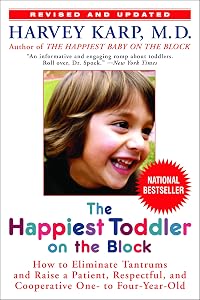
The Happiest Toddler on the Block: How to Eliminate Tantrums and Raise a Patient, Respectful, and Cooperative One- to Four-Year-Old: Revised Edition
by Harvey Karp
On This Page
Description
Perfect for expecting parents who want to prepare themselves for the challenging toddler years (which starts around eight months of age), this essential guide, a national bestseller by respected pediatrician and child development expert Dr. Harvey Karp, not only helps reduce tantrums but makes happy kids even happier by boosting patience, cooperation, and self-confidence.Toddlers can drive you bonkers…so adorable and fun one minute…so stubborn and demanding the next! Yet, as show more unbelievable as it sounds, there is a way to turn the daily stream of “nos” and “don’ts” into “yeses” and hugs…if you know how to speak your toddler’ s language. In one of the most useful advances in parenting techniques of the past twenty-five years, Dr. Karp reveals that toddlers, with their immature brains and stormy outbursts, should be thought of not as pint-size people but as pintsize…cavemen.
Having noticed that the usual techniques often failed to calm crying toddlers, Dr. Karp discovered that the key to effective communication was to speak to them in their own primitive language. When he did, suddenly he was able to soothe their outbursts almost every time! This amazing success led him to the realization that children between the ages of one and four go through four stages of “evolutionary” growth, each linked to the development of the brain, and each echoing a step in prehistoric humankind’s journey to civilization:
• The “Charming Chimp-Child” (12 to 18 months): Wobbles around on two legs, grabs everything in reach, plays a nonstop game of “monkey see monkey do.”
• The “Knee-High Neanderthal” (18 to 24 months): Strong-willed, fun-loving, messy, with a vocabulary of about thirty words, the favorites being “no” and “mine.”
• The “Clever Caveman” (24 to 36 months):
Just beginning to learn how to share, make friends, take turns, and use the potty.
• The “Versatile Villager” (36 to 48 months): Loves to tell stories, sing songs and dance, while trying hard to behave.
To speak to these children, Dr. Karp has developed two extraordinarily effective techniques:
1) The “fast food” rule—restating what your child has said to make sure you got it right;
2) The four-step rule—using gesture, repetition, simplicity, and tone to help your
irate Stone-Ager be happy again.
Once you’ve mastered “toddler-ese,” you will be ready to apply behavioral techniques specific to each stage of your child’ s development, such as teaching patience and calm, doing time-outs (and time-ins), praise through “gossiping,” and many other strategies. Then all the major challenges of the toddler years—including separation anxiety, sibling rivalry, toilet training, night fears, sleep problems, picky eating, biting and hitting, medicine taking — can be handled in a way that will make your toddler feel understood. The result: fewer tantrums, less yelling, and, best of all, more happy, loving time for you and your child. show less
Tags
Recommendations


























Member Recommendations

Member Reviews
Review of The Happiest Baby on the Block and The Happiest Toddler on the Block.
Karp "discovered" the toddler approach. He "discovered" the infant calming reflex. Oh please! He named things (rocking babies, swaddling, saying shush; talking to toddlers on their level) and made a brand. I might note that his claims to have "discovered" what has been known and practiced by most of the world for most of human history eerily echo the claims of many other "discoverers" of lands and knowledge possessed only by natives, women, and other non-important people.
Oh, and also? In Happiest Toddler his whole premise is based on the idea that "toddlers are little cavepeople", and he has articulated it by assigning stages of human evolution to stages of show more infancy. This, he tells us, is based on the scientific principle that "ontogeny recapitulates phylogeny" -- apparently, his genius was to see that toddlers are still developing! So they are ontologizing too! or something. Anyway Haeckel's recapitulation theory is wrong. It seems intuitive to people first learning about development and/or evolution, but it was refuted numerous times in the 20th century. One would have hoped that in the years Karp claims to have spent researching anthropology, biology, and so forth, he would have come across some of the literature actually discussing why it was wrong, and why educational vogues based on these ideas a hundred years ago are also wrong.
And his artfully posed author picture kills me.
Never mind. If you can get beyond the lame theorizing, and the pompous gasbaggery (carefully disguised in a patronizingly playful tone), and the painful politics of white male professionals claiming to have "discovered" historical parenting techniques -- if you can get past all that, then there are some nuggets in the books. For the most part these nuggets can be garnered by skimming through the book in half an hour. The videos are more useful, as they show actual parent-child interactions.
In summary: Check out of the library; do not buy. show less
Karp "discovered" the toddler approach. He "discovered" the infant calming reflex. Oh please! He named things (rocking babies, swaddling, saying shush; talking to toddlers on their level) and made a brand. I might note that his claims to have "discovered" what has been known and practiced by most of the world for most of human history eerily echo the claims of many other "discoverers" of lands and knowledge possessed only by natives, women, and other non-important people.
Oh, and also? In Happiest Toddler his whole premise is based on the idea that "toddlers are little cavepeople", and he has articulated it by assigning stages of human evolution to stages of show more infancy. This, he tells us, is based on the scientific principle that "ontogeny recapitulates phylogeny" -- apparently, his genius was to see that toddlers are still developing! So they are ontologizing too! or something. Anyway Haeckel's recapitulation theory is wrong. It seems intuitive to people first learning about development and/or evolution, but it was refuted numerous times in the 20th century. One would have hoped that in the years Karp claims to have spent researching anthropology, biology, and so forth, he would have come across some of the literature actually discussing why it was wrong, and why educational vogues based on these ideas a hundred years ago are also wrong.
And his artfully posed author picture kills me.
Never mind. If you can get beyond the lame theorizing, and the pompous gasbaggery (carefully disguised in a patronizingly playful tone), and the painful politics of white male professionals claiming to have "discovered" historical parenting techniques -- if you can get past all that, then there are some nuggets in the books. For the most part these nuggets can be garnered by skimming through the book in half an hour. The videos are more useful, as they show actual parent-child interactions.
In summary: Check out of the library; do not buy. show less
These days, it seems as though every book written by a doctor has a catchy gimmick designed to grab the interest of the reader. This book was no exception, as on the back cover Dr. Karp lovingly refers to toddlers everywhere as pint-sized cavemen. Since I am currently in the throws of the toddler years, I had to agree with Dr. Karp, as there are days that my little one happily wreaks destruction. Lest you think that Dr. Karp is somehow being insulting, let me assure you that it is very evident that not only does he enjoy toddlers and find them fascinating, but that he respects them as well. The point of all the prehistoric talk is really just a clever way to point out the differences that exist between the thought processes of an adult show more and a child (ages 1 to 4).
Dr. Karp's premise is that in the first four years of life your child will accomplish huge developmental milestones as their brains grow and develop. He divides the ages into four groups: The Charming Chimp-Child (12 to 18 Months), The Knee-High Neanderthal (18 to 24 Months), The Clever Cave-Kid (24 to 36 Months), and The Versatile Villager (36 to 48 Months). Each of these groupings is actually a pneumonic used to describe the highlights of that particular age grouping, for example Cave-Kid's are:
C= Curiouser and curiouser
A= Attention Increases
V= Very Busy
E= Enjoys Pleasing You
K= Kinder
I= Interested in Order and Comparisons
D= Determined to Communicate
Dr. Karp also enourages adults to speak to toddlers in their own language, or what he refers to as "Toddler-ese." Basically, the idea is that when a child is upset it is pretty pointless to try and talk to them as little adults. He offers basic tips on communicating more effectively with your toddler, and I found that many of these tips were good communication pointers in general.
I took my time reading this book as I was anxious to give his suggestions a try. Many of them actually worked! It was a little embarrasing speaking "Toddler-ese" in public, but Dr. Karp makes a good point that when your child is in the midst of a tantrum, you usually feel that you are the center of attention anyway. Most of all, I really enjoyed reading this book as it was fascinating to think about all the things my little one has already accomplished and all she will continue to accomplish. If you have young children, or spend a lot of time with the 1 to 4 set, then I can't recommend this book highly enough. show less
Dr. Karp's premise is that in the first four years of life your child will accomplish huge developmental milestones as their brains grow and develop. He divides the ages into four groups: The Charming Chimp-Child (12 to 18 Months), The Knee-High Neanderthal (18 to 24 Months), The Clever Cave-Kid (24 to 36 Months), and The Versatile Villager (36 to 48 Months). Each of these groupings is actually a pneumonic used to describe the highlights of that particular age grouping, for example Cave-Kid's are:
C= Curiouser and curiouser
A= Attention Increases
V= Very Busy
E= Enjoys Pleasing You
K= Kinder
I= Interested in Order and Comparisons
D= Determined to Communicate
Dr. Karp also enourages adults to speak to toddlers in their own language, or what he refers to as "Toddler-ese." Basically, the idea is that when a child is upset it is pretty pointless to try and talk to them as little adults. He offers basic tips on communicating more effectively with your toddler, and I found that many of these tips were good communication pointers in general.
I took my time reading this book as I was anxious to give his suggestions a try. Many of them actually worked! It was a little embarrasing speaking "Toddler-ese" in public, but Dr. Karp makes a good point that when your child is in the midst of a tantrum, you usually feel that you are the center of attention anyway. Most of all, I really enjoyed reading this book as it was fascinating to think about all the things my little one has already accomplished and all she will continue to accomplish. If you have young children, or spend a lot of time with the 1 to 4 set, then I can't recommend this book highly enough. show less
The principles all extending from the premise that toddlers are like cavemen and parents their ambassadors are useful but I am always rubbed the wrong way when a book takes on that slick "buy a timeshare in Nevada" sales pitch voice. It cheapens the overall experience and makes the book hard to recommend.
This book got a lot of good reviews, so I thought I'd give it a try. There were a few ideas that I liked, such as acknowledging your child's feelings before trying to stop or change them and keeping to short words and phrases when he/she is upset instead of suddenly "explaining" why he can't have something in long sentences. These things make sense to me and have seemed to help a little, but a lot of the book I found to be really silly. Maybe it will make more sense when my son is older, but I don't think it will really fit my parenting style. Also, the book has all of these annoying cartoons interspersed throughout the chapters and the anecdotes of real-life situations seem really contrived.
The principles all extending from the premise that toddlers are like cavemen and parents their ambassadors are useful but I am always rubbed the wrong way when a book takes on that slick "buy a timeshare in Nevada" sales pitch voice. It cheapens the overall experience and makes the book hard to recommend.
I would never say any help book is a cure-all, and that goes for the Happiest Toddler.
As with all non-fiction books I read, I go in taking advice with a grain of salt. As someone who is a new parent and literally had never been around babies or children since I was of the age, I've found myself enjoying reading other people's thoughts and ideas and opinions because I have no one else to talk to about such matters.
I feel like the advice given in this book goes down better when you view it like talking to a friend. You don't have to take all advice, but it's nice to have different viewpoints and ideas while you figure out what works for you and your child. I did find a lot of the advice helpful.
As with all non-fiction books I read, I go in taking advice with a grain of salt. As someone who is a new parent and literally had never been around babies or children since I was of the age, I've found myself enjoying reading other people's thoughts and ideas and opinions because I have no one else to talk to about such matters.
I feel like the advice given in this book goes down better when you view it like talking to a friend. You don't have to take all advice, but it's nice to have different viewpoints and ideas while you figure out what works for you and your child. I did find a lot of the advice helpful.
Karp's follow-up to The Happiest Baby on the Block offers very practical advice to parents for dealing with the toddler years of 1 to 4 years old. I think it's an even better book partly because it avoids the "infomercial style" of writing and is a more practical manual. The basic gist of the book is that when a child starts to throw a tantrum the parent should acknowledge what is upsetting by repeating back it back ("the fast food rule") and to use a simple vocabulary of words called "toddlerese" that toddlers will understand most when they are upset. This book doesn't have all the answers, for example, what to say to your son when you have no idea what is making him upset. Overall though I found it a book with useful advice and show more practically organized. show less
Members
- Recently Added By
Author Information

24+ Works 1,968 Members
Based in Santa Monica, Dr. Kapp is a practicing pediatrician and child development specialist who has worked with thousands of families, from inner city teen moms to superstar parents. He is an assistant professor of pediatrics at the UCLA School of Medicine. He and his wife and daughter live in California.
Awards and Honors
Awards
Classifications
- Genres
- Nonfiction, General Nonfiction, Health & Wellness
- DDC/MDS
- 649.122 — Applied science & technology Home economics & family management Child rearing; home care of people with illnesses and disabilities by family and friends Parenting Parenting Children by Age Babies
- LCC
- HQ774.5 .K37 — Social sciences The family. Marriage, Women and Sexuality The Family. Marriage. Women The family. Marriage. Home
- BISAC
Statistics
- Members
- 581
- Popularity
- 50,935
- Reviews
- 14
- Rating
- (3.50)
- Languages
- English
- Media
- Paper, Audiobook, Ebook
- ISBNs
- 11
- UPCs
- 2
- ASINs
- 6