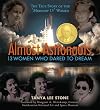
Almost Astronauts: 13 Women Who Dared to Dream
by Tanya Lee Stone
On This Page
Description
What does it take to be an astronaut? Excellence at flying, courage, intelligence, resistance to stress, top physical shape, any checklist would include these. But when America created NASA in 1958, there was another unspoken rule: you had to be a man. Here is the tale of thirteen women who proved that they were not only as tough as the toughest man but also brave enough to challenge the government. They were blocked by prejudice, jealousy, and the scrawled note of one of the most powerful show more men in Washington. But even though the Mercury 13 women did not make it into space, they did not lose, for their example empowered young women to take their place in the sky, piloting jets and commanding space capsules. Almost Astronauts is the story of thirteen true pioneers of the space age. show lessTags
Recommendations




Member Recommendations
Amelia Earhart's Daughters: The Wild and Glorious Story of American Women Aviators from World War II to the Dawn of the Space Age by Leslie Haynsworth
JenniferRobb AED discusses the history of aviation for women while AA focuses more on the 13 women who dreamed of joining the astronaut program in its infancy.
Member Reviews
Almost Astronauts is by turns inspiring and enraging. It is the story of 13 women pilots who were selected, in 1961, to undergo the same (and in some cases, more stringent) harrowing physical and psychological testing that the seven Mercury astronauts underwent, and who passed these tests with flying colors. The project was the brainchild of Randolph Lovelace, the NASA doctor who tested the Mercury Seven. He wanted to know: with their lighter body mass and lower oxygen requirements, would women be more cost-effective astronauts than men? But by embarking on a scientific program to answer this question, he and the 13 women astronaut candidates plunged into the 1960s' swirling maelstrom of prejudice and politics. Of course, those 13 women show more never made it to space, and it was not until 1999 that 8 of the surviving 11 were able to witness the first American space launch to be piloted by a woman. The second half of the book details the tumultuous social changes in both the public and military spheres that were necessary before women could be admitted to the inner core of America's space program, first as mission specialists and later as shuttle pilots. Although this story is often frustrating, the book is no feminist rant against past injustice. Instead, the reader is left with admiration for how brave, how resourceful, how strong, how capable these thirteen women were; how they competed on a very unequal playing field to achieve thousands of hours in the air as civilian pilots; and, once they were finally admitted into a program where they were tested no differently from the men, they rose to the challenge and demonstrated that they, too, had the legendary Right Stuff. They may never have made it to space, but because of their courageous struggle, later generations succeeded. The 13 were Myrtle Cagle, Jerrie Cobb, Janet Dietrich, Marion Dietrich, Wally Funk, Sarah Gorelick, Jane "Janey" Briggs Hart, Jean Hixson, Rhea Woltman, Gene Nora Stumbough, Irene Leverton, Jerri Sloan, and Bernice Steadman. show less
My daughter began studying astronomy this month, and right now our focus is on astronauts. So when I heard that Sally Ride had passed away yesterday, we already had a large stack of books about astronauts. I tucked my daughter in to bed and began looking through our books, thinking I would put together an impromptu lesson about the first American woman in space. Imagine my surprise when only two of the books about astronauts that I'd pulled from the library last week even mentioned Sally Ride.
One that did mention Sally Ride was Almost Astronauts by Tanya Lee Stone. I almost didn't pick this one up because my daughter is only seven, and I'd rather not give her the sense that there is anything standing in the way of her achieving her show more dreams other than her own drive and interest. I worry that bringing home books that highlight the fact that "girls can do things, too!" will just alert her to the possibility that being female might be an impediment to something besides peeing standing up. But I realize that another reason I don't pick up books like this is because I really, really want to believe that we don't need them anymore, that "women's history" has finally been integrated into just plain "history." My experience with the astronaut books showed me that this just isn't the case yet.
This morning while my daughter listened to an audiobook and my son played dress-up in the playroom (taking a break to argue with one another over the last brioche), I read Almost Astronauts.
Wow. This is a story I'd never, ever heard before. Jerrie Cobb and Jane Hart (a mother of eight, in addition to being an accomplished pilot) testified before Congress in favor of women being allowed the same opportunities to go into space as men, and I'd never even heard their names. Nor had I heard of the other eleven women who passed a grueling battery of tests, made huge personal sacrifices, and faced ridicule and discrimination at every step only to be told that, regardless of their performance, they would not be allowed into space simply by virtue of being female.
This book is engaging and includes wonderful photographs of the "Mercury 13" as well as the women who came after them, including Sally Ride and Eileen Collins, the first woman to command a space shuttle. I felt inspired by Jerrie Cobb and the story of her successes, encouraged by what promised to be a happy ending to the Mercury 13 women's quest to join the space program, then discouraged to the point of tears when their hopes were dashed. The book ends on a somewhat ambivalent note: mixed with the celebration of the doors that these women opened for other women in the decades to come is a sense of indignation that, despite all of their work and sacrifice, they were not able to go into space themselves.
This book is a little advanced for my seven-year-old. The reading level isn't too difficult, but the concepts are a probably little too involved for her. I'm not even sure if she has a clear idea of what NASA or Congress are, much less the Women Airforce Service Pilots. But it was a quick read, and it would be easy enough to excerpt it for her and give her background explanations as necessary, then read more as she becomes more interested. This is one we'll be looking at again, that's for sure. show less
One that did mention Sally Ride was Almost Astronauts by Tanya Lee Stone. I almost didn't pick this one up because my daughter is only seven, and I'd rather not give her the sense that there is anything standing in the way of her achieving her show more dreams other than her own drive and interest. I worry that bringing home books that highlight the fact that "girls can do things, too!" will just alert her to the possibility that being female might be an impediment to something besides peeing standing up. But I realize that another reason I don't pick up books like this is because I really, really want to believe that we don't need them anymore, that "women's history" has finally been integrated into just plain "history." My experience with the astronaut books showed me that this just isn't the case yet.
This morning while my daughter listened to an audiobook and my son played dress-up in the playroom (taking a break to argue with one another over the last brioche), I read Almost Astronauts.
Wow. This is a story I'd never, ever heard before. Jerrie Cobb and Jane Hart (a mother of eight, in addition to being an accomplished pilot) testified before Congress in favor of women being allowed the same opportunities to go into space as men, and I'd never even heard their names. Nor had I heard of the other eleven women who passed a grueling battery of tests, made huge personal sacrifices, and faced ridicule and discrimination at every step only to be told that, regardless of their performance, they would not be allowed into space simply by virtue of being female.
This book is engaging and includes wonderful photographs of the "Mercury 13" as well as the women who came after them, including Sally Ride and Eileen Collins, the first woman to command a space shuttle. I felt inspired by Jerrie Cobb and the story of her successes, encouraged by what promised to be a happy ending to the Mercury 13 women's quest to join the space program, then discouraged to the point of tears when their hopes were dashed. The book ends on a somewhat ambivalent note: mixed with the celebration of the doors that these women opened for other women in the decades to come is a sense of indignation that, despite all of their work and sacrifice, they were not able to go into space themselves.
This book is a little advanced for my seven-year-old. The reading level isn't too difficult, but the concepts are a probably little too involved for her. I'm not even sure if she has a clear idea of what NASA or Congress are, much less the Women Airforce Service Pilots. But it was a quick read, and it would be easy enough to excerpt it for her and give her background explanations as necessary, then read more as she becomes more interested. This is one we'll be looking at again, that's for sure. show less
When I was a kid, I was obsessed with NASA and astronauts. One year I spent the entire summer studying for the Air Force Academy's entrance exam because I thought the best way to be an astronaut was to be a pilot. The only thing that I didn't learn was that years before Sally Ride was shot into space, thirteen women were willing, ready and able to do the same.
In Almost Astronauts: 13 Women Who Dared to Dream, Tanya Lee Stone, takes us back to a time before Title IX, before women in science programs, before the second wave of feminism, when it was all too easy for the US Government, NASA and a Vice-President to simply say no to women dreaming of floating among the stars.
The discrimination against these 13 women was atrocious. Every show more single test that was set up, these women passed with flying colors, yet NASA still said no to them. Many of the men of Mercury and Apollo missions testified against the women in front of Congress. The wives of astronauts would also speak up against the women. But the 13 women weren't alone...Scores of women across the country took to the streets and wrote letters to the White House demanding that the 13 women be allowed to enter the astronaut program.
Almost Astronauts is a moving young adult book. One that tells a simply story of women striving to fulfill their dreams. One that fills in some holes in American history, but I didn't feel was hitting young people over the head with the feminism stick. The photos and historical documents shown are powerful. I would recommend this book to any young woman, especially one in high school who is ready to take on the world on her own, who may be questioning where she will take her life and definitely one who may be dreaming bigger than most people think is proper. show less
In Almost Astronauts: 13 Women Who Dared to Dream, Tanya Lee Stone, takes us back to a time before Title IX, before women in science programs, before the second wave of feminism, when it was all too easy for the US Government, NASA and a Vice-President to simply say no to women dreaming of floating among the stars.
The discrimination against these 13 women was atrocious. Every show more single test that was set up, these women passed with flying colors, yet NASA still said no to them. Many of the men of Mercury and Apollo missions testified against the women in front of Congress. The wives of astronauts would also speak up against the women. But the 13 women weren't alone...Scores of women across the country took to the streets and wrote letters to the White House demanding that the 13 women be allowed to enter the astronaut program.
Almost Astronauts is a moving young adult book. One that tells a simply story of women striving to fulfill their dreams. One that fills in some holes in American history, but I didn't feel was hitting young people over the head with the feminism stick. The photos and historical documents shown are powerful. I would recommend this book to any young woman, especially one in high school who is ready to take on the world on her own, who may be questioning where she will take her life and definitely one who may be dreaming bigger than most people think is proper. show less
This one is non-fiction, something I don't read enough of. I had been curious initially because I am a fan of space exploration (and I just wrote a book about an earth-girl who runs away to join an intergalactic circus). And indeed one of the very interesting things about this book is the window it provides into the sort of intense screening and training astronauts have to go through. But more than that, this book really opened my eyes and made me think about privilege and prejudice.
It was fascinating, inspiring, and infuriating. I am so glad I read it, because never before have I truly internalized the fact that the freedoms and opportunities I have as a woman are founded on the efforts of the women (and men!) who came before me. show more Whether by luck, or because things really have changed, I myself have never once encountered a coworker or a teacher who has made me feel that "girls can't do science": not in my high-school advanced math classes, not college as a math major or grad school while getting my MA in math, or at any of the companies where I have worked as a software designer. I recognize that this is something to be grateful for, but it has always been a sort of distant intellectual feeling.
Reading this book made it all much more real to me: that less than 50 years ago women who proved themselves space-worthy were denied their dreams simply because they were female (and apparently because the powers that be were also afraid that if they let qualified women into space they would also have to let non-white men have the opportunity). I am so thankful that those women did not give up, and that there were open-minded men who encouraged change from within the system. show less
It was fascinating, inspiring, and infuriating. I am so glad I read it, because never before have I truly internalized the fact that the freedoms and opportunities I have as a woman are founded on the efforts of the women (and men!) who came before me. show more Whether by luck, or because things really have changed, I myself have never once encountered a coworker or a teacher who has made me feel that "girls can't do science": not in my high-school advanced math classes, not college as a math major or grad school while getting my MA in math, or at any of the companies where I have worked as a software designer. I recognize that this is something to be grateful for, but it has always been a sort of distant intellectual feeling.
Reading this book made it all much more real to me: that less than 50 years ago women who proved themselves space-worthy were denied their dreams simply because they were female (and apparently because the powers that be were also afraid that if they let qualified women into space they would also have to let non-white men have the opportunity). I am so thankful that those women did not give up, and that there were open-minded men who encouraged change from within the system. show less
Almost Astronauts: 13 Women Who Dared to Dream. By Tanya Lee Stone. Candlewick Press. 2009. 133 pages. 978-0763636111. Grades 6-12.
In powerful, measured prose, Stone tells the tale of the “Mercury 13” – 13 women who in 1961 underwent the grueling testing given to male astronauts but were shut out of the space program despite passing the tests with flying colors. Stone’s passion and sense of indignation at this injustice shine throughout, demonstrating the importance of personal investment in nonfiction and making this a book young adults will want to read. The text is peppered with a variety of engrossing pictures, from magazine covers and cartoons of the time to images of the women undergoing the barrage of tests. Brief show more italicized “imagine this” sections help the reader empathize with these women’s emotions and experiences. Interested readers can dig deeper by perusing the thorough bibliography or the easily readable section of citations: Stone provides an excellent model for developmentally-appropriate research behavior. Stone’s book is a gripping, compelling read, one that can inspire young readers to follow in her investigative footsteps as they read and write nonfiction. Highly recommended. show less
In powerful, measured prose, Stone tells the tale of the “Mercury 13” – 13 women who in 1961 underwent the grueling testing given to male astronauts but were shut out of the space program despite passing the tests with flying colors. Stone’s passion and sense of indignation at this injustice shine throughout, demonstrating the importance of personal investment in nonfiction and making this a book young adults will want to read. The text is peppered with a variety of engrossing pictures, from magazine covers and cartoons of the time to images of the women undergoing the barrage of tests. Brief show more italicized “imagine this” sections help the reader empathize with these women’s emotions and experiences. Interested readers can dig deeper by perusing the thorough bibliography or the easily readable section of citations: Stone provides an excellent model for developmentally-appropriate research behavior. Stone’s book is a gripping, compelling read, one that can inspire young readers to follow in her investigative footsteps as they read and write nonfiction. Highly recommended. show less
Almost Astronauts by Tanya Lee Stone is a work of nonfiction that focuses the barriers and struggles that women faced in the workplace during the 1960s, highlighting the particular struggles of female pilots trying to become astronauts. The book follows a group of female pilots referred to as the “Mercury 13,” and delves deeper into the career of Jerri Cobb, the woman who was first put through the rigorous testing that astronauts had to endure.
This book is particularly interesting because it really stresses the difficulties that women faced in this field simply because of their gender. The surprising and telling fact is that many of these women exceeded their male counterparts’ results in both the physical and psychological show more examinations. I found the description of the isolation test very interesting; some of the women were able to withstand isolation in a pool of water for eight to ten hours – a much more rigorous experience than the men’s isolation test of three hours in a dark room with a pen and paper.
It was also shocking to read about NASA’s utter defiance in allowing women to be tested and enter into the program; while prejudice against women’s ability in the workplace was common during this era, it was still surprising that they were so willing to publicly denounce the abilities of women. Another aspect of the book that surprised me were the numerous quotations by men that basically stated in various ways that a woman’s only place is in the home, cooking and caring for children. While I realize that this was (and in some cases still is) the stereotypical role for women, I am happy to know that it is not nearly as difficult for women in the workplace as it once was, although there is still progress to be made.
The pictures included throughout the book are one of its better features; they really help the reader to visualize the types of tests that these women went through. Stone’s writing voice also brings the story of these women’s struggles to life. She writes in a way that demonstrates to the reader how much discrimination these women truly did face; while men certainly had a role in the prejudice of women in the workforce, I do think at times the author seemed to be “man-bashing” a little too much for my personal taste.
I would recommend Almost Astronauts to students in middle and early high school, especially for girls who are interested in the field of math and science. This book could easily be incorporated into a social studies classroom while studying the 1960s and 70s and the women’s rights movement as females began breaking the glass ceiling in different fields of work. show less
This book is particularly interesting because it really stresses the difficulties that women faced in this field simply because of their gender. The surprising and telling fact is that many of these women exceeded their male counterparts’ results in both the physical and psychological show more examinations. I found the description of the isolation test very interesting; some of the women were able to withstand isolation in a pool of water for eight to ten hours – a much more rigorous experience than the men’s isolation test of three hours in a dark room with a pen and paper.
It was also shocking to read about NASA’s utter defiance in allowing women to be tested and enter into the program; while prejudice against women’s ability in the workplace was common during this era, it was still surprising that they were so willing to publicly denounce the abilities of women. Another aspect of the book that surprised me were the numerous quotations by men that basically stated in various ways that a woman’s only place is in the home, cooking and caring for children. While I realize that this was (and in some cases still is) the stereotypical role for women, I am happy to know that it is not nearly as difficult for women in the workplace as it once was, although there is still progress to be made.
The pictures included throughout the book are one of its better features; they really help the reader to visualize the types of tests that these women went through. Stone’s writing voice also brings the story of these women’s struggles to life. She writes in a way that demonstrates to the reader how much discrimination these women truly did face; while men certainly had a role in the prejudice of women in the workforce, I do think at times the author seemed to be “man-bashing” a little too much for my personal taste.
I would recommend Almost Astronauts to students in middle and early high school, especially for girls who are interested in the field of math and science. This book could easily be incorporated into a social studies classroom while studying the 1960s and 70s and the women’s rights movement as females began breaking the glass ceiling in different fields of work. show less
Almost Astronauts gives me the pervasive feeling that it was written in earnest.It doesn't just tell the story of the "Mercury 13," it also reads like a long persuasive essay, and that is probably a necessity. The unfortunate truth is that we, as readers, need to be assured that these women were really as good as Tanya Lee Stone says they were. Even today, society views women as less qualified in the arenas of science and aeronautics (and many others). She gives us as much evidence as we could hope for to prove her assurances that these women had "the right stuff".
With regard to structure, I think that Stone's choices are effective. With so many different women involved, in combination with the workings of outside influences, people, show more and events, the decision to maintain some ties to chronology is a good one. There are flashbacks and forward jumps in time, but time is still the main organizational factor. I also didn't find the book misleading or confusing in any way. Some of my classmates mentioned that they initially thought that these women were actually astronauts, and more involved with NASA. My response would be that the title says "Almost"!
In Almost Astronauts, Stone tells us the story of women in flight, with respect to the armed forces and NASA; it is about the Mercury 13 and many others. She tells a story about the misogynistic politics that kept worthy individuals from realizing their dreams, and also touches upon the racist views that were intertwined in some of these decisions. She does all of this while maintaining a conversational storytelling style, and has a good instinct for phrasing and explanations for the young reader.
I have one small gripe with regard to the text: Stone takes some liberties with grammar that I am not convinced are a good idea for kids. Perhaps these liberties are synonymous with modernity at this point in time, but I remember being told in elementary school that I needed to learn the rules before I could break them.I think it was a good point. Throughout the text of this book are sentence fragments, and I found them a bit distracting: "Rhea Hurrle has a beautiful smile. A warm spirit with a no-nonsense air" (50). Here is another example: "And, of course, once again, babysitters needed to be lined up. Fridges stocked. Travel plans made (53). Maybe this is not a big deal to most readers. I know that I am seeing this from the perspective of a brand new English teacher, but I also felt that all of the periods drag the flow of the narrative.
Having said that, this is a story that needed to be told, and all young girls should get to hear it. Girls don't have enough of the right kind of role model, even today, and they should understand the challenges women faced and are still facing in gaining equality. If they don't hear otherwise, society's misguided and harmful assumptions about gender will be absorbed and carried on. I will keep this book in my classroom. show less
With regard to structure, I think that Stone's choices are effective. With so many different women involved, in combination with the workings of outside influences, people, show more and events, the decision to maintain some ties to chronology is a good one. There are flashbacks and forward jumps in time, but time is still the main organizational factor. I also didn't find the book misleading or confusing in any way. Some of my classmates mentioned that they initially thought that these women were actually astronauts, and more involved with NASA. My response would be that the title says "Almost"!
In Almost Astronauts, Stone tells us the story of women in flight, with respect to the armed forces and NASA; it is about the Mercury 13 and many others. She tells a story about the misogynistic politics that kept worthy individuals from realizing their dreams, and also touches upon the racist views that were intertwined in some of these decisions. She does all of this while maintaining a conversational storytelling style, and has a good instinct for phrasing and explanations for the young reader.
I have one small gripe with regard to the text: Stone takes some liberties with grammar that I am not convinced are a good idea for kids. Perhaps these liberties are synonymous with modernity at this point in time, but I remember being told in elementary school that I needed to learn the rules before I could break them.I think it was a good point. Throughout the text of this book are sentence fragments, and I found them a bit distracting: "Rhea Hurrle has a beautiful smile. A warm spirit with a no-nonsense air" (50). Here is another example: "And, of course, once again, babysitters needed to be lined up. Fridges stocked. Travel plans made (53). Maybe this is not a big deal to most readers. I know that I am seeing this from the perspective of a brand new English teacher, but I also felt that all of the periods drag the flow of the narrative.
Having said that, this is a story that needed to be told, and all young girls should get to hear it. Girls don't have enough of the right kind of role model, even today, and they should understand the challenges women faced and are still facing in gaining equality. If they don't hear otherwise, society's misguided and harmful assumptions about gender will be absorbed and carried on. I will keep this book in my classroom. show less
Members
- Recently Added By
Lists

Robert F. Sibert Informational Book Medal
102 works; 1 member
Author Information

97+ Works 6,854 Members
Tanya Lee Stone studied English at Oberlin College and was an editor of children's nonfiction for many years. She also has a Masters Degree. She teaches writing at Champlain College. After many years as an editor. Tanya moved to Vermont and returned to writing. This award-winning author has written titles that include the young adult novel, A Bad show more Boy Can Be Good for a Girl, Up Close: Ella Fitzgerald , picture books Elizabeth Leads the Way, Sandy's Circus, and Who Says Women Can't Be Doctors? She has also written narrative nonfiction with her titles: Almost Astronauts: 13 Women Who Dared to Dream, and The Good, the Bad, and the Barbie. In 2014 her title, Courage Has No Color: The True Story of the Triple Nickles, made The New York Times Best Seller List. (Bowker Author Biography) show less
Awards and Honors
Awards
Distinctions
Notable Lists
Common Knowledge
- Original publication date
- 2009
- People/Characters
- Victor Anfuso; Jeffrey Ashby; Lucille Ball; Myrtle Cagle; Liz Carpenter; M. Scott Carpenter (show all 70); Kalpana Chawla; Jerrie Cobb; Jackie Cochran; Catherine G. Coleman; Eileen Collins; Hiden T. Cox; Jan Davis; Jan Dietrich; Marion Dietrich; Deborah Douglas; Amelia Earhart; Anna Fisher; Donald Flickinger; Betty Friedan; Wally Funk; John H. Glenn, Jr.; Sarah Gorelick (Sarah Gorelick Ratley); Jane Briggs Hart (a/k/a "Janey" Hart); Steven A. Hawley; Susan Helms; Jean Hixson; Rhea Hurrle (Rhea Hurrle Woltman); Mae Jemison; Lyndon Baines Johnson; John F. Kennedy; Donald Kilgore; Irene Leverton; Randolph Lovelace; George Low; Shannon Lucid; Nicole Malachowski; Pam Melroy; George Miller; Edward R. Murrow; Nichelle Nichols; Ruth Nichols; Miles O'Brien; Floyd Odlum; Robert B. Pirie; Martha Ann Reading; Judith Resnik; Sally Ride; Margaret Rhea Seddon; Alan B. Shepard, Jr.; Jay Shurley; Betty Skelton; Donald 'Deke' Slayton (Donald Kent Slayton); Jerri Sloan Truhill (a/k/a Geraldine "Jerri" Hamilton Sloan Truhill); Bernice 'B' Steadman; Gloria Steinem; Susan Still; Gene Nora Stumbough (Gene Nora Stumbough Jessen); Kathryn Sullivan; Valentina Tereshkova; Michel Tognini; Robert Voas; Janice Voss; Cathryn Walters; James E. Webb; Peggy Whitson; Sunita Williams; Tom Wolfe; Chuck Yeager; Elmo Zumwalt
- Important events
- Project Mercury
- Epigraph
- A note about "Mercury 13"
The "Mercury 13" is actually a misnomer, as these thirteen women were never part of the Mercury space program. But because they went through many of the same tests that the Mercury astronauts ... (show all)did, the "Mercury 13" has become the nickname most often associated with the women in this story. - Dedication
- For the extraordinary women in my family - beginning with Bessie, Sarah, Leah, and Dorothy - all the way to Laurie, Sarah, Leah, and Liza
- First words
- July 1999
One woman stands alone, off to the side of the crowd.
Classifications
- Genres
- Nonfiction, Tween, Kids
- DDC/MDS
- 629.450092273 — Applied science & technology Engineering Transportation Vehicles Spacecraft & Vehicles Manned space flight General & Biography General & Biography Biographies & History Biography
- LCC
- TL789.85 .A1 .S79 — Technology Motor vehicles. Aeronautics. Astronautics Motor vehicles. Aeronautics. Astronautics Astronautics. Space travel
- BISAC
Statistics
- Members
- 838
- Popularity
- 32,817
- Reviews
- 171
- Rating
- (4.11)
- Languages
- English
- Media
- Paper, Audiobook, Ebook
- ISBNs
- 25
- ASINs
- 3