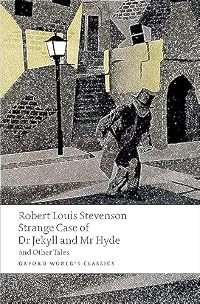
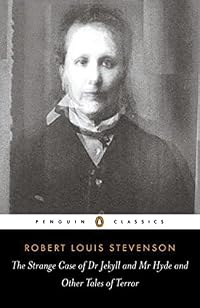
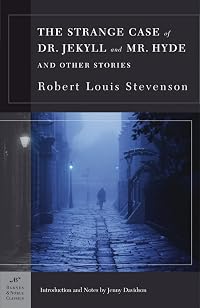
Dr. Jekyll and Mr. Hyde and Other Tales [Oxford World's Classics]
by Robert Louis Stevenson
On This Page
Description
This dark psychological fantasy is more than a moral tale. It is also a product of its time, drawing on contemporary theories of class, evolution and criminality and the secret lives behind Victorian propriety, to create a unique form of urban Gothic.Tags
Recommendations






Member Reviews
"I who sicken and freeze at the mere thought of him...when I know how he fears my power to cut him off by suicide, I find it in my heart to pity him." This quote comes at the end of the novella, when the crux of Stevenson's point comes to a head. It is at this point when madness and reason - the forms of Hyde and Jekyll, respectively - are completely separated, and Hyde threatens to completely overtake Jekyll. It is in this last chapter that the core philosophy is revealed in all of its stunning originality. Leading up to this moment however, is an almost unremarkable detective story with stock characterizations. Albeit the imagery gives a foreboding tone ("The fog still slept on the wing above the drowned city, where the lamps show more glittered like carbuncles") and the narrative moves by briskly, the text as a whole isn't particularly remarkable. Truly, it is the last chapter that stands out the most, and the reader is finally able to get a glimpse of the pure evil that the story has been leading up to. Vague on details yet astute on human psychology, Stevenson has created a tale that resonates in its concept, not in its literary abilities. show less
Having never read any Robert Louis Stevenson, I decided to remedy this by reading Dr Jekyll and Mr. Hyde, together with two of his other short stories contained within the same volume. They are all well-written, with likeable and realistically flawed characters. Dr. Jekyll and Mr. Hyde is perhaps the best of the three, which all have something of the moral tale about them, but the other two are also worth reading, particularly The Treasure of Franchard.
It's a bit hard to comment on a classic that has resulted in numerous adaptations. I found the stories in this book to be creepy and the essays interesting.
Jekyll is a well written tale with a spooky sense running throughout it. One you can get through in a day but I just did not feel inclined to read all the other short tales. Maybe I will dip back into this one. Just not that much of a fan of short stories I guess.
Not sure what to say about this book.
I saw the movie and must say, that that made a bigger impression on me than this book. Maybe because the actually telling of the story was quite factual, of cold, or distant I didn't get as involved in the book in the strange case as I might have otherwise. Maybe I had set my expectations too high, I don't know.
If I'm totally honest, while writing this review nearly a week after finishing the book, I have a hard time to recall exactly the how, who and when. And that about sums it up for me, unfortunately.
I saw the movie and must say, that that made a bigger impression on me than this book. Maybe because the actually telling of the story was quite factual, of cold, or distant I didn't get as involved in the book in the strange case as I might have otherwise. Maybe I had set my expectations too high, I don't know.
If I'm totally honest, while writing this review nearly a week after finishing the book, I have a hard time to recall exactly the how, who and when. And that about sums it up for me, unfortunately.
From the Introduction, by Roger Luckhurst:
"Stevenson veered constantly between high literary ambition and writing in commercial forms for market rates, and many of his critics were confused about where to place each work. Stevenson was himself unsure at times, and frequently misjudged things. PRINCE OTTO, a novel on which he spent five years to secure his reputation as a 'serious' novelist, was not well received; JEKYLL AND HYDE, dreamt up, written, rewritten, and published all in under ten weeks, became his masterpiece. It was also a commercial success, selling 40,000 copies in England in six months, and innumerable tens of thousands of pirated copies in America, where the book was a popular sensation. This confusion over incompatible show more forms of high and low literary value was not unusual in the late Victorian era, as authors as diverse as Oscar Wilde, Arthur Conan Doyle, and Joseph Conrad sought to negotiate the new commercial forms and the increasing professionalization of literature (including newfangled things like literary agents and limited international copyright). The distinction of high and low literature, as we understand them in the modern sense, was still emergent, so that this was a moment when a lowly Gothic romance might conjoin unexpectedly with a species of psychological realism to produce a JEKYLL AND HYDE." (Kindle location 96-108) show less
"Stevenson veered constantly between high literary ambition and writing in commercial forms for market rates, and many of his critics were confused about where to place each work. Stevenson was himself unsure at times, and frequently misjudged things. PRINCE OTTO, a novel on which he spent five years to secure his reputation as a 'serious' novelist, was not well received; JEKYLL AND HYDE, dreamt up, written, rewritten, and published all in under ten weeks, became his masterpiece. It was also a commercial success, selling 40,000 copies in England in six months, and innumerable tens of thousands of pirated copies in America, where the book was a popular sensation. This confusion over incompatible show more forms of high and low literary value was not unusual in the late Victorian era, as authors as diverse as Oscar Wilde, Arthur Conan Doyle, and Joseph Conrad sought to negotiate the new commercial forms and the increasing professionalization of literature (including newfangled things like literary agents and limited international copyright). The distinction of high and low literature, as we understand them in the modern sense, was still emergent, so that this was a moment when a lowly Gothic romance might conjoin unexpectedly with a species of psychological realism to produce a JEKYLL AND HYDE." (Kindle location 96-108) show less
Ratings
Members
- Recently Added By
Lists

Books Featured on Gilmore Girls
307 works; 21 members

Honey For a Child's Heart
1,152 works; 25 members
Author Information

Novelist, poet, and essayist Robert Louis Stevenson was born in Edinburgh, Scotland. A sickly child, Stevenson was an invalid for part of his childhood and remained in ill health throughout his life. He began studying engineering at Edinburgh University but soon switched to law. His true inclination, however, was for writing. For several years show more after completing his studies, Stevenson traveled on the Continent, gathering ideas for his writing. His Inland Voyage (1878) and Travels with a Donkey (1878) describe some of his experiences there. A variety of essays and short stories followed, most of which were published in magazines. It was with the publication of Treasure Island in 1883, however, that Stevenson achieved wide recognition and fame. This was followed by his most successful adventure story, Kidnapped, which appeared in 1886. With stories such as Treasure Island and Kidnapped, Stevenson revived Daniel Defoe's novel of romantic adventure, adding to it psychological analysis. While these stories and others, such as David Balfour and The Master of Ballantrae (1889), are stories of adventure, they are at the same time fine studies of character. The Master of Ballantrae, in particular, is a study of evil character, and this study is taken even further in The Strange Case of Dr. Jekyll and Mr. Hyde (1886). In 1887 Stevenson and his wife, Fanny, went to the United States, first to the health spas of Saranac Lake, New York, and then on to the West Coast. From there they set out for the South Seas in 1889. Except for one trip to Sidney, Australia, Stevenson spent the remainder of his life on the island of Samoa with his devoted wife and stepson. While there he wrote The Wrecker (1892), Island Nights Entertainments (1893), and Catriona (1893), a sequel to Kidnapped. He also worked on St. Ives and The Weir of Hermiston, which many consider to be his masterpiece. He died suddenly of apoplexy, leaving both of these works unfinished. Both were published posthumously; St. Ives was completed by Sir Arthur Quiller-Couch, and The Weir of Hermiston was published unfinished. Stevenson was buried on Samoa, an island he had come to love very much. Although Stevenson's novels are perhaps more accomplished, his short stories are also vivid and memorable. All show his power of invention, his command of the macabre and the eerie, and the psychological depth of his characterization. (Bowker Author Biography) show less
All Editions
Series
Belongs to Publisher Series
Work Relationships
Contains
Common Knowledge
- Canonical title
- Dr. Jekyll and Mr. Hyde and Other Tales [Oxford World's Classics]
- People/Characters
- Henry Jekyll; Edward Hyde
- Important places
- London, England, UK
- Quotations
- "If he be Mr Hyde," he had thought, "I shall be Mr Seek."
- Disambiguation notice
- This collection consists of 6 stories, together with 3 appendices/essays (see description for details). Please do not combine with works that contain additional stories, fewer stories, or different stories. Thank you.
Classifications
Statistics
- Members
- 707
- Popularity
- 39,962
- Reviews
- 5
- Rating
- (3.56)
- Languages
- English
- Media
- Paper, Ebook
- ISBNs
- 8
- ASINs
- 7