On This Page
Description
The classic graphic novel. Seven explorers return from an expedition in the Andes, where they unearthed the tomb of an Incan priest. One by one, they fall into a coma. Can Tintin figure out what is causing the mysterious illness?Tags
Recommendations



















Member Recommendations
Member Reviews
My review, as published in Tintin Books:
"The Seven Crystal Balls" is a wonderfully atmospheric album, in which fears of the supernatural meld perfectly with the scientific discoveries of the time. Anyone who grew up with the animated TV series will probably recall this one in great detail, as there is so much good material here: particularly notable is the agonising wait in Tarragon's manor, and the marvelous frame of the seven victims waking up on cue in their hospital beds, and screaming.
Although Herge was remaining stoically apolitical, his series had acquired a wealth of recurring characters to enrich the story, and many of them - Thompson & Thomson, Bianca Castafiore, Nestor, General Alcazar, as well as the newcomer Cuthbert show more Calculus - appear here. There's some very good character work for a wide variety of the cast - including a welcome return for General Alcazar - and it's pleasant how quickly we care for Calculus. His disappearance, and Haddock's subsequent concern, are affecting even though we only met him in the last album! Among other evolutions in the series, Tintin appears to have left his Brussels flat in favour of living with Haddock at Marlinspike Hall. Their relationship with Calculus has also quickly deepened, as evidenced by Haddock's severe depression when the professor goes missing. Like Haddock before him, Calculus' popularity was a surprise for the artist - but a surprise he took in his stride.
At the same time, it is worth mentioning that a lot of time is spent on set-up. Very little actually happens for most of this album. This is partly a result of Herge's required output in the era, and partly because he himself was so fascinated by creating realism in his settings, characters and costumes, that he devoted himself to every scene and every supporting character. It's very clearly only the start of the story (which is why most adaptations take us to South America and the plot of [book:Prisoners of the Sun|96428 quite quickly).
However, what we have here is both creepy and amusing, and clearly demonstrate the mastery of his form which would soon lead Herge to start playing around with the established formula. I'd probably give it a high three-and-a-half stars, but I'm upgrading it to four for the sake of this review. show less
"The Seven Crystal Balls" is a wonderfully atmospheric album, in which fears of the supernatural meld perfectly with the scientific discoveries of the time. Anyone who grew up with the animated TV series will probably recall this one in great detail, as there is so much good material here: particularly notable is the agonising wait in Tarragon's manor, and the marvelous frame of the seven victims waking up on cue in their hospital beds, and screaming.
Although Herge was remaining stoically apolitical, his series had acquired a wealth of recurring characters to enrich the story, and many of them - Thompson & Thomson, Bianca Castafiore, Nestor, General Alcazar, as well as the newcomer Cuthbert show more Calculus - appear here. There's some very good character work for a wide variety of the cast - including a welcome return for General Alcazar - and it's pleasant how quickly we care for Calculus. His disappearance, and Haddock's subsequent concern, are affecting even though we only met him in the last album! Among other evolutions in the series, Tintin appears to have left his Brussels flat in favour of living with Haddock at Marlinspike Hall. Their relationship with Calculus has also quickly deepened, as evidenced by Haddock's severe depression when the professor goes missing. Like Haddock before him, Calculus' popularity was a surprise for the artist - but a surprise he took in his stride.
At the same time, it is worth mentioning that a lot of time is spent on set-up. Very little actually happens for most of this album. This is partly a result of Herge's required output in the era, and partly because he himself was so fascinated by creating realism in his settings, characters and costumes, that he devoted himself to every scene and every supporting character. It's very clearly only the start of the story (which is why most adaptations take us to South America and the plot of [book:Prisoners of the Sun|96428 quite quickly).
However, what we have here is both creepy and amusing, and clearly demonstrate the mastery of his form which would soon lead Herge to start playing around with the established formula. I'd probably give it a high three-and-a-half stars, but I'm upgrading it to four for the sake of this review. show less
After hitting on the successful formula of pulp action in the diptych of The Secret of the Unicorn and Red Rackham's Treasure that would both provide an enjoyable story and keep him out of trouble with both sides of World War II, Hergé decided to follow it up with another two-part story starting with The Seven Crystal Balls and leading to Prisoners of the Sun. Where the story of recovering Red Rackham's hoard was a pirate adventure, the story of The Seven Crystal Balls is a pulp fantasy reminiscent of the fiction of Edgar Rice Burroughs or H. Rider Haggard. Of the three two-part Tintin stories, this is the weakest, but this is a minor criticism, as the two-part stories are the highlights of the Tintin series, and this is no exception. show more This is also the first Tintin story that contains full blown fantasy elements. Previous books, such as Cigars of the Pharaoh, contained minor fantasy elements like fakirs from India who could stab themselves with knives and walk away unharmed, but this book is the first in which the fantasy elements are an integral part of the plot.
While not reporting on the news Tintin comes across a story in the paper that kicks off the plot of the book: an expedition returning from Peru with the ancient Incan mummy of Rascar Capc that they had found on their travels when a fellow train passenger ominously warns that disturbing Incan graves will lead to trouble. In a fit of awareness, Hergé has his unnamed kibbitzer wonder how Europeans would like explorers from South America or Africa coming over and digging up their kings without so much as a by-your-leave. Clearly Hergé's thinking had progressed considerably from the days when he had Tintin giving lessons to native Congolese about their Belgian fatherland and their benevolent King Leopold. And this is, I think, the most important point to be made about Hergé: he was willing to learn and change his positions on issues like colonialism. Even though his earlier books displayed some fairly odious views, Hergé's later works demonstrate a more empathetic position that more than makes up for them.
Having given the plot a quick kick start, the book turns to some comedy by showing how Haddock is trying to fit into his new life as a member of the landed gentry - falling off horses and going through an endless number of monocles. The book also makes a quick reference back to the opening when Calculus shows up with his pendulum and Haddock comments that the professor is convinced that his dowsing will lead him to a Saxon burial ground - just the sort of place that one expects a Bolivian expedition to Europe would not be welcomed. But before too long we are back on the trail of the plot, but in the roundabout way of Haddock's new found fascination with magic tricks, and a trip he takes to the theater with Tintin. While there to observe a magic act, they see a knife throwing act featuring none other than Tintin's old friend General Alcazar from The Broken Ear, but now deposed and in disguise. Also part of the performance is Bianca Castafiore, last seen in King Ottokar's Sceptre. In response to her appearance, Tintin observes that she shows up everywhere: Syldavia, Borduria, and the Red Sea. But this makes no sense if Tintin is sequential - Tintin and Haddock don't see her in Borduria until The Calculus Affair, five books after this one, and they won't find her in the Red Sea until The Red Sea Sharks, the book after that. Not only that, when Tintin met Castafiore in Syldavia, it was in King Ottokar's Sceptre, before he had even met Captain Haddock (and as a result, contrary to what Tintin implies here, Haddock was not with him for that encounter). This is yet more evidence, along with the references to Marlinspike and Destination Moon from Cigars of the Pharaoh and numerous other examples, that the Tintin books take place in a weird universe in which everything is simultaneously in the future and in the past. And people who were never present for events were in fact present for them.
After filling some space with Haddock driven slapstick (including a couple of very nice oversize panels), the story gets back on track when Thompson and Thomson arrive at Tintin's door the next morning to consult him in their investigation into the mysterious illness of one of the seven members of the expedition that brought back Rascar Capac's mummy. Leaving aside the question of why a pair of detectives would consult a journalist who does no journalism, the result of their consultation is that Tintin dismisses it as a mere coincidence until the detectives produce shards of crystal that were found next to the now unconscious explorer. Soon the seven explorers begin to fall one by one, each turning up unconscious with shards of crystal by their side. As quickly as Tintin, Haddock, Thompson, and Thomson can get in touch with the scientists, they turn up unconscious - and when the detectives are improbably assigned to guard one of the men, their blundering predictably results in yet another man in an inexplicable coma lying next to shards of crystal.
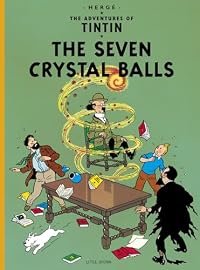
At this point the story establishes what will become the pattern for the series: any time anything related to science rears its head from this point on, Professor Calculus will take center stage. In this case, it turns out that Calculus is an old school friend of the last conscious member of the Peruvian expedition, Professor Hercules Tarragon. In short order our heroes visit Tarragon to try to figure out why the other members have all fallen into a perpetual deep sleep. After viewing the mummy of Rascar Capac (which Tarragon keeps in a glass case in his front hall), there is an action sequence involving some ball lightning that gives the book its cover illustration and causes the mummy to vanish. After everyone has bad dreams, Tarragon is stricken with the same malady as his compatriots, complete with shards of crystal, and while everyone is out investigating Calculus finds a golden bracelet that he decides to wear as a lark.
But before too long Calculus goes missing, and the mystery of the unconscious scientists deepens when it turns out they have regular synchronized fits. In short order the story turns into a kidnapping investigation as Tintin and Haddock hunt for the missing Calculus, a hunt that leads them to the docks and a procession of clues that lead to the Pachacamac, a Peruvian freighter that had recently left for South America. And unlike many other investigations conducted by Tintin, this one is interesting because it involves actual investigation, rather than Tintin falling into the hands of his enemies and then foiling them. Hergé's storytelling abilities improve with each volume, as he shows this here by setting up a mystery and having his characters follow a trail of clues that keep the reader guessing and interested, but once revealed, fall into place and make sense. One element that is something of note is that when Tintin and Haddock undertake to find Calculus' kidnappers, they are not assisted or accompanied by Thompson and Thomson, which may account for their success. This being the first half of a two-part story, the book ends on a cliff-hanger with nothing resolved, setting up Prisoners of the Sun. Interestingly, just like The Secret of the Unicorn, which is also the first half of a two-part story, all of the action in The Seven Crystal Balls takes place in Tintin's home country.
Coupling pulp fantasy with a good story heavy on investigation with just the right amount of humor, The Seven Crystal Balls is an excellent first half of a fun and exciting story. Despite the fact that the story is manifestly incomplete in just this volume, this is still an beautiful book with all of the elements one has come to expect from a Tintin story - bumbling silliness from Thompson and Thomson, clueless meandering from Calculus, boisterous excitability from Haddock, as well as some inebriation (and some additional inebriation for Snowy), and of course, through it all is the steady virtue and resourcefulness of Tintin. Intentionally devoid of politics save for the brief condemnation of Western imperialism, the book is almost entirely pure investigation, and is also one of the best books in the series.
This review has also been posted to my blog Dreaming About Other Worlds. show less
While not reporting on the news Tintin comes across a story in the paper that kicks off the plot of the book: an expedition returning from Peru with the ancient Incan mummy of Rascar Capc that they had found on their travels when a fellow train passenger ominously warns that disturbing Incan graves will lead to trouble. In a fit of awareness, Hergé has his unnamed kibbitzer wonder how Europeans would like explorers from South America or Africa coming over and digging up their kings without so much as a by-your-leave. Clearly Hergé's thinking had progressed considerably from the days when he had Tintin giving lessons to native Congolese about their Belgian fatherland and their benevolent King Leopold. And this is, I think, the most important point to be made about Hergé: he was willing to learn and change his positions on issues like colonialism. Even though his earlier books displayed some fairly odious views, Hergé's later works demonstrate a more empathetic position that more than makes up for them.
Having given the plot a quick kick start, the book turns to some comedy by showing how Haddock is trying to fit into his new life as a member of the landed gentry - falling off horses and going through an endless number of monocles. The book also makes a quick reference back to the opening when Calculus shows up with his pendulum and Haddock comments that the professor is convinced that his dowsing will lead him to a Saxon burial ground - just the sort of place that one expects a Bolivian expedition to Europe would not be welcomed. But before too long we are back on the trail of the plot, but in the roundabout way of Haddock's new found fascination with magic tricks, and a trip he takes to the theater with Tintin. While there to observe a magic act, they see a knife throwing act featuring none other than Tintin's old friend General Alcazar from The Broken Ear, but now deposed and in disguise. Also part of the performance is Bianca Castafiore, last seen in King Ottokar's Sceptre. In response to her appearance, Tintin observes that she shows up everywhere: Syldavia, Borduria, and the Red Sea. But this makes no sense if Tintin is sequential - Tintin and Haddock don't see her in Borduria until The Calculus Affair, five books after this one, and they won't find her in the Red Sea until The Red Sea Sharks, the book after that. Not only that, when Tintin met Castafiore in Syldavia, it was in King Ottokar's Sceptre, before he had even met Captain Haddock (and as a result, contrary to what Tintin implies here, Haddock was not with him for that encounter). This is yet more evidence, along with the references to Marlinspike and Destination Moon from Cigars of the Pharaoh and numerous other examples, that the Tintin books take place in a weird universe in which everything is simultaneously in the future and in the past. And people who were never present for events were in fact present for them.
After filling some space with Haddock driven slapstick (including a couple of very nice oversize panels), the story gets back on track when Thompson and Thomson arrive at Tintin's door the next morning to consult him in their investigation into the mysterious illness of one of the seven members of the expedition that brought back Rascar Capac's mummy. Leaving aside the question of why a pair of detectives would consult a journalist who does no journalism, the result of their consultation is that Tintin dismisses it as a mere coincidence until the detectives produce shards of crystal that were found next to the now unconscious explorer. Soon the seven explorers begin to fall one by one, each turning up unconscious with shards of crystal by their side. As quickly as Tintin, Haddock, Thompson, and Thomson can get in touch with the scientists, they turn up unconscious - and when the detectives are improbably assigned to guard one of the men, their blundering predictably results in yet another man in an inexplicable coma lying next to shards of crystal.
At this point the story establishes what will become the pattern for the series: any time anything related to science rears its head from this point on, Professor Calculus will take center stage. In this case, it turns out that Calculus is an old school friend of the last conscious member of the Peruvian expedition, Professor Hercules Tarragon. In short order our heroes visit Tarragon to try to figure out why the other members have all fallen into a perpetual deep sleep. After viewing the mummy of Rascar Capac (which Tarragon keeps in a glass case in his front hall), there is an action sequence involving some ball lightning that gives the book its cover illustration and causes the mummy to vanish. After everyone has bad dreams, Tarragon is stricken with the same malady as his compatriots, complete with shards of crystal, and while everyone is out investigating Calculus finds a golden bracelet that he decides to wear as a lark.
But before too long Calculus goes missing, and the mystery of the unconscious scientists deepens when it turns out they have regular synchronized fits. In short order the story turns into a kidnapping investigation as Tintin and Haddock hunt for the missing Calculus, a hunt that leads them to the docks and a procession of clues that lead to the Pachacamac, a Peruvian freighter that had recently left for South America. And unlike many other investigations conducted by Tintin, this one is interesting because it involves actual investigation, rather than Tintin falling into the hands of his enemies and then foiling them. Hergé's storytelling abilities improve with each volume, as he shows this here by setting up a mystery and having his characters follow a trail of clues that keep the reader guessing and interested, but once revealed, fall into place and make sense. One element that is something of note is that when Tintin and Haddock undertake to find Calculus' kidnappers, they are not assisted or accompanied by Thompson and Thomson, which may account for their success. This being the first half of a two-part story, the book ends on a cliff-hanger with nothing resolved, setting up Prisoners of the Sun. Interestingly, just like The Secret of the Unicorn, which is also the first half of a two-part story, all of the action in The Seven Crystal Balls takes place in Tintin's home country.
Coupling pulp fantasy with a good story heavy on investigation with just the right amount of humor, The Seven Crystal Balls is an excellent first half of a fun and exciting story. Despite the fact that the story is manifestly incomplete in just this volume, this is still an beautiful book with all of the elements one has come to expect from a Tintin story - bumbling silliness from Thompson and Thomson, clueless meandering from Calculus, boisterous excitability from Haddock, as well as some inebriation (and some additional inebriation for Snowy), and of course, through it all is the steady virtue and resourcefulness of Tintin. Intentionally devoid of politics save for the brief condemnation of Western imperialism, the book is almost entirely pure investigation, and is also one of the best books in the series.
This review has also been posted to my blog Dreaming About Other Worlds. show less
There's the usual Tintin fun to be had, but it feels like the set-up of a story, which of course it is, rather than an adventure in itself.
There are some nicely effective sections, the best being Tintin's dream-vision of the mummy, Rascar Capac. Or, was it a dream-vision? I'm looking forward to the next instalment, Prisoners of the Sun, which I hope will pay off on the set up of this book.
There are some nicely effective sections, the best being Tintin's dream-vision of the mummy, Rascar Capac. Or, was it a dream-vision? I'm looking forward to the next instalment, Prisoners of the Sun, which I hope will pay off on the set up of this book.
A tee-up story for Prisoner's of the Sun, which is great. Nothing really happens in this one, but it's adequate enough.
bookshelves: radio-4x, series
Read on November 29, 2013
HUZZAH! Sunday ...
OR
Complete adventure on youtube
Took the easy option and went for the youtube version. Excellent. Every time Snowy barked, and he barked a lot in this one, K9 growled.
HAH!
Read on November 29, 2013
HUZZAH! Sunday ...
OR
Complete adventure on youtube
Took the easy option and went for the youtube version. Excellent. Every time Snowy barked, and he barked a lot in this one, K9 growled.
HAH!
Review by: Liying
This book is about young reporter Tintin and his frinds having a great adventure. Seven explorers who discovered the the mummy that from Inca. They all got a attack and fallen sleep. Tintin's friend kidnapped after all these things happened. Could Tintin get his friend back? I am very looking forward to read the next book! I like this book very much. I like the way how author give the detail of the story. And I could guess what might happen next after I read a few more pages. This book is a comic book, that makes me could understand what happened easily.
Review by: Mickey
TYVM you've solved all my problems
This book is about young reporter Tintin and his frinds having a great adventure. Seven explorers who discovered the the mummy that from Inca. They all got a attack and fallen sleep. Tintin's friend kidnapped after all these things happened. Could Tintin get his friend back? I am very looking forward to read the next book! I like this book very much. I like the way how author give the detail of the story. And I could guess what might happen next after I read a few more pages. This book is a comic book, that makes me could understand what happened easily.
Review by: Mickey
TYVM you've solved all my problems
first english edition has a red cloth spine
Members
- Recently Added By
Lists

Recommended Comics / Graphic Novels
595 works; 122 members

Kidnapping -- children's/young adult fiction
598 works; 3 members

Favorite Childhood Books
1,646 works; 517 members

Books Read in 2014
2,342 works; 89 members

Paranormal investigators and space detectives
274 works; 9 members
Author Information

'Hergé' was born Georges Remi on 22 May, 1907 in Etterbeek, a suburb of Brussels, in Belgium. After leaving school, he worked for the daily newspaper, Le XXe Siècle (The 20th Century). He was responsibe the for the section of the newspaper designed for children. Tintin, the main character in his works, was introduced on January 10, 1929 in a show more story entitled 'Tintin in the Land of the Soviets.' Each story ran as a comic strip in the newspaper and then was published as a book. Some of these books were adapted for the small screen including The Crab With The Golden Claws, Star of Mystery, Red Rakham's Treasure, Black Island, Objective Moon and The Calculus Affair. French TV produced longer versions of twenty of the books in 1992, which have been broadcast in over fifty countries. On 3 March, 1983, he died in Brussels. At the time of his death, he was working on Tintin and the Alpha-Art, which was published in an unfinished form. (Bowker Author Biography) show less
All Editions
Some Editions
Awards and Honors
Notable Lists
Series

Work Relationships
Is contained in
Has the adaptation
Common Knowledge
- Canonical title
- The Seven Crystal Balls
- Original title
- Les 7 Boules de cristal
- Alternate titles*
- Tintin : Les 7 boules de cristal
- Original publication date
- 1946
- People/Characters
- Tintin; Bianca Castafiore; Snowy; Professor Calculus; Captain Haddock; Professor Hercules Tarragon (show all 23); The Thompson Twins; Captain Barnacle; Nestor; Ragdalam the Fakir; Madame Yamilah; Mrs Clarkson; Ramon Zarate; General Alcazar; Professor Sanders-Hardiman; Doctor Simone; Professor Reedbuck; Mark Falconer; Professor Paul Cantonneau; Doctor Midge; Rascar Capac; Inspector Jackson; Rupac Inca Huaco
- Important places
- Marlinspike Hall; Westermouth
- First words
- HOME AFTER TWO YEARS Sanders-Hardiman Expedition Returns
- Last words
- (Click to show. Warning: May contain spoilers.)"Yes, that's all very fine, but I wonder if it will be as easy as you think..."
- Original language
- French
*Some information comes from Common Knowledge in other languages. Click "Edit" for more information.
Classifications
- Genre
- Graphic Novels & Comics
- DDC/MDS
- 741.59493 — Arts & recreation Drawing & decorative arts Drawing Comic books, graphic novels, fotonovelas, cartoons, caricatures, comic strips History, geographic treatment, biography European Other European Belgium & Luxembourg
- LCC
- PN6790 .B43 .R449513 — Language and Literature Literature (General) Literature (General) Collections of general literature Comic books, strips, etc.
- BISAC
Statistics
- Members
- 2,038
- Popularity
- 10,198
- Reviews
- 15
- Rating
- (4.17)
- Languages
- 28 — Arabic, Basque, Bengali, Catalan, Chinese, Czech, Danish, Dutch, English, Finnish, French, German, Greek, Hindi, Indonesian, Italian, Japanese, Korean, Norwegian (Bokmål), Norwegian, Portuguese, Russian, Serbian, Croatian, Spanish, Swedish, Turkish, Welsh
- Media
- Paper, Ebook
- ISBNs
- 97
- ASINs
- 19