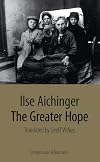
Herod's Children
by Ilse Aichinger
On This Page
Description
The novel deals with a persecuted girl in Germany at the end of World War II.Tags
Recommendations























Member Reviews
Die größere Hoffnung was Aichinger's only novel, developed out of her first published story, "Das vierte Tor" (1945 - included as an appendix in the 1991 edition of the novel). Aichinger was never really comfortable with long-form texts - she revised and considerably shortened the book in 1960, and she's quoted as saying that she wished she could have condensed the book into a single sentence. We should probably be grateful that her publishers stopped her from going so far: it's a magnificent, beautifully written and very moving novel, a book that follows its own rules in a kind of spare, abstract, nightmarish modernism that resembles nothing else I know of. If you could imagine how Kafka might have rewritten Emil and the detectives show more after reading Mrs Dalloway you would have a vague sort of idea, perhaps...
The book deals with the experiences of children of Jewish descent in Nazi Vienna, obviously drawing to a large extent on Aichinger's own experience (she was a teenager at the time of the Anschluss, and remained in Vienna with her Jewish mother and grandmother while her twin sister was able to get away to England on a Kindertransport). The children in the novel - obviously a bit younger than Aichinger was herself - have to learn to deal with a world in which they are hated, feared, humiliated, and excluded from most aspects of normal life merely because they have "the wrong kind of grandparents". Ellen, who has enough of the wrong sort of grandparents for her life to be messed up, but not enough to qualify to wear a star and share her friends' fate, has to struggle to win the trust and friendship of the other excluded children. At first they plot exotic schemes to get "over the frontier" or "over the sea", but as the story goes on they come to see that these plans for physical escape will not free them, but that there is a "greater hope" that they can aspire to through a kind of Christian-Existentialist understanding of their own humanity. As long as they know that they are able to love and be loved, to renounce what they have willingly, and to forgive, they have nothing to fear from their oppressors. I'm not sure how an Auschwitz survivor like Primo Levi would have felt about this, but Aichinger clearly believes that this is how she managed to live through the horror herself, and she makes a convincing case. And you don't need to agree with her to find that the book tells you something very direct about what it must have felt like to be a child in those times. show less
The book deals with the experiences of children of Jewish descent in Nazi Vienna, obviously drawing to a large extent on Aichinger's own experience (she was a teenager at the time of the Anschluss, and remained in Vienna with her Jewish mother and grandmother while her twin sister was able to get away to England on a Kindertransport). The children in the novel - obviously a bit younger than Aichinger was herself - have to learn to deal with a world in which they are hated, feared, humiliated, and excluded from most aspects of normal life merely because they have "the wrong kind of grandparents". Ellen, who has enough of the wrong sort of grandparents for her life to be messed up, but not enough to qualify to wear a star and share her friends' fate, has to struggle to win the trust and friendship of the other excluded children. At first they plot exotic schemes to get "over the frontier" or "over the sea", but as the story goes on they come to see that these plans for physical escape will not free them, but that there is a "greater hope" that they can aspire to through a kind of Christian-Existentialist understanding of their own humanity. As long as they know that they are able to love and be loved, to renounce what they have willingly, and to forgive, they have nothing to fear from their oppressors. I'm not sure how an Auschwitz survivor like Primo Levi would have felt about this, but Aichinger clearly believes that this is how she managed to live through the horror herself, and she makes a convincing case. And you don't need to agree with her to find that the book tells you something very direct about what it must have felt like to be a child in those times. show less
Plot:
Ellen is a teenager in Vienna in the 40s. Her mother is Jewish and has fled the country, her father is Arian and doesn’t want to know Ellen anymore. So she lives with her maternal grandmother and dreams of finding a way to join her mother. But her days are mostly spent in isolation with a group of other children who are all Jewish and outcast.
Aichinger poured her own experiences of “having the wrong grandparents” into Die größere Hoffnung, an impressionistic, surreal novel in evocative, though not always literal and clear images. It’s one of the most harrowing novels about World War 2 I ever read, and one of the most beautifully written.
Read more on my blog: show more target="_top">https://kalafudra.com/2016/04/12/die-grosere-hoffnung-herods-children-ilse-aichi... show less
Ellen is a teenager in Vienna in the 40s. Her mother is Jewish and has fled the country, her father is Arian and doesn’t want to know Ellen anymore. So she lives with her maternal grandmother and dreams of finding a way to join her mother. But her days are mostly spent in isolation with a group of other children who are all Jewish and outcast.
Aichinger poured her own experiences of “having the wrong grandparents” into Die größere Hoffnung, an impressionistic, surreal novel in evocative, though not always literal and clear images. It’s one of the most harrowing novels about World War 2 I ever read, and one of the most beautifully written.
Read more on my blog: show more target="_top">https://kalafudra.com/2016/04/12/die-grosere-hoffnung-herods-children-ilse-aichi... show less
Ratings
Members
- Recently Added By
Lists

Speculative Fiction from around the World
610 works; 18 members

Books Read in 2016
4,666 works; 199 members

Die besten Werke der deutschsprachigen Erzählliteratur von 1924 bis 2024
100 works; 2 members
Author Information

Some Editions
Awards and Honors
Series
Belongs to Publisher Series
Ilse Aichinger Werkausgabe (Band 1)
Bibliothek des 20. Jahrhunderts (Dt. Bücherbund) (Aichinger, Ilse)
Volk und Welt Spektrum (129)
Fischer Taschenbuch (10821)
Work Relationships
Is contained in
Common Knowledge
- Canonical title
- Herod's Children
- Original title
- Die größere Hoffnung
- Original publication date
- 1948
Classifications
Statistics
- Members
- 192
- Popularity
- 171,229
- Reviews
- 2
- Rating
- (4.00)
- Languages
- 8 — Danish, Dutch, English, French, German, Italian, Spanish, Swedish
- Media
- Paper, Ebook
- ISBNs
- 20
- ASINs
- 6