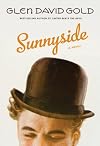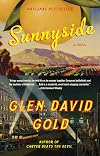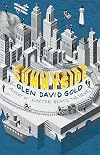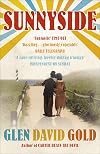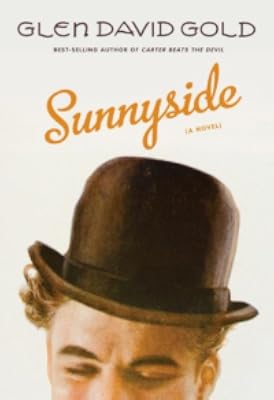
Sunnyside
by Glen David Gold
On This Page
Description
On a winter day in 1916 American capitalism, a world at war, and the emerging mecca of Hollywood intersect to spawn an enduring culture of celebrity. Charlie Chaplin is spotted in more than eight hundred places simultaneously, an extraordinary delusion that brings together the fortunes of three men: Leland Wheeler, son of the world's last (and worst) Wild West star, as he finds unexpected love on the battlefields of France; Hugo Black, drafted to fight under the towering General Edmund show more Ironside in America's doomed expedition against the Bolsheviks; and Chaplin himself, as he faces a tightening vise of complications--studio moguls, questions about his patriotism, his unchecked heart, and, most menacing of all, "his mother." show lessTags
Recommendations







Member Reviews
A fantastic addition to the epic Americana novel tradition. Vivid characters and deeply researched settings bring a fascinating time period to life. Gold is a wiz at turning historical figures into fiction; in this case Charlie Chaplin and a host of other silent film era folks rub shoulders with other, strictly fictional characters to paint a lush, multi-layered portrait of America between the Wars. Fans of E.L. Doctorow (Ragtime, Billy Bathgate), T.C. Boyle (The Road To Wellville), William Boyd (Any Human Heart, The New Confessions), and of course Gold's fantastic first novel, Carter Beats The Devil, should not pass this one up.
Gold seems to have forgotten the reason people read fiction: we want a story. We want to get inside the lives of others, live in a fictive dream. This book seems to not to want to get its hands dirty. It keeps a cool and unemotional distance from itself and its characters. There's a very annoying tendency towards irony and self-indulgence. One example of this is the inclusion of a father and daughter who pop up periodically for no apparent reason other than to confuse the reader. Their last name? Golud. Just subtract the "u", folks, and he's inserted his own relatives into a story about great events and people. The daughter even ends up killing one of the main characters (didn't like him anyway, though).
There's one scene I need to show more mention, since it is either an intentional mistake (but why?) or just a flub. There's a party at Goldwyn's house. There are paid entertainers posing as statues, based on works of art. One is, according to Gold, the Death of David. There is no such thing. He must mean "Death of Marat," painted by J.L. David. How could he get that wrong? Or is he saying Chaplin gets it wrong? It seems as though the mistake is the narrator's. Not clear, but then, so much of this book is obtuse and needlessly vague. That ironic distance, as I mentioned.
If you want to turn this into a novel of reasonable length, just skip all the scenes dealing with Hugo and Ironsides and Russia. Just skip 'em. They should have been edited out, since they don't add to the story one whit.
Many times Gold write things that make no sense at all, stopping me cold in my tracks, as I page back and forth, trying to figure out just what he's referring to. Strikes me as, well, self-indulgent. Very disappointing. No more Mr. Gol(u)d for me, I think. The writer needs to value and respect his readers. show less
There's one scene I need to show more mention, since it is either an intentional mistake (but why?) or just a flub. There's a party at Goldwyn's house. There are paid entertainers posing as statues, based on works of art. One is, according to Gold, the Death of David. There is no such thing. He must mean "Death of Marat," painted by J.L. David. How could he get that wrong? Or is he saying Chaplin gets it wrong? It seems as though the mistake is the narrator's. Not clear, but then, so much of this book is obtuse and needlessly vague. That ironic distance, as I mentioned.
If you want to turn this into a novel of reasonable length, just skip all the scenes dealing with Hugo and Ironsides and Russia. Just skip 'em. They should have been edited out, since they don't add to the story one whit.
Many times Gold write things that make no sense at all, stopping me cold in my tracks, as I page back and forth, trying to figure out just what he's referring to. Strikes me as, well, self-indulgent. Very disappointing. No more Mr. Gol(u)d for me, I think. The writer needs to value and respect his readers. show less
Chaplin is only one of the characters in the book, with nearly equal time given to two other young men whose destinies are caught in the grip of the Great War. Luckily I enjoy the silent movie era and WW1 so this book was right up my alley, as the kids say.
The book has a huge cast of characters and the narrator does a fine job keeping them distinctive though his uniquely bass voice makes for an interesting fit with the more dainty characters (ie: Mary Pickford). It did make me want rewatch some Chaplin films so that’s a plus.
The book has a huge cast of characters and the narrator does a fine job keeping them distinctive though his uniquely bass voice makes for an interesting fit with the more dainty characters (ie: Mary Pickford). It did make me want rewatch some Chaplin films so that’s a plus.
You know the man who speed-read 'War and Peace' (“It’s about Russia”)? Well, this is about Charlie Chaplin. Why would anyone want to write a novel about Charlie Chaplin, you may ask, and I can only answer, it beats the hell out of me. You may also ask why anyone would then try to read it. The answer to that one is that I loved Gold’s previous book, 'Carter Beats the Devil': it’s one of the few books that I’ve wished, when I finished it, I could go back and read for the first time.
Truthfully, it’s not entirely about Chaplin: there are two other story strands, one based around Leland Duncan, whose claim to fame is that he brought the world Rin Tin Tin (true confession: I ploughed dry-eyed through reams of poverty, show more depression, despair, the horrors of the battlefield and an unfortunate soldier who gets a pine cone shoved up his arse, but wept buckets over the death of a dog. I’m not sure if that says more about me, or about the author). The other strand concerns a fictitious – I assume – character named Hugo Black, who begins his life with intellectual pretensions, has the misfortune to be shipped off to the Russian Front, and ends up horribly dead. There may or may not be a moral to be learned from this - put like that, it sounds a bit like a Ruthless Rhyme. How do the three strands tie together? Tenuously, at best; arguably, not at all.
When I worked in the rare books trade, we used to play a game of ‘authors who should have left well alone’. Françoise Sagan generally got a mention here, as did Joseph Heller. On the showing of 'Sunnyside', Glen David Gold may soon be joining the list. show less
Truthfully, it’s not entirely about Chaplin: there are two other story strands, one based around Leland Duncan, whose claim to fame is that he brought the world Rin Tin Tin (true confession: I ploughed dry-eyed through reams of poverty, show more depression, despair, the horrors of the battlefield and an unfortunate soldier who gets a pine cone shoved up his arse, but wept buckets over the death of a dog. I’m not sure if that says more about me, or about the author). The other strand concerns a fictitious – I assume – character named Hugo Black, who begins his life with intellectual pretensions, has the misfortune to be shipped off to the Russian Front, and ends up horribly dead. There may or may not be a moral to be learned from this - put like that, it sounds a bit like a Ruthless Rhyme. How do the three strands tie together? Tenuously, at best; arguably, not at all.
When I worked in the rare books trade, we used to play a game of ‘authors who should have left well alone’. Françoise Sagan generally got a mention here, as did Joseph Heller. On the showing of 'Sunnyside', Glen David Gold may soon be joining the list. show less
Gold's second novel is a frustratingly disjointed read. Where Carter Beats the Devil was a tightly wound narrative, Sunnyside is a sprawl of loose ends. With a collection of main characters, no one feels like the protagonist. Is it Chaplin? Is it Lee Duncan? Or is it someone else entirely?
I like Gold's writing style – three-dimensional description of time, place, and character – but this book would've benefited from stronger editing. As it was published, the reader can almost tell where Gold stopped writing and picked up the narrative in his next session. That's not good.
In a word, this book was disappointing. And not just as a second novel from a promising, talented writer, but generally.
I like Gold's writing style – three-dimensional description of time, place, and character – but this book would've benefited from stronger editing. As it was published, the reader can almost tell where Gold stopped writing and picked up the narrative in his next session. That's not good.
In a word, this book was disappointing. And not just as a second novel from a promising, talented writer, but generally.
Sunnyside is a wonderfully descriptive and beautifully written story about people, both famous and not, attempting to realize their ambitions in a world where dreams are easier planned than attained. But, it's more than the typical struggling-person-tries-to-make-dreams-come-true book. It considers the value of what it is the characters are striving to accomplish, often quite ruthlessly. And, as the characters progress toward their dreams, they find life's meaning changes and their values adjust, leaving them unmoored and listless, until they adapt to their new moral surroundings. It's certainly not a depressing book. As in life, it was both amusing and cruel, and in the end, well worth the journey.
A fantastic addition to the epic Americana novel tradition. Vivid characters and deeply researched settings bring a fascinating time period to life. Gold is a wiz at turning historical figures into fiction; in this case Charlie Chaplin and a host of other silent film era folks rub shoulders with other, strictly fictional characters to paint a lush, multi-layered portrait of America between the Wars. Fans of E.L. Doctorow (Ragtime, Billy Bathgate), T.C. Boyle (The Road To Wellville), William Boyd (Any Human Heart, The New Confessions), and of course Gold's fantastic first novel, Carter Beats The Devil, should not pass this one up.
Members
- Recently Added By
Published Reviews
ThingScore 63
Sunnyside is not perfect; a stronger editor might have cut a further 50 pages. But it is a gloriously enjoyable read, with pleasures on almost every page: a novel of which Chaplin, the supreme entertainer, would have been proud.
added by SandSing7
Sunnyside is a big novel in all senses: 560 dense pages, with a huge cast and an authorial tendency to pile diversion on diversion until it nearly collapses under its own weight. There are breathtaking moments here - three paragraphs on the treatment of Native American soldiers in France are so piquant and engrossing they could be a novel in themselves - but too often it feels as though Gold show more can't help including nearly everything that struck his fancy. He can be both immensely charming and wildly imaginative, but Sunnyside is finally too obsessive to be an entirely comfortable read. show less
added by private library
Lists

Powell's Indiespensable
79 works; 6 members

real people in fiction circumstances
74 works; 10 members
Author Information

Some Editions
Awards and Honors
Common Knowledge
- Canonical title
- Sunnyside
- Original publication date
- 2009
- People/Characters
- Charlie Chaplin; Leland Wheeler; Hugo Black
- Important places
- Los Angeles, California, USA; San Francisco, California, USA; France; Russia
- Important events
- World War I
- Dedication
- For Alice
- First words
- At its northernmost limit, the California coastline suffered a winter of brutal winds pitched against iron-clad fog, and roiling seas whose whiplash could scar a man's cheek as quickly as a cat-o'-nine-tails.
Classifications
Statistics
- Members
- 522
- Popularity
- 57,276
- Reviews
- 25
- Rating
- (3.23)
- Languages
- English
- Media
- Paper, Audiobook, Ebook
- ISBNs
- 16
- ASINs
- 5