On This Page
Description
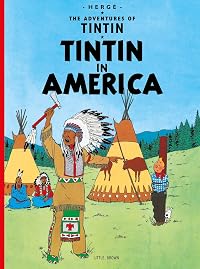
The boy hero comes to the United States and triumphs over gangsters in Chicago of the 1930's and the pitfalls of the wild West.Tags
Recommendations













Member Reviews
http://nwhyte.livejournal.com/1719727.html
This is one of the three pre-war Tintin books which are not in general circulation in English, and for fairly good reason; it's not all that good. Tintin goes to America in 1931, briefly captures Al Capone (who was still just about at liberty in real life at that stage), is himself captured by the Blackfoot tribe, and then has a series of unlikely and disjointed adventures ending with him rolling up the entire Chicago Syndicate of Gansters and sent back to Belgium as a hero. The only African-Americans in the book (at least in the current version) are lynched off-screen (apparently even this is omitted in the English translation), and the Blackfoot are kicked off their land because Tintin show more discovers oil on it; Hergé is at least offering a critique of racism, though not a very elegant one. It's interesting as a fore-runner of the much better stuff to come. It's a very long time since I last read Cigars of the Pharaoh, the next album in sequence, but my memory is that it is a massive upshift in quality and coherence compared with this. show less
This is one of the three pre-war Tintin books which are not in general circulation in English, and for fairly good reason; it's not all that good. Tintin goes to America in 1931, briefly captures Al Capone (who was still just about at liberty in real life at that stage), is himself captured by the Blackfoot tribe, and then has a series of unlikely and disjointed adventures ending with him rolling up the entire Chicago Syndicate of Gansters and sent back to Belgium as a hero. The only African-Americans in the book (at least in the current version) are lynched off-screen (apparently even this is omitted in the English translation), and the Blackfoot are kicked off their land because Tintin show more discovers oil on it; Hergé is at least offering a critique of racism, though not a very elegant one. It's interesting as a fore-runner of the much better stuff to come. It's a very long time since I last read Cigars of the Pharaoh, the next album in sequence, but my memory is that it is a massive upshift in quality and coherence compared with this. show less
The previous Tintin yarn, Tintin in the Congo, is unanimously reviled for its racist portrayal of the African continent. Because of this, it, and the obscure Tintin yarn before it, are left out of modern printings of the complete Tintin library.
[N.B. This review includes images, and was formatted for my site, dendrobibliography -- located here.]
Tintin in America is just as ignorant and vile in its portrayal of Native Americans as ...Congo was of Africans. Shallow commentary on the American government and mobsters aside, it's nuts that Hergé's portrayal of Native Americans gets a more dismissive free pass because people don't really give a shit about Native American issues.
Like the previous book, Tintin's third adventure is a random show more string of gags and unrelated events. Tintin bounces from one encounter to the next, each playing off of a different, antiquated stereotype of something American. In the end, they all tie in some way to a bizarre mob plot to stop Tintin before he accidentally stops them from doing mob stuff. It was originally serialized in small segments, so its intent was gags rather than telling a story. Still, it's hard to argue it deserves a place anywhere near the later, more fleshed-out Tintin adventures. show less
[N.B. This review includes images, and was formatted for my site, dendrobibliography -- located here.]
Tintin in America is just as ignorant and vile in its portrayal of Native Americans as ...Congo was of Africans. Shallow commentary on the American government and mobsters aside, it's nuts that Hergé's portrayal of Native Americans gets a more dismissive free pass because people don't really give a shit about Native American issues.
Like the previous book, Tintin's third adventure is a random show more string of gags and unrelated events. Tintin bounces from one encounter to the next, each playing off of a different, antiquated stereotype of something American. In the end, they all tie in some way to a bizarre mob plot to stop Tintin before he accidentally stops them from doing mob stuff. It was originally serialized in small segments, so its intent was gags rather than telling a story. Still, it's hard to argue it deserves a place anywhere near the later, more fleshed-out Tintin adventures. show less
Full of stereotypes. The depiction of Native Americans was of simpletons, and most characters lacked motivation and dimensionality. This was a strange book to read to represent Belgium because it does not take place in Belgium and most of the characters are from Chicago and the surrounding areas, but it did give an interesting insight into European Stereotypes of America during the 1930s, and an image of how Herge thought people and heroes should conduct themselves.
Tintin travels to Chicago where he encounters all the typically American violence, corruption, and adventure that 1930s Europe could imagine. He runs into trouble with gangsters led by Al Capone, is taken captive by an absurdly stereotypical Indian tribe, and is nearly strung up by a lynch mob. Tintin consistently gets into and out of tight spots until he finally saves the day and a celebration is declared in his honor. While this series could be considered something of a classic, it comes off as extremely outdated and fairly offensive. The portrayal of Native Americans and the language used to describe them is particularly troubling. This book is interesting to consider from a historical standpoint, but I would not be comfortable show more including it in my collection. And even with the renewed interest in comics and graphic novels, it is not something that I can imagine children being very taken with. show less
This would sound like blasphemy to my younger self, but I really don't think the early Tintin books are all that good. The story is very haphazard, the characters are one-dimensional, and it would all be very predictable if half of the time, the solution to any problem wouldn't be "Tintin has a very lucky escape".
If my memory isn't completely off, the books get good once Captain Haddock is introduced, and the stories have a proper arc (Le secret de la Licorne was my favorite book as a child). These 30's travel books (Congo, America) simply don't live up to modern standards.
If my memory isn't completely off, the books get good once Captain Haddock is introduced, and the stories have a proper arc (Le secret de la Licorne was my favorite book as a child). These 30's travel books (Congo, America) simply don't live up to modern standards.
The third volume in the Tintin Collection. This time Tintin goes to Chicago to clean up the mob bosses. Somehow he ends up out on the range in cowboy gear getting captured by Native Americans. While this volume isn't nearly as racist as Tintin goes to the Congo, the depiction of Native Americans is pretty low-brow at best. I doubt that Herge did much research into Native American culture for his comic, much less Chicago for that matter. Belgium is a long way from Illinois, especially in the 1930's. Still, it's funny to notice some of the European stereotypes about America coming through in the plot line. In the middle of the story Tintin is on an Indian reservation and is stuck in a cave so he blows up an entrance with some handy TNT. show more He accidentally sets off a natural oil geyser. Within seconds there are twenty different oil companies offering to pay him thousands and thousands of dollars for the land rights. Tintin tells them basically that its not his land, its the Native American's land. The very next panel is the oil execs giving the Indian Chief $25 and half an hour to get off the land. in a somewhat surreal four panels, within one day the oil company has moved in, built a factory, built a city, and chastising Tintin for wearing cowboy wear. It's really quite funny. Reminds me of the Simpson's satirical style. There is also a funny meat packing scene, a la Upton Sinclair. It goes to show that even in the 1930's, America's reputation for over processed food with mysterious origins was already cemented in the minds of the international community.
Well, the quest continues. Next up, Tintin and the Cigars of the Pharaoh. show less
Well, the quest continues. Next up, Tintin and the Cigars of the Pharaoh. show less
As the first "Tintin" book for which Hergé was legitimately excited, 'Tintin in America' shows the early traces of the author's consummate professionalism in research. It's not complete yet - the two main settings are anachronistic to say the least! - but he substitutes the unexpectedly lush Congo for a more atmospheric downtown Chicago. The plight of the Native Americans is quite dimensional, with their oppression and bigoted treatment at the hands of the white man. However, they still remain simpler savages: a trope that would remain with Herge until "The Blue Lotus". Already, though, Tintin and his adventures had attracted scores of fans, and Herge would be able to widen his scope even further in
The quality of the drawing is certainly markedly improved, but the first third of the album is just Tintin being attacked on every page, and escaping on the next. There is no greater depth to the story. The portrayal of the Native Americans improves over the course of the book, but starts out very very weak. They're noble, of course, but also easily misled by the white man. Still, Herge is working through a lot of the elements that he'll eventually refine for the remainder of the (very good) Tintin works. Reaching the end, and this is certainly a bewildering little piece. Tintin runs a marathon race here, being brought to death's door and escaping on every. single. page. It's also quite a peripatetic little story, with the 'Tintin beats Capone' story followed quickly by the Native American episodes, followed by a Snowy kidnap plot and a general 'North by Northwest'-esque chase drama. Not a great work, by any means.
Members
- Recently Added By
Author Information

553+ Works 59,565 Members
'Hergé' was born Georges Remi on 22 May, 1907 in Etterbeek, a suburb of Brussels, in Belgium. After leaving school, he worked for the daily newspaper, Le XXe Siècle (The 20th Century). He was responsibe the for the section of the newspaper designed for children. Tintin, the main character in his works, was introduced on January 10, 1929 in a show more story entitled 'Tintin in the Land of the Soviets.' Each story ran as a comic strip in the newspaper and then was published as a book. Some of these books were adapted for the small screen including The Crab With The Golden Claws, Star of Mystery, Red Rakham's Treasure, Black Island, Objective Moon and The Calculus Affair. French TV produced longer versions of twenty of the books in 1992, which have been broadcast in over fifty countries. On 3 March, 1983, he died in Brussels. At the time of his death, he was working on Tintin and the Alpha-Art, which was published in an unfinished form. (Bowker Author Biography) show less
Some Editions
Awards and Honors
Notable Lists
Series

Work Relationships
Is contained in
Is a retelling of
Has the adaptation
Is expanded in
Common Knowledge
- Canonical title
- Tintin in America
- Original title
- Tintin en Amérique
- Alternate titles*
- Tintin : Tintin en Amérique
- Original publication date
- 1946 (Color) (Color)
- People/Characters
- Tintin; Snowy; Al Capone; Bobby Smiles; Maurice Oyle
- Important places
- Chicago, Illinois, USA; Redskin City, USA
- First words
- Chicago, 1931, when gangster bosses ruled the city...
- Last words*
- (Click to show. Warning: May contain spoilers.)Je commençais à peine à m'habituer...
- Original language
- French
- Disambiguation notice
- This is the 1945 redrawn and colourised version of "Tintin in America" (Tintin en Amérique). Please, do not combine it with the 1932 original black and white version.
*Some information comes from Common Knowledge in other languages. Click "Edit" for more information.
Classifications
- Genre
- Graphic Novels & Comics
- DDC/MDS
- 741.5 — Arts & recreation Drawing & decorative arts Drawing Comic books, graphic novels, fotonovelas, cartoons, caricatures, comic strips
- LCC
- PN6790 .B44 .T57813 — Language and Literature Literature (General) Literature (General) Collections of general literature Comic books, strips, etc.
- BISAC
Statistics
- Members
- 2,141
- Popularity
- 9,550
- Reviews
- 32
- Rating
- (3.42)
- Languages
- 25 — Afrikaans, Bengali, Catalan, Chinese, Czech, Danish, Dutch, English, Finnish, French, German, Galician, Greek, Hindi, Italian, Korean, Norwegian (Bokmål), Polish, Portuguese, Serbian, Croatian, Spanish, Swedish, Turkish, Welsh
- Media
- Paper, Ebook
- ISBNs
- 88
- ASINs
- 18