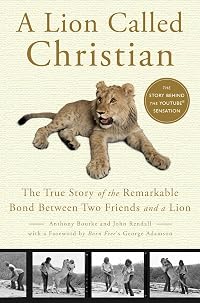
A Lion Called Christian
by Anthony Bourke, John Rendall
On This Page
Description
A wondrous, serendipitous tale that tracks Christian's migration from London streets to Kenyan wilderness and the new friends, both lion and human (notably lion expert George Adamson of Born Free fame) that he finds there. Most astonishing, however, is that in 1971, after a year's absence, his old friends Bourke and Rendall returned to Africa and successfully reunited with Christian.Tags
Recommendations





Member Recommendations
Ella_Jill This book also tells the story of a human-reared lion rehabilitated to the wild.
Sylak This is the 'young readers' version of the book.
Sylak If not for this book, and subsequent film, Bourke and Rendall would likely never have been introduced to George Adamson through Bill Travers and Virginia McKenna, and Christian's future may have been far less bright.

Sylak George talks some more about his time with Christian in his book.


Sylak Tony joined George Adamson during Christian's introduction back to the wild, and continued his work after George's death.
Member Reviews
A lovely updated version of the 70s book written by two young Australians who became besotted with a lion cub for sale in Harrods and decided to take him home (as you do)... They lived with him in London for a year, first in a furniture shop, and then they were taken under the wing of Bill Travers and Virginia McKenna (of Born Free movie fame) who built a compound for Christian on their country estate just outside the city. From there he was flown to Kenya to be rehabilitated into a new wild pride by George Adamson (of actual Born Free fame), with Ace and John staying in the camp alongside him for several months. The book is updated to include the YouTube-famous reunions between Ace, John and Christian, first after a year, then again show more after two; the footage of a fully grown wild lion running to greet his old friends after all that time apart went viral and brought Christian's charming story to a whole new generation.
The delightful stories from Christian's year in London are so funny and sweet, and his intelligence and playfulness make them a joy to read. Whether they're playing football in the garden, or Christian is playing coy with them, climbing onto their knees for a cuddle, or practising pouncing on shop customers from behind the furniture, the affection between the trio glows from every page. Oh, and there are photos! Highly recommended for lovers of heartwarming wildlife stories and cats of all sizes... show less
The delightful stories from Christian's year in London are so funny and sweet, and his intelligence and playfulness make them a joy to read. Whether they're playing football in the garden, or Christian is playing coy with them, climbing onto their knees for a cuddle, or practising pouncing on shop customers from behind the furniture, the affection between the trio glows from every page. Oh, and there are photos! Highly recommended for lovers of heartwarming wildlife stories and cats of all sizes... show less
I read this book whilst similarly being charged with an infant wild animal in my care, not anything as dramatic as one of the big cats, but rather less exotic: a fledgling crow who was suffering malnutrition and had been abandoned by it's parents. It was pure chance that I began reading this book at around that time, and although quite different from Ace and John's situation in both the circumstances of the acquisition as well as scale of responsibility, I discovered in a small way quite a few similarities in our situations.
I too was surprised just how quickly and easily a young wild animal adapted to humans as it's carers. And without deliberately imposing to much anthropomorphism in to the equation, how easy it was to feel a bond show more growing between us that seemed to connect us on an emotional level (although my logical side reassures me that the birds excitement to see me in the morning was simply to be fed). I did however get to experience first hand just how intelligent these animals are and how quickly they learn. I can just imagine how impressed Ace and John must have been with Christian's progress as I was with Coal's.
If this book has been criticised for lacking in details on the challenges of caring for a wild animal in the rural setting of a basement in West London, I can only assume that it is because, contrary to popular perception, the actual task at hand was remarkably trouble free and dare I say unremarkable in daily routine, with few oddities beyond those mentioned in the book - as recalled by the authors on several occasions.
Finally, just like Ace and John discovered on their journey, I realised that I would require more expertise than first anticipated in order to return my animal successfully to the wild and sought out the skills of a proper wildlife hospital who, in much a similar way that George Adamson did with Christian, introduced Coal into a family group that he could form bonds with prior to release, rather than simply being set free alone into the local woodlands; where, even with hover support in the form of regular food drops, I was assured that he would have certainly perished falling victim to the other established wild groups already there.
I found many parallels in our two stories, and like with Christian, I will never know for sure if the release was a one hundred percent success. Once you let go of an animal and allow it to return to the wild the risk factor goes up as you relinquish your structured control over its life to the chaos and uncertainty of nature. The very human need for closure may never be fulfilled because most of the time, as with Katania's fate in the book, we can simply never know for sure. That is the difference between a Hollywood animal movie and a true life account.
This is a good book as well as a wake up call about attempting to interfere with nature even with the best of human intentions. Not that I don't support wildlife rescue in principle.
Reading this book also took me back to the 1970s, a different time and a very different London. For all it's faults and trappings it was a more relaxed environment to live in than the claustrophobic and soulless city of today. Sure, it wasn't perfect. It was a little more edgy to be sure, but it was also far more interesting. Each district retained it's own special pace and had local characters who had grown up in the same community who added colour and also layers of background history that created whole environments of London that had a way of life that was as individual as often walking into another world. That is what made promenading across
London and visiting different areas so worth while. Overdevelopment has destroyed a way of life that had existed for hundreds of years, and in it's place left many people feeling isolated and confused. Progress in the form of broad sweeping sudden changes like this are also destroying human environments and a whole intricate way of life that is being lost forever.
Just take a look at the many web sites and blogs where people are attempting to now connect through old photographs and sharing stories about their lost communities. It's just as sad.
Sophisto-Cat at 475 Kings Road, where Christian lived with Ace and John has long since disappeared. In fact, by the time Ace and John said their final farewell to Christian at Kampi ya Simba in 1972, the shop along with Christian's basement were very likely already demolished, along with the whole area he once knew; sitting under the new World's End Estate.
Regulations have since been put in place to prevent the open trafficking and private ownership of many exotics. But if you look closely at the state of our dwindling wildlife and the ecology of our planet in general it paints a bleak picture for the future.
The story of a Lion Called Christian is destined sooner or later to be made into a major feature film. The fact that it hasn't already is very surprising indeed. I just hope that when the day comes and contracts are drawn up, that a significant portion will be put into the GAWPT so that they may explore the possibilities of re-opening Kora National Park. show less
I too was surprised just how quickly and easily a young wild animal adapted to humans as it's carers. And without deliberately imposing to much anthropomorphism in to the equation, how easy it was to feel a bond show more growing between us that seemed to connect us on an emotional level (although my logical side reassures me that the birds excitement to see me in the morning was simply to be fed). I did however get to experience first hand just how intelligent these animals are and how quickly they learn. I can just imagine how impressed Ace and John must have been with Christian's progress as I was with Coal's.
If this book has been criticised for lacking in details on the challenges of caring for a wild animal in the rural setting of a basement in West London, I can only assume that it is because, contrary to popular perception, the actual task at hand was remarkably trouble free and dare I say unremarkable in daily routine, with few oddities beyond those mentioned in the book - as recalled by the authors on several occasions.
Finally, just like Ace and John discovered on their journey, I realised that I would require more expertise than first anticipated in order to return my animal successfully to the wild and sought out the skills of a proper wildlife hospital who, in much a similar way that George Adamson did with Christian, introduced Coal into a family group that he could form bonds with prior to release, rather than simply being set free alone into the local woodlands; where, even with hover support in the form of regular food drops, I was assured that he would have certainly perished falling victim to the other established wild groups already there.
I found many parallels in our two stories, and like with Christian, I will never know for sure if the release was a one hundred percent success. Once you let go of an animal and allow it to return to the wild the risk factor goes up as you relinquish your structured control over its life to the chaos and uncertainty of nature. The very human need for closure may never be fulfilled because most of the time, as with Katania's fate in the book, we can simply never know for sure. That is the difference between a Hollywood animal movie and a true life account.
This is a good book as well as a wake up call about attempting to interfere with nature even with the best of human intentions. Not that I don't support wildlife rescue in principle.
Reading this book also took me back to the 1970s, a different time and a very different London. For all it's faults and trappings it was a more relaxed environment to live in than the claustrophobic and soulless city of today. Sure, it wasn't perfect. It was a little more edgy to be sure, but it was also far more interesting. Each district retained it's own special pace and had local characters who had grown up in the same community who added colour and also layers of background history that created whole environments of London that had a way of life that was as individual as often walking into another world. That is what made promenading across
London and visiting different areas so worth while. Overdevelopment has destroyed a way of life that had existed for hundreds of years, and in it's place left many people feeling isolated and confused. Progress in the form of broad sweeping sudden changes like this are also destroying human environments and a whole intricate way of life that is being lost forever.
Just take a look at the many web sites and blogs where people are attempting to now connect through old photographs and sharing stories about their lost communities. It's just as sad.
Sophisto-Cat at 475 Kings Road, where Christian lived with Ace and John has long since disappeared. In fact, by the time Ace and John said their final farewell to Christian at Kampi ya Simba in 1972, the shop along with Christian's basement were very likely already demolished, along with the whole area he once knew; sitting under the new World's End Estate.
Regulations have since been put in place to prevent the open trafficking and private ownership of many exotics. But if you look closely at the state of our dwindling wildlife and the ecology of our planet in general it paints a bleak picture for the future.
The story of a Lion Called Christian is destined sooner or later to be made into a major feature film. The fact that it hasn't already is very surprising indeed. I just hope that when the day comes and contracts are drawn up, that a significant portion will be put into the GAWPT so that they may explore the possibilities of re-opening Kora National Park. show less
[Originally written for my book blog at www.michelleamanda.co.uk]
I really loved this remarkable true story. The authors are very careful to point out the modern laws and acts introduced since this story, which are there to safeguard animal welfare, which is good on their part. But they also explain their story well enough to illustrate how times were very different in the years where one could buy a lion at Harrods!
The tale was amusing and heartwarming. For an animal lover, the glossy colour photographs dispersed throughout the book are a big attraction. (Guilty as charged; this was what made me purchase the book!)
I imagine this book to be a hit with those who love animals. I’m not sure how it is received by the general reader who show more doesn’t have a particular interest in animals, as I find the book to be written very much as a re-telling of the events revolving around Christian rather than any intricately weaved novel you might expect when reading fiction. show less
I really loved this remarkable true story. The authors are very careful to point out the modern laws and acts introduced since this story, which are there to safeguard animal welfare, which is good on their part. But they also explain their story well enough to illustrate how times were very different in the years where one could buy a lion at Harrods!
The tale was amusing and heartwarming. For an animal lover, the glossy colour photographs dispersed throughout the book are a big attraction. (Guilty as charged; this was what made me purchase the book!)
I imagine this book to be a hit with those who love animals. I’m not sure how it is received by the general reader who show more doesn’t have a particular interest in animals, as I find the book to be written very much as a re-telling of the events revolving around Christian rather than any intricately weaved novel you might expect when reading fiction. show less
This is the story of two men (Ace and John) who see a lion cub, Christian, at Harrods Department Store in London and purchase him. Once Christian becomes too big, they return him to the wild in Kenya with the help of George Adamson, called the "father of lions." Leaving aside the irresponsibility and stupidity of Harrods in having lion cubs for purchase in their store, it turns out to be a heartwarming tale of love between man and beast as Christian adjusts to being in the wild, mating with wild lionesses and hopefully establishing a pride of his own. Ace and John reunite with Christian one year and again at two years after Christian has lived in Kenya, but thereafter they have no idea what happened to him as he was never seen again. show more One hopes that he had a long and magnificent life in the wild. There is a YouTube video of the first reunion which has caused quite a sensation, and I want to thank a co-worker of mine for telling me of this story as I had never heard of it. show less
As a child I was a fan of Born Free so it was very interesting to me to read about Christian, the lion that was raised in London by two free spirited Australians and was later rehabilitated to be released into the wilds of Africa by none other than George Adamson himself. What an interesting true story. I enjoyed all of it, especially how they portrayed Christian as being such a cool, loving lion. I also enjoyed getting to know the Adamsons, both George and Joy as the human beings with faults that we all are. How sad that both George and Joy came to such horrible deaths, even though it sounded like Joy brought hers on herself. This is a good read!
The authors describe how they bought a lion cub in a department store in London in 1969, were raising him for a year and then took him to Kenya where George Adamson rehabilitated him to the wild. It’s a warm, entertaining and very well-written book that any animal lover would enjoy, although not having read the original 1971 edition of this book, I cannot say how they compare or how much original material is in this one.
The greater part of the book describes Christian in London in arresting detail. The authors found him very affectionate (he liked to jump from the floor into their arms and generally sit close to them) and were surprised that he wasn’t at all possessive about his food (they write that they could even take it from show more his mouth if necessary). He was obviously very playful, but quickly learned to be careful with people.
The latter part of the book describes Christian’s sojourn in Adamson’s camp. Since the authors only stayed there for several weeks, there are no descriptions of rehabilitation to the wild per se (for instance, it’s not mentioned if Christian needed to be taught to hunt like Elsa was), but we learn a lot about Christian’s interactions with other captive lions from whom Adamson tried to create a pride and the wild lions in the area. Not surprisingly, they weren’t willing to give up part of their territory for the newcomers (would people?) and although Christian amazingly proved able to stand up to them and survive without major injuries even after his would-be pride-mates either died or, in case of some females, got absorbed into the existing prides, he couldn’t establish a territory there and later migrated “in the direction of the Meru National Park, a much more attractive area and a good hunting ground,” never to be seen again. The authors write: “We liked to imagine that he had established a territory and pride of his own, too far away to return and visit George.” Personally, I didn’t feel as optimistic when reading this book. Just because he went in the direction of the park, doesn’t mean he got there, and even if he did, a good hunting area would mean more lions and smaller territories, so they’d be even more able to defend their ground. Christian grew up to be a very large lion, but prides usually have two mature males defending them, and I’m not sure one, even large lion could defeat two and then defend the acquired territory successfully. Male cubs routinely disperse, driven out by their fathers when they grow up (which is nature’s way of preventing interbreeding), but usually they seem to do this with a pride-mate or two and the mortality rate for them during this time is high. On the other hand, in nature, male lions are much younger when they disperse than Christian was in 1972 and certainly nowhere as large, so, perhaps, there’s hope. Unfortunately, no prognosis from Adamson or someone with similar knowledge of lions and the area is included. Perhaps, if a specialist reads this book today, he/she would comment… But regardless, I found this book was very enjoyable and informative and certainly worth reading and very likely rereading. show less
The greater part of the book describes Christian in London in arresting detail. The authors found him very affectionate (he liked to jump from the floor into their arms and generally sit close to them) and were surprised that he wasn’t at all possessive about his food (they write that they could even take it from show more his mouth if necessary). He was obviously very playful, but quickly learned to be careful with people.
The latter part of the book describes Christian’s sojourn in Adamson’s camp. Since the authors only stayed there for several weeks, there are no descriptions of rehabilitation to the wild per se (for instance, it’s not mentioned if Christian needed to be taught to hunt like Elsa was), but we learn a lot about Christian’s interactions with other captive lions from whom Adamson tried to create a pride and the wild lions in the area. Not surprisingly, they weren’t willing to give up part of their territory for the newcomers (would people?) and although Christian amazingly proved able to stand up to them and survive without major injuries even after his would-be pride-mates either died or, in case of some females, got absorbed into the existing prides, he couldn’t establish a territory there and later migrated “in the direction of the Meru National Park, a much more attractive area and a good hunting ground,” never to be seen again. The authors write: “We liked to imagine that he had established a territory and pride of his own, too far away to return and visit George.” Personally, I didn’t feel as optimistic when reading this book. Just because he went in the direction of the park, doesn’t mean he got there, and even if he did, a good hunting area would mean more lions and smaller territories, so they’d be even more able to defend their ground. Christian grew up to be a very large lion, but prides usually have two mature males defending them, and I’m not sure one, even large lion could defeat two and then defend the acquired territory successfully. Male cubs routinely disperse, driven out by their fathers when they grow up (which is nature’s way of preventing interbreeding), but usually they seem to do this with a pride-mate or two and the mortality rate for them during this time is high. On the other hand, in nature, male lions are much younger when they disperse than Christian was in 1972 and certainly nowhere as large, so, perhaps, there’s hope. Unfortunately, no prognosis from Adamson or someone with similar knowledge of lions and the area is included. Perhaps, if a specialist reads this book today, he/she would comment… But regardless, I found this book was very enjoyable and informative and certainly worth reading and very likely rereading. show less
i am a sucker for wildlife stories and this one has it all. the you tube video is remarkable. the book is good. somewhat amaturish but good.
Members
- Recently Added By
Lists

Unlikely Pets
7 works; 6 members

Best Books About Animals
143 works; 48 members

Books about Animals
86 works; 4 members
Author Information
5 Works 659 Members
2 Works 648 Members
Some Editions
Awards and Honors
Distinctions
Work Relationships
Has the adaptation
Common Knowledge
- Canonical title
- A Lion Called Christian
- Alternate titles
- Lion Called Christian
- Original publication date
- 1971
- People/Characters
- Anthony 'Ace' Bourke; John Rendall; Christian (Lion); Virginia McKenna; Bill Travers; George Adamson (show all 20); Diana Rigg; Mia Farrow; Unity Bevis-Jones; Chi-Chi; Jack de Manio; Derek Cattani; Charles Bewick; Peter Bowen; Margot (Puma); James Hill; Roy Hazle; Terence Adamson; Joy Adamson; Tony Fitzjohn
- Important places
- Sophisto-Cat, Chelsea, London, England, UK; Chelsea, London, England, UK; Harrods, London, England, UK; Ilfracombe Zoo, Ilfracombe, Devon, England, UK; Longleat Safari Park, England, UK; Longleat, Wiltshire, England, UK (show all 13); Leith Hill, Surrey, England, UK; Kenya; Rotterdam Zoo, Rotterdam, South Holland, Netherlands; Heathrow Airport, Hillingdon, London, England, UK; Jomo Kenyatta Airport, Kenya; Kora National Park, Tana River County, Kenya; Moravian Burial Ground, Lindsey House, Chelsea, London, England, UK
- Related movies
- The Lion Who Thought He Was People (1971 | IMDb); A Lion Called Christian (IMDb); A Lion Called Christian (2010 | IMDb)
- Dedication
- To Christian and our families who never met him
- First words
- No zoo is complete without lions.
- Last words
- (Click to show. Warning: May contain spoilers.)If all of us touched by Christian's story came together to address some of the issues faced by the global community, what could we achieve together in the spirit of Christian's love and love of life?
Classifications
Statistics
- Members
- 646
- Popularity
- 44,855
- Reviews
- 20
- Rating
- (3.79)
- Languages
- 10 — Chinese, Dutch, English, Finnish, German, Italian, Norwegian (Bokmål), Portuguese, Spanish, Swedish
- Media
- Paper, Audiobook, Ebook
- ISBNs
- 29
- ASINs
- 7