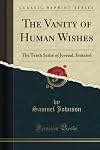
Vanity of Human Wishes: The Tenth Satire of Juvenal, Imitated by Samuel Johnson
by Samuel Johnson 
35 Members (3.79)
On This Page
Description
Excerpt from The Vanity of Human Wishes: The Tenth Satire of Juvenal, Imitated Remark each anxious Toil, each eager Strife, And watch the bufy Scenes of crouded Life 5 Then fay how Hope and Fear, Defire and Hate. About the Publisher Forgotten Books publishes hundreds of thousands of rare and classic books. Find more at www.forgottenbooks.com This book is a reproduction of an important historical work. Forgotten Books uses state-of-the-art technology to digitally reconstruct the work, show more preserving the original format whilst repairing imperfections present in the aged copy. In rare cases, an imperfection in the original, such as a blemish or missing page, may be replicated in our edition. We do, however, repair the vast majority of imperfections successfully; any imperfections that remain are intentionally left to preserve the state of such historical works. show lessTags
Recommendations

























Member Reviews
Members
- Recently Added By
Lists

How to Read a Book's Recommended Reading List
309 works; 10 members
Author Information

491+ Works 9,446 Members
Samuel Johnson was born in 1709, in Lichfield, England. The son of a bookseller, Johnson briefly attended Pembroke College, Oxford, taught school, worked for a printer, and opened a boarding academy with his wife's money before that failed. Moving to London in 1737, Johnson scratched out a living from writing. He regularly contributed articles and show more moral essays to journals, including the Gentleman's Magazine, the Adventurer, and the Idler, and became known for his poems and satires in imitation of Juvenal. Between 1750 and 1752, he produced the Rambler almost single-handedly. In 1755 Johnson published Dictionary of the English Language, which secured his place in contemporary literary circles. Johnson wrote Rasselas in a week in 1759, trying to earn money to visit his dying mother. He also wrote a widely-read edition of Shakespeare's plays, as well as Journey to the Western Isles of Scotland and Lives of the Poets. Johnson's writing was so thoughtful, powerful, and influential that he was considered a singular authority on all things literary. His stature attracted the attention of James Boswell, whose biography, Life of Johnson, provides much of what we know about its subject. Johnson died in 1784. (Bowker Author Biography) show less
Samuel Johnson has a Legacy Library. Legacy libraries are the personal libraries of famous readers, entered by LibraryThing members from the Legacy Libraries group.
Classifications
Statistics
- Members
- 35
- Popularity
- 836,989
- Rating
- (3.79)
- Languages
- English
- Media
- Paper
- ISBNs
- 9
- ASINs
- 1