On This Page
Description
In these early novellas SF Grand Master Jack Vance tells tales of fanaticism, interplanetary politics, intrigue and subterfuge, while displaying his trademark gifts for inventiveness, rich detail and colorful description.Son of the Tree - Joe, a young Earthman, finds himself stranded on Kyril, a planet of five billion peasants, two million Druids--and a great Tree. The Tree, worshiped by the Druids, towers twelve miles from root to ultimate bud, shouldering the clouds, wearing lightning like show more a tinsel wreath. Joe is swept up in a swirl of change, at the center of which is a potted plant - the Son of the Tree!The Houses of Iszm - masters of botany for 200,000 years, the Iszic have developed strains of living houses, semi-intelligent organic units which need no crude additions such as furniture, plumbing or décor, and can be grown for the price of seed -- the solution to the housing needs of a galaxy! The Iszic are protective of their lucrative monopoly, and when botanist Aile Farr of Earth arrives for a visit, he is under immediate suspicion of attempting to steal a female house. So begins a cat-and-mouse game between the graceful, unfailingly courteous Iszic, and a determined man of Earth. show lessTags
Recommendations


Member Reviews
Two fun, early Jack Vance novellas. Whilst neither shine against his very best work, they still have all his wry wit and unparalleled imagination for unique societies, planets and cultures. Both of these have botanic themes; Houses of the Iszm focusing on a culture that grows houses from custom plant pods and guards them from outworlders with unnatural zealotry, whilst Son of the Tree focuses on a druidic world worshipping a World Tree as the source of life and its attempts to spread the religion to its neighbours.
In typical Vance fashion, these are SF stories that blend genres - in this case they are capers, with one being more of a heist story and the other rich in political intrigue, both led by a typically put upon protaganist. show more Packing a lot into 110 pages each, there's not much difference between the two stories in terms of quality, but at a push I probably prefer Houses of Iszm overall, whilst Son of the Tree has the slightly better ending.
Poking fun at all things religious, nationalistic and capitalistic with equal fervour, these two stories rich with dastardly shenanigans, treachery, twists, comical self interested characters, wondrous worlds and the odd civilisation brought crumbling to its knees. It's hard not to love even the lesser Jack Vance novels and his books always provide me with plenty of entertainment - which is all that matters. show less
In typical Vance fashion, these are SF stories that blend genres - in this case they are capers, with one being more of a heist story and the other rich in political intrigue, both led by a typically put upon protaganist. show more Packing a lot into 110 pages each, there's not much difference between the two stories in terms of quality, but at a push I probably prefer Houses of Iszm overall, whilst Son of the Tree has the slightly better ending.
Poking fun at all things religious, nationalistic and capitalistic with equal fervour, these two stories rich with dastardly shenanigans, treachery, twists, comical self interested characters, wondrous worlds and the odd civilisation brought crumbling to its knees. It's hard not to love even the lesser Jack Vance novels and his books always provide me with plenty of entertainment - which is all that matters. show less
[in progress]
Son of the Tree: This early Vance from 1951 that lacks the colorful language of later works, with the exception of a few isolated paragraphs, but it does have his trademark sardonic dialog and cultural grace notes. There's a silly romantic subplot involving an old flame that is so peripheral it's not clear why it was included.
The Houses of Iszm: Most of this short novel from 1954 is more typical Vance, with a mostly passive protagonist exploring the culture of the Iszm where they grow trees that turn into houses, a limited few of which are available for sale elsewhere. The last portion though is atypical. First, after a mysterious set of attempted and achieved murders on a spaceship, we return to Earth, an uncommon locale show more for Vance. Second, once there, the plot and tone become much more like Philip K. Dick as the main character finds followed no matter where he goes, and where he goes, even though he attempts to pick randomly, always brings him ever closer to the very Dickianly named K. Penche.
I found it curious that Wollheim's preface to this 1964 Ace Double refers to Vance as "not too often a contributor to the science fiction field these days". Despite his forays into fantasy and mystery, to me Vance seemed always very much in SF.
Recommended for fans of Vance, despite the creaky plot mechanics creak and thin characters. show less
Son of the Tree: This early Vance from 1951 that lacks the colorful language of later works, with the exception of a few isolated paragraphs, but it does have his trademark sardonic dialog and cultural grace notes. There's a silly romantic subplot involving an old flame that is so peripheral it's not clear why it was included.
The Houses of Iszm: Most of this short novel from 1954 is more typical Vance, with a mostly passive protagonist exploring the culture of the Iszm where they grow trees that turn into houses, a limited few of which are available for sale elsewhere. The last portion though is atypical. First, after a mysterious set of attempted and achieved murders on a spaceship, we return to Earth, an uncommon locale show more for Vance. Second, once there, the plot and tone become much more like Philip K. Dick as the main character finds followed no matter where he goes, and where he goes, even though he attempts to pick randomly, always brings him ever closer to the very Dickianly named K. Penche.
I found it curious that Wollheim's preface to this 1964 Ace Double refers to Vance as "not too often a contributor to the science fiction field these days". Despite his forays into fantasy and mystery, to me Vance seemed always very much in SF.
Recommended for fans of Vance, despite the creaky plot mechanics creak and thin characters. show less
This is a very early story in the career of Jack Vance a respected mystery, fantasy and science fiction writer. Published in 1951 as a story in the magazine Thrilling Wonder Stories it was eventually published as part of an Ace Double novel in 1964. Vance had his science fiction hat on for this one as our hero Joe Smith is planet hopping in search of a rival in love. The story catches up with him on Kyril where a race of druids are in control; keepers of an enormous tree that they claim gives life to the planet and is fed by the work of an underclass. The druids are a proud testy race and Joe meets Hableyat a spy from the planet Mangtse who helps him deal with the druids in his quest to move onto the planet Ballenkarch. Meanwhile Joe show more has met and fallen in love with the druid princess Elfane who is on a government mission to Ballenkarh. Everyone ends up on the spaceship to Ballenkarch where politics, espionage and murder are acted out before the denouement on the planet.
It is all over in 110 pages but Vance proves that he can write a good story. The politics are breezily worked through, the plot progresses smoothly and I enjoyed the character sketches of Princess Elfane and Hableyat. There is not much time for world building, but the scenarios are well set. The story is not overcomplicated and as a science fiction adventure story it moves quickly through the gears and so 3 stars. show less
It is all over in 110 pages but Vance proves that he can write a good story. The politics are breezily worked through, the plot progresses smoothly and I enjoyed the character sketches of Princess Elfane and Hableyat. There is not much time for world building, but the scenarios are well set. The story is not overcomplicated and as a science fiction adventure story it moves quickly through the gears and so 3 stars. show less
Son of the Tree is from 1951, pure vintage SF. Joe Smith of planet Earth is on a two-year quest, the nature of which is not revealed until quite late in the story. So he's working his way from planet to planet, and now finds himself on Kyril, where 2 million of the Druid class keep 5 billion of the Laity in servitude through worship of the Tree. This novelette is a zippy 110 pages, so I won't try to explain any more, except to say that attitudes several thousands of years after humankind's settlement of galaxies are, in fact, remarkably similar to attitudes in the USA in 1951. Nonetheless engaging depictions of imagined worlds.
In the Houses of Iszm, an Earther botanist, Aile Farr, visits Iszm, a planet where houses grow as trees. show more Jealous of their cash crop, the Iszics keep a close watch on Farr. After an unpleasant incident involving a deep tree root holding cell, and upon embarking on his return trip to Earth, Farr learns that someone is trying to kill him. Descriptions of future Los Angeles are amusing. Like the paired novelette Son of the Tree, one could call this arboreal sci-fi. show less
In the Houses of Iszm, an Earther botanist, Aile Farr, visits Iszm, a planet where houses grow as trees. show more Jealous of their cash crop, the Iszics keep a close watch on Farr. After an unpleasant incident involving a deep tree root holding cell, and upon embarking on his return trip to Earth, Farr learns that someone is trying to kill him. Descriptions of future Los Angeles are amusing. Like the paired novelette Son of the Tree, one could call this arboreal sci-fi. show less
Ratings
Members
- Recently Added By
Author Information

373+ Works 34,844 Members
John Holbrook Vance (August 28, 1916 - May 26, 2013) was an American mystery, fantasy and science fiction writer. Most of his work was published under the name Jack Vance. He also wrote 11 mystery novels as John Holbrook Vance and three as Ellery Queen, and once each used pseudonyms Alan Wade, Peter Held, John van See, and Jay Kavanse. Vance won show more the World Fantasy Award for Life Achievement in 1984. The Science Fiction Hall of Fame inducted him in 2001. Among his awards for particular works were: Hugo Awards, in 1963 for The Dragon Masters, in 1967 for The Last Castle, and in 2010 for his memoir This is Me, Jack Vance!; a Nebula Award in 1966, also for The Last Castle; the Jupiter Award in 1975; the World Fantasy Award in 1990 for Lyonesse: Madouc. He also won an Edgar (the mystery equivalent of the Nebula) for the best first mystery novel in 1961 for The Man in the Cage. He died at his home in Oakland, California, on May 26, 2013, aged 96. (Bowker Author Biography) show less
Series

Belongs to Publisher Series
Work Relationships
Contains
Common Knowledge
- Canonical title
- Son of the Tree / The Houses of Iszm
- Original title
- Son of the Tree / The Houses of Iszm
- Disambiguation notice
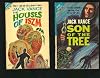
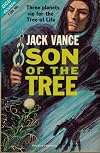
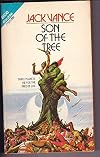
- This is an Ace Double edition that contains Son of the Tree and The Houses of Iszm. Please do not combine it with either individual work. It was published as Ace Double F-265 and later as Ace Double 77525.
Classifications
Statistics
- Members
- 176
- Popularity
- 185,917
- Reviews
- 4
- Rating
- (3.80)
- Languages
- Dutch, English, Russian
- Media
- Paper, Ebook
- ISBNs
- 3
- ASINs
- 13