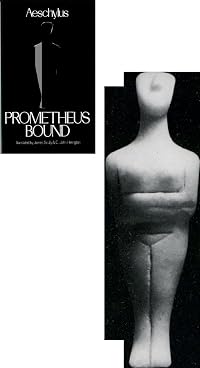
Prometheus Bound
by Aeschylus
On This Page
Description
When a jealous Zeus discovers that the compassionate Titan, Prometheus, has introduced the gift of fire to liberate mere mortals from oppression and servitude, he has Prometheus bound to a rocky prison in the Scythian desert, where the god discloses the reason for his punishment - And in one brief sentence learn the whole at once. All arts among the human race are from Prometheus. Prometheus Bound is one of only seven surviving plays by the prolific Athenian playwright, Aeschylus. Born into show more a noble family in 525 BC, Aeschylus is credited with having introduced dialogue into the Greek drama, and indeed is a father of modern theater. show lessTags
Recommendations











Member Recommendations

CGlanovsky Reading Aeschylus's play through the lens of Camus's interpretation of the absurd hero is interesting.
Member Reviews
Didn't read it, instead I watched the performance by CasaItalianaNYU (on yt) which though lacking in theatrics and costumes more than makes up for with the sheer passion present in the dialogue delivery.
This is the link: https://youtu.be/VTs72K6z8LM?feature=shared
On to the book itself; I saw an adaptation of this story by James Baldwin's collection of greek myths for children. Additionally, I was also interested in reading Percy Shelley's Prometheus Unbound- but before that, we must see how he got.. bound.
After reading this, I can see why Christianity 'conquered' the Greek polytheistic gods. Too voilent, too cruel without rhyme or reason but sheer fear of losing power. Virtue wasn't present from a desire to get close to enlightenment show more but from fear. I can see why they would deem pagans as barbarous. And sure you can make the argument that it is a tragedy- it is meant to have a character who doesn't learn wisdom, it is meant to be barbaric and foolish but I think it captures the 'collective consciousness' of the Greco-Romans.
I think this problem of Fear, some sort of M.A.D. has stayed with the West even after the takeover of Christianity in that they still continue to chase power, to chase 'more'. I won't do a cultural analysis here but I think it's an underrated piece if you actually wish to do so. show less
This is the link: https://youtu.be/VTs72K6z8LM?feature=shared
On to the book itself; I saw an adaptation of this story by James Baldwin's collection of greek myths for children. Additionally, I was also interested in reading Percy Shelley's Prometheus Unbound- but before that, we must see how he got.. bound.
After reading this, I can see why Christianity 'conquered' the Greek polytheistic gods. Too voilent, too cruel without rhyme or reason but sheer fear of losing power. Virtue wasn't present from a desire to get close to enlightenment show more but from fear. I can see why they would deem pagans as barbarous. And sure you can make the argument that it is a tragedy- it is meant to have a character who doesn't learn wisdom, it is meant to be barbaric and foolish but I think it captures the 'collective consciousness' of the Greco-Romans.
I think this problem of Fear, some sort of M.A.D. has stayed with the West even after the takeover of Christianity in that they still continue to chase power, to chase 'more'. I won't do a cultural analysis here but I think it's an underrated piece if you actually wish to do so. show less
Prometeu Prisioneiro, de Ésquilo (c. 525-456 a.C.), é uma peça única dentre as tragédias gregas, e uma das mais marcantes da história da literatura, tendo influenciado escritores e filósofos como Goethe, Marx, Nietzsche, Freud, Brecht, Camus e muitos outros. Integrante de uma tetralogia perdida, escrita provavelmente no final da vida de seu autor, ela se passa nos primórdios da civilização, após a Titanomaquia, e traz, de forma inédita, seres divinos como protagonistas.
A história tem início quando Força, Poder e Hefesto, por ordem de Zeus, acorrentam Prometeu a uma montanha nos confins do planeta. Preso e prestes a ser castigado, o Titã é visitado pelo coro das Oceânides, por Oceano, por Io e por Hermes, que tentam show more demovê-lo de seu enfrentamento com o novo chefe do Olimpo.
Verdadeiro libelo contra a tirania, mas também um alerta sobre os excessos do homem contra a natureza, a peça é apresentada aqui na esmerada tradução de Trajano Vieira. Esta edição bilíngue inclui ainda um posfácio do tradutor, excertos da crítica e um ensaio do classicista inglês C. J. Herington, que aborda os múltiplos aspectos desta obra ímpar do teatro grego. show less
A história tem início quando Força, Poder e Hefesto, por ordem de Zeus, acorrentam Prometeu a uma montanha nos confins do planeta. Preso e prestes a ser castigado, o Titã é visitado pelo coro das Oceânides, por Oceano, por Io e por Hermes, que tentam show more demovê-lo de seu enfrentamento com o novo chefe do Olimpo.
Verdadeiro libelo contra a tirania, mas também um alerta sobre os excessos do homem contra a natureza, a peça é apresentada aqui na esmerada tradução de Trajano Vieira. Esta edição bilíngue inclui ainda um posfácio do tradutor, excertos da crítica e um ensaio do classicista inglês C. J. Herington, que aborda os múltiplos aspectos desta obra ímpar do teatro grego. show less
Prometheus bound is Aeschylus' play about Prometheus, the minor Greek deity who stole fire from the gods and gave it to humankind. For this act of rebellion, he is punished by Zeus. He is chained to a rock and forced to endure a crow eating his internal organs every day. By night he regenerates, never to die and never to escape the crow. He only gets freed by Herakles (Hercules), who is strong enough to break the chains binding Prometheus.
As a classics major, I encounter a lot of ancient literature. And much of that literature exists in bland public-domain translations from the late 1800s. Even worse, some translators render beautiful ancient poetry into prose. I avoid as much of that stuff as possible.
This translation is just the show more opposite. The product of a collaboration between Scully (a poet) and Herington (a classicist), this rendering is a very beautiful even if a bit loose. See this speech by the chorus:
"May Zeus never turn
His world
wide
power against my mind
may I never
hesitate
to approach the gods
with holy feasts
of blood drenched bulls
where Father Ocean, our father, streams and streams
may I never
say a sinful word
may this be ever
engraved in my mind
not melt
as words on wax
Nothing is sweeter
than life
lived
as long as this may be
always to hope
and feast, keep
the heart while it throbs
alive, lit up
with happiness
O but my blood runs cold, I'm cold, seeing you
raked over with
ten thousand tortures
you won't cower for Zeus,
you've a mind of your own
and you
honor humans
too much! Prometheus!"
Definitely not your standard translation!
I really like how Aeschylus brings out some of the nuances in this story. We're not sure whether or not Prometheus is telling the truth about his motives - he claims he wanted to help humans. We are also not sure whether or not Zeus acted justly or unjustly in punishing Prometheus. Was he being petty and vindictive, or just setting an example for those rebelling against his authority?
I like this edition, because it also has forewards from the translators and an appendix with fragments from the other two plays in the trilogy. (Greek plays entered in the Dionysian theater-competitions were always in a trilogy, which need not be one storyline. "Prometheus Bound" is the first of this trilogy, and the only one we still have. The second and third plays, "Prometheus Unbound" and "Prometheus Firebearer," exist only in scattered quotations and paraphrases from other authors.)
I'll leave with this statement from the translator:
"This is one play that seems to have been written with the head, hands, and heart: bunched, impacted, in the solar plexus. Ideally it would not be read or seen, but undergone." (25) show less
As a classics major, I encounter a lot of ancient literature. And much of that literature exists in bland public-domain translations from the late 1800s. Even worse, some translators render beautiful ancient poetry into prose. I avoid as much of that stuff as possible.
This translation is just the show more opposite. The product of a collaboration between Scully (a poet) and Herington (a classicist), this rendering is a very beautiful even if a bit loose. See this speech by the chorus:
"May Zeus never turn
His world
wide
power against my mind
may I never
hesitate
to approach the gods
with holy feasts
of blood drenched bulls
where Father Ocean, our father, streams and streams
may I never
say a sinful word
may this be ever
engraved in my mind
not melt
as words on wax
Nothing is sweeter
than life
lived
as long as this may be
always to hope
and feast, keep
the heart while it throbs
alive, lit up
with happiness
O but my blood runs cold, I'm cold, seeing you
raked over with
ten thousand tortures
you won't cower for Zeus,
you've a mind of your own
and you
honor humans
too much! Prometheus!"
Definitely not your standard translation!
I really like how Aeschylus brings out some of the nuances in this story. We're not sure whether or not Prometheus is telling the truth about his motives - he claims he wanted to help humans. We are also not sure whether or not Zeus acted justly or unjustly in punishing Prometheus. Was he being petty and vindictive, or just setting an example for those rebelling against his authority?
I like this edition, because it also has forewards from the translators and an appendix with fragments from the other two plays in the trilogy. (Greek plays entered in the Dionysian theater-competitions were always in a trilogy, which need not be one storyline. "Prometheus Bound" is the first of this trilogy, and the only one we still have. The second and third plays, "Prometheus Unbound" and "Prometheus Firebearer," exist only in scattered quotations and paraphrases from other authors.)
I'll leave with this statement from the translator:
"This is one play that seems to have been written with the head, hands, and heart: bunched, impacted, in the solar plexus. Ideally it would not be read or seen, but undergone." (25) show less
41. Prometheus Bound by Aeschylus, translated by Paul Roche
1st performed: c ~456 bce ?? (alternately 430 bce, authored by Aeschylus' son, Euphorion)
format: 128 page Paperback - 1964 Mentor Classic
acquired: unknown. It comes from my childhood home. Perhaps one of my parents used it in high school or college.
read: July 2-3
rating: 4
I read this recently with a different translator. That review includes a brief summary. See HERE.
As far as I can tell, Paul Roche is a pretty obscure translator. I thought he created something really nice, keeping the poetry and recreating the rhythms. It's not as clean as David Grene, Robert Fitzgerald etc, and it's not as poetic as Philip Vellacott, but it is somewhere between these two. It's easily show more readable, but also provides noticeable poetic feel. Roche includes an introduction and various thoughts afterward in the format of questions and answers. I found the introduction particularly interesting as he talks about his struggle to translate this. He had translated about half the play unhappily. He studied the translation of Elizabeth Barrett Browning, then went back to the Greek and noticed how clean the line endings were. Based on this, he re-worked the translation over again, trying to focus on clean line endings, with the rhyme, alliteration, assonance etc similar to the original. He even diagrams a few examples. No easy thing this, and very interesting to read about in brief, as he has it.
As far as re-reading the play itself, I'm struck first by Prometheus's character. Pinned to a rock the entire play, literally just hanging there, everything hinges on what he says and how he says it. He is an elegant stoic, in the modern sense, never losing his composure regardless of the pain and the endlessness of it all. He also makes Zeus, who condemned him, out to be an absolute tyrant, in the sense of, say, a Persian emperor. Zeus can do as he pleases and command endless torture for any frivolous reason, and there is no one even to complain to. It's a clear political point. (Critics have felt the negative light he writes of Zeus is inconsistent with his other works. Some have tried to give the play to other authors.)
2016
https://www.librarything.com/topic/220674#5642886 show less
1st performed: c ~456 bce ?? (alternately 430 bce, authored by Aeschylus' son, Euphorion)
format: 128 page Paperback - 1964 Mentor Classic
acquired: unknown. It comes from my childhood home. Perhaps one of my parents used it in high school or college.
read: July 2-3
rating: 4
I read this recently with a different translator. That review includes a brief summary. See HERE.
As far as I can tell, Paul Roche is a pretty obscure translator. I thought he created something really nice, keeping the poetry and recreating the rhythms. It's not as clean as David Grene, Robert Fitzgerald etc, and it's not as poetic as Philip Vellacott, but it is somewhere between these two. It's easily show more readable, but also provides noticeable poetic feel. Roche includes an introduction and various thoughts afterward in the format of questions and answers. I found the introduction particularly interesting as he talks about his struggle to translate this. He had translated about half the play unhappily. He studied the translation of Elizabeth Barrett Browning, then went back to the Greek and noticed how clean the line endings were. Based on this, he re-worked the translation over again, trying to focus on clean line endings, with the rhyme, alliteration, assonance etc similar to the original. He even diagrams a few examples. No easy thing this, and very interesting to read about in brief, as he has it.
As far as re-reading the play itself, I'm struck first by Prometheus's character. Pinned to a rock the entire play, literally just hanging there, everything hinges on what he says and how he says it. He is an elegant stoic, in the modern sense, never losing his composure regardless of the pain and the endlessness of it all. He also makes Zeus, who condemned him, out to be an absolute tyrant, in the sense of, say, a Persian emperor. Zeus can do as he pleases and command endless torture for any frivolous reason, and there is no one even to complain to. It's a clear political point. (Critics have felt the negative light he writes of Zeus is inconsistent with his other works. Some have tried to give the play to other authors.)
2016
https://www.librarything.com/topic/220674#5642886 show less
I can see Prometheus Bound serving as an excellent first play in a trilogy, but unfortunately any sequels to this work have been lost to the sands of time. As a standalone work Prometheus Bound has some fascinating characteristics, but spends so much time on long monologues of exposition and establishing conflicts that never come to fruition that it doesn't succeed in isolation.
As the title would suggest the titan Prometheus takes center stage in this play, the work opening after he has already disobeyed Zeus and given fire (and with it the arts and sciences) to humanity. Prometheus did this knowing full well that he would be punished for it, tortured in fact, but he accepts this fate in order to save mankind. When he is being chained show more and nailed to the mountainside it's impossible not to note the parallels between the figure of Prometheus and that of Jesus Christ, but while the suffering to redeem others is the same, no third day ascendance is at hand for Prometheus. Likewise, though Prometheus has taken action knowing what fate would result, he does not accept such punishment as did Christ. Prometheus is not going quietly into the night, nor is he a humble figure, but instead he continues to struggle against the injustice that has been done to him and refuses to bow down to the perpetrator of that injustice, despite acknowledging the superior power of Zeus. While Christ acted in accordance with God's wishes and suffered at the hands of those he sought to redeem, Prometheus went against Zeus for the sake of mankind, and suffers at the hands of Zeus because of it. Prometheus is, in short, a fascinating character, the very embodiment of the idea that tyranny should never be bowed to, but always struggled against. He is prideful, to be sure, but is being humble the correct response to injustice?
The other focus of the play is the newly enthroned Zeus, a character who never appears within the text of the play but who nevertheless influences every part of it. Through Prometheus, the chorus, Io, and Hermes the messenger, Aeschylus paints a dictatorial Zeus that has already begun to abuse his power. Zeus lords over both gods and man, taking what he wants and threatening to crush any opposition. He is a powerful God, but far from just, the only character who seems to conflate the two being Hermes his messenger. Of Zeus' newfound power Prometheus states that there "is a sickness, it seems, that goes along with dictatorship-inability to trust one's friends." A lesson still worth knowing now, over 2,400 years after the play was written. Like Prometheus is a fascinating character for resisting tyranny, Zeus is a fascinating character to look to for the descent into tyranny and the corrupting influence of power. He is not just powerful, but the ultimate power in the universe, and while there is the well known adage that "absolute power corrupts absolutely," Zeus' position at the head of the pantheon means that he will have to be dealt with before Prometheus is to be freed, and force is not an option.
In a scant forty pages Aeschylus establishes two fascinating characters (one of which doesn't even appear in person) and sets up a fascinating dynamic between the two. Unfortunately, that is all he does with this piece. The next two plays, if they existed, might have brought to fruition all of the potential this play contains, and if that had occurred then the Prometheus Cycle would have eclipsed the Oresteia and become a centerpiece of classical study. As it stands, however, all we have left is this introductory piece, with all the threads left dangling. We have lost whatever other parts of the cycle existed, and are left to wonder what might have been. show less
As the title would suggest the titan Prometheus takes center stage in this play, the work opening after he has already disobeyed Zeus and given fire (and with it the arts and sciences) to humanity. Prometheus did this knowing full well that he would be punished for it, tortured in fact, but he accepts this fate in order to save mankind. When he is being chained show more and nailed to the mountainside it's impossible not to note the parallels between the figure of Prometheus and that of Jesus Christ, but while the suffering to redeem others is the same, no third day ascendance is at hand for Prometheus. Likewise, though Prometheus has taken action knowing what fate would result, he does not accept such punishment as did Christ. Prometheus is not going quietly into the night, nor is he a humble figure, but instead he continues to struggle against the injustice that has been done to him and refuses to bow down to the perpetrator of that injustice, despite acknowledging the superior power of Zeus. While Christ acted in accordance with God's wishes and suffered at the hands of those he sought to redeem, Prometheus went against Zeus for the sake of mankind, and suffers at the hands of Zeus because of it. Prometheus is, in short, a fascinating character, the very embodiment of the idea that tyranny should never be bowed to, but always struggled against. He is prideful, to be sure, but is being humble the correct response to injustice?
The other focus of the play is the newly enthroned Zeus, a character who never appears within the text of the play but who nevertheless influences every part of it. Through Prometheus, the chorus, Io, and Hermes the messenger, Aeschylus paints a dictatorial Zeus that has already begun to abuse his power. Zeus lords over both gods and man, taking what he wants and threatening to crush any opposition. He is a powerful God, but far from just, the only character who seems to conflate the two being Hermes his messenger. Of Zeus' newfound power Prometheus states that there "is a sickness, it seems, that goes along with dictatorship-inability to trust one's friends." A lesson still worth knowing now, over 2,400 years after the play was written. Like Prometheus is a fascinating character for resisting tyranny, Zeus is a fascinating character to look to for the descent into tyranny and the corrupting influence of power. He is not just powerful, but the ultimate power in the universe, and while there is the well known adage that "absolute power corrupts absolutely," Zeus' position at the head of the pantheon means that he will have to be dealt with before Prometheus is to be freed, and force is not an option.
In a scant forty pages Aeschylus establishes two fascinating characters (one of which doesn't even appear in person) and sets up a fascinating dynamic between the two. Unfortunately, that is all he does with this piece. The next two plays, if they existed, might have brought to fruition all of the potential this play contains, and if that had occurred then the Prometheus Cycle would have eclipsed the Oresteia and become a centerpiece of classical study. As it stands, however, all we have left is this introductory piece, with all the threads left dangling. We have lost whatever other parts of the cycle existed, and are left to wonder what might have been. show less
This is probably the best and most classic telling of Prometheus, from his giving fire to man from the noblest of reasons to how horribly and seemingly unjustly that Zeus punishes him.
All arts and tools come from Prometheus, after all, and he should always be considered the greatest of all friends of mankind even though he is a titan.
However, he's also the one that pushed us to improve our intellect in the same way he did for himself, and in doing so, he brought harm upon himself. See a trend? We created war with the smelting of ore into weapons, after all. It's not all about cooking and keeping warm or creating medicine.
Was Zeus right? Was it right to keep an immortal chained and have a bird eat his liver for all eternity? Or was this show more just the graphic depiction of what we will always do to ourselves?
I wish I could read the other two parts of this play. I think that would be awesome. :) But alas. What we've got is still pretty raw and emotional and delightfully slanted. After all, we're meant to sympathize entirely with Prometheus throughout the play.
It reminds me an awful lot of Paradise Lost. :) Good motivations and charismatic leaders leading to roads paved to hell. :) show less
All arts and tools come from Prometheus, after all, and he should always be considered the greatest of all friends of mankind even though he is a titan.
However, he's also the one that pushed us to improve our intellect in the same way he did for himself, and in doing so, he brought harm upon himself. See a trend? We created war with the smelting of ore into weapons, after all. It's not all about cooking and keeping warm or creating medicine.
Was Zeus right? Was it right to keep an immortal chained and have a bird eat his liver for all eternity? Or was this show more just the graphic depiction of what we will always do to ourselves?
I wish I could read the other two parts of this play. I think that would be awesome. :) But alas. What we've got is still pretty raw and emotional and delightfully slanted. After all, we're meant to sympathize entirely with Prometheus throughout the play.
It reminds me an awful lot of Paradise Lost. :) Good motivations and charismatic leaders leading to roads paved to hell. :) show less
A somewhat unusual Aeschyles play, and probably not by his hand. Experts attribute it to his son or grandson, ca. 450 BCE. I noticed that the style is less archaic than that of Aeschyles himself, with sharper dialogue and much shorter choral pieces; the rather erratic structure (with a long digression to the story of Io), some downright weak passages, and the fact that this is the only play by Aeschyles (at least of those handed down to us) in which only gods appear, betray a somewhat different hand.
Whoever the author was, he certainly focused on the well-known story of Prometheus (established by Hesiod more than two centuries earlier), the Titan god who stood up for humans and had to pay dearly for it. This tragedy does not really show more present the classical story (although it does feature several times), but zooms in primarily on Prometheus's resistance to the omnipotence of Zeus. There is an interesting historical aspect to that, a critique of tyranny, which I highlight in my review on my History account on Goodreads: https://www.goodreads.com/review/show/8511094896.
Disclaimer: I'm reading and reviewing all classic ancient Greek plays, more or less in chronological order. But I'm not giving a rating. How could I, given their age? I'll make an exception only when a play is exceptional and still strikes an emotional and/or intellectual chord. show less
Whoever the author was, he certainly focused on the well-known story of Prometheus (established by Hesiod more than two centuries earlier), the Titan god who stood up for humans and had to pay dearly for it. This tragedy does not really show more present the classical story (although it does feature several times), but zooms in primarily on Prometheus's resistance to the omnipotence of Zeus. There is an interesting historical aspect to that, a critique of tyranny, which I highlight in my review on my History account on Goodreads: https://www.goodreads.com/review/show/8511094896.
Disclaimer: I'm reading and reviewing all classic ancient Greek plays, more or less in chronological order. But I'm not giving a rating. How could I, given their age? I'll make an exception only when a play is exceptional and still strikes an emotional and/or intellectual chord. show less
Members
- Recently Added By
Lists

Favourite Books
1,819 works; 316 members

Great Books Favorites
71 works; 6 members

100 Books to Read in a Lifetime (That Are Older Than 200 Years)
415 works; 173 members

Favourite Greek Books
97 works; 1 member
Truly old classics
63 works; 6 members

Western World's Greatest Books - Project Gutenberg
295 works; 15 members

Harold Bloom - The Western Canon: A. The Theocratic Age
97 works; 13 members

The Road to Freedom (Will Durant's 100 Best Books for an Education)
100 works; 8 members

A Reading List
100 works; 3 members

Greatest Books, allegedly
484 works; 9 members

Recommended Reading : 600 Classics Reviewed, Editors of Salem Press, 2015
634 works; 6 members

My Play Collection
769 works; 3 members
Author Information

Aeschylus was born at Eleusis of a noble family. He fought at the Battle of Marathon (490 b.c.), where a small Greek band heroically defeated the invading Persians. At the time of his death in Sicily, Athens was in its golden age. In all of his extant works, his intense love of Greece and Athens finds expression. Of the nearly 90 plays attributed show more to him, only 7 survive. These are The Persians (produced in 472 b.c.), Seven against Thebes (467 b.c.), The Oresteia (458 b.c.)---which includes Agamemnon, Libation Bearers, and Eumenides (or Furies) --- Suppliants (463 b.c.), and Prometheus Bound (c.460 b.c.). Six of the seven present mythological stories. The ornate language creates a mood of tragedy and reinforces the already stylized character of the Greek theater. Aeschylus called his prodigious output "dry scraps from Homer's banquet," because his plots and solemn language are derived from the epic poet. But a more accurate summation of Aeschylus would emphasize his grandeur of mind and spirit and the tragic dignity of his language. Because of his patriotism and belief in divine providence, there is a profound moral order to his plays. Characters such as Clytemnestra, Orestes, and Prometheus personify a great passion or principle. As individuals they conflict with divine will, but, ultimately, justice prevails. Aeschylus's introduction of the second actor made real theater possible, because the two could address each other and act several roles. His successors imitated his costumes, dances, spectacular effects, long descriptions, choral refrains, invocations, and dialogue. Swinburne's (see Vol. 1) enthusiasm for The Oresteia sums up all praises of Aeschylus; he called it simply "the greatest achievement of the human mind." Because of his great achievements, Aeschylus might be considered the "father of tragedy." (Bowker Author Biography) show less
Some Editions
Awards and Honors
Series
Belongs to Publisher Series
L'esparver clàssic (41)
Work Relationships
Is contained in
Great Books of The Western World: Aeschylus, Sophocles, Euripides, Aristophanes by Robert Maynard Hutchins (indirect)
Aeschylus (In Two Volumes). Volumes I and II [1, 2] (Loeb Classical Library) by Aeschylus (indirect)
World Drama, Volume 1: Ancient Greece, Rome, India, China, Japan, Medieval Europe, and England by Barrett H. Clark
Has the adaptation
Inspired
Has as a student's study guide
Common Knowledge
- Canonical title
- Prometheus Bound
- Original publication date
- 480 BCE (ca) (ca)
- People/Characters
- Cratus; Bia; Hephaestus; Prometheus; Oceanus; Io (show all 7); Hermes
- Important places
- Argos, Greece
- Dedication
- for KIUMON FRIAR
homage with the great tradition
(Let any greeks here enter in by lot
according to the law,
and I shall prophesy as the god leads on.)
-The Eumenides 31-33
Slices from Homer's migh... (show all)ty dinners
(Aeschylus, of his own works: Athenaeus 8.347e) - First words
- This is the world's limit that we have come to; this is the Scythian country, an untrodden desolation. - (tr. Grene, 1942)
We've come to the end, then--the world's end:
This Scythian tract, a desert without men.,
[Tr. Paul Roche, 1964] - Last words
- (Click to show. Warning: May contain spoilers.)O Holy mother mine,/ O Sky that circling brings the light to all,/ you see me, how I suffer, how unjustly. - (tr. Grene, 1942)
(Click to show. Warning: May contain spoilers.)O Mother, holy Mother, the Air,
Spinning us the light we share,
Watch how I wickedly suffer!
[Amid a universal bombardment of thunder and lightning Prometheus together with the daughters of Oceanus--the Chorus--disappear]
[Tr. Paul Roche, 1964] - Original language
- Ancient Greek
- Canonical DDC/MDS
- 882.011
- Disambiguation notice
- This is for translated versions of Prometheus Bound, not the original greek.
Classifications
- Genres
- Fiction and Literature, Poetry
- DDC/MDS
- 882.011 — Literature & rhetoric Classical & modern Greek literatures Classical Greek dramatic poetry and drama standard subdivisions; collections; history, description, critical appraisal; Specific periods Ancient period to ca. 499 Aeschylus
- LCC
- PA3827 .P8 .S3 — Language and Literature Greek language and literature. Latin language and literature Greek literature Individual authors Aeschylus
- BISAC
Statistics
- Members
- 1,638
- Popularity
- 13,783
- Reviews
- 28
- Rating
- (3.88)
- Languages
- 16 — Catalan, Czech, Dutch, English, French, German, Greek (Ancient), Greek, Italian, Latin, Norwegian (Bokmål), Polish, Portuguese, Russian, Spanish, Swedish
- Media
- Paper, Audiobook, Ebook
- ISBNs
- 124
- UPCs
- 1
- ASINs
- 47