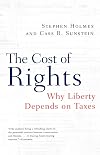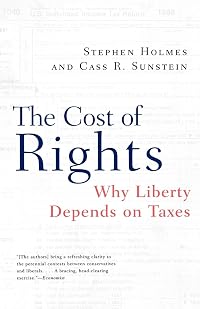
The Cost of Rights: Why Liberty Depends on Taxes
by Stephen Holmes, Cass R. Sunstein
On This Page
Description
All legally enforceable rights cost money. A practical, commonsense notion? Yes, but one ignored by almost everyone, from libertarian ideologues to Supreme Court justices to human rights advocates. The simple insight that rights are expensive reminds us that freedom is not violated by a government that taxes and spends, but requires it - and requires a citizenry vigilant about how money is allocated. Laying bare the folly of some of our most cherished myths about rights, this groundbreaking show more tract will permanently change the terms of our most critical and contentious political debates. show lessTags
Recommendations













Member Reviews
This is a book that I thought was a response to the widespread idea in the contemporary United States that taxation is a bad thing that restricts liberty. While it is in some ways that book, it comes at from a different angle presenting the legal and philosophical case that rights actually have a fiscal cost, and therefore taxes are necessary to protect them. The book is a bit challenging as it has some legalese, but overall the authors do a good job of defining the issues and presenting their case for taxation.
Favorite Passages:
Favorite Passages:
"American liberalism, like its counterparts elsewhere in the world is based on the reasonable premise that public investment is richly repaid, not least of all because reliably enforced property rights helpshow more
increase social wealth and therefore, among other benefits, swell the tax base upon which government can draw to protect other kinds of rights. But the strategic wisdom of an initial investment does not undo the fact that it is an investment."show less
"Many political conservatives, but not they alone, urge government to 'get out of the marketplace.' For their part, some liberals counter that government quite legitimately interferes, or 'steps into,' the market wherever disadvantaged Americans are at risk. But this familiar debate is built on sand. No sharp line can be drawn between markets and government: the two entities have no existence detached from one another. Markets do no create prosperity beyond the 'protective perimeter' of the law, they function well only with reliable legislative and judicial assistance."
"Individual freedom, however defined, cannot mean freedom from all forms of dependency. No human actor can single-handedly create all the preconditions for his own action. A free citizen is especially dependent... Liberty, rightly conceived, does not require a lack of dependence on government; on the contrary, affirmative government provides the preconditions for liberty. The Bill of Rights is a do-it-yourself kit that citizens can obtain only at tax-payer-funded outlets."
"The most common and persuasive criticism of the regulatory-welfare state concerns incentives to antisocial behavior and other undesirable side effects. But 'dependency' in and of itself should not be considered one of them. There are different kinds of dependency, and not all of them are bad. Although police and fire protection definitely make citizens dependent on 'public assistance,' such paternalistic support also increase the willingness of private individuals to embellish and add to their holdings. Publicly funded education, when operating well, has the same effect. It, too, is a form of state help designed to foster self-help. The question is not how to eliminate state intervention, but how to design welfare programs to enhance autonomy and initiative."
Ratings
Members
- Recently Added By
Lists

LT picks: Blue Books
197 works; 44 members
Author Information
7+ Works 303 Members

89+ Works 10,308 Members
Cass R. Sunstein is a law professor at Harvard Law School and is the most cited law professor in the United States. (Bowker Author Biography)
Classifications
- Genres
- Politics and Government, Nonfiction, Economics, General Nonfiction, Philosophy
- DDC/MDS
- 323.0973 — Society, government, & culture Political science Civil Rights & Liberties/ Human Rights Civil Rights Biography And History North America United States
- LCC
- JC599 .U5 .H55 — Political Science Political theory Political theory. The state. Theories of the state Purpose, functions, and relations of the state
- BISAC
Statistics
- Members
- 80
- Popularity
- 398,299
- Reviews
- 2
- Rating
- (3.86)
- Languages
- English, Italian, Spanish
- Media
- Paper, Ebook
- ISBNs
- 5
- ASINs
- 1