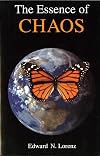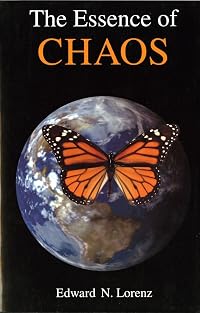
The Essence of Chaos
by Edward N. Lorenz
On This Page
Description
Chaos surrounds us. Seemingly random events -- the flapping of a flag, a storm-driven wave striking the shore, a pinball's path -- often appear to have no order, no rational pattern. Explicating the theory of chaos and the consequences of its principal findings -- that actual, precise rules may govern such apparently random behavior -- has been a major part of the work of Edward N. Lorenz. In The Essence of Chaos, Lorenz presents to the general reader the features of this ?new science,? with show more its far-reaching implications for much of modern life, from weather prediction to philosophy, and he describes its considerable impact on emerging scientific fields. Unlike the phenomena dealt with in relativity theory and quantum mechanics, systems that are now described as ?chaotic? can be observed without telescopes or microscopes. They range from the simplest happenings, such as the falling of a leaf, to the most complex processes, like the fluctuations of climate. Each process that qualifies, however, has certain quantifiable characteristics: how it unfolds depends very sensitively upon its present state, so that, even though it is not random, it seems to be. Lorenz uses examples from everyday life, and simple calculations, to show how the essential nature of chaotic systems can be understood. In order to expedite this task, he has constructed a mathematical model of a board sliding down a ski slope as his primary illustrative example. With this model as his base, he explains various chaotic phenomena, including some associated concepts such as strange attractors and bifurcations. As a meteorologist, Lorenz initially became interested in the field of chaos because of its implications for weather forecasting. In a chapter ranging through the history of weather prediction and meteorology to a brief picture of our current understanding of climate, he introduces many of the researchers who conceived the experiments and theories, and he describes his own initial encounter with chaos. A further discussion invites readers to make their own chaos. Still others debate the nature of randomness and its relationship to chaotic systems, and describe three related fields of scientific thought: nonlinearity, complexity, and fractality. Appendixes present the first publication of Lorenz's seminal paper ?Does the Flap of a Butterfly's Wing in Brazil Set Off a Tornado in Texas?; the mathematical equations from which the copious illustrations were derived; and a glossary. show lessTags
Recommendations








Member Reviews
As a book for people with advanced geometry experience or a BA in mathematics, this would be a great intro read for Chaos studies. Lorenz is a recognized name in this subject, and he certainly helped advance exploration into dynamic systems/chaos, as theory and in application to various fields. As a book for the general public this book is a bit less successful. There are a few paragraphs where it seems Lorenz was trying to simplify his writing for the general reader, but even then, the writing style remains more similar to a graduate-level math textbook. Even readers who have sufficient background to understand all the jargon, this book may not be a fun read, since it would still probably feel like homework-type assigned reading. show more Still, chaos is a cool topic, enough to make this book worth trying. I'd still rather be reading Gleick's Chaos, or a more modern book along those lines, for chaos-themed pleasure reading. show less
This is an interesting book about chaos that presents a great background to the topic and interesting personal anecdotes by the author. I wish I'd read it back in college when I was more immersed in math and physics. I had a harder time understanding the book than I'd like to admit! (I was also reading this piecemeal on work breaks, on buses, on trains - probably not an ideal setting either.)
(See Kellert.) A popular-style intro by one of the subject's pioneers.
Ratings
Members
- Recently Added By
Lists

Books to Read
95 works; 2 members
Author Information

4+ Works 261 Members
Awards and Honors
Awards
Series
Belongs to Publisher Series
Common Knowledge
- Canonical title
- The Essence of Chaos
- Original title
- The Essence of Chaos
- Original publication date
- 1993
- Dedication
- To my grandchildren, Nicky and Sarah
- First words
- Preface
IN THE SPRING OF 1990 I received an invitation from the University of Washington to deliver a set of lectures, as part of the series that had been inaugurated a generation earlier through the benevolence and... (show all) farsightedness of Jessie and John Danz.
CHAPTER 1 Glimpses of Chaos
It Only Looks Random
WORDS are not living creatures; they cannot breathe, nor walk, nor become fond of one another. Yet, like the human beings whom they are destined to serve, they... (show all) can lead unique lives. A word may be born into a language with just one meaning, but, as it grows up,
it may acquire new meanings that are related but nevertheless distinct. - Last words
- (Click to show. Warning: May contain spoilers.)There is little question but that "chaos", like "strange attractor", is an appealing term—the kind that tends to establish itself. I have often speculated as to how well James Gleick’s best-seller would have fared at the bookstores if it had borne a title like Sensitive Dependence: Making a New Science.
- Original language
- English
Classifications
Statistics
- Members
- 255
- Popularity
- 127,349
- Reviews
- 4
- Rating
- (3.97)
- Languages
- English, Spanish
- Media
- Paper, Ebook
- ISBNs
- 10
- ASINs
- 2