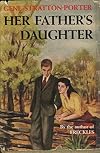
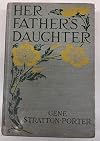
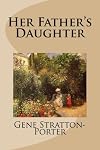
Her Father's Daughter
by Gene Stratton-Porter
On This Page
Description
Two sisters find themselves in unimaginably trying circumstances: left as orphans with no one else to turn to, the girls struggle to make it on their meager income. When their already-tenuous existence is imperiled even further by unforeseen circumstances, the two begin a journey of discovery that leads them to truths about themselves—and their legacy. If you loved Freckles, Michael O'Halloran, and Gene Stratton-Porter's other novels about orphans, you'll relish the opportunity to read Her show more Father's Daughter.. show less
Tags
Recommendations

















Member Reviews
Not bad, though not good, as far as the story goes - and fantastic descriptions of the land and plants of Southern California. However, it's spoiled by rampant racism. A large part of the driver of the story is the "Jap" in a high school class, and how he's at the top of the class - which is a shame to all whites (cue long rants about the Yellow Peril (she literally uses those words)) and besides all they can do is imitate so the white boy should figure out some new way to come at the questions and leave the Jap in the dust...ugh. And when the white boy does top him in class, there are mysterious attempts on the white boy's life, based on other "Japs" being willing to stab the white boy in the back to help the "Jap" in the class. It's show more so incredibly stupid - textbook othering and disparaging. I repeat, UGH. And it's so much of a driver I don't think it could be removed from the book without major surgery. Other than that, it's an OK romance, of an odd sort - the heroine is so much her father's daughter that she's never really learned anything about being feminine. Despite (or because of) this, she has at least three men after her (politely) for most of the book. Oh yes, there's a second villain - who is totally underhanded, as well as being romantically pushy, but this is put on him rather than on all...white men (can't), men from (wherever he's from, not local), short men...whatever. It's that one individual who's a villain - so she knew how to do it, but didn't apply that technique to the boy (who isn't such a boy) in the school. Anyway, it ends up with the heroine putting herself entirely in the hands of an older man - given how much, throughout the book, she's demonstrated self-confidence and ability, this rings a wrong note. I don't know. The more I think about it the less I like it. The descriptions of the countryside, and the discussions of how to eat and otherwise use the plants there, are fantastic. But the story itself ranges from barely readable to unacceptable. show less
Not my favorite of Stratton-Porter's books, but definitely fascinating if just because of the political bent of the characters.
First, the reader must remember that the book was published in 1921, not long after WW! (hence the intense dislike of the German people) and during this period of history, the Japanese were flexing their muscles by invading and decimating parts of China and Korea a (reflected in the anti-Japanese rhetoric the characters pontificate).
The story follows a high school student, Linda, as she moves through life in the earl _ days of the Los Angeles area. She is an orphaned daughter of a surgeon and his wife, who with her elder sister, live extremely comfortably on their inheritance-although the elder sister does take show more advantage of being in charge of money and gives herself a much more comfortable life than Linda. This is resolved over the year in which the book takes place.
Linda is an extraordinary individual, I think what she says and does is a direct reflection of who Gene Stratton-Porter was when she wrote this book. She writes and illustrates a monthly column for a New York magazine, assists and directs older and professional writers and architects in their work (men who by description in the book are wildly successful in their fields yet somehow an untrained 17 year old knows better).
I could go on ad nauseam about this girl's brilliance, but hopefully you get the picture.
What I really enjoyed about this book, is the description and history of the Los Angeles area during this time period. Ms Stratton-Porter put her heart into these areas of her written work. As an active environmentalist (you need to read her bio, she was amazing!) she would delve into learning bout the flora and fauna of whatever area she lived or visited. And boy can she put her knowledge to pen and make it come to life!
I can also appreciate the anti-German and anti-Japanese rhetoric of the characters. Initially this shocked me as today a book like this would be "cancelled", but after a few minutes of though and research, I realized how pervasive this belief was 100 years ago. It also reinvigorated my interest in world event s of this time period.
I believe people with an open mind and a desire to learn where we were 100 years ago will like this book very much. show less
First, the reader must remember that the book was published in 1921, not long after WW! (hence the intense dislike of the German people) and during this period of history, the Japanese were flexing their muscles by invading and decimating parts of China and Korea a (reflected in the anti-Japanese rhetoric the characters pontificate).
The story follows a high school student, Linda, as she moves through life in the earl _ days of the Los Angeles area. She is an orphaned daughter of a surgeon and his wife, who with her elder sister, live extremely comfortably on their inheritance-although the elder sister does take show more advantage of being in charge of money and gives herself a much more comfortable life than Linda. This is resolved over the year in which the book takes place.
Linda is an extraordinary individual, I think what she says and does is a direct reflection of who Gene Stratton-Porter was when she wrote this book. She writes and illustrates a monthly column for a New York magazine, assists and directs older and professional writers and architects in their work (men who by description in the book are wildly successful in their fields yet somehow an untrained 17 year old knows better).
I could go on ad nauseam about this girl's brilliance, but hopefully you get the picture.
What I really enjoyed about this book, is the description and history of the Los Angeles area during this time period. Ms Stratton-Porter put her heart into these areas of her written work. As an active environmentalist (you need to read her bio, she was amazing!) she would delve into learning bout the flora and fauna of whatever area she lived or visited. And boy can she put her knowledge to pen and make it come to life!
I can also appreciate the anti-German and anti-Japanese rhetoric of the characters. Initially this shocked me as today a book like this would be "cancelled", but after a few minutes of though and research, I realized how pervasive this belief was 100 years ago. It also reinvigorated my interest in world event s of this time period.
I believe people with an open mind and a desire to learn where we were 100 years ago will like this book very much. show less
Written well before the Second World War, this novel is apt to make modern readers wince with its casual destruction of fragile ecosystems and vicious anti-Asian racism. At times Stratton-Porter's attitudes come very close to what would today be regarded as white supremacist thinking. The heroine, Linda, advocates simple and "sensible" living, but ideas of what is "sensible" have certainly changed in 80+ years' time.
How can you not like a book where the heroine drives a Stutz Bearcat?
Loved this one in my teens! Belonged to my mother and I loved the Stutz Bearcat that figured prominently in the storyline
Ratings
Members
- Recently Added By
Author Information

52+ Works 9,995 Members
Geneva Grace Stratton was born on a farm in Wabash County, Indiana in 1863. Stratton attended public schools. At an early age she roamed the countryside and developed a lively interest in nature and wildlife. In 1874 the family moved to the city of Wabash. She stayed in school until she was almost twenty, but did not receive a high school diploma. show more After an accident Stratton met during her recovery Charles Darwin Porter, a pharmacist from Geneva. He was 13 years her senior, but they were married in 1886. After oil was discovered on some farmland Mr. Porter owned, the Porters built a large house on the edge of the Limberlost swamp, a natural preserve for wild plants, moths, and birds. Stratton-Porter began to photograph birds and animals of the Swamp. Her early photographs appeared in the magazines Recreation and Outing. In 1901 she published her first piece of fiction in Metropolitan magazine. Stratton-Porter made her debut with The Song of the Cardinal. The next story, Freckles, about an orphan who gets a job as a timber guard in Limberlost, became a success. The book was made into a film in 1935 and 1960. During World War I Stratton-Porter moved to California. She wrote editorials for McCall's magazine and founded in 1922 Gene Stratton Porter film company to produce movies of her books. Stratton-Porter died on December 6, 1924, in Los Angeles, from injuries following a traffic accident when her limousine was hit by a trolley car. She was buried in Hollywood Cemetery in California. Her book, The Keeper of the Bees was posthumously published. The book was filmed in 1935. (Bowker Author Biography) show less
Awards and Honors
Distinctions
Common Knowledge
- Original publication date
- 1921-09
- People/Characters
- Linda Strong; Eileen Strong; Marian Thorne; John Gilman; Peter Morrison; Henry Anderson
- Dedication
- To James Sweetser Lawshe, to whom I owe all that I know about the flowers of California
- First words
- "What makes you wear such funny shoes?"
- Last words
- (Click to show. Warning: May contain spoilers.)"Peter, you are so satisfyingly satisfactory."
Classifications
Statistics
- Members
- 273
- Popularity
- 119,009
- Reviews
- 5
- Rating
- (3.60)
- Languages
- English
- Media
- Paper, Audiobook, Ebook
- ISBNs
- 48
- ASINs
- 22