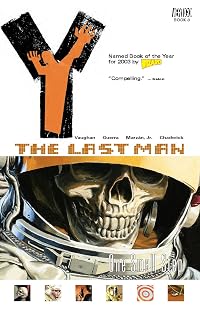
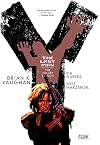
Y: The Last Man Vol. 03: One Small Step
by Brian K. Vaughan (Writer), Paul Chadwick (Illustrator), Pia Guerra (Illustrator), José Marzán, Jr. (Illustrator)
Y: The Last Man (Trade Paperbacks — 3)
On This Page
Description
A Russian Soyuz capsule is coming down from the International Space Stationcarrying three passengers: one woman and two men. Could this be the end of Yorick's tenure as last living male?Tags
Recommendations











Member Recommendations

Member Reviews
Access a version of the below that includes illustrations on my blog.
In her excellent book, Postapocalyptic Fiction and the Social Contract: "We'll Not Go Home Again", Claire P. Curtis defines postapocalyptic fiction as "any account that takes up how humans start over after the end of life on earth as we understand it" (5). Apocalyptic fiction depicts the end, but postapocalyptic fiction foregrounds what comes after the end; she argues that it's a combination of apocalyptic fiction and the pioneer novel, in that it "take[s] the social criticism inherent in the apocalyptic text and the utopian impulse of the pioneer novel and outline[s] an origin story ironically appropriate for our time when the frontier is absent and the possibility of show more catastrophe seems imminent. [...] End of the world accounts serve multiple purposes. They are both didactic and cathartic. They provide both the voyeuristic satisfaction of terrible violence and the Robinson Crusoe excitement of starting over again" (6).
We can't tell stories of people living spare lives on the frontier because there is no frontier anymore; this is arguably the same impulse that gives us The Walking Dead, for example. I taught both Y: The Last Man and The Walking Dead in the same summer course on the apocalypse. And indeed, Y: The Last Man provides the "Robinson Crusoe excitement of starting over": we see in this volume how the women left after the "gendercide" have to do things like fill the gap left when popular entertainment is all gone, or how they even have women who fake being men with facial hair in order to provide sexual experiences to straight women.
Curtis is a political theorist, so what's most interesting to her are the ways the postapocalyptic fiction explores the return to the "state of nature" and the creation of a new "social contract": when we can go back to an imagined beginning, we can figure out what was natural and what was social, and try to build a new and better society: the state of nature "offers a mechanism for seeing humans are they really are, absent the conventions of an artificially constructed rule bound society; and it gives a moment for humans to consider what kind of government they would actually choose to live under" (10). If this is the purpose of Brian K. Vaughan and Pia Guerra in Y: The Last Man, it's mildly depressing. It's easy to imagine an all-the-men-are-dead novel where a feminist utopia is created-- if men are the source of all violence, then their elimination should usher in a new and better world. This does not happen in Y: The Last Man; women are perfectly capable of perpetuating conflict on their own, as we see in One Small Step where the United States and Israel battle over the recovery of what might be the last men left alive. Of course, this might simply point to the fact that the values of the "manned world" haven't been completely eradicated in the "unmanned" one. Maybe there is no real way to get back to the state of nature.
The second story collected in this volume, where we look in on a community of women visiting by a traveling theatre troupe trying to create art for the unmanned world, seems to be engaging with the idea of Curtis that "[u]topian postapocalyptic fiction uses the destruction of one world to usher in a new and potentially better one. […] These accounts can also analyze the very idea of the state of nature and the kind of contract that emerges from that state: what do we fear, what do we desire, how do we plan to allay those fears and realize those desires, how can human community help us to accomplish these ends" (7). The playwright wants to usher in a new and better world, and is doing her part by writing art that functions within that world, trying to shape the fears and desires of her postapocalyptic audience. But the audience turns out to not want that: they just want the old world back, and they just want art that tells them it's just going to be okay. They reject the promise of the postapocalypse to bring in a utopia, because to them the old world was utopian enough.
On the other hand, you can also imagine a book where a woman-run world turns out to be a dystopia, and Y: The Last Man doesn't give us that, either. A fun adventure book, of course, but I also found it was very teachable and has a lot of interesting ideas going on. show less
In her excellent book, Postapocalyptic Fiction and the Social Contract: "We'll Not Go Home Again", Claire P. Curtis defines postapocalyptic fiction as "any account that takes up how humans start over after the end of life on earth as we understand it" (5). Apocalyptic fiction depicts the end, but postapocalyptic fiction foregrounds what comes after the end; she argues that it's a combination of apocalyptic fiction and the pioneer novel, in that it "take[s] the social criticism inherent in the apocalyptic text and the utopian impulse of the pioneer novel and outline[s] an origin story ironically appropriate for our time when the frontier is absent and the possibility of show more catastrophe seems imminent. [...] End of the world accounts serve multiple purposes. They are both didactic and cathartic. They provide both the voyeuristic satisfaction of terrible violence and the Robinson Crusoe excitement of starting over again" (6).
We can't tell stories of people living spare lives on the frontier because there is no frontier anymore; this is arguably the same impulse that gives us The Walking Dead, for example. I taught both Y: The Last Man and The Walking Dead in the same summer course on the apocalypse. And indeed, Y: The Last Man provides the "Robinson Crusoe excitement of starting over": we see in this volume how the women left after the "gendercide" have to do things like fill the gap left when popular entertainment is all gone, or how they even have women who fake being men with facial hair in order to provide sexual experiences to straight women.
Curtis is a political theorist, so what's most interesting to her are the ways the postapocalyptic fiction explores the return to the "state of nature" and the creation of a new "social contract": when we can go back to an imagined beginning, we can figure out what was natural and what was social, and try to build a new and better society: the state of nature "offers a mechanism for seeing humans are they really are, absent the conventions of an artificially constructed rule bound society; and it gives a moment for humans to consider what kind of government they would actually choose to live under" (10). If this is the purpose of Brian K. Vaughan and Pia Guerra in Y: The Last Man, it's mildly depressing. It's easy to imagine an all-the-men-are-dead novel where a feminist utopia is created-- if men are the source of all violence, then their elimination should usher in a new and better world. This does not happen in Y: The Last Man; women are perfectly capable of perpetuating conflict on their own, as we see in One Small Step where the United States and Israel battle over the recovery of what might be the last men left alive. Of course, this might simply point to the fact that the values of the "manned world" haven't been completely eradicated in the "unmanned" one. Maybe there is no real way to get back to the state of nature.
The second story collected in this volume, where we look in on a community of women visiting by a traveling theatre troupe trying to create art for the unmanned world, seems to be engaging with the idea of Curtis that "[u]topian postapocalyptic fiction uses the destruction of one world to usher in a new and potentially better one. […] These accounts can also analyze the very idea of the state of nature and the kind of contract that emerges from that state: what do we fear, what do we desire, how do we plan to allay those fears and realize those desires, how can human community help us to accomplish these ends" (7). The playwright wants to usher in a new and better world, and is doing her part by writing art that functions within that world, trying to shape the fears and desires of her postapocalyptic audience. But the audience turns out to not want that: they just want the old world back, and they just want art that tells them it's just going to be okay. They reject the promise of the postapocalypse to bring in a utopia, because to them the old world was utopian enough.
On the other hand, you can also imagine a book where a woman-run world turns out to be a dystopia, and Y: The Last Man doesn't give us that, either. A fun adventure book, of course, but I also found it was very teachable and has a lot of interesting ideas going on. show less
I like this series well enough. I liked Brian K Vaughan's Runaways more; still, this is an interesting concept. Yorrick's humorous lines are my favorite thing about the comic. The Amazon group is probably my least favorite-I don't find them very convincing, especially Hero's role in the group. She strikes me as very easily led, which, given the references to her childhood relationship with Yorrick and the strength of conviction her mother, doesn't seem to match what we know of her character.
This issue got a higher rating than the last because, well, there was a lot less Amazon action for one. I also liked Natalya, and her interactions with Yorrick and 355 in this one. Also, the twist of Shakespeare being performed by all-female show more actors was a fun addition to this volume
Not sure how I'll feel about the whole thing once I finish it, but I do plan to stick with the series. show less
This issue got a higher rating than the last because, well, there was a lot less Amazon action for one. I also liked Natalya, and her interactions with Yorrick and 355 in this one.
Not sure how I'll feel about the whole thing once I finish it, but I do plan to stick with the series. show less
After the clever premise wears off (about three volumes), every page of this series just had me saying, "enough already! Just explain the secrets!" The incredibly excellent art work and wonderful story lines were not enough to keep me interested. The sword hanging over the story was just too much.
I've been flouncing around the house all pouty and restless, unable to come up with a book I could concentrate on for more than five seconds. Because this is the book that I wanted to read, and I thought it wasn't coming out until next month. But we stopped in at the comics store on our way home from some errands this afternoon just to look around, and I barely kept myself from squealing when I saw this book on the shelves. Yes, ladies and gentlemen, this series is that good. It's good sci-fi and a good comic. It makes you ponder and it makes you giggle fiendishly. Or at least it makes me giggle fiendishly. If I were limited to reading only one comic this year, this would be it. (but only if I get to catch up on all the back-issues of show more Strangers in Paradise next year, as cheesy as that is.) show less
Summary: Yorick Brown is the last man left alive on Earth... but he's not the only man left in orbit. There are three astronauts who have been stuck in the space station since the plague that killed all of the males struck... and two of the three are men. They're coming back down to Earth, and landing in Kansas, and Yorick, 355, and Dr. Mann are headed to meet them. However, the Israeli army has also gotten wind that Yorick might not be the only Y chromosome anymore, and they've got plans of their own. There's also a two-issue arc which features Ampersand falling in with a traveling theater troupe.
Review: Another solid installment in an increasingly interesting and involving series. There are always a lot of elements in play, and even show more as some of them converge and get resolved, new ones are added in. There's a good mix of action and story and character development, and a great combination of immediate payoffs and slow-burning plot threads that dole out their hints a little at a time. There are some hilarious bits of dialogue, and some scenes that were absolutely heartwrenching. This volume has two discrete storylines, which are acceptably self-contained, but have plenty of interesting bits to keep me on the hook for future installments. 4.5 out of 5 stars.
Recommendation: This series is fantastic... why aren't you reading it already? show less
Review: Another solid installment in an increasingly interesting and involving series. There are always a lot of elements in play, and even show more as some of them converge and get resolved, new ones are added in. There's a good mix of action and story and character development, and a great combination of immediate payoffs and slow-burning plot threads that dole out their hints a little at a time. There are some hilarious bits of dialogue, and some scenes that were absolutely heartwrenching. This volume has two discrete storylines, which are acceptably self-contained, but have plenty of interesting bits to keep me on the hook for future installments. 4.5 out of 5 stars.
Recommendation: This series is fantastic... why aren't you reading it already? show less
The second volume of Y -- Cycles -- left me a little disappointed. It wasn't bad, but it just wasn't as good as I'm used to Brain K. Vaughan being. One Small Step brought me back into the series with enthusiasm. Here is what Vaughan does best -- bring various people with various motives together into a train wreck (or a shuttle wreck) and then pick up the pieces.
It is wonderful that even amongst the different interests there are still differing motives. Not all of the Israeli women are the same. Not all of the actresses in the second story-arc are the same. Yorick even has frequent disagreements with his own friends. Yes, the people have divided into sects, but they remain people.
I guess that is what I disliked about Cycles. The former show more prisoners were largely the same, and the Amazons were largely the same. In this one, however, we have about twelve real characters. They are not prisoners to their jobs, in other words. show less
It is wonderful that even amongst the different interests there are still differing motives. Not all of the Israeli women are the same. Not all of the actresses in the second story-arc are the same. Yorick even has frequent disagreements with his own friends. Yes, the people have divided into sects, but they remain people.
I guess that is what I disliked about Cycles. The former show more prisoners were largely the same, and the Amazons were largely the same. In this one, however, we have about twelve real characters. They are not prisoners to their jobs, in other words. show less
Y: The Last Man continues strong in this third installment of the series, throwing in a new plot element - there are two men still alive in space. You can imagine the ramifications this would produce once people learn of it. The ending of this arc surprised me, but I will not spoil it, I will only say that it probably is NOT at all what you would expect. Excellent book and definitely one of the series' strongest.
Members
- Recently Added By
Lists

Recommended Comics / Graphic Novels
595 works; 121 members
Author Information

Brian K. Vaughan, New York Times bestselling author, was born in 1976. He is a comic book and television writer, best known for the comic book series Y: The Last Man, Ex Machina, Runaways, Pride of Baghdad, and Saga. Vaughan was also a writer, story editor and producer of the television series Lost. He is currently the showrunner and executive show more producer of the TV series Under the Dome. Between 2005 and 2015, he was awarded eleven Eisner Awards, a Rave Award, and a Hugo Award. (Bowker Author Biography) show less


All Editions
Some Editions
Awards and Honors
Awards
Notable Lists
Series

Belongs to Publisher Series
Work Relationships
Is contained in
Common Knowledge
- Canonical title
- Y: The Last Man Vol. 03: One Small Step
- Original publication date
- 2004-04-01
- People/Characters
- Yorick Brown; Agent 355; Dr. Allison Mann; Natalya Zamyatin; Ciba Weber; Vlad (show all 16); Alter Tse'elon; Sadie; Heidi Hartle; Heather Hartle; Edie; Cayce; Henrietta; Manda; Toyota; Ampersand
- Important places
- Marquand, Missouri, USA; Washington, D.C., USA; Oldenbrook, Kansas, USA; International Space Station
- Important events
- Post-apocalypse
- First words
- "Yorick?"
- Last words
- (Click to show. Warning: May contain spoilers.)"Everyone's a critic..."
Classifications
- Genre
- Graphic Novels & Comics
- DDC/MDS
- 741.5973 — Arts & recreation Drawing & decorative arts Drawing Comic books, graphic novels, fotonovelas, cartoons, caricatures, comic strips History, geographic treatment, biography North American United States (General)
- LCC
- PN6728 .Y2 .V38 — Language and Literature Literature (General) Literature (General) Collections of general literature Comic books, strips, etc.
- BISAC
Statistics
- Members
- 2,211
- Popularity
- 9,149
- Reviews
- 39
- Rating
- (4.09)
- Languages
- 11 — Czech, Dutch, English, French, German, Italian, Japanese, Polish, Portuguese, Spanish, Turkish
- Media
- Paper, Ebook
- ISBNs
- 16
- ASINs
- 2