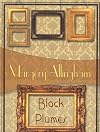
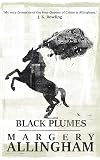
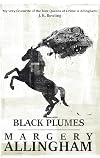
Black Plumes
by Margery Allingham
On This Page
Description
A classic from the Golden Age of Detective Fiction. "One of the best books by a mystery novelist whose work is always of first rank." -The New York Times Something is afoot at the Ivory Gallery in London. A string of suspicious incidents-a Kang-Tse vase broken, a specially commissioned catalog burned, and now a painting slashed-has young Frances Ivory on edge. She suspects that the instigator is her stepsister's husband, Robert Madrigal, but there's not much she can do about it while her show more father is out of the country. Robert is even interfering in Frances's love life, encouraging her to marry his loathsome assistant. To stop his infernal matchmaking, Frances agrees to a sham engagement with the painter whose work was defaced. But when Robert disappears after a confrontation with the artist, he's found stashed in a cupboard, dead. Frances is now drawn into a mystery that will have her second-guessing her family, her fiancé, and even herself . . . Praise for Margery Allingham "Margery Allingham stands out like a shining light." -Agatha Christie "The best of mystery writers." -The New Yorker "Don't start reading these books unless you are confident that you can handle addiction." -The Independent "One of the finest Golden-Age crime novelists." -The Sunday Telegraph. show lessTags
Recommendations

















Member Reviews
In post WW-1 London, a series of small acts of vandalism have culminated in the murder of the bullying manager of a swanky art gallery. Ordinarily, Albert Campion would arrive to tidy of up the mess, but as this is one of Allingham’s stand-alone novels, the story is instead placed in the hands of empathetic young heiress/first-person narrator Francis, appalled at the real possibility that the murderer is going to turn out to be a member of her inner circle.
This conscientiously (perhaps a little too conscientiously) checks all the boxes on the "mid-century modern mystery" checklist. There's a murder, a limited pool of suspects, a frisson of international intrigue (an expedition to Tibet that ends tragically), a preternaturally wise show more Victorian dowager, a silly, swooning ingénue, various hysterical servants, a budding romance, secret passages, secret marriages, people creeping along corridors at night, a menacing blackamoor, envy, blackmail, a cheerfully inscrutable detective, and a solution that relies on timetables.
So many promising ingredients ... and yet the final product doesn't quite deliver. Oh, the blossoming romance between Francis and the worldly painter who has loved her since forever is rather sweet, and the Victorian dowager is a hoot. (Aren't they always?) Allingham's prose is as elegant as always (bounds above Christie but not quite as accomplished as Sayers), and her red herrings cleverly done. (The title “Black Plumes” being one of them ….) But Francis is, frankly, a bit of a sop, content to wring her hands in anxiety while everyone else does the detecting; the cheerful Scottish detective never feels particularly engaging or authentic; the reveal, when it finally comes, hits as rushed and not terrifically clever; and Allingham disappointingly evokes the hoariest of authorial manipulations, the overused "I'm not going to tell the police what I know because I believe I'm protecting someone I care about” plot trope, to extend a mystery that otherwise might have been solved after a couple of chapters.
Okay as a beach book, but definitely not one of Allingham's best and nothing you’re likely to remember 10 minutes later. show less
This conscientiously (perhaps a little too conscientiously) checks all the boxes on the "mid-century modern mystery" checklist. There's a murder, a limited pool of suspects, a frisson of international intrigue (an expedition to Tibet that ends tragically), a preternaturally wise show more Victorian dowager, a silly, swooning ingénue, various hysterical servants, a budding romance, secret passages, secret marriages, people creeping along corridors at night, a menacing blackamoor, envy, blackmail, a cheerfully inscrutable detective, and a solution that relies on timetables.
So many promising ingredients ... and yet the final product doesn't quite deliver. Oh, the blossoming romance between Francis and the worldly painter who has loved her since forever is rather sweet, and the Victorian dowager is a hoot. (Aren't they always?) Allingham's prose is as elegant as always (bounds above Christie but not quite as accomplished as Sayers), and her red herrings cleverly done. (The title “Black Plumes” being one of them ….) But Francis is, frankly, a bit of a sop, content to wring her hands in anxiety while everyone else does the detecting; the cheerful Scottish detective never feels particularly engaging or authentic; the reveal, when it finally comes, hits as rushed and not terrifically clever; and Allingham disappointingly evokes the hoariest of authorial manipulations, the overused "I'm not going to tell the police what I know because I believe I'm protecting someone I care about” plot trope, to extend a mystery that otherwise might have been solved after a couple of chapters.
Okay as a beach book, but definitely not one of Allingham's best and nothing you’re likely to remember 10 minutes later. show less
While the director of the Ivory Art Gallery has been out of the country, someone has been vanadalizing the gallery. As if that weren't enough, someone's gone and killed the acting director, Mr. Robert Madrigal, the director's son-in-law. With a long list of suspects, the police certainly have their hands full, especially when another dead body turns up.
The book seemed to drone on and on -- Allingham is very into her characters and she seems to have done them to death here. Her characterization of Phillida (the wife of the dead assistant art gallery director) as a blithering ninny had me wanting to reach into the pages and slap her. And I couldn't believe her characterization of the police inspector from Scotland was nothing but a major show more stereotype and cariacture. I put this book down several times, and returned to it only because I just couldn't leave it unfinished. By the time I got to the end of this one, I just didn't care. In short, it wasn't one of my Allingham favorites.
This one I would very guardedly recommend to those who are fans of Margery Allingham; it's not a Campion novel but a standalone. Maybe readers of British mystery would like it, but I didn't care for it all that much. show less
The book seemed to drone on and on -- Allingham is very into her characters and she seems to have done them to death here. Her characterization of Phillida (the wife of the dead assistant art gallery director) as a blithering ninny had me wanting to reach into the pages and slap her. And I couldn't believe her characterization of the police inspector from Scotland was nothing but a major show more stereotype and cariacture. I put this book down several times, and returned to it only because I just couldn't leave it unfinished. By the time I got to the end of this one, I just didn't care. In short, it wasn't one of my Allingham favorites.
This one I would very guardedly recommend to those who are fans of Margery Allingham; it's not a Campion novel but a standalone. Maybe readers of British mystery would like it, but I didn't care for it all that much. show less
I love classic British mysteries (Christie, Marsh (yes, I know Marsh is from NZ)) but Allingham is hit or miss with me. Her characters are always verging on caricatures. This one isn't bad, some good red herrings and occasional really nice narrative passages. Typical 'murder in a mansion' but I enjoyed one of the characters so much, the elderly Gabrielle Ivory (who I kept imagining as Maggie Smith), that it kept me interested in the somewhat hackneyed plot.
Not, I'm afraid, one of the stronger Allingham stories. The plot revolves around a fine-arts gallery in London. It starts off with some nasty incidents involving the destruction of valuable property, and ultimately escalates into two murders. Unfortunately, when you toss in an explorer long thought dead in Tibet, bigamy, an oh-so-convenient outbreak of yellow fever delaying a key person, and spooky happenings in dark houses, you venture into the kind of territory that used to give Raymond Chandler the fits. There isn't the humour (or allegations of it) of Mr. Campion to leaven it, either. Give this one a pass.
The slashing of a valuable painting at the renowned Ivory Gallery in London, followed by the murder of the proprietor's son-in-law, Robert, sets the stage for another finely tuned Allingham mystery. The proprietor's mother, 90-year-old Gabrielle Ivory, holds the key to the web of intrigue and danger that permeates the gallery.
Downloaded from Audible, read by Francis Matthews.
This is the first non Campion book I've read/listened to. For once it's told from the point of view of one of the witnesses, which allows for noone to know what the police know, and we are not included in much of what goes on in the investigation itself.
In 1930s London, there are two adjacent houses, one house is the private residence of the Ivory family; their show more painting gallery business is housed next door. The story starts with Frances standing in front of her formidable grandmother Gabrielle, with the complaint that her brother-in-law, Roger (who is married to her rather unstable half sister Phillida), wants her to marry his unspeakable business partner. Lucar seems to have some unknown hold over Roger after a trip to Tibet which went horribly wrong, and which Lucar and Roger were the only survivors.
In the absence of her father, who's out in China on a long business trip, Frances fears she will be forced to marry Lucar. Getting no help from her grandmother - who is as imperious but as dotty as possible, Frances confides her fears to David Field, who immediately proposes a fake engagement so that Roger and Lucar will stop pestering her. Then Roger disappears, to be found murdered a week later. At the funeral, the third person on the Tibetan trip - whom everyone thought dead - reappears. Lucar - on his way to the US and therefore a prime candidate for the death of Roger, rapidly returns, attempts to blackmail all in the house - only to turn up dead too minutes later.
There are plenty of herrings littered about the place - red or otherwise - which makes you suspect most of the characters at some point or another. Frances - who realises that she is in fact in love with David (who painted her portrait when she was 14) - has to face the fact that he might be a killer.
So secret passages, international travel (China to England by plane taking "only" about a week!), blackmail, murder, romance, mysteries....what more could you want? show less
Downloaded from Audible, read by Francis Matthews.
This is the first non Campion book I've read/listened to. For once it's told from the point of view of one of the witnesses, which allows for noone to know what the police know, and we are not included in much of what goes on in the investigation itself.
In 1930s London, there are two adjacent houses, one house is the private residence of the Ivory family; their show more painting gallery business is housed next door. The story starts with Frances standing in front of her formidable grandmother Gabrielle, with the complaint that her brother-in-law, Roger (who is married to her rather unstable half sister Phillida), wants her to marry his unspeakable business partner. Lucar seems to have some unknown hold over Roger after a trip to Tibet which went horribly wrong, and which Lucar and Roger were the only survivors.
In the absence of her father, who's out in China on a long business trip, Frances fears she will be forced to marry Lucar. Getting no help from her grandmother - who is as imperious but as dotty as possible, Frances confides her fears to David Field, who immediately proposes a fake engagement so that Roger and Lucar will stop pestering her. Then Roger disappears, to be found murdered a week later. At the funeral, the third person on the Tibetan trip - whom everyone thought dead - reappears. Lucar - on his way to the US and therefore a prime candidate for the death of Roger, rapidly returns, attempts to blackmail all in the house - only to turn up dead too minutes later.
There are plenty of herrings littered about the place - red or otherwise - which makes you suspect most of the characters at some point or another. Frances - who realises that she is in fact in love with David (who painted her portrait when she was 14) - has to face the fact that he might be a killer.
So secret passages, international travel (China to England by plane taking "only" about a week!), blackmail, murder, romance, mysteries....what more could you want? show less
I enjoyed this much more than my previous encounter with Allingham. There are some splendidly drawn (if larger-than-life) characters, including the geriatric Gabrielle, the scheming underling Lucar, the slightly feckless artist David, and the explorer Godolphin; also some notable descriptive passages. Having disposed of her first victim, the author does a fairly neat line in misdirecting the reader towards different suspects. Only once did I spot a possible misstep, as Frances announced to David that the police are interested in him after he has already implied pretty directly that he knows this and is trying to hide incriminating circumstances (his injured hand). This one is not going on the Out pile.
MB 4-iii-2014
MB 4-iii-2014
This stand-alone mystery was originally published in 1940. Not surprisingly, the behaviors and attitudes of some of the characters are decidedly foreign to modern sensibilities. That said, you get a classic Golden-Age British mystery. The murder of an upper-crust gallery owner horrifies the Ivory family associated with that gallery. Gabrielle Ivory, a Victorian matriarch, dominates the action although her granddaughter, Frances, is the ingenue love interest that we follow. Multiple bodies and a spot of blackmail add additional interest. Lightweight, but certainly well-done!
Members
- Recently Added By
Lists

Recommend the 20 best books you've read in the last five years
2,168 works; 606 members

A Rainbow of Books: Colors in the Title
570 works; 24 members

Books Read in 2024
4,623 works; 126 members
Author Information

131+ Works 20,322 Members
Margery Allingham, one of England's leading mystery writers, was born on May 20, 1904, in Ealing, a western suburb of London, but grew up in a remote village in Essex. Both of her parents were writers, and Margery carried on that tradition when she sold her first short story as an eight-year-old. At the Regent Street Polytechnic, she continued show more writing and studied drama and speech. While there, she wrote a verse play, Dido and Aeneas, in which she had a starring role during performances in London. At age 19, Allington published her first novel, Blackkerchief Dick. She wrote another novel, The White Cottage Mystery, before creating her most famous character, Albert Campion, in The Black Dudley Murder (published in England as The Crime at Black Dudley) in 1929. Allington went on to create twenty-eight more Campion mysteries, including several collections. She wrote more than 10 other novels, some under the pseudonym Maxwell March, as well as four novellas and sixty-four short stories. During World War II, Allingham served as First Aid Commandant for her district, organized the billeting and care of evacuees from London, and allowed her house to be turned into a temporary military base for eight officers and two hundred men of the Cameronians. The war greatly deepened Allingham's passion for her country, as evidenced in her later works. Allingham died of cancer on June 30, 1966. (Bowker Author Biography) show less
Series
Belongs to Publisher Series
Work Relationships
Is abridged in
Common Knowledge
- Canonical title
- Black Plumes
- Original publication date
- 1940-11
- People/Characters
- Frances Ivory; David Field
- Important places
- London, Middlesex, England, UK
- First words
- The October wind, which had promised rain all day, hesitated in its reckless flight down the moist pavements to hurl a handful of fine drops at the windows of the drawing-room in the big Hampstead house.
- Last words
- (Click to show. Warning: May contain spoilers.)'You'd have had the shock of your existence if I didn't,' she said, and her eyes were as confidently mocking as his own.
Classifications
Statistics
- Members
- 506
- Popularity
- 59,217
- Reviews
- 17
- Rating
- (3.37)
- Languages
- Danish, English
- Media
- Paper, Audiobook, Ebook
- ISBNs
- 29
- ASINs
- 14