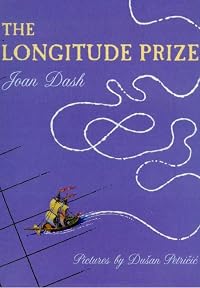
The Longitude Prize
by Joan Dash, Dusan Petricic (Illustrator)
On This Page
Description
The story of John Harrison, inventor of watches and clocks, who spent forty years working on a time-machine which could be used to accurately determine longitude at sea.Tags
Recommendations



























Member Reviews
I had a hard time getting into The Longitude Prize, perhaps in part because I was expecting more history and less science. However, after about 20 or 30 pages, I did get invested in the story and was more interested in the book. Basically, this nonfiction book covers the 18th century attempts to accurately determine longitude while at sea, partly to provide safety to sailing vessels and partly for the person who accomplished this to win Britain’s monetary prize to the tune of about $12 million in today’s U.S. currency. A major part of the book is about the efforts of John Harrison and his son William to create a clock that would remain accurate over long sea voyages. One problem I had with this book was its lack of focus. As I show more mentioned already, it is part history and part science, although it is also to some degree a biography of John Harrison. The book covers a lot of ground, and I’m afraid that some of the content is perhaps too technical for its intended audience of child readers. I also found the ridiculous pictures an absurd addition to a book that is otherwise very somber in tone. However, I did enjoy that the book covered a subject I otherwise didn’t know much about, and I imagine that could appeal to others as well. show less
Um. If I had read this _before_ Longitude, I think I would have liked it better. This is definitely a children's book - she tries desperately to derive human interest from the scanty data available. The data presented is essentially identical to what was in Longitude, except that this book skims over the technical aspects and tries to present the people available. Unfortunately there's very little data on the people, so it comes off as highly superficial. Of course I'm enough of a geek that I greatly enjoyed the technical aspects covered in Longitude and found the skimming annoying in this book. Again, reading them the other way around - first this intro to the situation with discussion of the people involved, then the deeper technical show more presentation - would probably have made both books far more interesting. In this order, Longitude was good and The Longitude Prize is too superficial to be interesting (to me). show less
Joan Dash weaves together historical facts with fun insight into one of the most important developments in sailing. Taking place in Britain in 1714, this book is about the British Navy's effort to help their sailors navigate the open sea. Sprinkled with great nautical details but not overly technical, children will easily become engrossed in the tale of an unlikely hero. Great for an independent read. Ages 12 and up.
This book is very informational and gives background on longitude and latitude and how it was invented. This is something that students might not think of how latitude and longitude will affect sailors. This would be good for 6-8 grade and can be used for classroom instruction and activities in class.
Ratings
Members
- Recently Added By
Published Reviews
ThingScore 100
Kirkus (Kirkus Reviews, October 15, 2000 (Vol. 68, No. 20))
John Harrison, an obscure 18th-century carpenter and clockmaker from Yorkshire, solved a problem that had plagued sailors for centuries: how to tell East-West location at sea, thereby avoiding shipwrecks and other costly disasters. To aid sailors, the British government offered the Longitude Prize, an enormous sum of D20,000 (an amount show more equal to $12 million today), to the inventor of a device that would determine longitude "that shall have been Tried and found Practicable and useful at Sea." Harrison met the challenge with his Harrison's Number One-H-1, the first accurate portable clock. Dash ("We Shall Not Be Moved", 1996, etc.) brings the inventor to life with excerpts from his diaries and letters, as she reports on his painstaking experiments, refinements, and extensive sea tests of his 75-pound portable clock. B&w illustraions add a whimsical touch to the telling. For the gruff and meticulous clock-builder, perfecting the clock proved less difficult than claiming the prize offered. Politics and class distinctions in 18th-century England made it extremely difficult for someone not university-educated to get a fair hearing. It took the intervention of His Majesty George III and nearly 50 years of effort before Harrison saw even a portion of his prize money. Dash documents the development of Harrison's inventions and provides an overview of the politics and science of the period, introducing luminaries such as Sir Isaac Newton and Edmond Halley. Harrison emerges as a stubborn perfectionist who succeeded at long last through great effort. For a less-detailed but perhaps sufficient take on the subject, Trent Duffy's less-detailed "The Clock "(p. 630) provides a chapter on Harrison and his chronometric clock. Dash's title provides an in-depth look at a little known inventor and his life and times and makes good use of primary sources seldom available to students. show less
John Harrison, an obscure 18th-century carpenter and clockmaker from Yorkshire, solved a problem that had plagued sailors for centuries: how to tell East-West location at sea, thereby avoiding shipwrecks and other costly disasters. To aid sailors, the British government offered the Longitude Prize, an enormous sum of D20,000 (an amount show more equal to $12 million today), to the inventor of a device that would determine longitude "that shall have been Tried and found Practicable and useful at Sea." Harrison met the challenge with his Harrison's Number One-H-1, the first accurate portable clock. Dash ("We Shall Not Be Moved", 1996, etc.) brings the inventor to life with excerpts from his diaries and letters, as she reports on his painstaking experiments, refinements, and extensive sea tests of his 75-pound portable clock. B&w illustraions add a whimsical touch to the telling. For the gruff and meticulous clock-builder, perfecting the clock proved less difficult than claiming the prize offered. Politics and class distinctions in 18th-century England made it extremely difficult for someone not university-educated to get a fair hearing. It took the intervention of His Majesty George III and nearly 50 years of effort before Harrison saw even a portion of his prize money. Dash documents the development of Harrison's inventions and provides an overview of the politics and science of the period, introducing luminaries such as Sir Isaac Newton and Edmond Halley. Harrison emerges as a stubborn perfectionist who succeeded at long last through great effort. For a less-detailed but perhaps sufficient take on the subject, Trent Duffy's less-detailed "The Clock "(p. 630) provides a chapter on Harrison and his chronometric clock. Dash's title provides an in-depth look at a little known inventor and his life and times and makes good use of primary sources seldom available to students. show less
added by kthomp25
Elizabeth Bush (The Bulletin of the Center for Children's Books, October 2000 (Vol. 54, No. 2))
As the prestige of the eighteenth-century British merchant and naval fleets was threatened by an unfortunate propensity to run aground for lack of accurate charts and position reckoning, a Board of Longitude was established which authorized a D20,000 reward for the inventor of a system or device that show more could calculate longitude with precision. Rural English clockmaker John Harrison produced and refined just such a device, a seaworthy clock that could help calculate distance from a point of known longitude on land, and his decades-long battle to prove its effectiveness to a Board that openly favored a lunar calculation system is the subject of Dash’s work. She navigates readers through the complexities of the rival systems with reasonable ease and does a good job of conveying the years of frustration and tedium that marked Harrison’s dealings with the Board--too good a job, perhaps, since some of that tedium occasionally (unavoidably?) spills into her narration, and not all readers will share the redoubtable Harrison’s determination to see this pursuit through. Petricic’s black-and-white illustrations, particularly the inventive initial vignettes that open each chapter, puff some wind into the sails when the momentum slows, though, and a glossary, timeline, and index assist researchers pursuing this bittersweet tale of justice denied. (Reviewed from galleys) Review Code: R -- Recommended. (c) Copyright 2000, The Board of Trustees of the University of Illinois. 2000, Foster/Farrar, 208p, $16.00. Grades 5-9. show less
As the prestige of the eighteenth-century British merchant and naval fleets was threatened by an unfortunate propensity to run aground for lack of accurate charts and position reckoning, a Board of Longitude was established which authorized a D20,000 reward for the inventor of a system or device that show more could calculate longitude with precision. Rural English clockmaker John Harrison produced and refined just such a device, a seaworthy clock that could help calculate distance from a point of known longitude on land, and his decades-long battle to prove its effectiveness to a Board that openly favored a lunar calculation system is the subject of Dash’s work. She navigates readers through the complexities of the rival systems with reasonable ease and does a good job of conveying the years of frustration and tedium that marked Harrison’s dealings with the Board--too good a job, perhaps, since some of that tedium occasionally (unavoidably?) spills into her narration, and not all readers will share the redoubtable Harrison’s determination to see this pursuit through. Petricic’s black-and-white illustrations, particularly the inventive initial vignettes that open each chapter, puff some wind into the sails when the momentum slows, though, and a glossary, timeline, and index assist researchers pursuing this bittersweet tale of justice denied. (Reviewed from galleys) Review Code: R -- Recommended. (c) Copyright 2000, The Board of Trustees of the University of Illinois. 2000, Foster/Farrar, 208p, $16.00. Grades 5-9. show less
added by kthomp25
Lists

Robert F. Sibert Informational Book Medal
102 works; 1 member
Author Information
8 Works 1,005 Members

Awards and Honors
Awards
Distinctions
Notable Lists
Common Knowledge
- People/Characters
- George III, King of the United Kingdom; Captain James Cook, RN, FRS; John Harrison
- Important places
- Greenwich Meridian
Classifications
Statistics
- Members
- 136
- Popularity
- 239,648
- Reviews
- 5
- Rating
- (3.54)
- Languages
- English, German, Portuguese
- Media
- Paper
- ISBNs
- 3