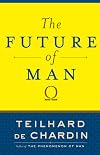
The Future of Man
by Pierre Teilhard de Chardin, Pierre Teilhard de Chardin (Author)
On This Page
Description
The Future of Man is a magnificent introduction to the thoughts and writings of Pierre Teilhard de Chardin, one of the few figures in the history of the Catholic Church to achieve renown as both a scientist and a theologian. Trained as a paleontologist and ordained as a Jesuit priest, Teilhard de Chardin devoted himself to establishing the intimate, interdependent connection between science--particularly the theory of evolution--and the basic tenets of the Christian faith. At the center of show more his philosophy was the belief that the human species is evolving spiritually, progressing from a simple faith to higher and higher forms of consciousness, including a consciousness of God, and culminating in the ultimate understanding of humankind's place and purpose in the universe. The Church, which would not condone his philosophical writings, refused to allow their publication during his lifetime. Written over a period of thirty years and presented here in chronological order, the essays cover the wide-ranging interests and inquiries that engaged Teilhard de Chardin throughout his life: intellectual and social evolution; the coming of ultra-humanity; the integral place of faith in God in the advancement of science; and the impact of scientific discoveries on traditional religious dogma. Less formal than The Phenomenon of Man and The Divine Milieu, Teilhard de Chardin's most renowned works, The Future of Man offers a complete, fully accessible look at the genesis of ideas that continue to reverberate in both the scientific and the religious communities. show lessTags
Recommendations























Member Reviews
893 The Future of Man, by Pierre Teilhard de Chardin translated from the French by Norman Denny (read 12 Feb 1967) This is a collection of short pieces by Teilhard put together to illustrate his thoughts on man's future. I certainly did not read as attentively as I ought to have, but his conclusions are intriguing, encouraging, and exhilarating, if rather inexhaustively founded. His words (actually written in 1924) re the end of the world: "As the end of time approaches a terrifying spiritual pressure will be brought to bear on the limits of the Real, born of the effort of souls desperately straining in their desire to escape from the Earth. This pressure will be unanimous .... And no doubt it is then, as a Creation brought to the show more paroxysm of its aptitude for union, that the Parousia will occur. The unique process of assimilation and synthesis, pursued from the beginning of time, being at length revealed, the universal Christ will appear like a flash of lightning amid the storm-clouds of a slowly consecrated World..." astonishing--and far more powerful than the traditional imagery. show less
Essential reading that preludes many of the brightest evolutionary theorists today while managing to imbue the subject of humanities gradual evolution towards the Omega point with more heart and gentleness than anyone else I have read. The book is a montage of a number of different papers published by Teilhard and is thus without the overall perspective of "The Phenomenon of Man" but on the other hand gains in the department of succinctness on the individual topics. The best book by Teilhard in my opinion.
essays on human progress
2 copies
oeuvres de pierre teilhard du chardin
Feb 9, 2024Italian
Ratings
Members
- Recently Added By
Author Information

182+ Works 7,837 Members
Born in Sarcenat, France, Teilhard de Chardin was the son of a landowner and was educated at a Jesuit school. In 1911 he was ordained a Jesuit priest, but also became interested in geology and paleontology. In 1918 Teilhard de Chardin became professor of geology at the Institut Catholique in Paris. Between 1923 and 1946, he went on paleontological show more and anthropological expeditions to China and Central Asia, where he helped discover Peking Man in 1929. His work in Cenozoic geology and paleontology earned him widespread recognition, including the French Legion of Honour (1946). Early Man in China, one of his writings from his period as a scientist, is still available. Teilhard de Chardin's lively mind moved beyond science to speculative cosmology. He ranks as an interpreter of naturalistic evolution within a broadened framework of spirituality. During his lifetime his writings were disapproved by the authorities in his order and the church; however, their posthumous publication in the wake of Vatican II catapulted Teilhard into the very center of attention, by intellectuals and philosophers throughout the world. Although his views seem insupportable to many more cautious minds, they have been taken seriously and have stimulated considerable discussion. Teilhard's system on philosophy has been ably epitomized by J. E. Bruns in his review of Phenomenon of Man: ""The story of life is not more than a movement of consciousness veiled by morphology.' These words of the author, referring to consciousness as related to organic structure, express the essential theme of his book. . . . Evolution has not run its course. Geogenesis led to biogenesis, "which turned out in the end to be nothing else than psychogenesis. . . . Psychogenesis has led to man. Now it efficaces itself, relieved or absorbed by another and a higher function---the engendering and subsequent development of all the stages of the mind, in one word noogenesis noogenesis.' Noogenesis implies the production of a "superabundance of mind' and looks forward to the ultimate earth, a "universe of conscious substance.' Teilhard envisions mankind, through an ever increasing psychosocial unity, concentrating on the transcendent center of this psychic convergence---God---until it reaches the "Omega point,' the "fulfillment of the spirit of the earth,' a detachment of the mind from its material matrix and an abandonment of its organoplanetary foothold" (Catholic World). (Bowker Author Biography) show less
Awards and Honors
Distinctions
Common Knowledge
- Original title
- L'avenir de l'homme
- Original publication date
- 1959
- Blurbers
- Bronowski, J.; Elson, John T.; Hutchison, John A.
Classifications
- Genres
- Philosophy, Nonfiction, Religion & Spirituality, Science & Nature, General Nonfiction
- DDC/MDS
- 113 — Philosophy & psychology Metaphysics (existence, purpose, and the nature of reality) Cosmology (Philosophy of nature)
- LCC
- BD450 .T413 — Philosophy, Psychology and Religion Speculative philosophy Speculative philosophy Ontology
- BISAC
Statistics
- Members
- 749
- Popularity
- 37,724
- Reviews
- 5
- Rating
- (3.66)
- Languages
- 6 — Catalan, Dutch, English, French, German, Spanish
- Media
- Paper
- ISBNs
- 11
- ASINs
- 30