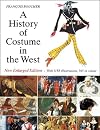
20,000 Years of Fashion: The History of Costume and Personal Adornment
by François Boucher
On This Page
Description
Contains 1,200 illustrations from prehistory through modern times with text depicting clothing and accessories.Tags
Recommendations










































Member Reviews
As TRINA (LT) points out, fashion can be extremely frivolous, and also can speak volumes about ourselves in seconds.
{We've only been living in Cities for 6-8000 years; only had Agriculture for 12-18,000 years. Only had language for what, maybe 50,000 years? The earliest known humans are the 160,000 year old Huerto skulls from Ethiopia.}
{But back 30,000 years when we were first limning the Chauvet Cave with paint, and carving Venus, lo, the decorative cordage, the shell-nut necklace, the delta skirt. [22] We had yet to build cities or temples or palaces, but we most certainly had "Fashion"!}
Clothing is covering of the body. Costume is the particular choice of form of garment, reflecting physical conditions, technology, and social show more factors--beliefs, status, aesthetics. [9] Two theories of Costume: (1) The Greek/Chinese -- the covering starts from the physical, a protection from elements. (2) The Biblical -- the covering is invoked for modesty, magic, or the desire to please.
(Both of these grand theories, and neither of them, are correct.)
Two Helpful (accurate) Chronologies:
II. Prehistoric - on page 31.
III. Western Asia - 75.
Note the history of "pants" -- first introduced to civilization by horse "barbarians" [53, 68]. As late as Rome, men wore skirts.
Omits details on non-European parts of the world, which may be understandable in light of the differences of costume, village by village; still, the title promised so much more. Also neglects the history of Sumptuary Laws, and class restrictions coming under color of usually false "religious" mandates, with their influence on fashion. show less
{We've only been living in Cities for 6-8000 years; only had Agriculture for 12-18,000 years. Only had language for what, maybe 50,000 years? The earliest known humans are the 160,000 year old Huerto skulls from Ethiopia.}
{But back 30,000 years when we were first limning the Chauvet Cave with paint, and carving Venus, lo, the decorative cordage, the shell-nut necklace, the delta skirt. [22] We had yet to build cities or temples or palaces, but we most certainly had "Fashion"!}
Clothing is covering of the body. Costume is the particular choice of form of garment, reflecting physical conditions, technology, and social show more factors--beliefs, status, aesthetics. [9] Two theories of Costume: (1) The Greek/Chinese -- the covering starts from the physical, a protection from elements. (2) The Biblical -- the covering is invoked for modesty, magic, or the desire to please.
(Both of these grand theories, and neither of them, are correct.)
Two Helpful (accurate) Chronologies:
II. Prehistoric - on page 31.
III. Western Asia - 75.
Note the history of "pants" -- first introduced to civilization by horse "barbarians" [53, 68]. As late as Rome, men wore skirts.
Omits details on non-European parts of the world, which may be understandable in light of the differences of costume, village by village; still, the title promised so much more. Also neglects the history of Sumptuary Laws, and class restrictions coming under color of usually false "religious" mandates, with their influence on fashion. show less
My mum got this for me for my birthday, and i love it! It's got lots of beautiful pictures of people and dresses, and covers many centuries rather well detailed. I just love looking at the pictures and dreaming about the dresses!
A Beautiful read and well, mostly, view.
A Beautiful read and well, mostly, view.
I loved checking this book out from the library when I was younger. It was fun.
Costumes & Fashion
Ratings
Members
- Recently Added By
Author Information
6 Works 604 Members
Common Knowledge
- Canonical title
- 20,000 Years of Fashion: The History of Costume and Personal Adornment
- Original title
- Histoire du costume en Occident
- Original publication date
- 1966
- First words
- If one admits that clothing has to do with covering one's body, and costume with the choice of a particular form of garment for a particular use, is it then permissible to deduce that clothing depends primarily on such physi... (show all)cal conditions as climate and health, and on textile manufacture, whereas costume reflects social factors such as religious beliefs, magic, aesthetics, personal status, the wish to be distinguished from or to emulate one's fellows and so on?
- Last words
- (Click to show. Warning: May contain spoilers.)When studying contemporary costume it is impossible to decide which fasion is ephemeral and which will prove the starting-point for the developments of the future. But it is clear that the clothes we wear are not merely the covering of the body but the vesture of the soul, and that, at once changing permanent, they will continue to be not only the expression of an epoch, but the figuration as it were of human nature itself.
- Original language
- French
Classifications
- Genres
- Nonfiction, Art & Design, History, General Nonfiction
- DDC/MDS
- 391.009 — Society, government, & culture Customs, etiquette & folklore Costume and personal appearance Standard subdivisions History, geographic treatment, biography
- LCC
- GT510 .B6713 — Geography, Anthropology and Recreation Manners and customs (General) Manners and customs (General) Costume. Dress. Fashion
- BISAC
Statistics
- Members
- 598
- Popularity
- 49,202
- Reviews
- 4
- Rating
- (4.07)
- Languages
- English, French, Polish, Portuguese
- Media
- Paper
- ISBNs
- 11
- ASINs
- 8