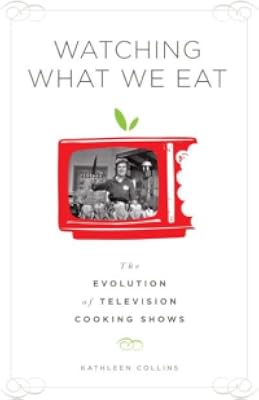
Watching What We Eat: The Evolution of Television Cooking Shows
by Kathleen Collins
On This Page
Description
Provides a detailed history of television cooking shows, discussing their origins, the shift in focus from education to entertainment, and how they have both reflected and influenced changes in American culture.Tags
Recommendations









Member Reviews
I’ve learned so much about food and cooking from watching cooking shows on television. As a teenager I would watch and long to be able to make the kinds of recipes being shown; dreamed of having a fancy kitchen, a professional mixer or food processor. Kathleen Collins has made a very detailed study of how those shows have changed over the decades of television history, and how those shows have influenced those of us who like to cook and eat.
The history of television cooking shows is much longer and richer than I could have imagined. Some of the earliest shows sound like some of the crazy Food Network shows on now. And it is interesting that throughout the entire history of cooking on television, here has been a voyeuristic quality and show more also a vicarious quality. In other words, we love watching others cook thins we know we will never cook ourselves. And yet I think a regular viewer of these shows learns about cooking and technique, much like watching someone cook in a kitchen , but because television cooking shows are such controlled and “chopped up” presentations, they do not teach how to plan a meal, how to cook a whole meal or party so all the food is ready at the same time. They never teach you about cleaning up, or planning your shopping and menus so you don’t have a lot of waste.
Food is entertaining becuase it is part of all of our lives, and have used the cooking shows to help live out and shape our fantasies of the ideal life. Collins does a great job of showing how these shows have excelled at that and captured the moving target of the American Dream over the last fifty years. show less
The history of television cooking shows is much longer and richer than I could have imagined. Some of the earliest shows sound like some of the crazy Food Network shows on now. And it is interesting that throughout the entire history of cooking on television, here has been a voyeuristic quality and show more also a vicarious quality. In other words, we love watching others cook thins we know we will never cook ourselves. And yet I think a regular viewer of these shows learns about cooking and technique, much like watching someone cook in a kitchen , but because television cooking shows are such controlled and “chopped up” presentations, they do not teach how to plan a meal, how to cook a whole meal or party so all the food is ready at the same time. They never teach you about cleaning up, or planning your shopping and menus so you don’t have a lot of waste.
Food is entertaining becuase it is part of all of our lives, and have used the cooking shows to help live out and shape our fantasies of the ideal life. Collins does a great job of showing how these shows have excelled at that and captured the moving target of the American Dream over the last fifty years. show less
Watching What We Eat focuses on the rise of food television. It traces the evolution of today's food obsession from its roots in the homemaking radio shows used to disseminate tips and recipes in the 1940s and early public broadcasting efforts such as Cooking with Julia Child and The Galloping Gourmet. Along the way it assesses the contributions of James Beard, Joyce Chen, Justin Wilson, Jeff Smith (the disgraced Frugal Gourmet), Martha Stewart and Rachel Ray.
Although I found the subject interesting, the book reads a bit like an academic tome. The author reports from the vantage of watching the shows, reading reviews from the relevant time period and learning more by reading what other cultural critics have to say. I never had a sense show more of which programs remain relevant today and which have become hopelessly dated. I don't know whether today's TV food stars acknowledge these influences or not. The book was a great start, but it left me wishing the author had gone just a step farther with her research. show less
Although I found the subject interesting, the book reads a bit like an academic tome. The author reports from the vantage of watching the shows, reading reviews from the relevant time period and learning more by reading what other cultural critics have to say. I never had a sense show more of which programs remain relevant today and which have become hopelessly dated. I don't know whether today's TV food stars acknowledge these influences or not. The book was a great start, but it left me wishing the author had gone just a step farther with her research. show less
Ratings
Members
- Recently Added By
Lists

Food Memoirs
97 works; 9 members
Author Information
2 Works 81 Members
Kathleen Collins is an experienced author and researcher who has studied and written about television, media history, and popular culture.
Classifications
- Genres
- Nonfiction, General Nonfiction, Food & Cooking, History
- DDC/MDS
- 791.45 — Arts & recreation Recreation, sports, and performing arts Public performances Motion pictures, radio, television, podcasting Television
- LCC
- PN1992.8 .C67 .C65 — Language and Literature Literature (General) Literature (General) Drama Broadcasting Television broadcasts
- BISAC
Statistics
- Members
- 78
- Popularity
- 406,294
- Reviews
- 2
- Rating
- (3.50)
- Languages
- English
- Media
- Paper, Ebook
- ISBNs
- 3