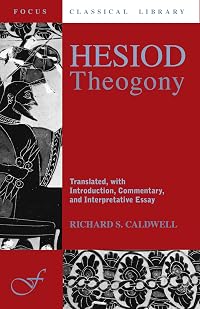
Theogony
by Hesiod
On This Page
Description
Hesiod's straightforward account of family conflict among the gods is the best and earliest evidence of what the ancient Greeks believed about the beginning of the world.Tags
Recommendations










Member Reviews
Hesiod is not a great storyteller, but he knew how to rationalize their (Greek) traditional customs and beliefs in a way that even a modern reader can understand or imagine them. Actually I enjoyed it a lot.
This is a pretty good book. I would say it’s clearly above the average/expected/fully adequate level in quality. It is a(n) historic book. I take it more seriously than I feel like the average antiquarian takes them, although I would like to have more linguistic knowledge about interesting languages like Greek. (I’m kinda putting most of my language-study time, recently, into learning the IPA, and later I would like to learn, say, Irish (yes, Irish) and French, and maybe German or the odd bit of classical Asian language—I haven’t fully chosen between learning Devanagari for Sanskrit names type numerology, or a few of the Chinese characters used by Lao Tzu; and yes, also Latin and Greek; I’m not an Edwardian, but it would show more be…. Beneficial to know, although I wouldn’t be doing it to impress anybody: although with the IPA I could potentially study languages in detail, whether it’s Canadian English, or French, (or Italian, right…. Spanish is also a fine language; but I find that, equally, ironically, with Greek, a language being ‘useful’ isn’t the same as having the feel of its spirit, the love for it, and the will, deep down, to know it—strangely enough, this is also the immigrant’s dilemma, right…. I’d like to be the immigrants’ political ally—and they do need a better political/economic system, more than they need a White Friend (TM), in my opinion; and I will maybe study Bad Bunny’s music, a bit, but if it were Bad Bunny or Wagner to take to a desert island: a three minute song just can’t compete with a song that lasts hours and hours, right…. It seems to go on, for ever….)
But yeah: I feel like I take Hesiod/history etc, more seriously than the antiquarian: that Hesiod and some modern scientists put Chaos first in the Emergence, is curious for understanding Reality, not for ~promoting literary pursuits~, right…. Of course, it is also ancient patriarchy, quite markedly, although I do think he understood SOME things, and that the book was better written than unwritten. (And of course, information was more expensive to preserve in ancient times, and Christians did preserve some things; but it remains that Christians make strange choices, which are sometimes prejudiced; certainly in The Theogony some ‘risqué’ stuff happens, but it does seem suggestive that he ends off with, “And now I want to talk about women”: and then the monk copying this stuff kinda goes; yeah, but that’s enough of that crap: pagan gods, and obeying a king of pagan gods—that’s all bad enough; but to copy down things about Women!!…. I have my reputation to think of! Big reputation! Big reputation!….)
It does clearly other women. On the other hand, the emphasis on names, (and therefore implicitly, on the Greek language), and especially that it came from spending time in Nature—and not from grabbing random party drugs of unknown kinds, like a modern poet; or locking oneself in a library with instructions to deliver food at specified times, and otherwise fuck off, like a modern researcher, right…. Knowledge of Reality comes from knowledge of the holy mountain you happen to be at the base of: that’s good. And yet of course, Hesiod also is alienated from women, and from anything, like rebellion in general, too far from authority.
I started listening to an audiobook where Samuel Butler is the uncredited translator—eye to the price-point!…. (I got the translator with ChatGPT’s help: I had to check his work; he only needed two guesses, lol; the second time he was right); and apparently somebody wrote Samuel Butler a letter where the person says, to simplify the sentence structure, and make it more explicit, of course they don’t as Edwardians have the same worldview as Homer etc: but it’s ~beautiful~; it’s beautiful writing. So they like it. I think that’s a good perspective. Of course, you can ‘strip’ books for information even where the author’s character is at least sometimes suspect—basically what I do with Crowley, right; and Hesiod does provide some nice info on Hecate and Prometheus even if he smugly likes to wrap things up with the impossibility of overturning mighty Zeus, right…. Character is relevant: but one cannot simply summarise and judge people, and make everything vague, right. And yeah: in some ways, since 1900 and the Edwardian times, for me, as a 21st century Wiccan, in some ways I’m closer to Hesiod than the literary crew of c. 1900: and in other ways, father away. (The way that one accent can be closer to RP than accent B in way 1, but for detail 2: the same accent can be farther away from RP—for sometimes “speech” is more like a maze than a straight line, or a ‘continuum’, right….). But if they can figure out, as clever Edwardians, that Hesiod wasn’t their own view of the world, but they can appreciate his beauty: that can also be something similar that I discover, and an important part of my self-exposure to Hesiod and such…. I do think, that poetry or, the sorta ultra-light prose poetry that is poetry rendered into prose, right, does get translated into audiobooks better than a novel about New Zealand/the 1800s, or nonfiction prose by Freud/Michelle Obama, etc., right. I guess it is kinda like stepping into the past, actually ~listening~, and the modern forms seem to me less effective. More similar to music without chords: shorter, more expressive language, and lending itself more to repetition, right. People listen to audiobooks because they’re tired or in their cars, or on the edge of wanting to read a book: but that is to consider ourselves—I do think that the medium itself has needs as well, though: and I do think that it responds best to poetry, in some narrow or broad sense, right….
And yeah, I love those lines: ‘Shepherds of the wilderness, wretched things of shame, mere bellies’—the sly fey dismissal of the mere Homo sapiens, right: and then, the theory of language, juxtaposed with their previous, on a literal level, very firm opinion, right: but in this context, kind of…. Unspeakable, right: the undefinable opinion, you know…. “We know how to say many false things as though they were true; but we know also, when we will—to say true things….”
It’s worth reading, anyway; it’s interesting…. I don’t know…. What can you say?…. The true, or the beautiful: what can you say, in the end?…. show less
But yeah: I feel like I take Hesiod/history etc, more seriously than the antiquarian: that Hesiod and some modern scientists put Chaos first in the Emergence, is curious for understanding Reality, not for ~promoting literary pursuits~, right…. Of course, it is also ancient patriarchy, quite markedly, although I do think he understood SOME things, and that the book was better written than unwritten. (And of course, information was more expensive to preserve in ancient times, and Christians did preserve some things; but it remains that Christians make strange choices, which are sometimes prejudiced; certainly in The Theogony some ‘risqué’ stuff happens, but it does seem suggestive that he ends off with, “And now I want to talk about women”: and then the monk copying this stuff kinda goes; yeah, but that’s enough of that crap: pagan gods, and obeying a king of pagan gods—that’s all bad enough; but to copy down things about Women!!…. I have my reputation to think of! Big reputation! Big reputation!….)
It does clearly other women. On the other hand, the emphasis on names, (and therefore implicitly, on the Greek language), and especially that it came from spending time in Nature—and not from grabbing random party drugs of unknown kinds, like a modern poet; or locking oneself in a library with instructions to deliver food at specified times, and otherwise fuck off, like a modern researcher, right…. Knowledge of Reality comes from knowledge of the holy mountain you happen to be at the base of: that’s good. And yet of course, Hesiod also is alienated from women, and from anything, like rebellion in general, too far from authority.
I started listening to an audiobook where Samuel Butler is the uncredited translator—eye to the price-point!…. (I got the translator with ChatGPT’s help: I had to check his work; he only needed two guesses, lol; the second time he was right); and apparently somebody wrote Samuel Butler a letter where the person says, to simplify the sentence structure, and make it more explicit, of course they don’t as Edwardians have the same worldview as Homer etc: but it’s ~beautiful~; it’s beautiful writing. So they like it. I think that’s a good perspective. Of course, you can ‘strip’ books for information even where the author’s character is at least sometimes suspect—basically what I do with Crowley, right; and Hesiod does provide some nice info on Hecate and Prometheus even if he smugly likes to wrap things up with the impossibility of overturning mighty Zeus, right…. Character is relevant: but one cannot simply summarise and judge people, and make everything vague, right. And yeah: in some ways, since 1900 and the Edwardian times, for me, as a 21st century Wiccan, in some ways I’m closer to Hesiod than the literary crew of c. 1900: and in other ways, father away. (The way that one accent can be closer to RP than accent B in way 1, but for detail 2: the same accent can be farther away from RP—for sometimes “speech” is more like a maze than a straight line, or a ‘continuum’, right….). But if they can figure out, as clever Edwardians, that Hesiod wasn’t their own view of the world, but they can appreciate his beauty: that can also be something similar that I discover, and an important part of my self-exposure to Hesiod and such…. I do think, that poetry or, the sorta ultra-light prose poetry that is poetry rendered into prose, right, does get translated into audiobooks better than a novel about New Zealand/the 1800s, or nonfiction prose by Freud/Michelle Obama, etc., right. I guess it is kinda like stepping into the past, actually ~listening~, and the modern forms seem to me less effective. More similar to music without chords: shorter, more expressive language, and lending itself more to repetition, right. People listen to audiobooks because they’re tired or in their cars, or on the edge of wanting to read a book: but that is to consider ourselves—I do think that the medium itself has needs as well, though: and I do think that it responds best to poetry, in some narrow or broad sense, right….
And yeah, I love those lines: ‘Shepherds of the wilderness, wretched things of shame, mere bellies’—the sly fey dismissal of the mere Homo sapiens, right: and then, the theory of language, juxtaposed with their previous, on a literal level, very firm opinion, right: but in this context, kind of…. Unspeakable, right: the undefinable opinion, you know…. “We know how to say many false things as though they were true; but we know also, when we will—to say true things….”
It’s worth reading, anyway; it’s interesting…. I don’t know…. What can you say?…. The true, or the beautiful: what can you say, in the end?…. show less
Gênese da mitologia grega apresenta a cosmogonia e teogonia da ordem e harmonia do universo transcendental grego. Tem como questão fundamental a origem e natureza dos deuses, bem como a forma como eles interagem entre si e com o mundo dos mortais. E como a criação da vida humana trouxe consigo a possibilidade da ruptura da ordem cósmica. Os seres humanos são apresentados como seres astutos e racionais, capazes de até mesmo desafiar os deuses. Essa liberdade dos seres humanos cria um paradoxo, uma vez que, por um lado, eles são vistos como inferiores aos deuses e sujeitos à sua vontade, e por outro lado, eles têm a capacidade de agir livremente e desenvolver suas almas.
Theogony are basically the list of geneology of greek gods and goddesses. Frankly theres very little plot in this hesiod poem except for... Lists of names. Weird. Basically it told a story from the beginning of time with Chasm and Kronos eventual defeat by his son Zeus, the captivity of titans, more names and athena's birth. I will read Theogony again in other translation but generally, its like a summary more than a telling. Review much later
Theogony are basically the list of geneology of greek gods and goddesses. Frankly theres very little plot in this hesiod poem except for... Lists of names. Weird. Basically it told a story from the beginning of time with Chasm and Kronos eventual defeat by his son Zeus, the captivity of titans, more names and athena's birth. I will read Theogony again in other translation but generally, its like a summary more than a telling. Review much later
don't go to mythology without it.
Edition: // Descr: xiii, 459 p. 22 cm. // Series: Call No. { } Edited with Prolegomena and Commentary by M.L. West The Prolegomena, Commentary, and Indexes are in English The Text is in Greek. // John E. Rexine Library Donation //
Members
- Recently Added By
Lists

Literary Works Read in College
316 works; 15 members

Western Canon
206 works; 2 members

Classical Conversations Challenge IV Exposition
8 works; 1 member

Books Read in 2010
631 works; 11 members

In Our Time books
4,934 works; 2 members
Author Information

The poet Hesiod tells us that his father gave up sea-trading and moved from Ascra to Boeotia, that as he himself tended sheep on Mount Helicon the Muses commanded him to sing of the gods, and that he won a tripod for a funeral song at Chalcis. The poems credited to him with certainty are: the Theogony, an attempt to bring order into the otherwise show more chaotic material of Greek mythology through genealogies and anecdotes about the gods; and The Works and Days, a wise sermon addressed to his brother Perses as a result of a dispute over their dead father's estate. This latter work presents the injustice of the world with mythological examples and memorable images, and concludes with a collection of folk wisdom. Uncertain attributions are the Shield of Heracles and the Catalogue of Women. Hesiod is a didactic and individualistic poet who is often compared and contrasted with Homer, as both are representative of early epic style. "Hesiod is earth-bound and dun colored; indeed part of his purpose is to discredit the brilliance and the ideals of heroism glorified in the homeric tradition. But Hesiod, too, is poetry, though of a different order. . . " (Moses Hadas, N.Y. Times). (Bowker Author Biography) show less
Some Editions
Series
Belongs to Publisher Series
Work Relationships
Is contained in
Common Knowledge
Classifications
- Genres
- Poetry, Fiction and Literature
- DDC/MDS
- 881.01 — Literature & rhetoric Classical & modern Greek literatures Classical Greek poetry Different categories of Greek classical poetry Philosophy and Theory
- LCC
- PA4010 .E5 .T5 — Language and Literature Greek language and literature. Latin language and literature Greek literature Individual authors
- BISAC
Statistics
- Members
- 1,157
- Popularity
- 21,752
- Reviews
- 13
- Rating
- (3.65)
- Languages
- 14 — Dutch, English, Finnish, French, German, Greek (Ancient), Greek, Italian, Japanese, Latvian, Portuguese, Serbian, Spanish, Swedish
- Media
- Paper, Audiobook, Ebook
- ISBNs
- 51
- ASINs
- 26