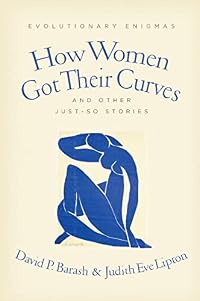
How Women Got Their Curves and Other Just-So Stories: Evolutionary Enigmas
by David P. Barash
On This Page
Description
So how did women get their curves? Why do they have breasts, while other mammals only develop breast tissue while lactating, and why do women menstruate, when virtually no other beings do so? What are the reasons for female orgasm? Why are human females kept in the dark about their own time of ovulation and maximum fertility, and why are they the only animals to experience menopause?David P. Barash and Judith Eve Lipton, coauthors of acclaimed books on human sexuality and gender, discuss the show more theories scientists have advanced to explain these evolutionary enigmas (sometimes called "Just-So stories" by their detractors) and present hypotheses of their own. Some scientific theories are based on legitimate empirical data, while others are pure speculation. Barash and Lipton distinguish between what is solid and what remains uncertain, skillfully incorporating their expert knowledge of biology, psychology, animal behavior, anthropology, and human sexuality into their entertaining critiques. Inviting readers to examine the evidence and draw their own conclusions, Barash and Lipton tell an evolutionary suspense story that captures the excitement and thrill of true scientific detection. show lessTags
Recommendations













Member Reviews
As an undergraduate, I had to write a paper for my evolution class on some mystery of evolution. I wanted to pick a topic I didn’t think my professor would know too much about, so I decided to research why human females have menstrual periods. It is a classic example of trying to determine the evolutionary cost/benefit to a part of half the population’s lives. Barash and Lipton (a husband/wife team of evolutionary biologist and psychiatrist) examine this and a handful of other “women’s mysteries” in this highly entertaining, well researched and approachable book.
This book is clearly intended for the reader who may not know all the details behind the theory of evolution, such as sexual versus natural selection or adaptive show more versus nonadaptive mutations. By reading this book, you’ll not only learn what those mean, you will gain insight into how a wide array of scientists contribute to the explanation of evolutionary mysteries.
While the chapter on menstruation was old news to me (almost all of the research I used in my paper was used by these authors, though they did leave out a random hypothesis about soy consumption), the chapters on breasts, orgasm, ovulation, and menopause were new. They even took some of the theories I had just accepted (such as breasts being a mimic of the buttocks and orgasm in women being akin to nipples on men—they are just there because of fetal development) and pointed out the flaws with those theories, the support and flaws for other theories, and their own theories. Unlike many books on similar topics, these authors concede that 1) there is no way one theory could explain everything about any of these topics; a constellation of factors could be at play and 2) they just don’t and can’t know all the answers.
Because this book was intended for a non-specialist crowd, some of the information tends to be repeated and some details are left out. However, I think most specialists or even courses on evolution would enjoy adding comments to this book. And let’s face it, half the fun of books showing us an array of hypotheses is ripping them to shreds! show less
This book is clearly intended for the reader who may not know all the details behind the theory of evolution, such as sexual versus natural selection or adaptive show more versus nonadaptive mutations. By reading this book, you’ll not only learn what those mean, you will gain insight into how a wide array of scientists contribute to the explanation of evolutionary mysteries.
While the chapter on menstruation was old news to me (almost all of the research I used in my paper was used by these authors, though they did leave out a random hypothesis about soy consumption), the chapters on breasts, orgasm, ovulation, and menopause were new. They even took some of the theories I had just accepted (such as breasts being a mimic of the buttocks and orgasm in women being akin to nipples on men—they are just there because of fetal development) and pointed out the flaws with those theories, the support and flaws for other theories, and their own theories. Unlike many books on similar topics, these authors concede that 1) there is no way one theory could explain everything about any of these topics; a constellation of factors could be at play and 2) they just don’t and can’t know all the answers.
Because this book was intended for a non-specialist crowd, some of the information tends to be repeated and some details are left out. However, I think most specialists or even courses on evolution would enjoy adding comments to this book. And let’s face it, half the fun of books showing us an array of hypotheses is ripping them to shreds! show less
Ratings
Members
- Recently Added By
Author Information

35 Works 1,425 Members
David P. Barash holds a Ph.D. in zoology & is professor of psychology & zoology at the University of Washington. He has been especially active in the growth & development of sociobiology as a scientific discipline. (Bowker Author Biography)
Series
Belongs to Publisher Series
Common Knowledge
- Original title
- How Women Got Their Curves and Other Just-So Stories: Evolutionary Enigmas
Classifications
- Genres
- Nonfiction, Science & Nature, Anthropology, General Nonfiction, Sexuality and Gender Studies
- DDC/MDS
- 305.4 — Social sciences Social sciences, sociology & anthropology Groups of people Women
- LCC
- GN281 .B368 — Geography, Anthropology and Recreation Anthropology Anthropology Physical anthropology. Somatology Human evolution
- BISAC
Statistics
- Members
- 49
- Popularity
- 611,843
- Reviews
- 1
- Rating
- (3.50)
- Languages
- English, German
- Media
- Paper, Ebook
- ISBNs
- 5