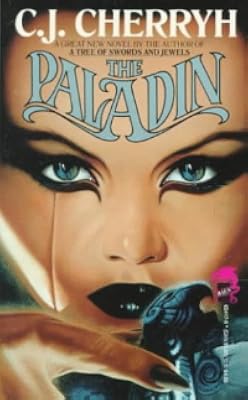
Paladín
by C. J. Cherryh
On This Page
Description
Now betrayed by the Emperor he once protected, master swordsman Saukendar leaves the way of the sword behind him forever-so he thinks. When a headstrong peasant girl burning to avenge her murdered family demands that he train her, Saukendar is faced with a momentous choice. Send Taizu away, never see her again-or join her and destroy the tyrant who has nearly destroyed them both.Tags
Recommendations
















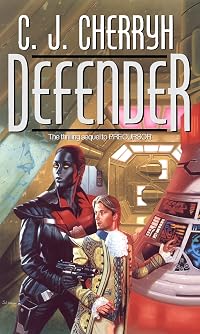
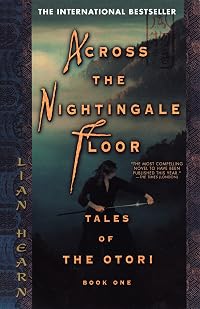
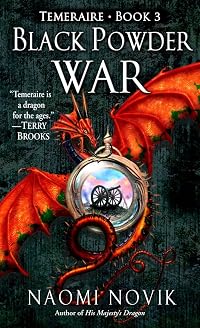
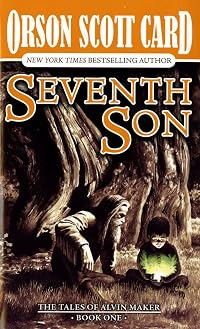
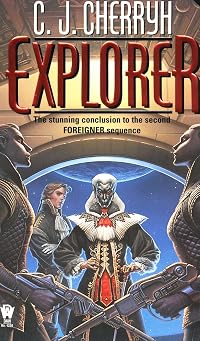
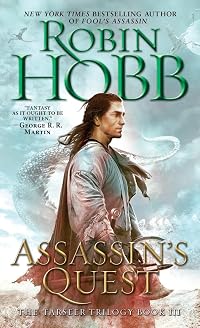
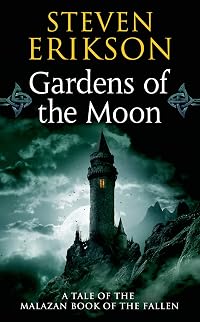
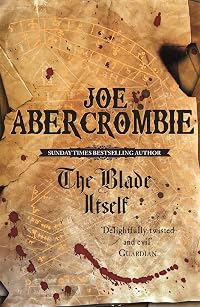

Member Recommendations
by anonymous user

by anonymous user

by anonymous user
Member Reviews
The only thing fantastical about this story is that it is set in a made-up place; there is no magic, other than the superstitions of the people. A young peasant girl whose whole family has been slaughtered, her province laid waste, turns up on the doorstep of exiled warrior/courtier Saukendar demanding to be trained so she can wreak revenge on the man who led the assault on her region. Girls and women are not trained in combat, it is illegal even for a woman to carry weapons, and Saukendar has the same prejudices as anyone else on the subject, so Taizu has a hard battle to convince him to train her and even then, he only slowly and grudgingly comes to teach her everything he knows. It was a most thoughtful portrayal of what a show more cross-gender apprenticeship in such a rigid culture might well be like: so that only a girl of extraordinary and unshakeable determination and stubbornness would break through to achieve respect. Saukendar reluctantly comes out of his exile and goes to meet what he always knew was his fate, freeing the young Emperor and putting decent rulers in charge of the Empire, even though he knows these efforts are never more than temporary, good eras followed by bad and on and on. Taizu is an inspiring character and one can hope that it is likely a culture-changing success, not simply an anomaly. She certainly won't stop being a warrior, she is always going to carry her own sword openly, you just know it and whose going to stop her! As always with Cherryh the story starts slowly and moves with lots of detail and inward thought but then moves to a wild climax. A small Cherryh gem. **** show less
Very much a traditional classic rags to riches fantasy tale, well crafted, but not Cherryh's finest work.
Shoka, master swordsman and bodyguard has retreated into exile following the death of the old emperor and rise of the Regent. He is beset by petitioners for nine years he turns them all away and lives his simple life on a mountain. Until Tzieu, a peasent girl, has the stubbeness to insist that he teaches her his skills, so that she can revenge her family. Initially unwilling, and knowing that a girl can never match the physical strength of a master swordsman, he cannot overcome her innate patience and teaches her as much as she can master. The relationship with his feisty student progresses until he finds the prospect of returning to show more solitary exile uncomfortable, and joins her in the quest for vengence, hoping some of his old demons from the Regent can be laid to rest as well.
Told from Shoka's point of view instead of the more traditional student's, it is a good tale of determination, love and courage in a world disintegrating into war.
Aftrer re-read:
The key difference between this and any other pigboy meets a master, gets trained and overcomes his enemies, is that the story is told from the point of view of the master. Very refreshing change, which completely alters the nature of the challenges. The 'unfairness' of the master and the menial nature of the initial training becomes instead a recluse resenting the interruption, and an old lamed man, attempting to cope with the challenges of life. Faced with the intractible stubbenness of a girl bent of revenge, Shoka slowly manages to come to terms with having a new student to train. The inevitable sexual tension between a master and his female student is touchingly detailed - a master's honour is a tocuhy issue, but a battered orphan isn't any more relaxed.
In some sense the concluding third - the action packed fights and flights as revenge is finally sought, is the least interesting. The places and rivers all blend together and the complex politics of lord's names likewise. But even this doesn't mar Cherryh's skill at weaving complex plots - for even decades later Shoka hasn't been forgotten by an empire that once honoured and feared his name. Maybe the old empire can come back after all. show less
Shoka, master swordsman and bodyguard has retreated into exile following the death of the old emperor and rise of the Regent. He is beset by petitioners for nine years he turns them all away and lives his simple life on a mountain. Until Tzieu, a peasent girl, has the stubbeness to insist that he teaches her his skills, so that she can revenge her family. Initially unwilling, and knowing that a girl can never match the physical strength of a master swordsman, he cannot overcome her innate patience and teaches her as much as she can master. The relationship with his feisty student progresses until he finds the prospect of returning to show more solitary exile uncomfortable, and joins her in the quest for vengence, hoping some of his old demons from the Regent can be laid to rest as well.
Told from Shoka's point of view instead of the more traditional student's, it is a good tale of determination, love and courage in a world disintegrating into war.
Aftrer re-read:
The key difference between this and any other pigboy meets a master, gets trained and overcomes his enemies, is that the story is told from the point of view of the master. Very refreshing change, which completely alters the nature of the challenges. The 'unfairness' of the master and the menial nature of the initial training becomes instead a recluse resenting the interruption, and an old lamed man, attempting to cope with the challenges of life. Faced with the intractible stubbenness of a girl bent of revenge, Shoka slowly manages to come to terms with having a new student to train. The inevitable sexual tension between a master and his female student is touchingly detailed - a master's honour is a tocuhy issue, but a battered orphan isn't any more relaxed.
In some sense the concluding third - the action packed fights and flights as revenge is finally sought, is the least interesting. The places and rivers all blend together and the complex politics of lord's names likewise. But even this doesn't mar Cherryh's skill at weaving complex plots - for even decades later Shoka hasn't been forgotten by an empire that once honoured and feared his name. Maybe the old empire can come back after all. show less
Wow. We certainly get down in the mud and blood with this. No training montage here - 2/3rds of the book is Taizu's training, and Shoka/Saukendar's dealing with the whole matter. It takes him a long time to move from limited, cut-down training to pushing her to her limits and beyond - that's where a lot of the mud and blood come in, as she realizes he's coddling her and pushes him to the next level. It's a single POV - we never get Taizu's take on things, it's all Shoka. It's also a detailed description of long-term sexual harassment - Shoka never quite pushes, but he never lets up either. I don't think Taizu was forced into anything, but she was certainly never allowed to forget what Shoka wanted. Then the last third or so of the book show more is Taizu going out to deal with the man who destroyed her home and family, and Shoka insisting on coming along - and then things snowball. I found the dragon rumor the most amusing part. And a happy ending, of sorts - I don't think they'll get their peaceful mountain home anymore, but it'll be a good bit better than trying to fit in at court, for both of them. show less
A re-read for me, I've owned a paperback copy for many years, but recently acquired the ebook version.
A pseudo-Oriental low fantasy that's well worth reading.
An aging warlord is living the life of a hermit having retreated from politics after the death of his childhood sweetheart who was married to the Imperial Heir by order of the old Emperor, and executed for adultery along with the Regent after the death of the old Emperor. Greedy and self-seeking men have seized power, and rule in the young Emperor's name even though the regency should have ended.
A peasant girl comes and disturbs his solitude, seeking revenge on one of the Regent's cronies who has killed her lord and her brothers. She persuades the warlord to train her in the arts show more of war and swordsmanship in exchange for acting as his servant. The warlord would prefer her to share his bed but she refuses and he is too honourable to force the matter although he thinks it would be best for her in the long run to give up the desire for revenge and become a wife and mother, if not a nun. (Although not explicitly stated, it's likely she was raped on her journey across the Empire and fears intimacy.)
The first half of the book deals with her training and the growing attraction both have for each other. It's quite slow-moving - it covers the period of about 2 years. The pace picks up dramatically in the second half when the couple leave their retreat and head to exact retribution on the Regent's crony. On the way, they manage to raise the provinces to rebel and attack the capital and the Regent, and against all odds, they succeed in destroying the Regency.
At the time, it read like a breath of fresh air amid the reams of pseudo medieval high fantasies in vogue at the time. Re-reading it after the space of a couple of decades, the relationship between the warlord and the peasant girl now comes across as a bit pervy given the age difference between the two, but there is a historical precedent in the age difference given that many women died in childbed, and were 'replaced' after a suitable period of mourning. Oddly, it's not the first book I've read recently with the same plotline - Hambly's Darwath series springs to mind, and Peter S Beagle's [b]In Calabria[/b].
Recommended show less
A pseudo-Oriental low fantasy that's well worth reading.
An aging warlord is living the life of a hermit having retreated from politics after the death of his childhood sweetheart who was married to the Imperial Heir by order of the old Emperor, and executed for adultery along with the Regent after the death of the old Emperor. Greedy and self-seeking men have seized power, and rule in the young Emperor's name even though the regency should have ended.
A peasant girl comes and disturbs his solitude, seeking revenge on one of the Regent's cronies who has killed her lord and her brothers. She persuades the warlord to train her in the arts show more of war and swordsmanship in exchange for acting as his servant. The warlord would prefer her to share his bed but she refuses and he is too honourable to force the matter although he thinks it would be best for her in the long run to give up the desire for revenge and become a wife and mother, if not a nun. (Although not explicitly stated, it's likely she was raped on her journey across the Empire and fears intimacy.)
The first half of the book deals with her training and the growing attraction both have for each other. It's quite slow-moving - it covers the period of about 2 years. The pace picks up dramatically in the second half when the couple leave their retreat and head to exact retribution on the Regent's crony. On the way, they manage to raise the provinces to rebel and attack the capital and the Regent, and against all odds, they succeed in destroying the Regency.
At the time, it read like a breath of fresh air amid the reams of pseudo medieval high fantasies in vogue at the time. Re-reading it after the space of a couple of decades, the relationship between the warlord and the peasant girl now comes across as a bit pervy given the age difference between the two, but there is a historical precedent in the age difference given that many women died in childbed, and were 'replaced' after a suitable period of mourning. Oddly, it's not the first book I've read recently with the same plotline - Hambly's Darwath series springs to mind, and Peter S Beagle's [b]In Calabria[/b].
Recommended show less
Okay. For the first two thirds or so, this was a full-on five-star book. It was a completely awesome story of a reclusive master swordsman who lives on a mountain in the middle of nowhere, and this girl who comes and insists he train her.
Totally great. I love an apprentice story, which is basically a makeover story (and I have probably said before that I LOVE makeover stories), and the characters were interesting and behaved like normal, stupid people.
AND THEN, just when things are getting good, they go off and get caught up in an EXTREMELY BORING WAR that lasts for the entire rest of the book. Seriously, I read the first part in one day and the rest took me almost a week to finish. sigh.
Totally great. I love an apprentice story, which is basically a makeover story (and I have probably said before that I LOVE makeover stories), and the characters were interesting and behaved like normal, stupid people.
AND THEN, just when things are getting good, they go off and get caught up in an EXTREMELY BORING WAR that lasts for the entire rest of the book. Seriously, I read the first part in one day and the rest took me almost a week to finish. sigh.
A solid effort from Cherryh. It was both gripping and pleasingly character-focused, and I felt that the obvious Asian influences on the setting were handled with respect. The first half was, I think, stronger than the second half, which felt rushed in comparison, but it was a satisfying read none the less.
I really enjoyed this gem of a book, which resonated deeply with me and which I expect I’ll reread from time to time. No magic and no science fiction, just cold steel and women and men. It might not be everyone’s cup of tea but it was the right book at the right time for me.
Members
- Recently Added By
Lists

Fantasy by Women Who Broke Away from Europe
144 works; 12 members

Favorite Science Fiction by Women Authors
737 works; 197 members
Author Information

256+ Works 74,944 Members
A multiple award-winning author of more than thirty novels, C. J. Cherryh received her B.A. in Latin from the University of Oklahoma, and then went on to earn a M.A. in Classics from Johns Hopkins University. Cherryh's novels, including Tripoint, Cyteen, and The Pride of Chanur, are famous for their knife-edge suspense and complex, realistic show more characters. Cherryh won the John W. Campbell Award for Best New Writer in 1977. She was also awarded the Hugo Award for her short story Cassandra in 1979, and the novels Downbelow Station in 1982 and Cyteen in 1989. (Bowker Author Biography) show less
Some Editions
Series
Belongs to Publisher Series
Work Relationships
Is contained in
Common Knowledge
- Canonical title
- Paladín
- Original title
- Paladin
- Original publication date
- 1988-07
- People/Characters
- Saukendar / Shoka; Taizu
- Important places
- Mon, Chiyaden
- First words
- They were haunted hills.
- Last words
- (Click to show. Warning: May contain spoilers.)"Never," he said.
- Original language
- English
Classifications
Statistics
- Members
- 1,036
- Popularity
- 24,958
- Reviews
- 20
- Rating
- (3.74)
- Languages
- Czech, English, German, Spanish
- Media
- Paper, Audiobook, Ebook
- ISBNs
- 10
- ASINs
- 5