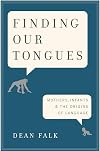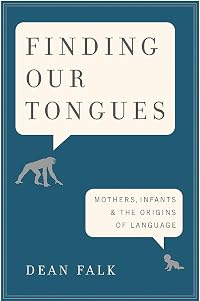
Finding Our Tongues: Mothers, Infants, and the Origins of Language
by Dean Falk
On This Page
Description
A controversial new theory that the origins of spoken language, music, and art lie in the early communication between mothers and infantsTags
Recommendations













Member Reviews
This is interesting so far. The idea behind it all is our upright walking created smaller birth canals (well established) which created the need for smaller, more dependent babies (well established), which created the need to talk to babies because the babies weren't strong enough to cling to mom's tummy or back and thus got laid down nearby while mom took care of various tasks (makes sense...). This created motherese (debatable) which was the beginning of language (the author's pet theory). Totally interesting.
I read two thirds of this, but can't bother finishing it. The theory is interesting, but unprovable either way. Reading the German translation may be part of the problem.
Ratings
Members
- Recently Added By
Lists

Great Books About Language
73 works; 45 members
Author Information

8+ Works 184 Members
Dean Falk is a Distinguished Research Professor and the Hale G. Smith Professor of Anthropology at Florida State University and a Senior Scholar at the School for Advanced Research in Santa Fe, New Mexico. Among her earlier books are Finding Our Tongues: Mothers, Infants, and the Origins of Language and 'The Fossil Chronicles: How Two show more Controversial Discoveries Changed Our View of Human Evolution. show less
Common Knowledge
- Canonical title
- Finding Our Tongues: Mothers, Infants, and the Origins of Language
- Alternate titles
- Finding Our Tongues
- Original publication date
- 2009
- People/Characters
- Jane Goodall; Sarah Hrdy
- First words
- Preface
How language began is a deeply challenging question—intellectually, philosophically, and emotionally.
Classifications
Statistics
- Members
- 53
- Popularity
- 572,673
- Reviews
- 2
- Rating
- (3.50)
- Languages
- English, German, Italian
- Media
- Paper, Ebook
- ISBNs
- 6
- ASINs
- 3