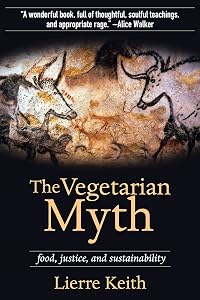
The Vegetarian Myth: Food, Justice, and Sustainability
by Lierre Keith
On This Page
Description
From the Publisher: Part memoir, nutritional primer, and political manifesto, this controversial examination exposes the destructive history of agriculture-causing the devastation of prairies and forests, driving countless species extinct, altering the climate, and destroying the topsoil-and asserts that, in order to save the planet, food must come from within living communities. In order for this to happen, the argument champions eating locally and sustainably and encourages those with the show more resources to grow their own food. Further examining the question of what to eat from the perspective of both human and environmental health, the account goes beyond health choices and discusses potential moral issues from eating-or not eating-animals. Through the deeply personal narrative of someone who practiced veganism for 20 years, this unique exploration also discusses alternatives to industrial farming, reveals the risks of a vegan diet, and explains why animals belong on ecologically sound farms. show lessTags
Recommendations


Member Reviews
To say that I hated this book would be incorrect. It's not that there's much in this book to hate, it's too vacillating, confusing, and utterly contradictory for that. Simply put, this book is under-researched and laden with unsupported statements, speculations and anecdotes. The only thing to hate about this book is that people will read it, trusting Keith to have given them good, true, useful information, and go on to make bad dietary choices.
The first problem with this book is that it almost never attacks veganism. It does attack many things: agriculture, big corporations, industrialization, environmental destruction, factory farms, and low fat diets (to name just a few). I think you'd be hard pressed to find any veg*ns who don't show more also believe that most, if not all, of the above mentioned have terrible ramifications and should be prevented. While not all US veg*ns are committed to ending the destruction of our planet, I think that many become enlightened as to the problems with many of the systems of our US culture and become committed to ending them.
So really, this book could have been called "The Agriculture Myth," but that wouldn't have generated as much shock value or sold as many books.
Keith does a makes a lot of radical statements, and then goes on to list many unrelated (and mostly un-referenced) "facts" that don't substantiate that claim, implying that the "facts" directly support her radical statements. For example, she states that veg*ns eat grains, grains are made out of carbohydrates which are turned into glucose and lead to diabetes. This implies that all veg*ns are at high risk of developing diabetes. Is there any peer-reviewed study referenced that makes this statement directly? Of course not. She leaves it to you to jump the gaps between her unsupported statements to make your own conclusions.
Keith also likes to take facts to their logical extremes. Eating plants destroys microorganisms and insects, therefore veg*nism is a product of death. So you may as well eat meat. Annual grains destroy soil and lead to monocrops of annual plants. Hence anybody who eats grains is directly causing the destruction of topsoil. Humans can't eat cellulose, and cows can, therefore humans should eat cows and not plants. I would say that this is a faulty philosophical system at best. It's also a great way to build up big straw-person arguments to support a point.
The "Nutritional" chapter of this book was really the worst of it, and here's why. According to Keith - who assumes that the plural of anecdote is data - here are approximately some of the problems I, a vegan, should be suffering from:
memory loss, depression, anorexia, diabetes, vitamin defficiency, "holes in [my] brain", exhaustion, breast cancer, Alzheimer's, bad teeth, digestive inflammation, rage, bone and joint problems, menstrual problems, fibroids, cysts, giving birth to babies with birth defects, thyroid problems, coldness, dry skin, early death and suicide
Whew. Unfortunately for her thesis (and fortunately for me), I do not and have not suffered from any of the above ailments. I'm sorry that Keith suffers from terrible health issues, but to assume that everybody has the same life experiences as her is incorrect. To assume that her health issues were directly related to veganism is also probably incorrect, but not being a doctor or nutritionist, I'm not qualified to make that claim. (Nor is she.)
Keith also drags out a lot of those tired, old, debunked stereotypes about veg*ns. You've heard them. We don't eat any fat or protein. We're sick all the time. Male veg*ns grow boobs because they eat too much soy. Really?
At one point Keith rails against conflating correlation and causation, on approximately page 164. I agree. I'm a scientist and a natural skeptic, and I know a thing or two about statistics. Rewind to page 151: "[E]pidemiologists do know that multiple sclerosis... is most prevalent in cultures where wheat and rye are staple foods." Did you catch the correlation being confused for causation in that statement? It's not blatant, but subtle and implied. Fast forward to page 172: "The past fifteen years have seen a reduction in fat consumption of almost 25 percent... Did you get healthier? Or did you notice that the incidence of diseases commonly blamed on animal products has gone from high to epidemic?" Maybe Keith just doesn't realize that those correlated facts aren't necessarily directly related, but she goes through such great pains to tell us how smart and enlightened she is that I'm sure she realizes it.
There are some truly baffling statements in this book. "Anorexics have holes in their brains; so do eaters of soy." Needless to say, that statement wasn't followed up by a reference. Also, "remember the many happy endings provided by another estrogen mimic [she is referring to soy isoflavones], diethylstilbestrol, aka DES." Soy products aren't synthetic estrogens, so why compare them like this?
Keith also imparts on veg*ns the mindset of the naive, the hopelessly child-like and the ignorant. Such a patronizing attitude is insulting and hostile. I don't know what Keith hopes to gain from making such an attack, and it is clearly not backed up by any peer reviewed scientific research, but Keith's own prejudices.
This book is just plain bad. There is no general thesis, no cohesion, just a long, rant-filled look at how terrible veg*nism (but more likely, Big Ag) is. If you were to take the points in this book to their logical conclusion, you would have to eat a diet composed entirely of raw meat that you hunted yourself from indigenous animals that forage on polycultures of perennials. Good luck with that. show less
The first problem with this book is that it almost never attacks veganism. It does attack many things: agriculture, big corporations, industrialization, environmental destruction, factory farms, and low fat diets (to name just a few). I think you'd be hard pressed to find any veg*ns who don't show more also believe that most, if not all, of the above mentioned have terrible ramifications and should be prevented. While not all US veg*ns are committed to ending the destruction of our planet, I think that many become enlightened as to the problems with many of the systems of our US culture and become committed to ending them.
So really, this book could have been called "The Agriculture Myth," but that wouldn't have generated as much shock value or sold as many books.
Keith does a makes a lot of radical statements, and then goes on to list many unrelated (and mostly un-referenced) "facts" that don't substantiate that claim, implying that the "facts" directly support her radical statements. For example, she states that veg*ns eat grains, grains are made out of carbohydrates which are turned into glucose and lead to diabetes. This implies that all veg*ns are at high risk of developing diabetes. Is there any peer-reviewed study referenced that makes this statement directly? Of course not. She leaves it to you to jump the gaps between her unsupported statements to make your own conclusions.
Keith also likes to take facts to their logical extremes. Eating plants destroys microorganisms and insects, therefore veg*nism is a product of death. So you may as well eat meat. Annual grains destroy soil and lead to monocrops of annual plants. Hence anybody who eats grains is directly causing the destruction of topsoil. Humans can't eat cellulose, and cows can, therefore humans should eat cows and not plants. I would say that this is a faulty philosophical system at best. It's also a great way to build up big straw-person arguments to support a point.
The "Nutritional" chapter of this book was really the worst of it, and here's why. According to Keith - who assumes that the plural of anecdote is data - here are approximately some of the problems I, a vegan, should be suffering from:
memory loss, depression, anorexia, diabetes, vitamin defficiency, "holes in [my] brain", exhaustion, breast cancer, Alzheimer's, bad teeth, digestive inflammation, rage, bone and joint problems, menstrual problems, fibroids, cysts, giving birth to babies with birth defects, thyroid problems, coldness, dry skin, early death and suicide
Whew. Unfortunately for her thesis (and fortunately for me), I do not and have not suffered from any of the above ailments. I'm sorry that Keith suffers from terrible health issues, but to assume that everybody has the same life experiences as her is incorrect. To assume that her health issues were directly related to veganism is also probably incorrect, but not being a doctor or nutritionist, I'm not qualified to make that claim. (Nor is she.)
Keith also drags out a lot of those tired, old, debunked stereotypes about veg*ns. You've heard them. We don't eat any fat or protein. We're sick all the time. Male veg*ns grow boobs because they eat too much soy. Really?
At one point Keith rails against conflating correlation and causation, on approximately page 164. I agree. I'm a scientist and a natural skeptic, and I know a thing or two about statistics. Rewind to page 151: "[E]pidemiologists do know that multiple sclerosis... is most prevalent in cultures where wheat and rye are staple foods." Did you catch the correlation being confused for causation in that statement? It's not blatant, but subtle and implied. Fast forward to page 172: "The past fifteen years have seen a reduction in fat consumption of almost 25 percent... Did you get healthier? Or did you notice that the incidence of diseases commonly blamed on animal products has gone from high to epidemic?" Maybe Keith just doesn't realize that those correlated facts aren't necessarily directly related, but she goes through such great pains to tell us how smart and enlightened she is that I'm sure she realizes it.
There are some truly baffling statements in this book. "Anorexics have holes in their brains; so do eaters of soy." Needless to say, that statement wasn't followed up by a reference. Also, "remember the many happy endings provided by another estrogen mimic [she is referring to soy isoflavones], diethylstilbestrol, aka DES." Soy products aren't synthetic estrogens, so why compare them like this?
Keith also imparts on veg*ns the mindset of the naive, the hopelessly child-like and the ignorant. Such a patronizing attitude is insulting and hostile. I don't know what Keith hopes to gain from making such an attack, and it is clearly not backed up by any peer reviewed scientific research, but Keith's own prejudices.
This book is just plain bad. There is no general thesis, no cohesion, just a long, rant-filled look at how terrible veg*nism (but more likely, Big Ag) is. If you were to take the points in this book to their logical conclusion, you would have to eat a diet composed entirely of raw meat that you hunted yourself from indigenous animals that forage on polycultures of perennials. Good luck with that. show less
Напоследък стана много модерно да си здравословен, да се храниш природосъобразно и здравословно. Колкото хора има, толкова и идеи за това какво е здравословно хранене съществуват, но особено разпространено е вярването, че месото е вредно и най-добре е да се избягва. Вегетарианците са много, сила набират и веганите - които никакви животински продукти не употребяват, за да са здрави и да спасят планетата.
show more
Авторката 20 години е била запален веган-активист, при което липсата на незаменими аминокиселини нанася непоправими вреди на организма й - костната и нервна система. Когато болките от заболяването й стават по-силни от идеологичните убеждения, тя започва да чете научни книги и материали, да изучава човешката физиология и хранене и разбира, че животинските продукти (протеини и мазнини) са жизненоважни за човека.
По-интересното в книгата обаче са представените факти и изводите относно еволюцията на някои растителни видове, по-специално зърнените култури и реакцията на човешкия организъм спрямо някои произвеждани от тях вещества. Накратко казано, авторката извежда тезата, че зърнените храни предизвикват у хората лека наркотична зависимост и именно затова е толкова трудно да се откажем от топлия хляб примерно.
Изключително забавна част от книгата пък са описанията и изводите относно вегетарианската и веганската част от населението, към която авторката се е причислявала толкова време. Става ясно, че това са хора които са изцяло движени от идеология (да спасим планетата, да не убиваме животни, да сме едно с природата) и вижданията им за природата и екологията са на елементарно, детско ниво, без почти никакви реални знания.
Частта относно индустриалното фермерство е особено информативна, за това как то разрушава почвения слой и екосистемите на Земята. Изводът на авторката е че изходът е в устойчивото фермерство, където животни и растения се отглеждат така, както едно време прабаба ти го е правила - телетата ядеш, а с тора им наторяваш градината. Което не е зле като идея, ако можеш да си позволиш с това да се занимаваш.
Като цяло, книгата засяга изключително широк кръг от теми, вкл. феминистични и социалистическите виждания на авторката, с които не съм съгласен, но е толкова добра в обяснението на мита за полезното вегетарианство, че я смятам за една от задължителните за прочитане книги, които препоръчвам на всичките си познати. show less
show more
Авторката 20 години е била запален веган-активист, при което липсата на незаменими аминокиселини нанася непоправими вреди на организма й - костната и нервна система. Когато болките от заболяването й стават по-силни от идеологичните убеждения, тя започва да чете научни книги и материали, да изучава човешката физиология и хранене и разбира, че животинските продукти (протеини и мазнини) са жизненоважни за човека.
По-интересното в книгата обаче са представените факти и изводите относно еволюцията на някои растителни видове, по-специално зърнените култури и реакцията на човешкия организъм спрямо някои произвеждани от тях вещества. Накратко казано, авторката извежда тезата, че зърнените храни предизвикват у хората лека наркотична зависимост и именно затова е толкова трудно да се откажем от топлия хляб примерно.
Изключително забавна част от книгата пък са описанията и изводите относно вегетарианската и веганската част от населението, към която авторката се е причислявала толкова време. Става ясно, че това са хора които са изцяло движени от идеология (да спасим планетата, да не убиваме животни, да сме едно с природата) и вижданията им за природата и екологията са на елементарно, детско ниво, без почти никакви реални знания.
Частта относно индустриалното фермерство е особено информативна, за това как то разрушава почвения слой и екосистемите на Земята. Изводът на авторката е че изходът е в устойчивото фермерство, където животни и растения се отглеждат така, както едно време прабаба ти го е правила - телетата ядеш, а с тора им наторяваш градината. Което не е зле като идея, ако можеш да си позволиш с това да се занимаваш.
Като цяло, книгата засяга изключително широк кръг от теми, вкл. феминистични и социалистическите виждания на авторката, с които не съм съгласен, но е толкова добра в обяснението на мита за полезното вегетарианство, че я смятам за една от задължителните за прочитане книги, които препоръчвам на всичките си познати. show less
God damn it. I really did not want this book to be true. I hated it when it came out, I cheered when vegan anarchists in my hometown of San Francisco threw a pepper-laced pie in Keith's face. Such an angry vegan was I. I wrote a whole book about factory farms and I have a vegan tattoo.
And I can't do it anymore.
Depression? Check. Anger? Check. Exhaustion? Check. Mild eating disorder? Check. Apparently these are not symptoms of living in 21st century America, but rather, of not eating meat. And I believe it. I've been "vegan" since I was about 17 and there hasn't been a solid year in the last decade that I haven't eaten meat and dairy at some point. If I can't stick to it, maybe it's because we aren't meant to.
The idea that my suicidal show more thoughts are just a dietary deficiency is revolutionary to me. Is that the case for everyone? No, and she makes that quite clear in the book. But my story sounded far too much like hers: a girl in her twenties with no health problems can't even walk up a flight of stairs or make it through a day of work. And then I eat meat, and I feel better. And hate myself for it.
I think her most powerful points are about grain production and oil. I don't own a car and I try to bike everywhere. I sold my car right around the time of the BP oil spill and never looked back. But veganism isn't the answer to our environmental problems - it is, in fact, part of the problem. This is something we as vegans put our fingers in our ears and went "la la la la la" to whenever someone tried to bring it up.
Is this the greatest book ever? No. Her writing is at times awkward, and she could have cited more nonpartisan sources, but at the end of it, her theories are sound and the evidence is overwhelming. It explains too much of why I have suffered for so long.
You should read this book if you've ever 1) been vegetarian or vegan 2) care about the environment 3) care about animals 4) want to understand humanity's place in the "food system" or 5) live in a big city or urban area and have no access to your own food. It's not perfect but it is radical and revolutionary in a culture that's increasingly losing touch with reality and coming up with dumber and simpler ways to "save" the planet. show less
And I can't do it anymore.
Depression? Check. Anger? Check. Exhaustion? Check. Mild eating disorder? Check. Apparently these are not symptoms of living in 21st century America, but rather, of not eating meat. And I believe it. I've been "vegan" since I was about 17 and there hasn't been a solid year in the last decade that I haven't eaten meat and dairy at some point. If I can't stick to it, maybe it's because we aren't meant to.
The idea that my suicidal show more thoughts are just a dietary deficiency is revolutionary to me. Is that the case for everyone? No, and she makes that quite clear in the book. But my story sounded far too much like hers: a girl in her twenties with no health problems can't even walk up a flight of stairs or make it through a day of work. And then I eat meat, and I feel better. And hate myself for it.
I think her most powerful points are about grain production and oil. I don't own a car and I try to bike everywhere. I sold my car right around the time of the BP oil spill and never looked back. But veganism isn't the answer to our environmental problems - it is, in fact, part of the problem. This is something we as vegans put our fingers in our ears and went "la la la la la" to whenever someone tried to bring it up.
Is this the greatest book ever? No. Her writing is at times awkward, and she could have cited more nonpartisan sources, but at the end of it, her theories are sound and the evidence is overwhelming. It explains too much of why I have suffered for so long.
You should read this book if you've ever 1) been vegetarian or vegan 2) care about the environment 3) care about animals 4) want to understand humanity's place in the "food system" or 5) live in a big city or urban area and have no access to your own food. It's not perfect but it is radical and revolutionary in a culture that's increasingly losing touch with reality and coming up with dumber and simpler ways to "save" the planet. show less
The author brought up some interesting points and I even believe her about the devastation that agriculture has wrought on our ecosystem. But I think she is being too idealistic in thinking we can change the landscape enough to reverse the damage of the last 10 thousand years (at least enough to support a population of 7 billion and growing).
I suppose I have a pessimistic outlook but I would prefer to stay closer to realism than idealism. We need to understand that even if we cleaned up all the messes we've created industrially, agriculturally, etc., there are emerging 3rd world countries with billions of people who are poised to strike the death blow to Earth as we know it. It's bleak but a very real danger.
Understanding that this book show more was aimed more at vegan and vegetarian democrats than meat-eating libertarians like me, I still enjoyed the very informative presentation. I had no idea that a vegetarian diet was so damaging to our bodies (or to the soil, for that matter). I respect what the author was trying to do and to the extent that we can do it, I'm on board. I will make a greater effort to consume more local food than previously and I'm glad I read this book. show less
I suppose I have a pessimistic outlook but I would prefer to stay closer to realism than idealism. We need to understand that even if we cleaned up all the messes we've created industrially, agriculturally, etc., there are emerging 3rd world countries with billions of people who are poised to strike the death blow to Earth as we know it. It's bleak but a very real danger.
Understanding that this book show more was aimed more at vegan and vegetarian democrats than meat-eating libertarians like me, I still enjoyed the very informative presentation. I had no idea that a vegetarian diet was so damaging to our bodies (or to the soil, for that matter). I respect what the author was trying to do and to the extent that we can do it, I'm on board. I will make a greater effort to consume more local food than previously and I'm glad I read this book. show less
This was one of the more controversial books we carried this year. A quick look at the online reviews will tell you the same thing - people are worked up about this thing. Lierre Keith is a brave, brave woman. I wouldn't want to pick a fight with every vegan in the world at the same time.
What I think has been lost in the furor is that her point - the heart of her point, at any rate - is very simple, and very hard to argue with. We take turns eating and being eaten - we consume today, but will be consumed in our turn. If you stop to think about this simple fact, and how it weaves all of us on earth together into an unending cycle of renewal and need, it can give you shivers. It's holy. And it's an idea that encourages us to be more show more reverent towards all of our food - not just the food with faces, but all of it, the seeds and fruit and leaves, and even the soil itself, richly and deeply alive.
To be reverent and respectful is to think about where your food comes from. It's not enough to give up animal products and think you're doing the world any favors. Monocrops and industrial agriculture, reliant as they are on huge amounts of water, fossil fuel, and chemicals, are not sustainable. And they're slaughtering animal and insect life all around them, so that even your vegetarian meal carries a heavy toll. And who is growing and processing your food, and how? How much fossil fuel is used to get it to your plate? It's at the very least a gross mistake for vegans to feel that their dietary choices have exempted them from considering these things. At worst it's a self-serving lie.
Honestly, I don't care if people are vegan or not. I have known healthy vegans and seriously emaciated unhealthy vegans, who really just needed to eat a steak or something. Keith's nutritional arguments in favor of meat eating are well constructed and meticulously footnoted, but I think it's a little beside the point. Which is hard to argue with: we are not, as a people, healthy, and we are quickly fucking up the earth.
There are some flaws in the book. People have taken issue with her flowery, personally revealing narrative, but I thought it was lovely and compassionate. She could have drawn from a wider range of books for her research, but that's a minor quibble. A larger point of issue is her attack on agriculture. It seems clear that the advent of large scale single crop agriculture brought with it a decline in ecological and human health. But the hunter gathering model, which she favors, isn't an entirely unagricultural enterprise. Many such societies managed certain resources - plants, berries, shellfish - for maximum yields, or controlled the environment in other ways, like by burning. If this is the model to strive for - semi-wild, with a diversity of plant and animal life mixed in (including meat and dairy animals) - then what we're looking at is starting to sound a lot like permaculture. Right? Maybe I'm just being too picky about terminology.
Anyway, there is a great deal to chew on in this book. I can see it stimulating some great discussions, and helping spur people to action. It's unfortunate that the online discussions I've seen have sort of devolved into mudslinging, though given the deep philosophical feelings of the vegan community, it's not surprising. show less
What I think has been lost in the furor is that her point - the heart of her point, at any rate - is very simple, and very hard to argue with. We take turns eating and being eaten - we consume today, but will be consumed in our turn. If you stop to think about this simple fact, and how it weaves all of us on earth together into an unending cycle of renewal and need, it can give you shivers. It's holy. And it's an idea that encourages us to be more show more reverent towards all of our food - not just the food with faces, but all of it, the seeds and fruit and leaves, and even the soil itself, richly and deeply alive.
To be reverent and respectful is to think about where your food comes from. It's not enough to give up animal products and think you're doing the world any favors. Monocrops and industrial agriculture, reliant as they are on huge amounts of water, fossil fuel, and chemicals, are not sustainable. And they're slaughtering animal and insect life all around them, so that even your vegetarian meal carries a heavy toll. And who is growing and processing your food, and how? How much fossil fuel is used to get it to your plate? It's at the very least a gross mistake for vegans to feel that their dietary choices have exempted them from considering these things. At worst it's a self-serving lie.
Honestly, I don't care if people are vegan or not. I have known healthy vegans and seriously emaciated unhealthy vegans, who really just needed to eat a steak or something. Keith's nutritional arguments in favor of meat eating are well constructed and meticulously footnoted, but I think it's a little beside the point. Which is hard to argue with: we are not, as a people, healthy, and we are quickly fucking up the earth.
There are some flaws in the book. People have taken issue with her flowery, personally revealing narrative, but I thought it was lovely and compassionate. She could have drawn from a wider range of books for her research, but that's a minor quibble. A larger point of issue is her attack on agriculture. It seems clear that the advent of large scale single crop agriculture brought with it a decline in ecological and human health. But the hunter gathering model, which she favors, isn't an entirely unagricultural enterprise. Many such societies managed certain resources - plants, berries, shellfish - for maximum yields, or controlled the environment in other ways, like by burning. If this is the model to strive for - semi-wild, with a diversity of plant and animal life mixed in (including meat and dairy animals) - then what we're looking at is starting to sound a lot like permaculture. Right? Maybe I'm just being too picky about terminology.
Anyway, there is a great deal to chew on in this book. I can see it stimulating some great discussions, and helping spur people to action. It's unfortunate that the online discussions I've seen have sort of devolved into mudslinging, though given the deep philosophical feelings of the vegan community, it's not surprising. show less
The author outlines the ridiculousness of the Vegan and Vegetarian mythos and digs into political, social, moral, nutritional, and most importantly, the sustainable aspects of eating... and ultimately our footprint, as a species, on planet Earth.
For this reader there was no huge revelations, since I'm well versed in the realities of agriculture and food at this point, and spend a great deal of time immersed in the natural and agricultural world, but the author nicely packages a fairly comprehensive discussion of the topic into this volume. There is a disturbing element to having all this laid out in one volume though: As you read it, it really underscores the pervasiveness of a community of folks that live their lives entirely divorced show more from the realities of the natural world and the cycles of life, death, and rebirth. I don't want to sound overly harsh, but it is a bit unavoidable. These are folks that look at nature from inside a bubble... through a pane of glass. Never really understanding it. Some is their fault, but it is a societal disorder, long in coming considering urbanization and how housebound most people in the 1st world are today.
The other disturbing element to the story as outlined by the author, is that though we know what we need to do to address the deeper ecological realities of massive over-population on this planet I personally am not confident that we'll take the necessary steps, and I don't think the author is either.
And that is where the biggest surprise of the book was found. The author was not afraid to summarize the corrective course of action that we would have to take as humans to make things better. Finally someone is bold enough, in a relatively mainstream book, to state that in order to ever have a sustainable, ecological, and ethical food system (or any system)... over-population really needs to be addressed. Severely. It will solve itself eventually, but it can either be messy and violent, or orderly and peaceful. Not many authors writing a mainstream book are bold enough to state it so plainly.
4 stars: There are three issues I had with the book: (1) The author slips into "appeal to emotion" a bit much, (2) It's hard to weed out the good science from the bad or mediocre, and (3) There is no index... which means you have to take notes, write in the margins, and highlight, or just have a really good memory. ;) Geez. Books like this *have* to have an index. I blame her editors. What a disappointment.
Great book. Folks, if you are confused as to why the vegan/vegetarian lifestyle is unsustainable, unnatural, relatively unhealthy, un-ecological, and ultimately more than a bit silly (but with non-silly implications)... this is a great book to to read. Even more importantly, it is a great discussion about environmentalism, food security, and agricultural sustainability, and of course, overpopulation -- topics that I am particularly passionate about, even more so than the main topic of the book.
Recommend. show less
For this reader there was no huge revelations, since I'm well versed in the realities of agriculture and food at this point, and spend a great deal of time immersed in the natural and agricultural world, but the author nicely packages a fairly comprehensive discussion of the topic into this volume. There is a disturbing element to having all this laid out in one volume though: As you read it, it really underscores the pervasiveness of a community of folks that live their lives entirely divorced show more from the realities of the natural world and the cycles of life, death, and rebirth. I don't want to sound overly harsh, but it is a bit unavoidable. These are folks that look at nature from inside a bubble... through a pane of glass. Never really understanding it. Some is their fault, but it is a societal disorder, long in coming considering urbanization and how housebound most people in the 1st world are today.
The other disturbing element to the story as outlined by the author, is that though we know what we need to do to address the deeper ecological realities of massive over-population on this planet I personally am not confident that we'll take the necessary steps, and I don't think the author is either.
And that is where the biggest surprise of the book was found. The author was not afraid to summarize the corrective course of action that we would have to take as humans to make things better. Finally someone is bold enough, in a relatively mainstream book, to state that in order to ever have a sustainable, ecological, and ethical food system (or any system)... over-population really needs to be addressed. Severely. It will solve itself eventually, but it can either be messy and violent, or orderly and peaceful. Not many authors writing a mainstream book are bold enough to state it so plainly.
4 stars: There are three issues I had with the book: (1) The author slips into "appeal to emotion" a bit much, (2) It's hard to weed out the good science from the bad or mediocre, and (3) There is no index... which means you have to take notes, write in the margins, and highlight, or just have a really good memory. ;) Geez. Books like this *have* to have an index. I blame her editors. What a disappointment.
Great book. Folks, if you are confused as to why the vegan/vegetarian lifestyle is unsustainable, unnatural, relatively unhealthy, un-ecological, and ultimately more than a bit silly (but with non-silly implications)... this is a great book to to read. Even more importantly, it is a great discussion about environmentalism, food security, and agricultural sustainability, and of course, overpopulation -- topics that I am particularly passionate about, even more so than the main topic of the book.
Recommend. show less
I have my issues with The Vegetarian Myth, one of the first being the title, which I find more polemic than the text itself. But on the whole she provides a great deal of solid information showing how vegetarian and particularly vegan diets are both ecologically destructive and personally unhealthy, how addiction to grains has influenced much of our human history, how eating meat and animal products can be a moral and responsible choice, and why we need to focus our fight against factory farms and large agribusinesses instead. She backs her points up with scientific citations as well as her own powerful experiences.
Members
- Recently Added By
Published Reviews
added by lemontwist
Lists

Best Environmental Books
32 works; 2 members

PM Press
56 works; 1 member
Author Information

5+ Works 617 Members
Common Knowledge
- Canonical title*
- Il mito vegetariano. Cibo, giustizia, sostenibilità: non bastano le buone intenzioni
- Original title
- The Vegetarian Myth: Food, Justice, and Sustainability
- Original publication date
- 2009
- Dedication
- To Annemarie Monahan, one of my favourite animals,
and
in memory of Terry Lotz. - First words
- This was not an easy book to write.
- Last words
- (Click to show. Warning: May contain spoilers.)Then join the feast.
- Blurbers
- Eades, Michael; Jensen, Derrick; Morell, Sally Fallon; Bane, Peter; Walker, Alice; Aiyenimelo, Olupero R. (show all 8); McBay, Aric; Hemenway, Toby
*Some information comes from Common Knowledge in other languages. Click "Edit" for more information.
Classifications
Statistics
- Members
- 382
- Popularity
- 82,123
- Reviews
- 21
- Rating
- (3.84)
- Languages
- 5 — English, French, German, Italian, Swedish
- Media
- Paper, Audiobook, Ebook
- ISBNs
- 13
- ASINs
- 7