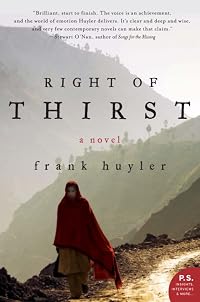
Right of Thirst
by Frank Huyler
On This Page
Description
Volunteering to assist earthquake relief efforts in an impoverished Islamic country after the shattering death of his wife, successful cardiologist Charles Anderson encounters life-threatening hostilities when the refugees he expects do not appear and the area where he is stationed comes under fire.Tags
Recommendations









































Member Reviews
Right of Thirst opens with cardiologist Dr. Charles Anderson saying good bye to his wife - as he assists with ending her life.
With her passing, Charles is lost, functioning but not really living. He attends a lecture by Scott Coles, who has started a relief organization to help earthquake victims in a third world country. On a whim, Charles offers to be the doctor of the refugee camp Coles is setting up.
"I suppose another world was what I wanted most."
Charles ends up in an unnamed third world country, high in the mountains, with Scott Cole's girlfriend as the other staff member as well as a resident cook and his nephew. In charge of the camp is military officer Captain Sanjit Rai.
But the refugees don't come. When they attempt to make show more contact with the local village, Rai discourages them. Anderson's skills are needed to help with a local child, but that is the extent of the use of his medical skills. They are visited by further military personnel, as there may be enemy action in the area, but still the camp remains empty of refugees.
Frank Huyler has created a powerful character driven novel. The interplay between the three main characters, each from a different world and their views on class, aid and life are compelling.
The title 'Right of Thirst' had me mystified in the beginning. It is explained part way through the novel and I think it is the catalyst for the entire plot.
"Our religion came from the desert. From Arabia. Water was very precious to them. And so one of our oldest laws is that we must give water to travelers. that is why we always give tea to our guests."
"Offering tea is an obligation?"
"Yes. In our scripture this is called the right of thirst."
Right of Thirst explores the obligation that Western countries and populace feel to provide aid to countries that they have deemed in need. What happens when that offering is not embraced? Charles has mixed feelings when he is at the camp. He is angry and annoyed at the local population for not being suitably impressed and thankful for what is being done for them.
"What is wrong with you people? Why do you do this? I'd like to know why I came all this way for nothing."
The reply make him even more unhappy.
"We did not ask you to come here. And now that you cannot be a hero, you are angry. You are trying to help yourself, not us."
Huyler's writing is beautiful. The detail and thought in every exchange and description is worth stopping, rereading and savouring. The juxtaposition between Western idealism and Third World reality is explored in this thought provoking and timely novel. Huyler himself is a physician and has lived in various countries. His work has a ring of authenticity. I found it especially interesting as I had just read and reviewed a memoir of a young doctor in a refugee camp.
Highly recommended. A portion of sales from this book are being donated to ProSorata by the author. show less
With her passing, Charles is lost, functioning but not really living. He attends a lecture by Scott Coles, who has started a relief organization to help earthquake victims in a third world country. On a whim, Charles offers to be the doctor of the refugee camp Coles is setting up.
"I suppose another world was what I wanted most."
Charles ends up in an unnamed third world country, high in the mountains, with Scott Cole's girlfriend as the other staff member as well as a resident cook and his nephew. In charge of the camp is military officer Captain Sanjit Rai.
But the refugees don't come. When they attempt to make show more contact with the local village, Rai discourages them. Anderson's skills are needed to help with a local child, but that is the extent of the use of his medical skills. They are visited by further military personnel, as there may be enemy action in the area, but still the camp remains empty of refugees.
Frank Huyler has created a powerful character driven novel. The interplay between the three main characters, each from a different world and their views on class, aid and life are compelling.
The title 'Right of Thirst' had me mystified in the beginning. It is explained part way through the novel and I think it is the catalyst for the entire plot.
"Our religion came from the desert. From Arabia. Water was very precious to them. And so one of our oldest laws is that we must give water to travelers. that is why we always give tea to our guests."
"Offering tea is an obligation?"
"Yes. In our scripture this is called the right of thirst."
Right of Thirst explores the obligation that Western countries and populace feel to provide aid to countries that they have deemed in need. What happens when that offering is not embraced? Charles has mixed feelings when he is at the camp. He is angry and annoyed at the local population for not being suitably impressed and thankful for what is being done for them.
"What is wrong with you people? Why do you do this? I'd like to know why I came all this way for nothing."
The reply make him even more unhappy.
"We did not ask you to come here. And now that you cannot be a hero, you are angry. You are trying to help yourself, not us."
Huyler's writing is beautiful. The detail and thought in every exchange and description is worth stopping, rereading and savouring. The juxtaposition between Western idealism and Third World reality is explored in this thought provoking and timely novel. Huyler himself is a physician and has lived in various countries. His work has a ring of authenticity. I found it especially interesting as I had just read and reviewed a memoir of a young doctor in a refugee camp.
Highly recommended. A portion of sales from this book are being donated to ProSorata by the author. show less
If one were to assign an author to come up with a novelized version of the Eliot poem “The Love Song of J. Alfred Prufrock,” this book could well have been the result.
Dr. Charles Anderson, 58, is a cardiologist on the back nine of life, and feeling a bit like Eliot’s Prufrock. In fact, there is more than one allusion to “The Love Song of J. Alfred Prufrock” in this tale of a mission to Pakistan. (The author doesn’t actually name the country but says in his post-story interview that the novel is set in a place “much like Pakistan” but purposely left unnamed so that “the setting is partly an allegory, a place that might, on some level, be anywhere, at any time.”)
Anderson’s wife has just died, and he is looking for a show more way to forget, a way to find meaning, a way to reclaim some of the passion he felt as a young man. His youth seems to have vanished, a victim of ambition and of the American compulsion to define oneself through work. He is plagued by a vague sense of lost possibilities. He is distant from himself, as well as from others.
He happens to attend a lecture on earthquake relief and impulsively volunteers to serve at a new refugee camp being erected. With him at this far outpost in the middle of nowhere are Sanjit Rai, the liaison officer; Elise, a young German geneticist; Ali the cook; and Ali’s nephew and helper.
They don’t stay long; fighting erupts nearby and they must move on. Anderson only fleetingly considers going to some other remote location, but rejects it as foolish. He is not as young as he used to be.
Throughout their adventure, they learn how alien this other culture is to them, and yet, there is a common humanity to be found as well. At the very least, binding them together, is the ceremony of tea. Offering water to travelers is a tenet of Islam. Rai explains “our religion came from the desert, from Arabia. Water was very precious to them. And so one of our oldest laws is that we must give water to travelers. That is why we always give tea to our guests.” Anderson asks, “Offering tea is an obligation?” “Yes,” answers Rai, “In our scripture this is called the right of thirst.”
The character of Rai is insistent on this basic right of Islamic people, as well as their right to be who and what they are, in spite of what Americans and Europeans may think. The assumed superiority of his way-of-life and his values by Anderson can be seen as a counterpart to America’s ethnocentric insistence on the universal appeal of its culture, its political organization, and its obsession with individual achievement and self-promotion.
Ironically, Anderson has discovered that on a personal level, all he had invested in achievement added up to nothing. The diplomas, the awards, the articles, the meetings, all had a human cost, and left him with not much but money. He doesn't seem to gain much insight from this revelation, however. He is baffled by the geopolitical realities outside of the West, and cannot help judging the people he meets by his own very different standards. The money, at least, is useful, and Anderson decides he will not be too hard on himself: “I was no worse than most, and better than many.…”
For I have known them all already, known them all:—
Have known the evenings, mornings, afternoons,
I have measured out my life with coffee spoons;
I know the voices dying with a dying fall
Beneath the music from a farther room.
So how should I presume?
We have lingered in the chambers of the sea
By sea-girls wreathed with seaweed red and brown
Till human voices wake us, and we drown.
The Love Song of J. Alfred Prufrock by T.S. Eliot
At one point Elise tells Anderson that he can be depressing, boring, thinks too much, and takes everything too seriously. I thought that was a fair description of the character, and perhaps the novel as well. Had the author not wanted to be allegorical, he might have closed the distance better between the reader and the book. There are some thought-provoking aspects of this novel, but I’m not sure it is worth the journey. show less
Dr. Charles Anderson, 58, is a cardiologist on the back nine of life, and feeling a bit like Eliot’s Prufrock. In fact, there is more than one allusion to “The Love Song of J. Alfred Prufrock” in this tale of a mission to Pakistan. (The author doesn’t actually name the country but says in his post-story interview that the novel is set in a place “much like Pakistan” but purposely left unnamed so that “the setting is partly an allegory, a place that might, on some level, be anywhere, at any time.”)
Anderson’s wife has just died, and he is looking for a show more way to forget, a way to find meaning, a way to reclaim some of the passion he felt as a young man. His youth seems to have vanished, a victim of ambition and of the American compulsion to define oneself through work. He is plagued by a vague sense of lost possibilities. He is distant from himself, as well as from others.
He happens to attend a lecture on earthquake relief and impulsively volunteers to serve at a new refugee camp being erected. With him at this far outpost in the middle of nowhere are Sanjit Rai, the liaison officer; Elise, a young German geneticist; Ali the cook; and Ali’s nephew and helper.
They don’t stay long; fighting erupts nearby and they must move on. Anderson only fleetingly considers going to some other remote location, but rejects it as foolish. He is not as young as he used to be.
Throughout their adventure, they learn how alien this other culture is to them, and yet, there is a common humanity to be found as well. At the very least, binding them together, is the ceremony of tea. Offering water to travelers is a tenet of Islam. Rai explains “our religion came from the desert, from Arabia. Water was very precious to them. And so one of our oldest laws is that we must give water to travelers. That is why we always give tea to our guests.” Anderson asks, “Offering tea is an obligation?” “Yes,” answers Rai, “In our scripture this is called the right of thirst.”
The character of Rai is insistent on this basic right of Islamic people, as well as their right to be who and what they are, in spite of what Americans and Europeans may think. The assumed superiority of his way-of-life and his values by Anderson can be seen as a counterpart to America’s ethnocentric insistence on the universal appeal of its culture, its political organization, and its obsession with individual achievement and self-promotion.
Ironically, Anderson has discovered that on a personal level, all he had invested in achievement added up to nothing. The diplomas, the awards, the articles, the meetings, all had a human cost, and left him with not much but money. He doesn't seem to gain much insight from this revelation, however. He is baffled by the geopolitical realities outside of the West, and cannot help judging the people he meets by his own very different standards. The money, at least, is useful, and Anderson decides he will not be too hard on himself: “I was no worse than most, and better than many.…”
For I have known them all already, known them all:—
Have known the evenings, mornings, afternoons,
I have measured out my life with coffee spoons;
I know the voices dying with a dying fall
Beneath the music from a farther room.
So how should I presume?
We have lingered in the chambers of the sea
By sea-girls wreathed with seaweed red and brown
Till human voices wake us, and we drown.
The Love Song of J. Alfred Prufrock by T.S. Eliot
At one point Elise tells Anderson that he can be depressing, boring, thinks too much, and takes everything too seriously. I thought that was a fair description of the character, and perhaps the novel as well. Had the author not wanted to be allegorical, he might have closed the distance better between the reader and the book. There are some thought-provoking aspects of this novel, but I’m not sure it is worth the journey. show less
I read this as a recommendation from someone, and honestly, I was quite surprised that I enjoyed it so much. The protagonist's moral dilemna and questioning of good and bad as a physician certainty appealed to my "medical side", and the writing was very engaging and I was easy pulled me into the story. I don't normally sympathize with characters but I found myself being very hopeful that the protagonist would "figure it out" and have a happy ending.
At first, when learning that Frank Huyler is a doctor who decided to weave through the literary world, I thought he'd be doing what John Grisham. But, besides remembering that there are a number of very famous writers who were once doctors, I suspended the preconceived notion and gave the book a read. I really enjoyed it - while not up to the standards of the literary greats, Huyler does craft a novel that gives some depth to the characters and some color to landscape and setting that isn't blatantly named.
After his wife dies,a middle-aged doctor searches for meaning in his life in the mountains in a country like Pakistan. The novel is engaging (especially on a long flight to Australia) and well-written, but ultimately a bit disappointing and bleak. This is a first novel for Frank Hulyer, and I would definitely give him another chance to impress me.
Ratings
Members
- Recently Added By
Published Reviews
ThingScore 50
“Right of Thirst” gives the initial impression of being a deeply serious book, but nothing in it is examined very deeply or very seriously. Huyler’s descriptions of externals — landscape, weather, the operation on the girl — are frequently marvelous, but at times he slips into cliché and his characters sometimes fail to talk like real people. “Who are you, Charles?” his wife show more asks in a remembered argument. “Who are you really?” I don’t know about you, but my marital rows rarely get that existential. show less
added by Shortride
Author Information
9 Works 344 Members
Frank Huyler is an emergency physician living in Santa Fe, New Mexico. His poetry has appeared in "The Atlantic Monthly," "The Georgia Review," "Poetry," & other publications. (Bowker Author Biography)
Common Knowledge
- Canonical title
- Right of Thirst
- Original publication date
- 2009
- People/Characters
- Charles Anderson; Elise; Sanjit Rai; Ali; General Said; Eric Anderson (show all 7); Scott Coles
- Epigraph
- From the war of nature, from famine and death, the most exalted object which we are capable of conceiving, namely, the production of the higher animals, directly follows. There is grandeur in this view of life. -- Charles Dar... (show all)win, The Origin of Species
- First words
- She let me lie down beside her.
- Quotations
- We all assume roles in the everyday world, and though the roles may vary, and though we may be unaware of them in our conscious minds, we endlessly fall into character nonetheless, and let them sustain us, and carry us along.
There are times when the weak inhabit the acts of the strong, and are therefore indistinguishable from them. - Last words
- (Click to show. Warning: May contain spoilers.)His face lit up, and he came toward me exactly as his mother had done, when she was his age, and had opened her arms for me also.
- Blurbers
- Fountain, Ben; Brokaw, Tom; O'Nan, Stewart
Classifications
Statistics
- Members
- 75
- Popularity
- 423,096
- Reviews
- 6
- Rating
- (3.81)
- Languages
- English
- Media
- Paper, Ebook
- ISBNs
- 3
- ASINs
- 1