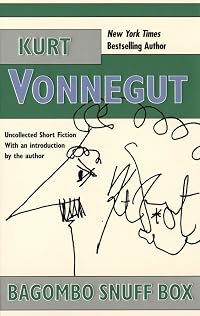
Bagombo Snuff Box: Uncollected Short Fiction
by Kurt Vonnegut
On This Page
Description
Twenty-three stories early in the writer's career. They range from Thanasphere, on an astronaut who hears the voices of the dead, to Runaways, in which teenage lovers learn you cannot live on love alone.Tags
Recommendations









Member Reviews
Reading Vonnegut's short stories is so intoxicating to me, because I almost always pick them up thinking I'll only read a few...then I read them all at once.
The stories collected in this volume are not all that different from the ones found in Welcome to the Monkey House, which is to say that they are all, at the very least, up to snuff (no pun intended).
What sets these apart is the notion that these are representative of a time when fiction like this had a real fan base and authors of such stories could make a real living. This context makes the somewhat cheesier stories, like "Find Me a Dream," artifacts of their time rather than merely schmaltzy tales.
But then there are the real knockouts, like "2BR02B," which are vintage Vonnegut show more through and through, with characters and endings reminiscent of O. Henry that hit you like a ton of bricks.
He may have been doing it for the money, but these stories are, for the most part, worthy members of the Vonnegut canon. show less
The stories collected in this volume are not all that different from the ones found in Welcome to the Monkey House, which is to say that they are all, at the very least, up to snuff (no pun intended).
What sets these apart is the notion that these are representative of a time when fiction like this had a real fan base and authors of such stories could make a real living. This context makes the somewhat cheesier stories, like "Find Me a Dream," artifacts of their time rather than merely schmaltzy tales.
But then there are the real knockouts, like "2BR02B," which are vintage Vonnegut show more through and through, with characters and endings reminiscent of O. Henry that hit you like a ton of bricks.
He may have been doing it for the money, but these stories are, for the most part, worthy members of the Vonnegut canon. show less
More than just a snapshot of Vonnegut's developing skills as a writer, Bagombo Snuff Box stands as a look back into American life in the mid-twentieth century. Full of stories of marriage, relationships, and love, this book explores changing notions of gender roles and family dynamics through the words of one of the country's greatest writers. Vonnegut's signature gentle humor comes through in early every story, and each reads as a quick jaunt into an easily-resolved dilemma.
This collection is a representation of what magazine audiences at the time wanted to read, more than what Vonnegut wanted to write. It's a fascinating little cultural nugget, and it makes me wonder how popular fiction of today will hold up in fifty or sixty years. show more Surely, 50 Shades of Grey and Twilight will not find themselves among the pantheon of great American literature, while Vonnegut's stories have done just that. show less
This collection is a representation of what magazine audiences at the time wanted to read, more than what Vonnegut wanted to write. It's a fascinating little cultural nugget, and it makes me wonder how popular fiction of today will hold up in fifty or sixty years. show more Surely, 50 Shades of Grey and Twilight will not find themselves among the pantheon of great American literature, while Vonnegut's stories have done just that. show less
This is a short story collection by Kurt Vonnegut. These short stories were written in a time when a writer could make a living selling short stories to commercial magazines, and these were Vonnegut's. Other writers who were cranking out short stories for a regular paycheck included William Faulkner, Ernest Hemingway,and John Steinbeck, so Vonnegut was in good company in this regard.
The stories in this collection are all very entertaining and all have Vonnegut's typical sardonic wit. None of the stories really stand out as all are quite enjoyable, and Vonnegut does not have the bad habit of repeating the same themes that can lead to a short story collection becoming tedious by the end of the book. Instead, these are all very inventive, show more and many are quite different from each other. The only thing missing from this collection was that one great short story that the reader will remember long after finishing the book. File these under forgettably fun read. show less
The stories in this collection are all very entertaining and all have Vonnegut's typical sardonic wit. None of the stories really stand out as all are quite enjoyable, and Vonnegut does not have the bad habit of repeating the same themes that can lead to a short story collection becoming tedious by the end of the book. Instead, these are all very inventive, show more and many are quite different from each other. The only thing missing from this collection was that one great short story that the reader will remember long after finishing the book. File these under forgettably fun read. show less
Vonnegut is quite reflective and musing upon the war experience, death ("Thanasphere" ), dead lives in need of a trickster ("Bagombo Snuff Box"). In this collection, the stories are emended and improved as explained in the afterword which also touches on the lost market of short stories for magazines. I know I have read at least some before. In this collection or elsewhere? Still what resonates with me the most is the accurate picture of the regrettable hubris of immaturity via the Marittima-Frascati in "The Powder-Blue Dragon".
Pick up this collection of short stories and you'll get to travel back several decades while inside of Kurt Vonnegut's bizarre imagination. It's a long strange trip through 23 previously unpublished stories. The stories in the collection were written shortly after he left his PR job at General Electric, back in the 1950's. That was a time when the nation's magazines provided a ready market for short stories, allowing Vonnegut to begin to make a living off of his creative writing. His rich and fertile imagination gives this collection a wonderful variety. Some of the social and sexual attitudes are dated, but the prices that past for outrageously expensive in the 50's are so very comical now—just imagine $100,000 mansions and rare show more expensive sports cars for $5,651!
Reading Bagombo Snuff Box brought memories flooding back of studying in college and using Vonnegut to "air out my mind" between reading Hegel and Marx. While it's guaranteed that Vonnegut fans will find some new favorite stories, all readers should know that it's impossible to traverse this fertile 23-step path without appreciating this writer's mind and his humorous imagination. You owe yourself some Vonnegut.
(5/01) show less
Reading Bagombo Snuff Box brought memories flooding back of studying in college and using Vonnegut to "air out my mind" between reading Hegel and Marx. While it's guaranteed that Vonnegut fans will find some new favorite stories, all readers should know that it's impossible to traverse this fertile 23-step path without appreciating this writer's mind and his humorous imagination. You owe yourself some Vonnegut.
(5/01) show less
I really enjoyed these short stories. These aren't sconce fiction except for one or two stories. It demonstates Vonnegut's mastery of storytelling. He could make a rock sound intersting. I love his introductions and epilogues. It really delves into the root of all of his stories and demonstates he doesn't take himself too seriously. These are the stories he had written before and during his first major novel, player piano. Many of the characters, plots and settings are revisited in depth in his later works. It's nice to read them here in their infancy. This book is more for the already established Vonnegut fan for that reason specifically. Fab lines:It proves that the short story, because of its phsiological and psychological effects on show more a human being, is more closely related to Buddhist styles of meditation than it is to any other form of narrative entertainment...a Buddhist cat-napReading a novel, War and Peace for example, is no Catnap. Because a novel is so long, reading one is like being married forever to somebody nobody knows or cares about. show less
This collection is ... well, I can't say it's disappointing, since you know what you're getting when you buy the "uncollected short fiction." This is not Vonnegut at his best.
It's interesting for that very reason: you see his style before he really had a style (some of the pieces are extraordinarily bland and voiceless, especially considering how recognisable Vonnegut usually is), and devoted fans will get a wee thrill each time the voice we recognise makes itself known for a moment or two. ("Is that maybe the first time he ever did that?" I found myself asking occasionally.)
The most evident lack is the wry humour. Without that light touch, his morals seem simplistic and many of his plots slightly saccharine. His later work has many show more similar moralistic elements, but tempered by the feeling that he's laughing at himself all the while. It shows here in a few places, but sadly only a few.
So this is one for the collectors, for the insight it gives about Vonnegut's developement as a writer. If you love him, you may find it deeply disappointing, or you may cherish the flashes of character all the more for their scarcity. If you only like him, this is definitely one to skip. show less
It's interesting for that very reason: you see his style before he really had a style (some of the pieces are extraordinarily bland and voiceless, especially considering how recognisable Vonnegut usually is), and devoted fans will get a wee thrill each time the voice we recognise makes itself known for a moment or two. ("Is that maybe the first time he ever did that?" I found myself asking occasionally.)
The most evident lack is the wry humour. Without that light touch, his morals seem simplistic and many of his plots slightly saccharine. His later work has many show more similar moralistic elements, but tempered by the feeling that he's laughing at himself all the while. It shows here in a few places, but sadly only a few.
So this is one for the collectors, for the insight it gives about Vonnegut's developement as a writer. If you love him, you may find it deeply disappointing, or you may cherish the flashes of character all the more for their scarcity. If you only like him, this is definitely one to skip. show less
Members
- Recently Added By
Lists

el
1,139 works; 1 member
Author Information

296+ Works 201,778 Members
The appeal of Kurt Vonnegut, especially to bright younger readers of the past few decades, may be attributed partly to the fact that he is one of the few writers who have successfully straddled the imaginary line between science-fiction/fantasy and "real literature." He was born in Indianapolis and attended Cornell University, but his college show more education was interrupted by World War II. Captured during the Battle of the Bulge and imprisoned in Dresden, he received a Purple Heart for what he calls a "ludicrously negligible wound." After the war he returned to Cornell and then earned his M.A. at the University of Chicago.He worked as a police reporter and in public relations before placing several short stories in the popular magazines and beginning his career as a novelist. His first novel, Player Piano (1952), is a highly credible account of a future mechanistic society in which people count for little and machines for much. The Sirens of Titan (1959), is the story of a playboy whisked off to Mars and outer space in order to learn some humbling lessons about Earth's modest function in the total scheme of things. Mother Night (1962) satirizes the Nazi mentality in its narrative about an American writer who broadcasts propaganda in Germany during the war as an Allied agent. Cat's Cradle (1963) makes use of some of Vonnegut's experiences in General Electric laboratories in its story about the discovery of a special kind of ice that destroys the world. God Bless You, Mr. Rosewater (1965) satirizes a benevolent foundation set up to foster the salvation of the world through love, an endeavor with, of course, disastrous results. Slaughterhouse-Five; or The Children's Crusade (1969) is the book that marked a turning point in Vonnegut's career. Based on his experiences in Dresden, it is the story of another Vonnegut surrogate named Billy Pilgrim who travels back and forth in time and becomes a kind of modern-day Everyman. The novel was something of a cult book during the Vietnam era for its antiwar sentiments. Breakfast of Champions (1973), the story of a Pontiac dealer who goes crazy after reading a science fiction novel by "Kilgore Trout," received generally unfavorable reviews but was a commercial success. Slapstick (1976), dedicated to the memory of Laurel and Hardy, is the somewhat wacky memoir of a 100-year-old ex-president who thinks he can solve society's problems by giving everyone a new middle name. In addition to his fiction, Vonnegut has published nonfiction on social problems and other topics, some of which is collected in Wampeters, Foma and Granfalloons (1974). He died from head injuries sustained in a fall on April 11, 2007. (Bowker Author Biography) show less
Series
Belongs to Publisher Series
ハヤカワ文庫 SF (1635)
Work Relationships
Contains
Common Knowledge
- Canonical title
- Bagombo Snuff Box: Uncollected Short Fiction
- Original title
- Bagombo Snuff Box: Uncollected Short Fiction
- Original publication date
- 1999; 1950-09-2 (Thanasphere) (Thanasphere); 1951-04-28 (Mnemonics) (Mnemonics); 1952-01-19 (Any Reasonable Offer) (Any Reasonable Offer); 1952-07-26 (The Package) (The Package); 1952-10-25 (Poor Little Rich Town) (Poor Little Rich Town) (show all 7); 1962-01 (2BR02B) (2BR02B)
- People/Characters
- Edward K. Wehling, Jr.; Benjamin Hitz; Leora Duncan
- Original language
- English
Classifications
Statistics
- Members
- 2,439
- Popularity
- 8,032
- Reviews
- 18
- Rating
- (3.62)
- Languages
- 9 — Czech, Danish, English, French, German, Hungarian, Japanese, Polish, Turkish
- Media
- Paper, Audiobook, Ebook
- ISBNs
- 32
- UPCs
- 1
- ASINs
- 11