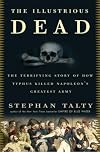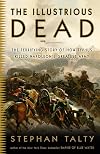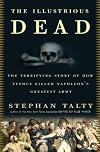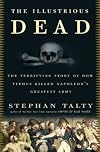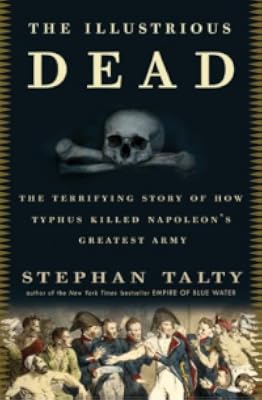
The illustrious dead
by Stephan Talty
On This Page
Description
In a dual narrative that pits the heights of human ambition and achievement against the supremacy of nature, Stephan Talty tells the story of a mighty ruler and a tiny microbe, antagonists whose struggle would shape the modern world. --from publisher descriptioinTags
Recommendations






























Member Reviews
I am an avid reader of medical history books, especially the history of diseases. This was not my favorite for a few reasons.
First, this book is more or less a story of Napoleon's attempt to invade Russia. The typhus story is a consistent theme, but it frankly is not the main story. Now, in fairness, I don't think you can adequately explain how typhus was able to ravage the Grand Armee so easily unless you provide context, so in that regard, the Russian invasion narrative was necessary to some degree. That being said, I felt as though the subtitle ("How Typhus Killed Napoleon's Greatest Army") is misleading because it implies that the book's central focus is typhus when it really wasn't.
Second, I like wartime histories, but some of show more the battle scenes in this book were exceptionally drawn-out and boring, especially if you are going into it looking for a medical drama. If you are looking for details about Napoleon's invasion of Russia, this is probably your book, but it is still kind of dry. The subject matter itself is actually very dramatic (typhus is a horrible way to die, and the details of the army's brutal march, occupation of Moscow, creation of battlefield hospitals, etc, are actually pretty interesting), but the writing makes an otherwise interesting subject matter seem like a slog.
The description of the inadequate makeshift hospitals was probably the best (worst?) part of this book because of the fact that medical knowledge at the time is so far removed from what we know today, and the battlefield hospitals were grossly unprepared for the number of battlefield and typhus casualties. If you are at all squeamish, I do not recommend reading these sections.
Overall, I give this book three stars because it contained good information, but it is not really a book about typhus, and it is somewhat boring as historical nonfiction goes. show less
First, this book is more or less a story of Napoleon's attempt to invade Russia. The typhus story is a consistent theme, but it frankly is not the main story. Now, in fairness, I don't think you can adequately explain how typhus was able to ravage the Grand Armee so easily unless you provide context, so in that regard, the Russian invasion narrative was necessary to some degree. That being said, I felt as though the subtitle ("How Typhus Killed Napoleon's Greatest Army") is misleading because it implies that the book's central focus is typhus when it really wasn't.
Second, I like wartime histories, but some of show more the battle scenes in this book were exceptionally drawn-out and boring, especially if you are going into it looking for a medical drama. If you are looking for details about Napoleon's invasion of Russia, this is probably your book, but it is still kind of dry. The subject matter itself is actually very dramatic (typhus is a horrible way to die, and the details of the army's brutal march, occupation of Moscow, creation of battlefield hospitals, etc, are actually pretty interesting), but the writing makes an otherwise interesting subject matter seem like a slog.
The description of the inadequate makeshift hospitals was probably the best (worst?) part of this book because of the fact that medical knowledge at the time is so far removed from what we know today, and the battlefield hospitals were grossly unprepared for the number of battlefield and typhus casualties. If you are at all squeamish, I do not recommend reading these sections.
Overall, I give this book three stars because it contained good information, but it is not really a book about typhus, and it is somewhat boring as historical nonfiction goes. show less
A decent overview of Napoleon's Russian campaign, with the focus on how typhoid fever was a major factor in his eventual defeat. You can, however, just read this book for an account of Napoleon's invasion of Russia, as it covers all the major events and personalities regardless of the title's focus on the disease.
The most interesting thing about this book is how the collective medical science of the late 18th century was unable to figure out what causes soldiers to suddenly fall very ill on long marches. So this work is not just a history of the war, but also a history of the disease - it's discovery, prevention and treatment. I'm not going to spoil it for you - it's actually more interesting than you think.
The most interesting thing about this book is how the collective medical science of the late 18th century was unable to figure out what causes soldiers to suddenly fall very ill on long marches. So this work is not just a history of the war, but also a history of the disease - it's discovery, prevention and treatment. I'm not going to spoil it for you - it's actually more interesting than you think.
A fascinating and compellingly-readable account of Napoleon's failed Russian campaign of 1812 and the REAL reason it was such a disaster: a horrible typhus epidemic that was ignored and mishandled. The Illustrious Dead combines the best of commercial history with a healthy dash of science/medical lit. It's filled with great little bits of information that I'll love having on hand at the next party I'm invited to (hint, hint)...
For example:
The microbe that causes typhus is one of the oldest bits of biology on the planet.
At one point 4000-5000 soldiers were dying PER DAY on the march to Moscow.
At the time, the Catholic Church considered to bathing to be immodest and therefore, a sin.
Great stuff.
For example:
The microbe that causes typhus is one of the oldest bits of biology on the planet.
At one point 4000-5000 soldiers were dying PER DAY on the march to Moscow.
At the time, the Catholic Church considered to bathing to be immodest and therefore, a sin.
Great stuff.
A good solid history. Shows how vulnerable the powerful are to epidemics and how they have shaped history. Napoleon lost his campaign due to his own follies, but typhus might have defeated him in the end anyway.
This was just too tedious and boring for me.
Frankrig, Rusland, 1812
Indeholder "Dramatis Personae", "Command Structures and Coalitions", "Introduction: Old Bones", "1. Incarnate", "2. A Portable Metropolis", "3. Drumbeat", "4. Crossing", "5. Pursuit", "6. Smolensk", "7. The Sound of Flames", "8. Smoke", "9. At Borodino", "10. Clash", "11. The Hospital", "12. The Last City", "13. Decision", "14. Two Roads", "15. Graveyard Trees", "Epilogue: Rendezvous in Germany", "Author's Note: The Doorway of the Hospital at Tunis", "Glossary", "Notes", "Sources", "Acknowledgements", "Index".
Meget levende beretning om de mange, der døde af tyfus undervejs til og fra Moskva. Baggrunden med Napoleons ikke længere helt så kække føring af land og tropper. En gigantisk hær, 690000 mand stor. show more Mellem 550000 og 600000 af dem krydser Niemen og invaderer Rusland. Tyfus har allerede fra starten godt ved og de russiske generaler undgår konfrontationer. Ved Smolensk koster et slag Napoleon 19000 mand og russerne 14000 mand. Ved Borodino går det løs den 7 september 1812. Her koster en gigantisk gensidig nedslagtning Napoleon 28000 mand og russerne 45000 mand. Napoleons overtro og manglende satsning på læger i feltet er dog endnu dyrere.
Hans livlæge Dominique Jean Larrey forholder ham ikke noget, men Napoleon nægter at tro på tallene for syge og døde.
Efter slaget ved Borodino indtager Napoleon Moskva, blot for at opdage at den er forladt pånær et efterladt korps af brandstiftere, der brænder byen ned til grunden. Napoleon havde planlagt at tvinge zar Alexander til at slutte fred, men må indse at der ingen vilje er til kompromis. Slukøret sætter han kursen hjemad den 16. oktober 1812.
Glimrende bog om en kæmpekatastrofe, alene forårsaget af Napoleon selv. show less
Indeholder "Dramatis Personae", "Command Structures and Coalitions", "Introduction: Old Bones", "1. Incarnate", "2. A Portable Metropolis", "3. Drumbeat", "4. Crossing", "5. Pursuit", "6. Smolensk", "7. The Sound of Flames", "8. Smoke", "9. At Borodino", "10. Clash", "11. The Hospital", "12. The Last City", "13. Decision", "14. Two Roads", "15. Graveyard Trees", "Epilogue: Rendezvous in Germany", "Author's Note: The Doorway of the Hospital at Tunis", "Glossary", "Notes", "Sources", "Acknowledgements", "Index".
Meget levende beretning om de mange, der døde af tyfus undervejs til og fra Moskva. Baggrunden med Napoleons ikke længere helt så kække føring af land og tropper. En gigantisk hær, 690000 mand stor. show more Mellem 550000 og 600000 af dem krydser Niemen og invaderer Rusland. Tyfus har allerede fra starten godt ved og de russiske generaler undgår konfrontationer. Ved Smolensk koster et slag Napoleon 19000 mand og russerne 14000 mand. Ved Borodino går det løs den 7 september 1812. Her koster en gigantisk gensidig nedslagtning Napoleon 28000 mand og russerne 45000 mand. Napoleons overtro og manglende satsning på læger i feltet er dog endnu dyrere.
Hans livlæge Dominique Jean Larrey forholder ham ikke noget, men Napoleon nægter at tro på tallene for syge og døde.
Efter slaget ved Borodino indtager Napoleon Moskva, blot for at opdage at den er forladt pånær et efterladt korps af brandstiftere, der brænder byen ned til grunden. Napoleon havde planlagt at tvinge zar Alexander til at slutte fred, men må indse at der ingen vilje er til kompromis. Slukøret sætter han kursen hjemad den 16. oktober 1812.
Glimrende bog om en kæmpekatastrofe, alene forårsaget af Napoleon selv. show less
Oct 11, 2013 (Edited)Danish
Members
- Recently Added By
Lists

Best Books About Plagues and Epidemics
99 works; 17 members
Author Information

20+ Works 2,679 Members
Stephan Talty is the best-selling author of The Black Hand and Agent Garbo, and coauthor of A Captain's Duty. His books have been made into two films, the Oscar-winning Captain Phillips and Only the Brave. He lives outside New York City with his family.
Common Knowledge
- Canonical title
- The illustrious dead
- Original publication date
- 2009
- People/Characters
- Napoleon Bonaparte; Alexander I, Emperor of Russia
- Important places
- Moscow, Russia; Borodino, Russia
- Important events
- Battle of Borodino (1812-09-07); Battle of Smolensk
- Dedication
- For Asher and Delphine
- First words
- In Lithuania, late in the winter of 2001, construction crews began clearing a piece of land in that part of the capital, Vilnius, known as Northern Town, digging trenches for phone lines and demolishing the old Soviet barrack... (show all)s that had stood on the land for decades.
1. It would be a remarkable thing to look at a map of the world in 1811 and not be struck by how much of it was controlled by France and its-forty-two-year-old leader, Napoleon Bonaparte. - Last words
- (Click to show. Warning: May contain spoilers.)The search for the killer's nature would be picked up again far from the nations it had tormented for so long.
(Click to show. Warning: May contain spoilers.)Its wager on the incurably violent human race hasn't quite played out. - Blurbers
- Alexander, Caroline; Reiss, Tom
- Original language
- English US
Classifications
- Genres
- History, Nonfiction, General Nonfiction
- DDC/MDS
- 940.2742 — History & geography History of Europe History of Europe Europe: Renaissance, Reformation, Enlightenment, Napolean Napoleonic period 1789-1815
- LCC
- DC235 .T27 — History of Europe, Asia, Africa and Oceania France – Andorra – Monaco History of France Modern, 1515- Revolutionary and Napoleonic period, 1789-1815
- BISAC
Statistics
- Members
- 240
- Popularity
- 135,534
- Reviews
- 7
- Rating
- (3.66)
- Languages
- English
- Media
- Paper, Audiobook, Ebook
- ISBNs
- 6
- ASINs
- 6