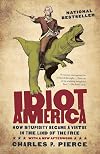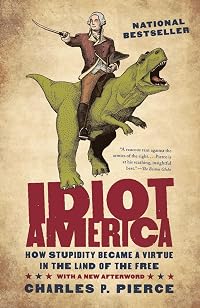
Idiot America
by Charles P. Pierce
On This Page
Description
The culture wars are over and the idiots have won. This is a veteran journalist's caustically funny, righteously angry lament about the glorification of ignorance in the United States.The three Great Premises of Idiot America: · Any theory is valid if it sells books, soaks up ratings, or otherwise moves units; anything can be true if someone says it loudly enough; fact is that which enough people believe. Truth is determined by how fervently they believe it.
Charles Pierce has led a show more career-long quest to separate the smart from the pap, and now it's time to try and salvage the Land of the Enlightened, buried somewhere in this new Home of the Uninformed. With his razor-sharp wit and erudite reasoning, Pierce delivers a gut-wrenching, side-splitting lament about the glorification of ignorance in the United States and how a country founded on intellectual curiosity has deteriorated into a nation of simpletons more apt to vote for an American Idol contestant than a presidential candidate.
With Idiot America, Pierce's thunderous denunciation is also a secret call to action, as he hopes that, somehow, being intelligent will stop being a stigma and that pinheads will once again be pitied, not celebrated.
. show less
Tags
Recommendations












Member Reviews
Loved this book, perhaps because it plays to all my prejudices, but trying to be objective, I think Pierce does hit upon trends in modern society that are very worrisome. He posits three basic maxims: (1) Any theory is valid if it sells books, soaks up ratings, or otherwise moves units; (2) Anything can be true if someone says it loudly enough; (3) Fact is that which enough people believe; truth is determined by how fervently they believe it. Try applying these maxims against any number of modern trends or events and see how accurately they apply.
Pierce is a journalist and he has been writing along these lines for some time, but the tipping point for him was a visit to the creationist “museum” (the mere concept boggles the mind), show more where he saw a dinosaur with a saddle on it, because if humans and dinosaurs co-existed, well we could assume that the former had domesticated the latter….this is ignorance on such a scale that it would require a backhoe to shovel it. Of course, that’s my opinion and isn’t anyone entitled to a contrary one? Well, no. Some questions can be legitimately debated, e.g. is there a God, is there life after death, are we here for some divine purpose or did we simply win the biological sweepstakes? But other questions, e.g. evolution, gravity, electromagnetism, quantum mechanics, relativity…all of these has been shown to be correct time and time again through rigorous scientific testing, and to deny them is not exercising some right to differ, it is demonstrating appalling ignorance. And, I’m sorry, but believing deeply does not overturn the scientific applecart. As Pierce puts it, the modern trend has come to this:
“If something feels right, it must be treated with the same respect given something that actually is right. If something is felt deeply, it must carry the same weight as something that is true. If there are two sides to every argument---or, more to the point, if there are people willing to take up two sides to every argument---they both must be right, or, at least, equally valid.” Um….no. This way lies madness, or at least considerable stupidity.
Pierce notes that “the founders wanted a nation of educated people: this, they believed, was essential to self-government,”, but he despairs with the directions he sees, for instance with talk radio: “….that was the driving force in changing American debate into American argument. It moved discussions southward from the brain to the Gut. Debate no longer consists of thesis and antithesis, moving forward to synthesis; it is now a matter of choosing up sides, finding someone on your team to sally forth, and the laying the wood to each other in between commercials for male-enhancement products.”
Pierce pulls no punches and refers to “three intermingled schools of idiocy” that have come to characterize modern society: political idiocy, “best represented on the AM radio dial and on those evening cable television news programs”, commercial idiocy as “the mechanism through which political idiocy (among other things) thrives”, and religious idiocy, “formidable on its own, also functions as a baptismal font for political and commercial idiocy. Gussy up your extremist politics, or your bunco museum in which dinosaurs wear saddles, with the Gospels, and you can paint anyone who suggests that your goods are ridiculous a member of the intelligent, educated segment of the population, come to discomfit the faith-based folks”.
Pierce will offend people who buy into these nostrums, who are taken in by the three maxims and who think this is right, this is the way things should be, but he has a serious argument and serious observations that deserve the sort of scrutiny and debate that is, alas, now all too infrequent.
The last word: “If the country took its obligations to self-government at all seriously, the presence of Sarah Palin on a national ticket would have been an insult on a par with the elevation of Caligula’s horse.”
Great stuff. show less
Pierce is a journalist and he has been writing along these lines for some time, but the tipping point for him was a visit to the creationist “museum” (the mere concept boggles the mind), show more where he saw a dinosaur with a saddle on it, because if humans and dinosaurs co-existed, well we could assume that the former had domesticated the latter….this is ignorance on such a scale that it would require a backhoe to shovel it. Of course, that’s my opinion and isn’t anyone entitled to a contrary one? Well, no. Some questions can be legitimately debated, e.g. is there a God, is there life after death, are we here for some divine purpose or did we simply win the biological sweepstakes? But other questions, e.g. evolution, gravity, electromagnetism, quantum mechanics, relativity…all of these has been shown to be correct time and time again through rigorous scientific testing, and to deny them is not exercising some right to differ, it is demonstrating appalling ignorance. And, I’m sorry, but believing deeply does not overturn the scientific applecart. As Pierce puts it, the modern trend has come to this:
“If something feels right, it must be treated with the same respect given something that actually is right. If something is felt deeply, it must carry the same weight as something that is true. If there are two sides to every argument---or, more to the point, if there are people willing to take up two sides to every argument---they both must be right, or, at least, equally valid.” Um….no. This way lies madness, or at least considerable stupidity.
Pierce notes that “the founders wanted a nation of educated people: this, they believed, was essential to self-government,”, but he despairs with the directions he sees, for instance with talk radio: “….that was the driving force in changing American debate into American argument. It moved discussions southward from the brain to the Gut. Debate no longer consists of thesis and antithesis, moving forward to synthesis; it is now a matter of choosing up sides, finding someone on your team to sally forth, and the laying the wood to each other in between commercials for male-enhancement products.”
Pierce pulls no punches and refers to “three intermingled schools of idiocy” that have come to characterize modern society: political idiocy, “best represented on the AM radio dial and on those evening cable television news programs”, commercial idiocy as “the mechanism through which political idiocy (among other things) thrives”, and religious idiocy, “formidable on its own, also functions as a baptismal font for political and commercial idiocy. Gussy up your extremist politics, or your bunco museum in which dinosaurs wear saddles, with the Gospels, and you can paint anyone who suggests that your goods are ridiculous a member of the intelligent, educated segment of the population, come to discomfit the faith-based folks”.
Pierce will offend people who buy into these nostrums, who are taken in by the three maxims and who think this is right, this is the way things should be, but he has a serious argument and serious observations that deserve the sort of scrutiny and debate that is, alas, now all too infrequent.
The last word: “If the country took its obligations to self-government at all seriously, the presence of Sarah Palin on a national ticket would have been an insult on a par with the elevation of Caligula’s horse.”
Great stuff. show less
Pierce is concerned with the growing contempt for knowledge in our culture, which he feels has wide relevance for our political, economic and social future. The material he covers will seem fairly self-evident to many i.e., the equating of religious belief with scientific theory, the growth in influence of talk radio hucksters as opposed to the informed experts, the mainstreaming of "crank" conspiracy theories. What makes this book refreshing is Pierce's wit and bravery. He makes the obvious, but frequently derided assertion, that not all assertions of fact or opinion are equally valid. Many people may vehemently believe something, but it may still be false. I have to give an example or two from the book. About the "Creation Museum" show more sponsored by Answers in Genesis: "It was impolite to wonder why our parents had sent us all to college, and why generations of immigrants had sweated and bled so that their children could be educated, if not so that one day we would feel confident enough to look at a museum full of dinosaurs rigged to run six furlongs at Aqueduct and make the not unreasonable assertion that it was batshit crazy, and that anyone who believed this righteous hooey should be kept away from sharp objects and their own money." Or this about the national "hangover" concerning our national level of thought. "Things are in the wrong place. Religion is in the box where science used to be. Politics in on the shelf where you thought you left science the previous afternoon. Entertainment seems to have been knocked over and spilled on everything." Gems like these kept me laughing and wincing. This book also made me more determined to speak out about abuses of language and sloppy or malicious abuses of logic in the public sphere. It's a refreshing, if sobering, book. People with a brain, you are not alone. show less
When acerbic opinion-monger Charles Pierce wrote this book in the years leading up to 2009, he considered titling it Blinking from the Ruins, but discarded that label since he thought it tacitly exonerated the Idiot Americans whom he indicts in the text. He does make allowances for the rest of us who have been "hijacked" into Idiot America, but he calls out the political and cultural leadership of the twenty-first century US for their war on expertise and rejection of rational categories. The book is a criticism of its moment and also a history and vernacular theory of American anti-intellectualism.
The history uses as a touchstone and point of contrast the character and ideals of "founding father" James Madison--who was "childless" show more according to the rubric set forth by today's vice-presidential aspirant J. D. Vance. Pierce's gallery of American cranks includes Atlantean para-geologist Ignatius Donnelly, anti-Masonic conspiracy theorists, UFO enthusiasts, and amateur investigators of the JFK assassination. He distinguishes the virtuous cranks as incubators of imagination from the vicious Idiot Americans who exploit ideas without regard for reality.
The theory of Idiot America is trained on the supremacy of the Gut which deprecates expertise, along with what Pierce calls the "Three Great Premises." These latter are, First: "Any theory is valid if it sells books, soaks up ratings, or otherwise moves units" (35); Second: "Anything can be true if someone says it loudly enough" (41); and Third: "respect for the effort required to develop and promulgate nonsense ... validates the nonsense itself" (47).
I particularly appreciated Pierce's excoriation of the term "faith-based" (133-5), and it is notable how much of Idiot America is driven by religion. The book is bracketed by visits to the Creation Museum of Ken Ham in Hebron, Kentucky, and a culminating point of the historical narrative is the 2005 Scopes redux case Kitzmiller v. Dover. The misogynistic worship of blastocysts was still simmering in 2009 (well before the worm-turning Burwell v. Hobby Lobby Stores, Inc.), but in this account it takes a back seat to bonkers Islamophobia and the durable creed of trickle-down economics.
In the section on "Consequences," Pierce discusses three fruits of Idiot America: the Terry Schiavo controversy, catastrophic climate change, and the US invasion of Iraq. Alas, the sort of idiocy he anatomizes here has only further entrenched itself in the institutions of government, and there was never any comeuppance for the malefactors in those incidents. And there has never been a conscious public correction for the torture porn propagandizing of the "War on Terra," let alone the torture itself that the propaganda helped to inspire and legitimate.
Pierce muses about "reality television" in order to discuss public epistemology in Idiot America, which comes off as borderline-prophetic with respect to the Idiot President chosen by the Electoral College in 2016, a failed real estate mogul who had most conspicuously found his niche in a game show that lionized him in the imaginary character of a business executive. The book shows how Idiot America has corrupted US civic life, and it is a good corrective for anyone who might imagine that this sort of cultural and political decay began with the ascendancy of Trumpism. At the same time, it seems to hold out a hope that the trend might have bottomed out and be susceptible to a reversal. Instead, the subsequent decade and a half has only shown its progression to the point that it imperils the inherited constitutional order and the lives of increasing numbers of citizens as well as the business of the day. show less
The history uses as a touchstone and point of contrast the character and ideals of "founding father" James Madison--who was "childless" show more according to the rubric set forth by today's vice-presidential aspirant J. D. Vance. Pierce's gallery of American cranks includes Atlantean para-geologist Ignatius Donnelly, anti-Masonic conspiracy theorists, UFO enthusiasts, and amateur investigators of the JFK assassination. He distinguishes the virtuous cranks as incubators of imagination from the vicious Idiot Americans who exploit ideas without regard for reality.
The theory of Idiot America is trained on the supremacy of the Gut which deprecates expertise, along with what Pierce calls the "Three Great Premises." These latter are, First: "Any theory is valid if it sells books, soaks up ratings, or otherwise moves units" (35); Second: "Anything can be true if someone says it loudly enough" (41); and Third: "respect for the effort required to develop and promulgate nonsense ... validates the nonsense itself" (47).
I particularly appreciated Pierce's excoriation of the term "faith-based" (133-5), and it is notable how much of Idiot America is driven by religion. The book is bracketed by visits to the Creation Museum of Ken Ham in Hebron, Kentucky, and a culminating point of the historical narrative is the 2005 Scopes redux case Kitzmiller v. Dover. The misogynistic worship of blastocysts was still simmering in 2009 (well before the worm-turning Burwell v. Hobby Lobby Stores, Inc.), but in this account it takes a back seat to bonkers Islamophobia and the durable creed of trickle-down economics.
In the section on "Consequences," Pierce discusses three fruits of Idiot America: the Terry Schiavo controversy, catastrophic climate change, and the US invasion of Iraq. Alas, the sort of idiocy he anatomizes here has only further entrenched itself in the institutions of government, and there was never any comeuppance for the malefactors in those incidents. And there has never been a conscious public correction for the torture porn propagandizing of the "War on Terra," let alone the torture itself that the propaganda helped to inspire and legitimate.
Pierce muses about "reality television" in order to discuss public epistemology in Idiot America, which comes off as borderline-prophetic with respect to the Idiot President chosen by the Electoral College in 2016, a failed real estate mogul who had most conspicuously found his niche in a game show that lionized him in the imaginary character of a business executive. The book shows how Idiot America has corrupted US civic life, and it is a good corrective for anyone who might imagine that this sort of cultural and political decay began with the ascendancy of Trumpism. At the same time, it seems to hold out a hope that the trend might have bottomed out and be susceptible to a reversal. Instead, the subsequent decade and a half has only shown its progression to the point that it imperils the inherited constitutional order and the lives of increasing numbers of citizens as well as the business of the day. show less
This was published in 2009, seven years before Idiocy reached a new high, to be followed be a mind-boggling four more years of steady climb. It's not done yet, I'm afraid, and I wonder what Mr. Pierce would have to say now (I'm sure I could find out, but I'm behind on other reading...)
Draped in James Madison anecdotes, observations, quotes and opinions, Madison is a hero to Pierce, who uses him and his writings as a foil. Pierce says, "Madison was never a superstar, not even among his contemporaries. His home never became a shrine, not the way Washington’s Mount Vernon did, or Jefferson’s Monticello.",
Pierce says in his Introduction
The First Great Premise: Any theory is valid if it sells books, soaks up ratings, or otherwise moves units.
The Second Great Premise: Anything can be true if someone says it loudly enough.
The Third Great Premise: Fact is that which enough people believe. Truth is determined by how fervently they believe it.
There it is, folks. The whole basis of FoxNews, Rush Limbaugh, Alex Jones, talk radio... Oh...and antisocial media. Shouting is harder there, but they do try hard to. Note: Pierce offers no solutions. To be fair, he couldn't. The anti-intellectual inertia and the momentum of their crank-loving propensity (witness the popularity of "reality" TV) are too much.
Some selected flagged observations:
A wrongwing writer named Jonah Goldberg wrote a book titled Liberal Fascism: The Secret History of the American Left from Mussolini to the Politics of Meaning and Pierce, pierces it with
Pierce spends more than a little time with one Ignatius Donnelly, an erudite crank in the 19th century who wrote a few books, one being Ragnarok, of which Pierce said, "Ragnarok is such almost perfect pseudoscience that Donnelly can be said to have helped invent the form. ... It so gleams with the author’s erudition that you don’t notice at first that none of it makes any sense." That's a big problem with cranks - they can baffle even real experts with their stupidity. And by baffle, I mean "where do we even start?" Donnelly had a way with words, saying this of a US Representative colleague (yes, he served there, too):
On Reagan's staff's traitorous selling of arms to Iran and the subsequent diversion of the proceeds (my embellishment):
On political parties, Pierce quotes his muse, Madison, who wrote to James Monroe,
On the ubiquitous, pervasive, wrongwing underbelly that is talk radio:
Hannity gets more than a little page time. On insisting long after they were debunked that Iraq had WMDs: "In any other job in the communications industry, such (and let us be kind) bungling would end a career. In his chosen field, it has made Hannity a multimedia force." Poor Alan Colmes, gets sympathy: "Colmes’s attempt to graft an intellectual conscience onto an industry based on profitable ignorance was exhausting. It was like watching someone try to explain that his hippo could conjugate verbs."
On religion (wrapped into a section on "faith-based" BS), Pierce says Madison knew "To invite religion into government is to invite discord and to establish the tyranny of the righteous." Further,
Global warming:
On the W Bush presidency
More soundbite quotables:
"Of course, if everyone is an expert, then nobody is." (Lots of YouTube financial and epidemiological experts now.)
"The founders wanted a nation of educated people: this, they believed, was essential to self-government." ... Oh well.
"Commercial idiocy is the mechanism through which political idiocy (among other things) thrives."
"Love of God and compassion and empathy leads you to a truly glorious place and science leads you to killing people.” Yes, Ben Stein, Ferris Bueller Idiot, said science leads you to killing people.
"In the months and years after September 11, the worst possible thing was to know what you were talking about."
We've lost. It's so much worse now than in 2009. I'll use this to close this review. Richard Hofstadter gets quoted a lot (but unfortunately, the sources aren't clear; I think this came from Anti-Intellectualism in American Life, which I'm going to read):
Embarrassing, that adjective in front of America. But unfortunately...accurate. show less
Draped in James Madison anecdotes, observations, quotes and opinions, Madison is a hero to Pierce, who uses him and his writings as a foil. Pierce says, "Madison was never a superstar, not even among his contemporaries. His home never became a shrine, not the way Washington’s Mount Vernon did, or Jefferson’s Monticello.",
But he felt something in his heart in this place. (And he did have a heart, the shy little fellow. He never would have won Dolleyshow more
without it.) He studied and he thought, and he ground away at his books, but it wasn’t all intellect with him. Not all the time. He knew the Gut, as well. He knew it well enough to keep it where it belonged."Gut"? Pierce says, "Once you're on television, you become an expert, with or without expertise, because once you're on television, you are speaking to the Gut, and the Gut is a moron, as anyone who's ever tossed a golf club, punbched a wall, or kicked a lawnmower knows. The Gut is the roiling repository of dark and ancient fears. It knows what it knows because it knows how it feels." The Gut is what's behind "facts don't matter".
Pierce says in his Introduction
Idiot America is not the place where people say silly things. It is not the place where people believe in silly things. It is not the place where people go to profit from the fact that people believe in silly things. That America has been with us always—the America of the medicine wagon and the tent revival, the America of the juke joint and the gambling den, the America of lunatic possibility that in its own mad way kept the original revolutionary spirit alive while an establishment began to calcify atop the place.The book is about distrust, with derision ... experts and expertise. And it's worse than ever. When the lieutenant governor of Texas says Dr. Fauci, an incredibly educated, accomplished, knowledgeable epidemiologist "doesn't know what he's talking about."... yeah, it's worse. United States of America, where Pierce says, "This is a great country, in no small part because it is the best country ever devised in which to be a public crank." And how? It's part of our national DNA. "Let us be clear. This is still the best country ever in which to peddle complete public lunacy." So Pierce outlines the Three Great Premises of Idiot America:
[...]
The rise of Idiot America, though, is essentially a war on expertise.
The First Great Premise: Any theory is valid if it sells books, soaks up ratings, or otherwise moves units.
The Second Great Premise: Anything can be true if someone says it loudly enough.
The Third Great Premise: Fact is that which enough people believe. Truth is determined by how fervently they believe it.
There it is, folks. The whole basis of FoxNews, Rush Limbaugh, Alex Jones, talk radio... Oh...and antisocial media. Shouting is harder there, but they do try hard to. Note: Pierce offers no solutions. To be fair, he couldn't. The anti-intellectual inertia and the momentum of their crank-loving propensity (witness the popularity of "reality" TV) are too much.
Some selected flagged observations:
A wrongwing writer named Jonah Goldberg wrote a book titled Liberal Fascism: The Secret History of the American Left from Mussolini to the Politics of Meaning and Pierce, pierces it with
Apparently written with a paint roller, Goldberg’s book is a lugubrious slog through a history without reliable maps, a pre-Columbian wilderness of the mind where, occasionally, events have to have their hearts ripped out of all context and waved on high to the pagan god of the unblinking sun.Love it! And it happens that Goldberg's and my opinion (and Pierce's) align on one point: Goldberg targets Woodrow Wilson for his own deluded reasons,and Pierce labels Wilson "admittedly, a hopelessly overrated president".
The book is little more than a richly footnoted loogie hawked by Goldberg at every liberal who ever loosely called him a fascist. In that capacity, if not as history, it is completely successful.
Pierce spends more than a little time with one Ignatius Donnelly, an erudite crank in the 19th century who wrote a few books, one being Ragnarok, of which Pierce said, "Ragnarok is such almost perfect pseudoscience that Donnelly can be said to have helped invent the form. ... It so gleams with the author’s erudition that you don’t notice at first that none of it makes any sense." That's a big problem with cranks - they can baffle even real experts with their stupidity. And by baffle, I mean "where do we even start?" Donnelly had a way with words, saying this of a US Representative colleague (yes, he served there, too):
“If there be in our midst one low, sordid, vulgar soul … one tongue leprous with slander; one mouth which is like unto a den of foul beasts giving forth deadly odors; if there be one character which, while blotched and spotted all over, yet raves and rants and blackguards like a prostitute; if there be one bold, bad, empty, bellowing demagogue, it is the gentleman from Illinois.”History repeats! Donnelly could have said that today of a certain narcissist.
On Reagan's staff's traitorous selling of arms to Iran and the subsequent diversion of the proceeds (my embellishment):
In fact, Iran-Contra was a remarkable piece of extraconstitutional theater, far beyond anything the Watergate burglars could’ve dreamed up. Arming terrorist states? Using the money to fund a vicious war of dubious legality elsewhere in the world? Government officials flying off to Teheran with a Bible and a cake in the shape of a key? A president whose main defenses against the charge of complicity were neglect and incipient Alzheimer’s disease? Who could make this up? Iran-Contra was a great criminal saga, even up to the fact that it was first revealed not by the lions of the elite American press, but by a tiny newspaper in Beirut.And the people swallowed it all, hook, line, and sinker.
On political parties, Pierce quotes his muse, Madison, who wrote to James Monroe,
"there seems to be a propensity in free governments which will always find or make subjects on which human opinions and passions may be thrown into conflict. The most perhaps that can be counted on is that … party conflicts in such a country or government as ours will be either so light or so transient as not to threaten any permanent or dangerous consequences to the character or prosperity of the republic.”Oops. Pierce says he "calamitously misjudged his fellow Americans." Yep.
On the ubiquitous, pervasive, wrongwing underbelly that is talk radio:
According to a 2007 joint study by the Free Press and the Center for American Progress, on the 257 stations owned by the five largest owners of commercial stations, 91 percent of weekday talk programming is conservative. On an average weekday, the study found, 2,570 hours and 15 minutes of conservative talk is broadcast, but just 254 hours of what the study called “progressive” talk.I know I don’t listen to “progressive” talk - I'm the individualist sort, rather than the flock of sheep type that the "conservatives" attract. And Pierce says Washington University (St. Louis) Professor Andrew Cline studied talk radio and television argument shows: "Television is an emotional medium,” Cline explains. “It doesn’t do reason well. This is entertainment, not analysis or reasoned discourse. Never employ a tightly reasoned argument where a flaming sound bite will do." And Pierce says "You can learn a great deal about how to talk on the radio, but very little about anything you might be talking about." Yep, again.
Hannity gets more than a little page time. On insisting long after they were debunked that Iraq had WMDs: "In any other job in the communications industry, such (and let us be kind) bungling would end a career. In his chosen field, it has made Hannity a multimedia force." Poor Alan Colmes, gets sympathy: "Colmes’s attempt to graft an intellectual conscience onto an industry based on profitable ignorance was exhausting. It was like watching someone try to explain that his hippo could conjugate verbs."
On religion (wrapped into a section on "faith-based" BS), Pierce says Madison knew "To invite religion into government is to invite discord and to establish the tyranny of the righteous." Further,
Mr. Madison went out of his way to wave red flags, most vigorously in Federalist 10, in which he cautions that “the latent causes of faction are [thus] sown in every man, and we see them everywhere brought into different degrees of activity, according to the different circumstances of civil society. A zeal for different opinions concerning religion, concerning government, and many other points … have in turn divided mankind into parties, inflamed them with mutual animosity, and rendered them much more disposed to vex and oppress each other than to co-operate for the common good.”Note which factious entity he listed first. He did know his stuff.
Global warming:
The echoes of Clarence Little are quite clear when Chris Mooney describes how, in 2002, a Republican consultant named Frank Luntz sent out a memo describing how Luntz believed the crisis of global warming should be handled within a political context. “The most important principle in any discussion of global warming is sound science,” wrote Luntz. “The scientific debate is closing [against the skeptics] but not yet closed. There is still a window of opportunity to challenge the science.” In short, it doesn’t matter what the facts actually are, all that matters is how you can make people feel about them.
On the W Bush presidency
Expertise, always, was beside the point, and the consequence had been both hilarious and dire: a disordered nation that applied the rules of successful fiction to the reality around it, and that no longer could distinguish very well the truth of something from its popularity. This election, which was said to be one that could reorder the country in many important ways, did not begin promisingly.Oh, how expert by contrast that was to what came in 2017.
More soundbite quotables:
"Of course, if everyone is an expert, then nobody is." (Lots of YouTube financial and epidemiological experts now.)
"The founders wanted a nation of educated people: this, they believed, was essential to self-government." ... Oh well.
"Commercial idiocy is the mechanism through which political idiocy (among other things) thrives."
"Love of God and compassion and empathy leads you to a truly glorious place and science leads you to killing people.” Yes, Ben Stein, Ferris Bueller Idiot, said science leads you to killing people.
"In the months and years after September 11, the worst possible thing was to know what you were talking about."
We've lost. It's so much worse now than in 2009. I'll use this to close this review. Richard Hofstadter gets quoted a lot (but unfortunately, the sources aren't clear; I think this came from Anti-Intellectualism in American Life, which I'm going to read):
The case against intellect is founded on a set of fictional and wholly abstract antagonisms. Intellect is pitted against feeling, on the ground that it is somehow inconsistent with warm emotion.
It is pitted against character, because it is widely believed that intellect stands for mere cleverness, which transmutes easily into the sly and diabolical. It is pitted against practicality, since theory is held to be opposed to practice. It is pitted against democracy, since intellect is felt to be a form of distinction that defies egalitarianism…. Once the validity of these antagonisms is accepted, then the case for intellect … is lost.
Embarrassing, that adjective in front of America. But unfortunately...accurate. show less
Surprisingly enough, author Charles P. Pierce comes to praise cranks, not to bury them — at least, the good old-fashioned type of cranks. Per Pierce, cranks and crackpot ideas are eminently American; why their right to expound ideas — “no matter how howlingly mad” — are enshrined in the very First Amendment to the U.S. Constitution! Cranks — including founding father Thomas Paine — traditionally formed a conduit for new ideas in American life. (We forget now, but the American democratic, meritocratic ideal had yet to be proven at the close of the 18th century.) At one time, cranks’ ideas were challenged by the status quo and, after being examined by their more skeptical fellow citizens, rejected outright or incorporated show more into the scientific schema or national consensus, whether in whole, in part, or with adaptation.
Pierce takes the time to extol Ignatius L. Donnelly, a Pennsylvania congressman and crank who promoted the Atlantis mythos so beloved of New Agers today. And Pierce lauds William Jennings Bryan who, in contrast to today’s cranks, put in a great deal of hard work in organizing.
Then came television. No one has to “prove” anything on television — nor could they if they wanted to do so in five, 10, or 20 minutes. So decisions are made based on “gut” reaction — never a good idea, says Pierce, as anyone who has ever kicked in a door or thrown a punch could testify. Pierce takes particular aim at the Creation Museum, Jonah Goldberg, 24 co-creator Joel Surnow, Sean Hannity, Glenn Beck, and Mitch Albom.
Decrying a New York Times article noting “a politically savvy challenge to evolution,” Pierce points out what the eminent astrophysicist Neil deGrasse Tyson has: science is “true whether or not you believe in it” and not subject to poll numbers. But let us hear directly from Pierce: “‘A politically savvy challenge to evolution’ makes as much sense as conducting a Gallup poll on gravity or running someone for president on the Alchemy party ticket. It doesn’t matter what percentage of people believe that they ought to be able to flap their arms and fly: none of them can. It doesn’t matter how many votes your candidate got: he’s not going to be able to turn lead into gold.”
How could you not love prose like that?
Pierce goes on to hilariously lambast the Evolution Wars, the Terri Schiavo travesty, reality television, the perfidious pursuit of the Iraq War, the orchestrated attacks on climate science, and the cynical politicians, those Hollow Men who believe whatever their campaign contributors and consultants tell them to believe. While lacking the breadth and scholarliness of Susan Jacoby’s The Age of American Unreason, Idiot America is definitely worth the price of admission to the sideshow carnival. show less
Pierce takes the time to extol Ignatius L. Donnelly, a Pennsylvania congressman and crank who promoted the Atlantis mythos so beloved of New Agers today. And Pierce lauds William Jennings Bryan who, in contrast to today’s cranks, put in a great deal of hard work in organizing.
Then came television. No one has to “prove” anything on television — nor could they if they wanted to do so in five, 10, or 20 minutes. So decisions are made based on “gut” reaction — never a good idea, says Pierce, as anyone who has ever kicked in a door or thrown a punch could testify. Pierce takes particular aim at the Creation Museum, Jonah Goldberg, 24 co-creator Joel Surnow, Sean Hannity, Glenn Beck, and Mitch Albom.
Idiot America is not the place where people say silly things. It is not the place where people believe in silly things. It is not the place where people go to profit from the fact that people believe in silly things. That America has been with us always — the America of the medicine wagon and the tent revival, the America of the juke joint and the gambling den, the America of lunatic possibility….
The rise of Idiot America, though, is essentially a war on expertise. It’s not so much antimodernism or the distrust of the intellectual elites that Richard Hofstadter teased out of the national DNA, although both of those things are part of it. The rise of Idiot America today reflects — for profit, mainly, but also, and more cynically, for political advantage and in the pursuit of power — the breakdown of the consensus that the pursuit of knowledge is a good…. And the words of an obscure biologist carry no more weight on the subject of biology than do the thunderations of some turkeyneck preacher of the Church of Christ’s Own Parking Structure in DeLand, Florida. Less weight, in fact, because our scientist is an “expert” and, therefore, an “elitist.” Nobody buys his books. Nobody puts him on cable. He’s brilliant, surely, but no different from all the rest of us, poor fool.
Decrying a New York Times article noting “a politically savvy challenge to evolution,” Pierce points out what the eminent astrophysicist Neil deGrasse Tyson has: science is “true whether or not you believe in it” and not subject to poll numbers. But let us hear directly from Pierce: “‘A politically savvy challenge to evolution’ makes as much sense as conducting a Gallup poll on gravity or running someone for president on the Alchemy party ticket. It doesn’t matter what percentage of people believe that they ought to be able to flap their arms and fly: none of them can. It doesn’t matter how many votes your candidate got: he’s not going to be able to turn lead into gold.”
How could you not love prose like that?
Pierce goes on to hilariously lambast the Evolution Wars, the Terri Schiavo travesty, reality television, the perfidious pursuit of the Iraq War, the orchestrated attacks on climate science, and the cynical politicians, those Hollow Men who believe whatever their campaign contributors and consultants tell them to believe. While lacking the breadth and scholarliness of Susan Jacoby’s The Age of American Unreason, Idiot America is definitely worth the price of admission to the sideshow carnival. show less
I've had this on my shelves for a while, but hadn't picked it up as I suspected it was more a rant than anything else. That turns out NOT to be the case. The central thesis is that how the marketplace of ideas in the US operates has fundamentally changed - and largely to the detriment of both mainstream society and the crank/fringe elements of the country. These latter elements are an essential part of how we generate notions and ideas here and the marketplace, now broken, no longer 'processes' them in the way is used to.
Having finished this, I can say that it gets even better nearer the end.
While it seems, on the surface, to be a rant against the right, this is because the right has, by its own admission, embraced irrationality and show more showmanship over reason. Nor are all the examples of idiocy in it confined to the right. There are idiots aplenty on all sides. show less
Having finished this, I can say that it gets even better nearer the end.
While it seems, on the surface, to be a rant against the right, this is because the right has, by its own admission, embraced irrationality and show more showmanship over reason. Nor are all the examples of idiocy in it confined to the right. There are idiots aplenty on all sides. show less
Idiot America, or more accurately, Idiot America: How Stupidity Became a Virtue in the Land of the Free, is best described as a populist follow-up to Kindly Inquisitors by Jonathon Rauch. This is not intended as dismissive or as an accusation of piggybacking, more an offering of explanation and a ringing endorsement.
Rauch’s book, put out in 1993, argued that America was founded on the principles of “liberal science.” He is not referring to left-wing science, but rather the idea that valid beliefs in our society are sussed out by the application of scientific principles – a liberal intellectualism. In our society, every individual is allowed to believe as he wishes, but in order for his beliefs to be taken seriously or accepted show more as “knowledge,” those beliefs must stand up to peer review and a scientific-like scrutiny from the public. This is what free speech commands and demands of us, that we allow all thoughts to be spoken but that we listen only to those that are valid.
Pierce picks up where Rauch left off, though he does so in a much funnier and current way. Where Rauch relied primarily on theory and historical examples, Pierce delights in intertwining a short historical example before a much lengthier discussion on how our society currently treats science as politics and politics as entertainment.
It’s an intriguing notion, and Pierce came to the table armed with no shortage of evidence (primarily from the conservative media). He does take an unusual tack, though. Instead of arguing – as Rauch did – for defending how we take things seriously, Pierce chooses to focus on the ideas and movements we shouldn’t be paying any attention to whatsoever.
Delving into the glorious American tradition of “cranks,” Pierce uses the example of one Ignatius L. Donnelly, a one-time Representative from the state of Minnesota and (almost certainly) a certifiable lunatic. After a fall from political grace, Donnelly mounted a comeback astride a volume he titled, Atlantis: The Antediluvian World, a pseudohistorical account of the reign and fall of the mythical continent, which he contended was located in the Atlantic Ocean near the Mediterannean Sea. The book was a smash hit, prompting him to write decidedly less-acclaimed books of ancient history (Noah’s flood was caused by a comet’s impact) and Shakespearean “scholarship” (Shakespeare’s works were penned by Francis Bacon, who himself was accused of being the pseudo-bastard son of Queen Elizabeth).
Pierce’s point in all this was that, in America, people are generally allowed to say and publish whatever they wish. They are not, however, supposed to make a living at it. Cranks encourage public discourse by moving the parameters of debate, but never ruin the argument by becoming the center of it. They are still left to hang at the fringes, discarded until their next fantastical notion comes along.
Unfortunately, Pierce argues, the cranks have “sold out” and are now demanding their farcical notions be taken as literally as any other. Once, people such as Michael “Autism is a brat who hasn’t been told to cut the act out” Savage and Sean “[Liberals] tell us that ‘God is dead,’ that ‘Christianity is for losers’” Hannity would be exiled from the public debate, clawing desperately to get their ideas heard. By packaging their ideas as product and proving a market exists for them, however, they are instead given free reign. They weigh in on matters such as stem-cell research and economic policies, something the man with degrees in anthropology and nutritional ethnomedicine (Savage) and nothing (Hannity dropped out of two colleges) have any actual expertise in. TV pundits in general occupy the same position.
Using Intelligent Design and many other examples, Pierce argues that our nation has accelerated the tendency to regard no one as an expert and, paradoxically, everyone as an expert. And, as he repeats numerous times throughout the book, in a nation where there are no experts, the worst thing one can be is an actual expert.
The book is a compelling read for those interested in the state of the nation, though it’s not without its flaws. Pierce does enjoy repeating himself (a few times verbatim), but does so sparingly enough that it’s not much of a bother.
Almost as interesting as the book’s thesis itself are the reactions elicited upon its publication. Some who agree with him completely miss the point:
Pierce’s book is a must-read wry romp through the lack of the most basic common sense and reasoning that has come to be emblematic of FOX “News” true believers, fundamentalists, and dittoheads …
For the most part, the review seems to have gotten the gist of Pierce’s argument, but abandon it in favor of catering to their own audience. Blaming it on the “right wing,” “corporatist[s]” and the “corporate mainstream media,” BuzzFlash (apparently a progressive blog) seems to have missed the point. You cannot solely hold those in power responsible for the rise of Idiot America – it only occurred because of the willingness of the populace as a whole to swallow the excuses, lies and truth-stretchings doled out by their various overlords.
The Amazon reviews, especially (which of course are usually the sort of erudite opinions one seeks in looking for books) seem to reinforce Pierce’s claims. Whether they’re positive or negative, they almost uniformly seize upon ad hominem or personal attacks.
The one-star reviews range from the expected:
The author apparently fails to realize that his own argument (and those who agree with his silliness) is the only evidence here that America is a nation of idiots. His argument is as follows: there are lots of conservatives in America, conservatives are idiots, and so America is a nation of idiots. The corollary, of course, is that he (as a liberal) is a certified genius. The book is nothing but narcissistic ranting from a true amateur in the field of political culture
to those who once again misunderstand that it’s not all about the “right-wingers”:
… The second reason this book has earned such enthusiastic reviews here is precisely the same reason millions of dittoheads listen to Rush Limbaugh daily. Those who listen to Rush or read Charles do so because it gives them a feeling of superiority when epithets such as “Idiot” are hurled at the opposition — them! And you know who *they* are — they’re the idiots! Listening to or reading someone who merely reinforces your beliefs — Hey, yeah! That’s just what I think! Good for me! — is satisfying to those who prefer a narrow bed of security to being challenged …
Of course, the five-stars don’t fare much better, confusing again who precisely comprises Idiot America:
The main problem with this book is this: the people who are likely to read it already know most of the story, and are mostly getting background information, and the people who won’t read it are like the six reviewers I mentioned in my intro — determined to ignore its stories and insights as “bias” because their politics and faith won’t let them look outside the cloister. The main value of this book, then, is to people on the fence, people in the center who are willing to learn where people get in over their heads and who are willing to admit that what they think they know may not be so.
The value of the book is not for the fence-sitters, but for everyone. It’s not that politics and faith won’t allow them to experience new ideas, it’s the idea that everyone seems to have: America is a horse race, and once you’ve chosen your mount it’s your patriotic duty to hang on no matter what happens. Politics and faith are merely symptoms, not the underlying illness. The sickness springs from the American way of thinking, of debating in sound bites and allowing non-answers to be submitted in lieu of actually being accountable. It crosses party lines, religious affiliations and every other sectarian delineation save for nationality, and with our tendency to export everything possible it may even conquer that, too.
Then there’s this two-thumbs-up gem:
He lays the blame at the feet of various ideology-driven entities, with special attention given to the same corporate-media war cheerleaders who happily passed on Bush’s lies about Iraqi weaponry to a somnolent public, and who, in the name of putting “balance” over reality, treat specious creationist nonsense and hard scientific fact as if both had equal validity.
I don’t know if it’s merely improper sentence structure or what, but once again the fundamental truth of Idiot America is that it’s all of our faults. The media and the ideologically-driven (left and right) groups are certainly part of the problem, but not the whole one. And until we can finally start acting like an educated citizenry and stop our unwavering reliance upon the GPS for setting our political course rather than looking out the window, it’s a problem not likely to go away any time soon. show less
Rauch’s book, put out in 1993, argued that America was founded on the principles of “liberal science.” He is not referring to left-wing science, but rather the idea that valid beliefs in our society are sussed out by the application of scientific principles – a liberal intellectualism. In our society, every individual is allowed to believe as he wishes, but in order for his beliefs to be taken seriously or accepted show more as “knowledge,” those beliefs must stand up to peer review and a scientific-like scrutiny from the public. This is what free speech commands and demands of us, that we allow all thoughts to be spoken but that we listen only to those that are valid.
Pierce picks up where Rauch left off, though he does so in a much funnier and current way. Where Rauch relied primarily on theory and historical examples, Pierce delights in intertwining a short historical example before a much lengthier discussion on how our society currently treats science as politics and politics as entertainment.
It’s an intriguing notion, and Pierce came to the table armed with no shortage of evidence (primarily from the conservative media). He does take an unusual tack, though. Instead of arguing – as Rauch did – for defending how we take things seriously, Pierce chooses to focus on the ideas and movements we shouldn’t be paying any attention to whatsoever.
Delving into the glorious American tradition of “cranks,” Pierce uses the example of one Ignatius L. Donnelly, a one-time Representative from the state of Minnesota and (almost certainly) a certifiable lunatic. After a fall from political grace, Donnelly mounted a comeback astride a volume he titled, Atlantis: The Antediluvian World, a pseudohistorical account of the reign and fall of the mythical continent, which he contended was located in the Atlantic Ocean near the Mediterannean Sea. The book was a smash hit, prompting him to write decidedly less-acclaimed books of ancient history (Noah’s flood was caused by a comet’s impact) and Shakespearean “scholarship” (Shakespeare’s works were penned by Francis Bacon, who himself was accused of being the pseudo-bastard son of Queen Elizabeth).
Pierce’s point in all this was that, in America, people are generally allowed to say and publish whatever they wish. They are not, however, supposed to make a living at it. Cranks encourage public discourse by moving the parameters of debate, but never ruin the argument by becoming the center of it. They are still left to hang at the fringes, discarded until their next fantastical notion comes along.
Unfortunately, Pierce argues, the cranks have “sold out” and are now demanding their farcical notions be taken as literally as any other. Once, people such as Michael “Autism is a brat who hasn’t been told to cut the act out” Savage and Sean “[Liberals] tell us that ‘God is dead,’ that ‘Christianity is for losers’” Hannity would be exiled from the public debate, clawing desperately to get their ideas heard. By packaging their ideas as product and proving a market exists for them, however, they are instead given free reign. They weigh in on matters such as stem-cell research and economic policies, something the man with degrees in anthropology and nutritional ethnomedicine (Savage) and nothing (Hannity dropped out of two colleges) have any actual expertise in. TV pundits in general occupy the same position.
Using Intelligent Design and many other examples, Pierce argues that our nation has accelerated the tendency to regard no one as an expert and, paradoxically, everyone as an expert. And, as he repeats numerous times throughout the book, in a nation where there are no experts, the worst thing one can be is an actual expert.
The book is a compelling read for those interested in the state of the nation, though it’s not without its flaws. Pierce does enjoy repeating himself (a few times verbatim), but does so sparingly enough that it’s not much of a bother.
Almost as interesting as the book’s thesis itself are the reactions elicited upon its publication. Some who agree with him completely miss the point:
Pierce’s book is a must-read wry romp through the lack of the most basic common sense and reasoning that has come to be emblematic of FOX “News” true believers, fundamentalists, and dittoheads …
For the most part, the review seems to have gotten the gist of Pierce’s argument, but abandon it in favor of catering to their own audience. Blaming it on the “right wing,” “corporatist[s]” and the “corporate mainstream media,” BuzzFlash (apparently a progressive blog) seems to have missed the point. You cannot solely hold those in power responsible for the rise of Idiot America – it only occurred because of the willingness of the populace as a whole to swallow the excuses, lies and truth-stretchings doled out by their various overlords.
The Amazon reviews, especially (which of course are usually the sort of erudite opinions one seeks in looking for books) seem to reinforce Pierce’s claims. Whether they’re positive or negative, they almost uniformly seize upon ad hominem or personal attacks.
The one-star reviews range from the expected:
The author apparently fails to realize that his own argument (and those who agree with his silliness) is the only evidence here that America is a nation of idiots. His argument is as follows: there are lots of conservatives in America, conservatives are idiots, and so America is a nation of idiots. The corollary, of course, is that he (as a liberal) is a certified genius. The book is nothing but narcissistic ranting from a true amateur in the field of political culture
to those who once again misunderstand that it’s not all about the “right-wingers”:
… The second reason this book has earned such enthusiastic reviews here is precisely the same reason millions of dittoheads listen to Rush Limbaugh daily. Those who listen to Rush or read Charles do so because it gives them a feeling of superiority when epithets such as “Idiot” are hurled at the opposition — them! And you know who *they* are — they’re the idiots! Listening to or reading someone who merely reinforces your beliefs — Hey, yeah! That’s just what I think! Good for me! — is satisfying to those who prefer a narrow bed of security to being challenged …
Of course, the five-stars don’t fare much better, confusing again who precisely comprises Idiot America:
The main problem with this book is this: the people who are likely to read it already know most of the story, and are mostly getting background information, and the people who won’t read it are like the six reviewers I mentioned in my intro — determined to ignore its stories and insights as “bias” because their politics and faith won’t let them look outside the cloister. The main value of this book, then, is to people on the fence, people in the center who are willing to learn where people get in over their heads and who are willing to admit that what they think they know may not be so.
The value of the book is not for the fence-sitters, but for everyone. It’s not that politics and faith won’t allow them to experience new ideas, it’s the idea that everyone seems to have: America is a horse race, and once you’ve chosen your mount it’s your patriotic duty to hang on no matter what happens. Politics and faith are merely symptoms, not the underlying illness. The sickness springs from the American way of thinking, of debating in sound bites and allowing non-answers to be submitted in lieu of actually being accountable. It crosses party lines, religious affiliations and every other sectarian delineation save for nationality, and with our tendency to export everything possible it may even conquer that, too.
Then there’s this two-thumbs-up gem:
He lays the blame at the feet of various ideology-driven entities, with special attention given to the same corporate-media war cheerleaders who happily passed on Bush’s lies about Iraqi weaponry to a somnolent public, and who, in the name of putting “balance” over reality, treat specious creationist nonsense and hard scientific fact as if both had equal validity.
I don’t know if it’s merely improper sentence structure or what, but once again the fundamental truth of Idiot America is that it’s all of our faults. The media and the ideologically-driven (left and right) groups are certainly part of the problem, but not the whole one. And until we can finally start acting like an educated citizenry and stop our unwavering reliance upon the GPS for setting our political course rather than looking out the window, it’s a problem not likely to go away any time soon. show less
Members
- Recently Added By
Published Reviews
ThingScore 75
[The book gives] the impression that Pierce is trying to stitch together a crazy quilt of a book with scraps of unused or already published material. Still, that material is enjoyable, and the book is loaded with poignant observations, such as the uncanny resemblance of A.M. talk radio to its television analogue, professional wrestling.
added by Shortride
[The] book is a diatribe against everything that galls Jon Stewart and Al Franken. It sings to the liberal chorus but is unlikely to rouse those of a different persuasion.
What saves Pierce’s book from being so much warmed-over Pablum are his lyrical riffs and raucously mocking gibes. At his lampooning, outlandish best, Pierce invites comparison to H.L. Mencken.
What saves Pierce’s book from being so much warmed-over Pablum are his lyrical riffs and raucously mocking gibes. At his lampooning, outlandish best, Pierce invites comparison to H.L. Mencken.
added by Shortride
Charles Pierce’s Idiot America is a lively and, dare I say, intelligent study of this ongoing assault on gray matter. “We’ve chosen up sides on everything,” he asserts, “fashioning our public lives as though we were making up a fantasy baseball team.”
added by Shortride
Lists

Grantland Authors
18 works; 1 member

Penguin Random House
458 works; 4 members
Author Information

6+ Works 1,041 Members
Some Editions
Common Knowledge
- Canonical title
- Idiot America
- Alternate titles
- Idiot America: How Stupidity Became a Virtue in the Land of the Free
- Original publication date
- 2009
- People/Characters
- James Madison; Ignatius Donnelly
- Epigraph
- Where can a heretic,
Where can a heretic,
Where can a heretic call home?
—Chris Whitley - Dedication
- To the memory of John Doris, Ph.D., lifelong teacher, lifelong student
- First words
- Introduction
There is some art—you might even say design—in the way southern Ohio rolls itself into the hills of northern Kentucky.
Ralph Ketcham sits on the porch of his little house tucked away on a dirt lane that runs down toward a lake, pouring soda for his guest and listening to the thrum of the rain on his roof. - Quotations
- We entertain ourselves with skepticism or, at worst, cynicism. But we govern ourselves with apathy or, at worst, credulity.
The facts are what they believe, and the truth depends on how fervently they believe it.
The Gut is democratic. It is the repository of fears so dark and ancient and general that we reflexively dress up the Gut as good ol’ common sense, which we define as “whatever the Gut tells us.” The Gut inevitably tell... (show all)s so many different people so many different things at so many different times that it causes them to choose up sides.
It’s not that there is less information on television than there once was. (Whether there is less actual news is another question entirely.) In fact, there is so much information that “fact” is now defined as something ... (show all)that so many people believe that television notices it.
The great thing about living vicariously is that you only take on yourself the admirable aspects of the person through whom you are living vicariously. Their flaws don’t exist in you; therefore, their flaws don’t exist at... (show all) all.
Talk radio pleads entertainment as an alibi for its most grotesque excesses while at the same time insisting on a serious place in the national discourse.
The First Amendment, God love it, lives to fight another day in a country that’s grown bored with talking to itself. America’s always been a great place to be crazy. It just used to be harder to make a living that way.
“Faith-based” is another dishonest term for a dishonest time. It’s a word for people too cowardly to call themselves religious and it is beloved by politicians too cowardly to debate something as substantial as faith. I... (show all)t was eagerly adopted by Idiot America, which is too lazy to do either one,
“We’ve been attacked,” Mummert said, “by the intelligent, educated segment of our culture.
“In my view, the punditry—and to some extent, the mainstream press is responsible, too—has been responsible for dumbing down people about how our political system works and, in particular, in my case, how the judicial b... (show all)ranch works. “These are purely political creatures who don’t understand what Article Three of the Constitution says. If you poll the United States today, you find that over forty percent, sometimes over fifty percent, of the people in the United States believe in creationism and not evolution. And they think that creationism should be taught alongside, or even supplant, evolution in the public schools. So they don’t understand why this federal judge in Pennsylvania, in my case, won’t get with the program and bend to the popular will.
“An ‘activist judge.’ That term is so misused,” Jones says. “It’s misused to the extent it’s become useless. You know what it means? It means a judge that you disagree with. It doesn’t mean anything else besid... (show all)es that. If I don’t agree with a judge’s decision, then he’s an activist judge. It’s ludicrous.”
In such a dialogue, there is no debate, because debate admits at least the possibility of eventual synthesis between the opposing positions. The manufacture of a buzzword requires the reckless unleashing of a noisy public fre... (show all)nzy that does not so much defeat the opposition as simply exhaust it. There is no more debate present at those times than exists between a rock and a window.
Nancy Grace, a CNN legal commentator who combines the nuance of a sledgehammer with the social graces of a harpy...
The novelist Michael Crichton wrote State of Fear, a thriller about bands of eco-terrorists bent on using the global warming “hoax” to capture the world. Inhofe invited Crichton to testify before Congress as an “expertâ... (show all)€� witness, and he was warmly received at, among other places, the White House. By those standards, poor Dan Brown should have gotten an audience with the pope.
The reality of global warming, beyond its value as a scary monster, has been fashioned into yet another kind of vaudeville debate, with each side lining up its team like children choosing up sides in a schoolyard, except that... (show all), in a schoolyard, the most expert players almost always get chosen first.
In short, it doesn’t matter what the facts actually are, all that matters is how you can make people feel about them.
...what the historian Daniel Boorstin called “a world of pseudo-events and quasi-information, in which the air is saturated with statements that are neither true nor false, but merely credible.” The effect on the countryâ... (show all)€™s leaders was that they began to believe their own nonsense. The effect on the country was that citizens recognized it as nonsense and believed it anyway.
If enough people believe that Gore said he’d invented the Internet, or that George Bush is a cowboy, then those are facts, even though Gore never said it and Bush is afraid of horses. If people devoutly hate Gore for saying... (show all) what he never said, or profoundly like Bush for being what he isn’t, then that becomes the truth.
McCain would end up as the nominee almost by default, and by virtue of the fact that he was able to allay the fears of the Republican base while maintaining a grip on that dwindling element of his party that can fairly be des... (show all)cribed as Not Insane. That grip did not hold.
If the country took its obligations to self-government at all seriously, the presence of Sarah Palin on a national ticket would have been an insult on a par with the elevation of Caligula’s horse.
John McCain became the first presidential candidate in American history to run as a parody of himself.
Speaking from his experience, which was both unique and not inconsiderable, John McCain argued that, in addition to being basically immoral, torture doesn’t work. He was quickly shouted down by Giuliani, who was once tortur... (show all)ed by the thought that his second wife wouldn’t move out of the mayor’s mansion in favor of his current girlfriend, and by Romney, who once was tortured by the fact that gay people in Massachusetts were allowed to marry each other, and who announced his desire to “double Guantanamo.” - Last words
- (Click to show. Warning: May contain spoilers.)Or else we will stay where we are, like that statue of Adam, before they covered his nether parts with water lillies so you wouldn't notice what was missing, lounging around, brainless and dickless, in an Eden that looks less and less like paradise.
- Blurbers
- Dickinson, Amy; Alterman, Eric; Blount, Ray Jr.; Sagal, Peter
- Canonical DDC/MDS
- 973.93
- Canonical LCC
- JK275
Classifications
- Genres
- Nonfiction, General Nonfiction, History, Politics and Government, Religion & Spirituality
- DDC/MDS
- 973.93 — History & geography History of North America United States 1901- New Millennium, Post 9/11 (2001-Present)
- LCC
- JK275 — Political Science Political institutions and public administration (United States) Political institutions and public administration United States
- BISAC
Statistics
- Members
- 878
- Popularity
- 30,982
- Reviews
- 35
- Rating
- (3.67)
- Languages
- English
- Media
- Paper, Audiobook, Ebook
- ISBNs
- 9
- ASINs
- 7