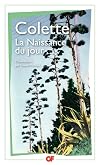
Break of Day
by Colette
There is 1 current discussion about this work.
On This Page
Description
Colette began writing "Break of Day" in her early fifties, at Saint-Tropez on the Cote d'Azur, where she had bought a small house after the breakup of her second marriage. The novel's theme -- the renunciation of love and the return to an independent existence supported and enriched by the beauty and peace of nature -- grows out of Colette's own period of self-assessment in the middle of her life. A collection of subtle reflections about love and life, it is among her most thoughtful and show more stylistically bold works. show lessTags
Recommendations



































Member Reviews
“A woman lays claim to as many native lands as she has had happy loves. She is born, too, under every sky where she has recovered from the pain of loving.”
The 1928 novella Break of Day is a contemplative book written by Colette, one of the most celebrated female authors of France, in a time of deep introspection and isolation during the latter years of her life. An experimental work that does not keep strictly to fiction or nonfiction, Break of Day twines the two in an artfully ambiguous narrative of such felt gentleness. The narrative, despite being so sparse as to be almost nonexistent, contains a wealth of emotion. Truly, between long passages of introspection, internal musings and remembrances, and gorgeously vivid descriptions show more of everything from human relationships to color to the dance of the salt air on the delicate summer plants, there are but a handful of scenes with any semblance of forward momentum. This novel has what feels like two and a half scenes of any distinguishable, memorable quality, and yet the prose is so filled with feeling and substance that the experience of reading Break of Day has yet to fade from my mind since turning the last page weeks ago.
“‘The worst thing in a woman’s life: her first man.’ He is the only one you die of.”
In this story, Colette, who is at once herself and yet also a fiction, is grappling with her decision to free herself from the cycle of romantic love, to cast off that ghost which has haunted her for the length of her life. A prominent aspect of this self-journey involves another ghost entirely, however, that of her deceased mother whose presence seems always with her. She shares snippets of letters penned by her mother and recounts tales and memories of this woman she so admired. Colette often compares herself to the ideals she saw within her mother, asking herself and her mother’s memory if Sido would be proud of her. These two ideas, a woman’s ongoing preoccupation with romantic love of one man or another as well as a woman’s admiration of her mother, make the novel. Colette is attempting to escape the constant desire to be in love, to be consumed by the heat and heartbreak of romance, in order to find the peace of a later stage of life.
“...An age comes for a woman when, instead of clinging to beautiful feet that are impatient to roam the world, expressing herself in soothing words, boring tears and burning, ever-shorter sighs--an age comes when the only thing that is left for her is to enrich her own self.”
Though she wishes to embody the contented self reliance and self assurance she so longs for not only for herself but also for her mother’s memory, it is not an easy transition. Colette cannot so simply do what she has set out to, cannot be what she believes came so effortlessly to the individualistic Sido. Despite her commitment to the task, Colette is still a woman of whom the desire to love and be loved is easily rekindled and not so easily ignored. A woman of passion and feeling, Colette’s descriptions of the all consuming nature of love and moments of passing beauty and connection seem to settle in the bones with the rightness of them, the truth of them.
“Giving becomes a sort of neurosis, a fierce egotistical frenzy. ‘Here’s a new tie, a cup of hot milk, a shred of my own live flesh, a box of cigarettes, a conversation, a journey, a kiss, a word of advice, the shelter of my arms, an idea. Take! And don’t dream of refusing unless you want me to burst. I can’t give you less, so put up with it!’”
And all throughout the book does Colette exhibit such a care for words, such an eye for detail and a skill for painting a moment vividly within the mind’s eye. She has the ability to dazzle the reader with almost every sentence, not, I think, out of a desire to simply impress one with her words but to so accurately share the experience of singular moments in time. Her descriptions of the summer landscape, of the small house she keeps near the sea and the animals who accompany her in this “lonely” pursuit of hers are bursting with the joy and perfection of life. Her ability to craft atmosphere, to transport the reader to a moment in time when the blue of morning is just seeping in through the windows, is unmatched in its mastery.
It is difficult to describe just how a novel that seems to do little beyond serve as a meditative jumble of thoughts has so unsuspectingly left such an impression, but I hope I was able to express at least enough to encourage someone else to consider reading Colette’s work. Break of Day is a slow book, but one that creeps up on you. And after it has, it stays there. show less
The 1928 novella Break of Day is a contemplative book written by Colette, one of the most celebrated female authors of France, in a time of deep introspection and isolation during the latter years of her life. An experimental work that does not keep strictly to fiction or nonfiction, Break of Day twines the two in an artfully ambiguous narrative of such felt gentleness. The narrative, despite being so sparse as to be almost nonexistent, contains a wealth of emotion. Truly, between long passages of introspection, internal musings and remembrances, and gorgeously vivid descriptions show more of everything from human relationships to color to the dance of the salt air on the delicate summer plants, there are but a handful of scenes with any semblance of forward momentum. This novel has what feels like two and a half scenes of any distinguishable, memorable quality, and yet the prose is so filled with feeling and substance that the experience of reading Break of Day has yet to fade from my mind since turning the last page weeks ago.
“‘The worst thing in a woman’s life: her first man.’ He is the only one you die of.”
In this story, Colette, who is at once herself and yet also a fiction, is grappling with her decision to free herself from the cycle of romantic love, to cast off that ghost which has haunted her for the length of her life. A prominent aspect of this self-journey involves another ghost entirely, however, that of her deceased mother whose presence seems always with her. She shares snippets of letters penned by her mother and recounts tales and memories of this woman she so admired. Colette often compares herself to the ideals she saw within her mother, asking herself and her mother’s memory if Sido would be proud of her. These two ideas, a woman’s ongoing preoccupation with romantic love of one man or another as well as a woman’s admiration of her mother, make the novel. Colette is attempting to escape the constant desire to be in love, to be consumed by the heat and heartbreak of romance, in order to find the peace of a later stage of life.
“...An age comes for a woman when, instead of clinging to beautiful feet that are impatient to roam the world, expressing herself in soothing words, boring tears and burning, ever-shorter sighs--an age comes when the only thing that is left for her is to enrich her own self.”
Though she wishes to embody the contented self reliance and self assurance she so longs for not only for herself but also for her mother’s memory, it is not an easy transition. Colette cannot so simply do what she has set out to, cannot be what she believes came so effortlessly to the individualistic Sido. Despite her commitment to the task, Colette is still a woman of whom the desire to love and be loved is easily rekindled and not so easily ignored. A woman of passion and feeling, Colette’s descriptions of the all consuming nature of love and moments of passing beauty and connection seem to settle in the bones with the rightness of them, the truth of them.
“Giving becomes a sort of neurosis, a fierce egotistical frenzy. ‘Here’s a new tie, a cup of hot milk, a shred of my own live flesh, a box of cigarettes, a conversation, a journey, a kiss, a word of advice, the shelter of my arms, an idea. Take! And don’t dream of refusing unless you want me to burst. I can’t give you less, so put up with it!’”
And all throughout the book does Colette exhibit such a care for words, such an eye for detail and a skill for painting a moment vividly within the mind’s eye. She has the ability to dazzle the reader with almost every sentence, not, I think, out of a desire to simply impress one with her words but to so accurately share the experience of singular moments in time. Her descriptions of the summer landscape, of the small house she keeps near the sea and the animals who accompany her in this “lonely” pursuit of hers are bursting with the joy and perfection of life. Her ability to craft atmosphere, to transport the reader to a moment in time when the blue of morning is just seeping in through the windows, is unmatched in its mastery.
It is difficult to describe just how a novel that seems to do little beyond serve as a meditative jumble of thoughts has so unsuspectingly left such an impression, but I hope I was able to express at least enough to encourage someone else to consider reading Colette’s work. Break of Day is a slow book, but one that creeps up on you. And after it has, it stays there. show less
La naissance du jour pourrait être la naissance d’une autre Colette, la femme tumultueuse se meurt, l’écrivain certes demeure mais s’impose l’être humain de tout à chacun tout naturellement au seuil d’une vieillesse d’où sans doute ce parallèle avec sa mère, ce besoin de se rapprochent pour amorcer sa propre déclinaison.
Jan 20, 2012French
> Une femme est arrivée à la maturité, à la sagesse et, croit-elle, au renoncement. C'est une sagesse souriante, un renoncement serein. Avec ses chats et ses livres, elle se retire dans le Midi, près de Saint-Tropez – alors petit village inconnu –. Elle va s'occuper de son jardin, de sa treille, bavarder avec de vieux amis, jouir de sa solitude et de sa liberté. Mais elle a pris pour un crépuscule ce qui était la naissance du jour. Car tout recommence et l'amour, un nouvel amour, intervient.
—Pauline Hamon (Culturebox)
—Pauline Hamon (Culturebox)
Dec 28, 2018 (Edited)French
merveilleux style
Dec 11, 2013French
Ratings
Members
- Recently Added By
Lists

Books and authors mentioned by Le Clézio in his Nobel Prize speech
87 works; 3 members

My Lesbian Literature Library
14 works; 1 member

In Our Time books
4,934 works; 2 members
Talk Discussions
Current Discussions
Break of Day by Colette - LIMITED EDITIONS CLUB 1983 in George Macy devotees (October 2025)
Author Information

278+ Works 12,663 Members
Some Editions
Awards and Honors
Series
Belongs to Publisher Series
De twintigste eeuw (28)
Work Relationships
Is contained in
Common Knowledge
- Canonical title
- Break of Day
- Original title
- La naissance du jour
- Alternate titles
- A Lesson in Love
- Original publication date
- 1928
- First words
- "Sir,
"You ask me to come and spend a week with you, which means I would be near my daughter, whom I adore. . . ."
Classifications
Statistics
- Members
- 399
- Popularity
- 78,020
- Reviews
- 4
- Rating
- (3.45)
- Languages
- 8 — Danish, Dutch, English, French, German, Italian, Polish, Spanish
- Media
- Paper, Audiobook, Ebook
- ISBNs
- 23
- ASINs
- 16