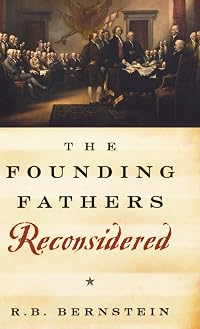
The Founding Fathers Reconsidered
by R. B. Bernstein
On This Page
Description
"This concise study reintroduces us to the history that shaped the founding fathers, the history that they made, and what history has made of them. It gives the reader a context within which to explore the world of the founding fathers and their complex and still-controversial achievements and legacies"--Provided by publisher.Tags
Recommendations




















Member Reviews
R.B. Bernstein's The Founding Fathers Reconsidered (Oxford University Press, 2009) is an accessible and useful introduction to the historiography of the "founding fathers," that nebulous group. Bernstein lays out his goals in the preface:
"I propose to take the founding fathers down from their pedestals without knocking them down. At the same time, I set their achievements and their failures within the context of their own time and place, while making clear that those achivements were not great beyond the bounds of mortal men and that those failures were not blameworthy beyond human beings' normal capacity to err. If we rework our relationship with the founding fathers so that we meet them eye to eye instead of gazing reverently upward show more of sneering contemptuously downward, perhaps we can form a more pragmatic sense of who they were, what they did and failed to do, and why we care" (p. xi).
Bernstein succeeds admirably in this. He examines, first, the roots of the term "founding fathers" (betcha didn't know it was Warren G. Harding in 1916 who coined the term!), and tracks the reputations of the group and several of its individual members over the course of historical memory and scholarly debate. Bernstein offers his reader a glimpse into the cultural context in America at the time of the Revolution, and how that, combined with the wide variety of background experiences held by the founding generation, shaped their minds and lives.
In the two longest chapters of the book, Bernstein discusses the achievements and challenges, as well as the legacies of the founding generation. This is the meat of the book, and these two chapters are perhaps the single best succinct synopsis of the issues I've read. Bernstein is fair-minded and writes with a clear and concise style, providing an in-depth analysis without getting bogged down in details. His lengthy and excellent footnotes will provide any interested reader with much additional reading material.
A good introductory text to the cultural context and historical memory of the men we know as founding fathers. Recommended as such.
http://philobiblos.blogspot.com/2009/08/book-review-founding-fathers.html show less
"I propose to take the founding fathers down from their pedestals without knocking them down. At the same time, I set their achievements and their failures within the context of their own time and place, while making clear that those achivements were not great beyond the bounds of mortal men and that those failures were not blameworthy beyond human beings' normal capacity to err. If we rework our relationship with the founding fathers so that we meet them eye to eye instead of gazing reverently upward show more of sneering contemptuously downward, perhaps we can form a more pragmatic sense of who they were, what they did and failed to do, and why we care" (p. xi).
Bernstein succeeds admirably in this. He examines, first, the roots of the term "founding fathers" (betcha didn't know it was Warren G. Harding in 1916 who coined the term!), and tracks the reputations of the group and several of its individual members over the course of historical memory and scholarly debate. Bernstein offers his reader a glimpse into the cultural context in America at the time of the Revolution, and how that, combined with the wide variety of background experiences held by the founding generation, shaped their minds and lives.
In the two longest chapters of the book, Bernstein discusses the achievements and challenges, as well as the legacies of the founding generation. This is the meat of the book, and these two chapters are perhaps the single best succinct synopsis of the issues I've read. Bernstein is fair-minded and writes with a clear and concise style, providing an in-depth analysis without getting bogged down in details. His lengthy and excellent footnotes will provide any interested reader with much additional reading material.
A good introductory text to the cultural context and historical memory of the men we know as founding fathers. Recommended as such.
http://philobiblos.blogspot.com/2009/08/book-review-founding-fathers.html show less
Ratings
Members
- Recently Added By
Lists

Founding Father
104 works; 11 members
Author Information
27+ Works 1,740 Members
R. B. Bernstein, Distinguished Adjunct Professor of Law at New York Law School, has written, edited, or co-edited nineteen books on American constitutional and legal history, including Thomas Jefferson.
Awards and Honors
Awards
Common Knowledge
- People/Characters
- Alexander Hamilton; Benjamin Franklin; George Washington; John Adams; James Madison; Thomas Jefferson
- Important places
- Philadelphia, Pennsylvania, USA; New York, New York, USA; Washington, D.C., USA
- Important events
- American Revolution (1775–1783); Constitutional Convention (USA : 1787)
Classifications
- Genres
- History, Nonfiction, General Nonfiction, Politics and Government, Biography & Memoir
- DDC/MDS
- 973.3092 — History & geography History of North America United States Revolutionary War (1775-89) Personal narratives--American Revolution
- LCC
- E302.5 .B47 — History of the United States United States Revolution to the Civil War, 1775/1783-1861 Biography (Late eighteenth century)
- BISAC
Statistics
- Members
- 148
- Popularity
- 222,190
- Reviews
- 1
- Rating
- (3.75)
- Languages
- English
- Media
- Paper, Ebook
- ISBNs
- 6
- ASINs
- 1