The World Doesn't End
by Charles Simic
On This Page
Description
A Pulitzer Prize-winning collection of prose poems by Charles Simic.Tags
Recommendations
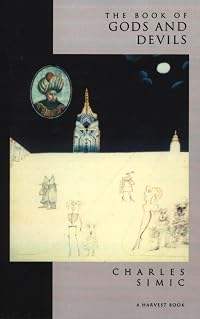
Member Reviews
The narratives arranged here are situated unclearly in time (there are skyscrapers but no computers or even telephones) and occasionally drift into the realm of the fabulous (characters like guardian angels and ambulating dead make appearances)—as a result the book reads something like a collection of children's tales, and it evokes a sense of wonder and potential that I recall deriving from books I read as a child. At the same time, the book is not truly "childlike"—if this is a book of "stories," it is a book of especially ambiguous, open-ended, lyrically dense stories, distinctly more rewarding to the sensibilities of adults than to those of children. I could not wish for a book with a better sense of balance.
Is it even poetry? In interviews, Simic has laughed at the idea of the Pulitzer community giving the prize in poetry to his collection of "prose fragments." Personally, I don't care what they're called-- the important thing is that they're good. Surreal writing is hard to get away with. Either too boring or too disjointed to hold the attention of a reader, surreal writing (on the whole) doesn't thrive.
The pieces in this book are entertaining, in the same tradition as Aloysius Bertrand (arguably the first prose poet), Simic approaches ordinary objects as something incredible while miracles are the most trivial things in the world. One passage involves the narrator blandly talking about his childhood of being stolen by gypsies, then his show more parents, as if he were writing a grocery list. Another passage treats a math problem as fantastic, a graveyard where the subject is forced to poke around with a piece of chalk.
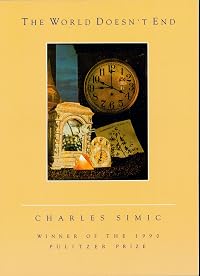
This approach makes this collection incredibly refreshing, readable, and it's definitely poetic. In comparison, the actual poems which end each section are rather bland. None of the insight, attention to language, or intricacies are present. Between this collection and Dime Store Alchemy (a book of prose passages/poems concerning Joseph Cornell, the artist who's work adorns the cover of The World Doesn't End), Simic establishes himself a master of the very form which he works so hard to deny practicing. It doesn't matter what category you place this book into, it's simply an amazing collection of writings. show less
The pieces in this book are entertaining, in the same tradition as Aloysius Bertrand (arguably the first prose poet), Simic approaches ordinary objects as something incredible while miracles are the most trivial things in the world. One passage involves the narrator blandly talking about his childhood of being stolen by gypsies, then his show more parents, as if he were writing a grocery list. Another passage treats a math problem as fantastic, a graveyard where the subject is forced to poke around with a piece of chalk.
This approach makes this collection incredibly refreshing, readable, and it's definitely poetic. In comparison, the actual poems which end each section are rather bland. None of the insight, attention to language, or intricacies are present. Between this collection and Dime Store Alchemy (a book of prose passages/poems concerning Joseph Cornell, the artist who's work adorns the cover of The World Doesn't End), Simic establishes himself a master of the very form which he works so hard to deny practicing. It doesn't matter what category you place this book into, it's simply an amazing collection of writings. show less
I started (coincidentally) reading this book around the same time I started reading Calvino's Numbers in the Dark, and while I've never seen those two names associated, some of the scenes Simic describes in his prose poems have a similar surrealistic quality, IMO. In some cases, even more surreal, for example with the piece that begins, "He held the Beast of the Apocalypse by its tail, the stupid kid!"
I would agree with the other review. Is this poetry? Is it deserving of a Pulitzer prize? It's a very quick read and I found this form of prose poetry to be less than appealing to me. I did find a few of these short story snippets enjoyable. Perhaps I'm not as familiar with Simic's work as I should be so I won't completely write this off. It's short enough to read and garner your own opinion.
A disappointing collection full of pretentious verse which on the whole expresses nothing, or at least nothing much of interest. Here and there, thankfully, there were real moment of genius, but sadly they weren't developed. Not a collection I can recommend.
I gave the book four stars, but I think I'm being kind. The only reason I recommend the book is for its imagry. Other than that, if you the sort who doesn't want to read the abstract, then I suggest you don't buy the book.
Ratings
Members
- Recently Added By
Lists

Tom's Bookstore
346 works; 2 members
Author Information

113+ Works 4,043 Members
Charles Simic was born in Belgrade, Yugoslavia, immigrated with his family to Chicago in 1954, and was educated at New York University. Although his native language was Serbian, he began writing in English. Some of his work reflects the years he served in the U.S. Army (1961--63). He has been awarded a MacArthur Foundation fellowship, a Guggenheim show more Foundation grant, and a National Endowment for the Arts award. "My poetry always had surrealistic tendencies, which were discouraged a great deal in the '50's," the poet said, but such tendencies were applauded in the 1970s and his reputation consequently flourished. His poems are about obsessive fears and often depict a world that resembles the animism of primitive thought. His work has affinities with that of Mark Strand and has in its turn produced several imitators. Simic was appointed the fifteenth Poet Laureate Consultant in Poetry to the Library of Congress in 2007 (Bowker Author Biography) show less
Awards and Honors
Awards
Common Knowledge
- Original publication date
- 1989
Classifications
Statistics
- Members
- 385
- Popularity
- 81,691
- Reviews
- 6
- Rating
- (3.88)
- Languages
- English, Italian
- Media
- Paper, Ebook
- ISBNs
- 5
- ASINs
- 2