
Russell Edson (1935–2014)
Author of The tunnel : selected poems
About the Author
Russell Edson was born in 1935. He attended the Art Students League and Black Mountain College. In the 1960s, he began publishing poetry and received fellowships from the Guggenheim Foundation and the National Endowment for the Arts. He illustrated his own collections of poetry including The Brain show more Kitchen: Writings and Woodcuts, The Clam Theatre, The Wounded Breakfast: Ten Poems, The Tormented Mirror, The Rooster's Wife, and See Jack. He also wrote a book of plays entitled The Falling Sickness and the novels Gulping's Recital and The Song of Percival Peacock. He died after a long illness on April 29, 2014 at the age of 79. (Bowker Author Biography) show less
Works by Russell Edson
The Very Thing that Happens: Fables and Drawings (A New Directions Paperbook) (1964) 23 copies, 2 reviews
Associated Works
The Poets' Grimm: 20th Century Poems from Grimm Fairy Tales (2003) — Contributor — 70 copies, 1 review
Stooge Thirteen, Spring 1975 — Contributor — 1 copy
Tagged
Common Knowledge
- Birthdate
- 1935
- Date of death
- 2014-04-29
- Gender
- male
- Occupations
- poet
novelist
writer
illustrator - Awards and honors
- Whiting Writers' Award (1989)
- Relationships
- Edson, Gus (father)
- Nationality
- USA
- Places of residence
- Darien, Connecticut, USA
- Associated Place (for map)
- Connecticut, USA
Members
Reviews
I first read about the poetry of Russell Edson in the book Writing Down the Bones by Natalie Goldberg. Goldberg wrote about a poetry reading that Edson had given at the University of Minnesota. After the reading Edson sat alone; the faculty and staff did not approach him. She wrote: Though we all laughed during the reading, he touched on naked truths in us all and we were uncomfortable. Edson's poetry is unique and strange. Recurring themes throughout his poems include monkeys/apes, show more cannibalism, cooking your pets, body parts falling off, chopping up people/animals with axes, ceilings and marrying inanimate objects. His poems feel like weird dreams. I liked these prose poems, but, they are definitely not for everyone.
The Mental Desert
The mind is mostly desert. The moon is lovely there, and almost turns the sands to water, save for one's natural logic.
At the paper-doll factory we are issued scissors, and warned not to monkey with our wrists.
I am an extremely serious person, needing no lectures on the care and maintenance of my tools.
I let the wrist business go unchallenged. Why should I invite discourse about monkeys with inferiors who, though in executive station, are nevertheless inferiors in the art of the scissors.
One's work involves the folding of paper, snipping here and there, and finally unfolding a self-portrait of insomniacs in a line of beds, each a night, arranged end to end.
Another ingenious design is a traffic of cars joined bumper to bumper, and so on, depending on how many folds one has made.
One dependable old woman with a rather unlovely stare, creates a masturbator pattern: a chain of lonely men holding their penises, ingeniously attached penis by penis: one long spit through all their groins.
There is the morning-bus motif, the public-toilet motif, any number of old favorites...Yet, I thought to give the factory a motif closer to the popular taste; and by this means prove myself worthy of executive station. I created a suicide motif: a chain of paper-doll factory workers attached elbow to elbow, cutting their wrists.
An inferior foreman merely said, you are well on your way to the misuse of your tools, which may well involve your monkey.
...My monkey? I screamed.
...Of course the mind is a desert, one grows used to the simplicity of thirst. show less
The Mental Desert
The mind is mostly desert. The moon is lovely there, and almost turns the sands to water, save for one's natural logic.
At the paper-doll factory we are issued scissors, and warned not to monkey with our wrists.
I am an extremely serious person, needing no lectures on the care and maintenance of my tools.
I let the wrist business go unchallenged. Why should I invite discourse about monkeys with inferiors who, though in executive station, are nevertheless inferiors in the art of the scissors.
One's work involves the folding of paper, snipping here and there, and finally unfolding a self-portrait of insomniacs in a line of beds, each a night, arranged end to end.
Another ingenious design is a traffic of cars joined bumper to bumper, and so on, depending on how many folds one has made.
One dependable old woman with a rather unlovely stare, creates a masturbator pattern: a chain of lonely men holding their penises, ingeniously attached penis by penis: one long spit through all their groins.
There is the morning-bus motif, the public-toilet motif, any number of old favorites...Yet, I thought to give the factory a motif closer to the popular taste; and by this means prove myself worthy of executive station. I created a suicide motif: a chain of paper-doll factory workers attached elbow to elbow, cutting their wrists.
An inferior foreman merely said, you are well on your way to the misuse of your tools, which may well involve your monkey.
...My monkey? I screamed.
...Of course the mind is a desert, one grows used to the simplicity of thirst. show less

One literary critic wrote: "The first Russell Edson prose poem I ever read was Counting Sheep. The poem begins: “A scientist has a test tube full of sheep. He wonders if he should try to shrink a pasture for them. // They are like grains of rice.” The poem was written at the same grade-level as USA Today, but it took the top of my head off per Emily Dickinson’s dictum —it moved me as much as any so-called real, immortal art. And, to my amazement, the lines were free from the show more self-congratulation that Wallace Stevens warned against."
Likewise, this collection of Russell Edson prose poems took the top of my head off. And his work moves me as much as any writing I've ever read. Here are three of my favorites below. Hope you enjoy!
YOU
Out of nothing there comes a time called childhood, which is simply a path leading through an archway called adolescence. A small town there, past the arch called youth.
Soon, down the road, where one almost misses the life lived beyond the flower, is a small shack labeled, you.
And it is here the future lives in the several postures of arm on windowsill, cheek on this elbow on knees, face in the hands; sometimes the head thrown back, eyes staring into the ceiling . . . This into nothing down the long day’s arc . . .
THE WOUNDED BREAKFAST
A huge shoe mounts up from the horizon, squealing and grinding forward on small wheels, even as a man sitting to breakfast on his veranda is suddenly engulfed in a great shadow, almost the size of the night . . .
He looks up and sees a huge shoe ponderously mounting out of the earth.
Up in the unlaced ankle-part an old woman stands at a helm behind the great tongue curled forward; the thick laces dragging like ships' rope on the ground as the huge thing squeals and grinds forward; children everywhere, they look from the shoelace holes, they crowd about the old woman, even as she pilots this huge shoe over the earth . . .
Soon the huge shoe is descending the opposite horizon, a monstrous snail squealing and grinding into the earth . . .
The man turns to his breakfast again, but sees it's been wounded, the yolk of one of his eggs is bleeding . . .
THE RAT'S TIGHT SCHEDULE
A man stumbled on some rat droppings.
Hey, who put those there? That's dangerous, he said.
His wife said, those are pieces of a rat.
Wait, he's coming apart, he's all over the floor, said the husband.
He can't help it; you don't think he wants to drop pieces of himself all over the floor, do you? said the wife.
But I could have flipped and fallen through the floor, said the husband.
Well, he's been thinking of turning into a marsupial, so try to have a little patience. I'm sure if you were thinking of turning into a marsupial he'd be patient with you. But, on the other hand, don't embarrass him if he decides to remain placental, he's on a very tight schedule, said the wife.
A marsupial, a wonderful choice, cried the husband . . . show less

To celebrate the bright strawberry in the sky (what some people refer to as the sun), I'd like to share a number of my favorite Russell Edson pieces from this, my favorite Russell Edson book. As if slices of scrumptious strawberry pie, I hope you find the writing delectable.
TURTLES
Bales of turtles descend like floating oriental villages; and still they come, until the hills are only turtles, until there is no surface of the immediate earth that is not a turtle. They cover the trunks of show more trees, the branches. They are everywhere!
People are forced to shovel their way to the roads; forced to shovel out their beds at night; only to awaken from dreaming endlessly of turtles, covered with turtles.
People becomes so distracted they no longer remember how to speak, they do not know words anymore; only turtle . . . They stare, their heads askew, whispering, turtle, turtle, turtle . . .
THE GINGERBREAD WOMAN
An old woman wishes she could climb into her own basket, like a gingerbread woman, the one who would have naturally married the gingerbread man, had they been made with more detail in their genital areas.
. . . How nice to lie in a basket on a linen napkin, near a pot of jam and a chicken leg, being kissed by a gingerbread man . . . Summer shadow, summer light, branch sway . . . Delight!
IN THE FOREST
I was combing some long hair coming out of a tree . . .
I had noticed long hair coming out of a tree, and a comb on the ground by the roots of that same tree.
The hair and the comb seemed to belong together. not so much that the hair needed combing, but the reassurance of the comb being drawn through it . . .
I stood in the gloom and silence that many forests have in the pages of fiction, combing the thick womanly hair, the mammal-warm hair; even as the evening slowly took the forest into night . . .
Similar to the illustration at the very top, this woodcut print is by Russell Edson himself. As something of a bonus, here are the first several lines of the prose poem:
A ROOF WITH SOME CLOUDS BEHIND IT
A man is climbing what he thinks is the ladder of success.
He's got the idea, says father.
Yes, he seems to know the direction, says mother.
But do you realize that some men have gone quite the other way and brought up gold? says father.
Then you think he would do better in the earth? says mother.
I have a terrible feeling he's on the wrong ladder, says father.
But he's still in the right direction, isn't he? says mother.
Yes, but, you see, there seems to be only a roof with some clouds behind it at the top of the ladder, says father.
Hmmm, I never noticed that before, how strange. I wonder if that roof and those clouds realize that they're in the wrong place, says mother.
I don't think they're doing it on purpose, do you? says father.
No, probably just a thoughtless mistake, says mother. show less
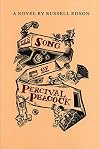
This Russell Edson novel is so weird it doesn't even make it on the lists of weird novels. Any reader familiar with the author's oddball, offbeat prose poems (what some term "microfictions") will have a good sense why this is the case.
For those folks not the least bit acquainted with Russell Edson, herein are gathered a bushel of Edson-esque features from The Song of Percival Peacock that will provide a small taste of what's to be found in this one-of-a-kinder that has created its own show more category within the world of the novel: hyperweirdism.
I sprinkled in several medieval woodcuts that, to my eye, express some of the novel's unique spirit. Russell Edson was himself both a writer and illustrator who worked in a number of mediums, including woodcuts.
Right from the get-go in this short novel (144 pages) we are treated to a dose of vintage Russell Edson bizarre home sweet home under the heading: MAYONNAISE. Here's a snatch of dialogue where Mr. Peacock, the new master of the house, continues his efforts to extract information about a missing chair from his servants, in this case, the Maid:
"I was trying to say that because of my rheumatism I like to undress in the kitchen, and put mayonnaise on my body, and just let it soak in. It's necessary for me to completely undress, said the Maid.
Yes, yes, you're covered with mayonnaise and naked, screamed Mr. Peacock.
You're talking so loudly I can barely gather my thoughts, said the Maid.
I'm all nerves, screamed Mr. Peacock.
I've told the Caretaker to keep out of the kitchen a thousand times. So many times I caught old my Hardcock by the window peeking in, said the Maid.
I don't want to appear rude. And I sympathize with your maidenly modesty. It's perfectly natural your not wanting to be viewed with mayonnaise all over you. But I'm very anxious about the missing chair, said Mr. Peacock."
The flaky aesthetic of The Song of Percival Peacock shares much with Conspirators of Pleasure, a 1996 film by the Czech creator Jan Švankmajer. Link to a 3 minute clip: https://www.youtube.com/watch?v=CfvHNaA13lc
When I watched Conspirators of Pleasure years ago, this 85 minute film nearly weirded me out. I had the same experience with the twisted sexuality in The Song of Percival Peacock. Curiously and perhaps not so coincidentally, both Russell Edson and Jan Švankmajer thrive in the shorter form as per the below Edson prose poem and Švankmajer shorty:
THE TREE
They have grafted pieces of an ape with pieces of a dog.
Then, what they have, wants to live in a tree.
No, what they have wants to lift its leg and piss on the tree . . .
Jan Švankmajer 3 minute film:
https://www.youtube.com/watch?v=BXe9lluFbdk
Did I mention twisted sexuality back there? It isn't long before the master of the house, Mr. Peacock, alternately called Mr. Sleepycock, Mr Beddycock, Mr. Horsecock, Mr. Pussycock, Mr. Freecock, Mr Weeweecock by his Caretaker and Maid, is dealing with upset to his traditional ideas about order as the master-servant relationship is turned topsy-turvy.
And that's shake n' bake chaos as in the Caretaker crawling into bed with Mr. Peacock to feel the warmth and touch Mr. Peacock in his delicate places. The Maid walks in and gives Mr. Peacock hell for all his carrying on in such ways with the Caretaker. A yelling match ensues until the Caretaker gives Mr. Peacock a good whack on the head with a hammer.
Some days later Mr. Peacock wakes up wearing a chastity belt and all his cloths are gone. No problem, the Maid tells him, she has a nice flowered dress he can wear since she always wanted a daughter. Outrageous events escalate, adding even more torque to contorted sexuality as Mr. Pussycock deals with the bird of his displeasure.
However, even with such kooky, grotesque and comical curlicues (I laughed out loud on nearly ever page), through the magic and power of Edson's storytelling, we are compelled to keep turning the pages to see what further antics poor Mr. Weeweecock must contend with in his self-proclaimed role as master. By the way, all this Edson-esque bedlam bestows fresh and expanded meaning to that time-honored phrase "to the manor born."
In point of fact, we shouldn’t feel too sorry for Percival the Horsecock since he judges his servants having no more humanness than oxen in a field. Maybe not a bad development when Maid and Caretaker assume the roles of mother and father for that uppity Mr. Freecock.
What are we to make of all this? Should we revoke Russell Edson’s license to write such novels? Actually it is too late since Russell Edson, born 1935, passed on into the mica glitter of star in 2014.
With an entire career creating such off-the-wall writing, is it any wonder Russell lived his entire life in solitude with his wife Frances in a small house on Weed Avenue in Stamford, Connecticut, eschewing the demands of literary notoriety? For Edson fans, we enjoy every morsel of his imagination. My recommendation here for readers new to Russell Edson is to pick up a collection or two of his prose poems prior to taking a whack at this singular, out-there novel.
"I do not permit people to touch my body. The flesh is not only the house of the soul, but a vehicle, including intake ports as well as exhaust ports; not to mention areas given wholly to the reproductive cycle. These areas are of particular note. They grow more meaningfully terrible in direct ratiio to one's growing sense of modesty, said Mr. Peacock." - Russell Edson, The Song of Percival Peacock show less
Awards
You May Also Like


Associated Authors
Statistics
- Works
- 24
- Also by
- 13
- Members
- 591
- Popularity
- #42,465
- Rating
- 3.9
- Reviews
- 24
- ISBNs
- 31
- Languages
- 3
- Favorited
- 5