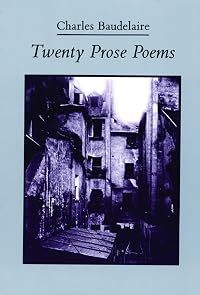
Twenty Prose Poems
by Charles Baudelaire
On This Page
Description
From the introduction by Michael Hamburger: "Baudelaire's prose poems were written at long intervals during the last twelve or thirteen years of his life. The prose poem was a medium much suited to his habits and character. Being pre-eminently a moralist, he needed a medium that enabled him to illustrate a moral insight as briefly and vividly as possible. Being an artist and sensualist, he needed a medium that was epigrammatic or aphoristic, but allowed him scope for fantasy and for that show more element of suggestiveness which he considered essential to beauty. His thinking about society and politics, as about everything else, was experimental; like the thinking of most poets it drew on experience and imagination, rather than on facts and general arguments. That is another reason why the prose poem proved a medium so congenial to Baudelaire." Charles Baudelaire (1821-1867) was a French poet, essayist, art critic, and translator for Edgar Allan Poe. He is credited with coining the term "modernity" to describe the fleeting, ephemeral experience of life in an urban metropolis and the responsibility art has to capture that experience. show lessTags
Recommendations








Member Reviews
These twenty pieces were written over a number of years and published separately in various periodicals. They don't form a sequence or have any relation to one another, and actually form part of a larger collection of around 50.
The term "prose poem" is not necessarily the best term for these works because its meaning is rather vague, however a more informative phrase would perhaps fail to capture whatever similarity these various short works have in common.
That is the ability to make a point, and to render in the reader a poetic state of mind. Of course, this can often be achieved as well by a scenic view, a good novel, an artwork, or an everyday encounter, as it can by a "prose poem", but these works do fill these requirements too and show more are written in prose so we can leave it that.
The topics of the different pieces are various, and being so show us many different emotional and aesthetic facets of the author's character, personality, and tastes.
These are probably best read one or two at a time, with space for reflection. It is therefore a good book for dipping into during brief available moments, and does not require a lot of effort on behalf of the reader.
This volume, published by "City Lights" press also contains side by side the original French, with the English translation, which would be excellent for the reader of French, the new student, or simply the curious reader. At only 79 pages including a 7 page introduction, and parallel language texts, it can be appreciated that most works are between one and two pages.
As an introduction to Baudelaire this is great, and I would recommend its literary quality and ease of reading.
If I was looking to compare this to works by an other author, there are many similarities here to the shorter of Virginia Woolf's works which capture a similar aesthetic/moral sensibility and impressionistic regard for the everyday event. However Baudelaire tends toward the more flamboyant, and to an epigrammatic certainty found often in Nietzsche's collections of aphorisms. show less
The term "prose poem" is not necessarily the best term for these works because its meaning is rather vague, however a more informative phrase would perhaps fail to capture whatever similarity these various short works have in common.
That is the ability to make a point, and to render in the reader a poetic state of mind. Of course, this can often be achieved as well by a scenic view, a good novel, an artwork, or an everyday encounter, as it can by a "prose poem", but these works do fill these requirements too and show more are written in prose so we can leave it that.
The topics of the different pieces are various, and being so show us many different emotional and aesthetic facets of the author's character, personality, and tastes.
These are probably best read one or two at a time, with space for reflection. It is therefore a good book for dipping into during brief available moments, and does not require a lot of effort on behalf of the reader.
This volume, published by "City Lights" press also contains side by side the original French, with the English translation, which would be excellent for the reader of French, the new student, or simply the curious reader. At only 79 pages including a 7 page introduction, and parallel language texts, it can be appreciated that most works are between one and two pages.
As an introduction to Baudelaire this is great, and I would recommend its literary quality and ease of reading.
If I was looking to compare this to works by an other author, there are many similarities here to the shorter of Virginia Woolf's works which capture a similar aesthetic/moral sensibility and impressionistic regard for the everyday event. However Baudelaire tends toward the more flamboyant, and to an epigrammatic certainty found often in Nietzsche's collections of aphorisms. show less
O estilo altamente original de poesia em prosa de Baudelaire influenciou toda uma geração de poetas, incluindo Paul Verlaine, Arthur Rimbaud e Stéphane Mallarmé, entre muitos outros. Acredita-se que ele cunhou o termo "modernidade" para designar a experiência fugaz e efêmera da vida em uma metrópole urbana e a responsabilidade que a arte tem de capturar essa experiência. “Quem entre nós não sonhou, em momentos de ambição, o milagre de uma prosa poética, musical sem ritmo nem rima, flexível e staccato o suficiente para se adaptar aos movimentos líricos da alma, às ondulações dos sonhos e aos súbitos saltos de alma e da consciência?¨T indaga o grande poeta.
Jan 13, 2019Portuguese (Brazil)
Ratings
Members
- Recently Added By
Author Information

765+ Works 19,374 Members
Charles Baudelaire, 1821 - 1867 Charles Baudelaire had perhaps had an immeasurable impact on modern poetry. He was born on April 9, 1821, to Joseph-Francois Baudelaire and Caroline Archimbaut Dufays in Paris. He was educated first at a military boarding school and then the College Louis-le-Grand, where he was later expelled in 1839. Baudelaire show more then began to study law, at the Ecole de Droit in Paris, but devoted most of his time to debauchery. After an abortive trip to the East, he settled in Paris and lived on an inheritance from his much despised step father, while he wrote poetry. During this period he met Jeanne Duval, a mulatto with whom he fell in love with and who became the "Black Venus," the muse behind some of his most powerful erotic verse. Baudelaire strove to portray sensual experiences and moods through complex imagery and classical form, avoiding sentimentality and objective description. Thus he profoundly influenced the later French symbolist writers, including Mallarme and Rimbaud, and such English-language poets as Yeats, Eliot, and Stevens. With much of his inheritance squandered, Baudelaire turned to journalism, especially art and literary criticism, the first of which were "Les Salons". Here he discovered the work of Edgar Allan Poe, which became an influence on his own poetry. While continuing to write unpublished verse, Baudelaire became famous as critic and translator of Poe. This reputation enabled Baudelaire to publish his most famous collection of poetry, "Les Fleurs du Mal" (The Flowers of Evil) in 1857. The result was an obscenity trial and the banning of six of the poems. Though he continued to write journalism with some success, he became increasingly depressed and pessimistic. Baudelaire attempted suicide in 1845, an attempt to get attention, and became minorly involved in the French Revolution. Today Baudelaire's work is considered the "last brilliant summation of romanticism, precursor of symbolism and the first expression of modern techniques". It was his originality that set him apart and ultimately proved to be his end. Baudelaire died, apparently from complications of syphilis, on August 31, 1867, in Paris. (Bowker Author Biography) show less
Series
Belongs to Publisher Series
Cape Editions (14)
dtv zweisprachig (Französisch)
Classifications
Statistics
- Members
- 174
- Popularity
- 188,661
- Reviews
- 2
- Rating
- (4.29)
- Languages
- Dutch, English, French, Multiple languages
- Media
- Paper, Ebook
- ISBNs
- 7
- ASINs
- 1