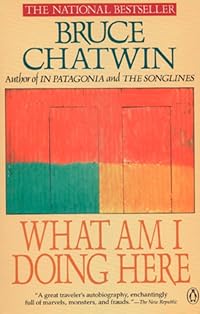
What Am I Doing Here
by Bruce Chatwin
On This Page
Description
In this text, Bruce Chatwin writes of his father, of his friend Howard Hodgkin, and of his talks with Andre Malraux and Nadezhda Mandelstram. He also follows unholy grails on his travels, such as the rumour of a "wolf-boy" in India, or the idea of looking for a Yeti.Tags
Recommendations





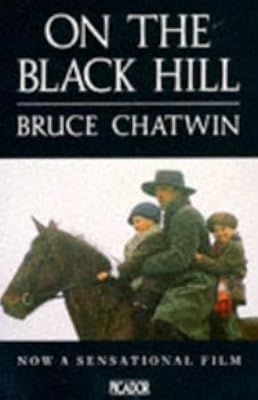










Member Recommendations

Member Reviews
Bruce Chatwin was perhaps the biggest star of the British travel-writing boom of the eighties, but also the first to burn out, a victim of that other great viral phenomenon of the period, AIDS. Before becoming a serious traveller, he had already established himself as a formidable judge of fine art, with a glowing career ahead of him at Sotheby's. But then he went off to South America for six months, and wrote In Patagonia, the first of a short but insanely beautiful collection of books that all hover somewhere on the borders of fiction and travel-writing.
This was Chatwin's last book, a collection of his short stories, essays and journalism from the seventies and eighties which he prepared for publication during his final illness (which show more he refers to in several pieces, but still steadfastly refuses to call by its proper name, even though everyone who read the book must have known what it was...).
Despite the circumstances, almost everything in the book still seems to reflect Chatwin's usual concern for perfection of style, and it's a pleasure to read throughout. The subject-matter, as you might expect, ranges widely over his big interests in life - in particular the fine art business, travel, architecture, nomads, and literature. He says in an introductory note that all but one of the pieces were "my ideas", but there does seem to be quite a spectrum between very personal reflections and obvious newspaper commissions (like the Observer article describing a cruise on the Volga with a boatload of German Stalingrad veterans and widows - a kind of trip it's rather difficult to imagine Chatwin going on on his own initiative).
There are some very interesting peripheral notes related to his other books, such as his account of working with Werner Herzog on the film version of The viceroy of Ouidah, and some tantalising hints of other things that might have been developed into books if he had had more time.
A book that everyone who enjoys Chatwin's prose would want to have on their shelves to complete the set, but perhaps not the first one you would reach for if you don't know his work yet. show less
This was Chatwin's last book, a collection of his short stories, essays and journalism from the seventies and eighties which he prepared for publication during his final illness (which show more he refers to in several pieces, but still steadfastly refuses to call by its proper name, even though everyone who read the book must have known what it was...).
Despite the circumstances, almost everything in the book still seems to reflect Chatwin's usual concern for perfection of style, and it's a pleasure to read throughout. The subject-matter, as you might expect, ranges widely over his big interests in life - in particular the fine art business, travel, architecture, nomads, and literature. He says in an introductory note that all but one of the pieces were "my ideas", but there does seem to be quite a spectrum between very personal reflections and obvious newspaper commissions (like the Observer article describing a cruise on the Volga with a boatload of German Stalingrad veterans and widows - a kind of trip it's rather difficult to imagine Chatwin going on on his own initiative).
There are some very interesting peripheral notes related to his other books, such as his account of working with Werner Herzog on the film version of The viceroy of Ouidah, and some tantalising hints of other things that might have been developed into books if he had had more time.
A book that everyone who enjoys Chatwin's prose would want to have on their shelves to complete the set, but perhaps not the first one you would reach for if you don't know his work yet. show less
Nothing that Chatwin wrote could be completely uninteresting, although several of the outtakes from his fiction here come close. When brilliance comes, however, it comes in his uniquely marvelous voice, so much worth it. But please read Songlines and In Patagonia for an immeasurably more wonderful experience; and no, I don't care whether he made some of it up, or what a flawed person he was, it's still worth every syllable.
My first read of Chatwin's writing, and this book turns out to have been his last. The essays are grouped under titles, such as "Friends", which includes Diana Vreeland. "Encounters" includes a wild memoir of being in Africa with Werner Herzog and Klaus Kinski as they filmed a movie. He also writes of nomads, French fashion designer Madeleine Vionnet in Paris, and meeting a "wolf-boy" in India in 1978.
Reading Chatwin's essays is like getting an education about the world of the last 35 years of the 20th Century. He sought out the rare and unusual, often focusing on one person, or a small group, to tell the story of how they live. I'll look for more from him.
Reading Chatwin's essays is like getting an education about the world of the last 35 years of the 20th Century. He sought out the rare and unusual, often focusing on one person, or a small group, to tell the story of how they live. I'll look for more from him.
The author of one of my favorite short novels, Bruce Chatwin here demonstrates his story-telling ability amidst the realities of travel and the vast world of his extended friendships and acquaintances. As an example the following is from “Mrs. Mandelstam,” Chatwin’s account of his visit with the widow of the Russian poet, Osip Mandelstam:
"White metal fastenings glittered among the brown stumps of her teeth. A cigarette stuck to her lower lip. Her nose was a weapon. You knew for certain she was one of the most powerful women in the world, and knew she knew it…. She waved me to a chair and, as she waved, one of her breasts tumbled out of her nightie. "Tell me," she shoved it back, "are there any grand poets left in your country?" show more
The joy of reading his prose is surpassed only by the delight in knowing that opening the book to any page you will be engrossed by the words upon the page. A reader's delight that persuades you with its charm that you should return to one of his other books as soon as possible. show less
"White metal fastenings glittered among the brown stumps of her teeth. A cigarette stuck to her lower lip. Her nose was a weapon. You knew for certain she was one of the most powerful women in the world, and knew she knew it…. She waved me to a chair and, as she waved, one of her breasts tumbled out of her nightie. "Tell me," she shoved it back, "are there any grand poets left in your country?" show more
The joy of reading his prose is surpassed only by the delight in knowing that opening the book to any page you will be engrossed by the words upon the page. A reader's delight that persuades you with its charm that you should return to one of his other books as soon as possible. show less
This is an ample selection of essays and notes taken from Chatwin's adventures in life. He was a romantic adventurer and a confident writer; he spoke succinctly about what he observed. He never gives the impression of being overbearing in his observations of the people he interviewed and met. Luckily for us he had a curiosity that allowed us all to share in personalities, historical oddities and places off the beaten track.
A worthwhile book to have in your library.
A worthwhile book to have in your library.
This is my first Chatwin book, and many people have said that is one of Chatwin's lesser efforts. If so I can't wait to read more of his works. He is an exceptionally good writer, able to capture in one or two sentences complete portraits of characters or places. He manages to combine the mundane with the thrilling, the everyday detail that makes up a personality with the extreme circumstance that shapes them, and his prose is always on the right side of spare while still being supple.
As with any collection of essays some are better than others, but none is unreadable, and some are superb. A book to read, and re-read.
As with any collection of essays some are better than others, but none is unreadable, and some are superb. A book to read, and re-read.
I really enjoy Bruce Chatwin's writing style (though I was a bit taken aback when I read his assessment that he writes like Hemingway or D.H. Lawrence....) so "What am I doing here?" has that going for it, at least.
The book really pales in comparison to Chatwin's others, however. It's filled with vignettes and a few short stories about people that Chatwin has met, traveled with (or liked to imagine he knew.) Some were really fascinating... others were really tedious.
I'd really only recommend this book to Chatwin completists. If you're new to his work, you are much better off with "In Patagonia" or "Songlines" for non-fiction or "On the Black Hill" for fiction, as all are really wonderful.
The book really pales in comparison to Chatwin's others, however. It's filled with vignettes and a few short stories about people that Chatwin has met, traveled with (or liked to imagine he knew.) Some were really fascinating... others were really tedious.
I'd really only recommend this book to Chatwin completists. If you're new to his work, you are much better off with "In Patagonia" or "Songlines" for non-fiction or "On the Black Hill" for fiction, as all are really wonderful.
Members
- Recently Added By
Published Reviews
In ''What Am I Doing Here,'' Chatwin comes right out and tells us that five of the pieces are short stories, labeling each of them ''A Story'' lest there be any confusion. They're the weakest part of this collection, and they read more like outtakes from his other books than self-contained works of fiction. But many of the essays in ''What Am I Doing Here'' are examples of Chatwin at his best show more - part observer, part interviewer, part scholar. What brings them alive is his special talent for noticing life's strange, riveting details. He was a born Autolycus, a snapper-up of unconsidered trifles. What comes through in his last book is a life miscellaneous and on the move, traveled on foot, but never pedestrian. show less
added by John_Vaughan
Lists

Books Read in 2023
5,638 works; 147 members
Author Information

54+ Works 14,587 Members
Some Editions
Awards and Honors
Distinctions
Series
Belongs to Publisher Series
Work Relationships
Is contained in
Common Knowledge
- Canonical title
- What Am I Doing Here
- Original title
- What Am I Doing Here
- Original publication date
- 1988
- First words
- What am I doing here?
- Last words
- (Click to show. Warning: May contain spoilers.)I have always acted on this advice.
- Original language*
- Engels
*Some information comes from Common Knowledge in other languages. Click "Edit" for more information.
Classifications
Statistics
- Members
- 1,451
- Popularity
- 16,217
- Reviews
- 22
- Rating
- (3.76)
- Languages
- 10 — Danish, Dutch, English, French, German, Italian, Japanese, Portuguese, Spanish, Swedish
- Media
- Paper, Ebook
- ISBNs
- 35
- ASINs
- 8