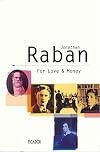
For Love and Money
by Jonathan Raban
On This Page
Description
Jonathan Raban weighs up the advantages of maintaining an independent spirit against problems of insolvency and self-worth, confesses to travel as an escape from the blank page, ponders the true art of the book review, admires the role of the literary editor and remembers with affection and hilarity events from his eccentric life at the heart of literary London. Reading it is like embarking on a humane, rigorous and witty conversation.Tags
Recommendations






















Member Recommendations

Member Reviews
This is a selection of his very best essays, reportage, travel writings and literary criticism, linked with a narrative thread that bravely attempts the agonizing and revelatory question 'Why do you write?' In fact, Raban has some engaging remarks on this subject. As he says, very few people can now make a living by writing reviews. Indeed the risk for young writers is that they may love the job too much. ‘Waking to the flop of the jiffybag on the mat, he knows it as the sound of the beginning of a good day’; the piece he does will be published quite quickly, while the book he neglects in order to meet the deadline of the literary editor won’t in any case see the light for a year or two. Moreover reviewing gives him the show more satisfaction of being a part of the judicial process by which books are sorted out at the discretion of a handful of his peers. I love the sound of the jiffy bag or cardboard version form Amazon whenever I get a nee book or CD, so I know that joy very well.
It is true that just as people read reviews rather than books, they prefer short reviews to long ones, so the snap judgments of the dailies and Sundays have undue influence. But this doesn’t mean there is no place for serious reviewing. I for one love to dip into the London Review of Books for such longueurs whilst idling time in the library. This is a wonderful pot-pourri of articles that you can dip into anytime. One which I thoroughly enjoyed. show less
It is true that just as people read reviews rather than books, they prefer short reviews to long ones, so the snap judgments of the dailies and Sundays have undue influence. But this doesn’t mean there is no place for serious reviewing. I for one love to dip into the London Review of Books for such longueurs whilst idling time in the library. This is a wonderful pot-pourri of articles that you can dip into anytime. One which I thoroughly enjoyed. show less
Lots of people dream of making a living from writing. Sadly in the modern world, it is only the authors that sell millions of copies that are able to do this, or who have been fortunate enough to land significant advances. Raban started off as a lecturer at The University College of Wales before heading to the University of East Anglia. It was there that he was given the chance to write book reviews. He resigned the steady job and took the opportunity and waded into the London literary scene.
In those days you could earn a reasonable living from being a literary reviewer, those the days that they paid for people to write reviews and there were a lot more column inches to fill too. He was sent piles of books to read, and it could be quite show more lucrative too as he could sell them on afterwards. He had a particular way of doing things, which suited some editors, but I am sure that he loved the accolade of a ‘troublesome reviewer’ from one of his editors. Book reviews then were much more expansive then, often considering the author’s wider works and all sorts of other things that took their interest. He includes some of his best reviews in this part.
Raban then tried to get into writing plays, partly as it was work that was much less solitary than sitting alone in a flat in London and the money could be really good. He soon found out that it was a very different discipline than writing a book review and to be perfectly frank, it wasn’t very successful…
Then we are onto the part where he writes about writing for magazines like the New Review, where editorial demands are both high and relaxed, being mostly dedicated to good writing without having a set agenda or a particular axe to grind. There look for pieces from contributors that could be taken from any subject that they wanted to write about. Raban provides some examples of work that he had published. Next is my favourite part of the book, the section on travel writing.
He has discovered that the best way to travel is to cast himself adrift in the world and ensure that he has no appointments to make and how a letter of introduction can take you places that you’d rather not go. The same working conditions for a writer that drives him to drink can also drive him to travel as they would do anything to get away from the typewriter. The procrastination with make you think of sunnier climes and of those whose footsteps you wish to follow. He revels in the chaos of travel and has a thing for seeing different places from boats. He then goes onto review some of his fellow travel writers books and journeys, some of which I have read and some of which I haven’t.
This was another enjoyable book by Raban. His writing style is more crisp and efficient when compared to his books as these were pieces for periodicals and not originally intended for a book. In this, his infectious enthusiasm for the written word is evident and not just the words he has wrestled onto the page, but the admiration for authors who have done the same. show less
In those days you could earn a reasonable living from being a literary reviewer, those the days that they paid for people to write reviews and there were a lot more column inches to fill too. He was sent piles of books to read, and it could be quite show more lucrative too as he could sell them on afterwards. He had a particular way of doing things, which suited some editors, but I am sure that he loved the accolade of a ‘troublesome reviewer’ from one of his editors. Book reviews then were much more expansive then, often considering the author’s wider works and all sorts of other things that took their interest. He includes some of his best reviews in this part.
Raban then tried to get into writing plays, partly as it was work that was much less solitary than sitting alone in a flat in London and the money could be really good. He soon found out that it was a very different discipline than writing a book review and to be perfectly frank, it wasn’t very successful…
Then we are onto the part where he writes about writing for magazines like the New Review, where editorial demands are both high and relaxed, being mostly dedicated to good writing without having a set agenda or a particular axe to grind. There look for pieces from contributors that could be taken from any subject that they wanted to write about. Raban provides some examples of work that he had published. Next is my favourite part of the book, the section on travel writing.
He has discovered that the best way to travel is to cast himself adrift in the world and ensure that he has no appointments to make and how a letter of introduction can take you places that you’d rather not go. The same working conditions for a writer that drives him to drink can also drive him to travel as they would do anything to get away from the typewriter. The procrastination with make you think of sunnier climes and of those whose footsteps you wish to follow. He revels in the chaos of travel and has a thing for seeing different places from boats. He then goes onto review some of his fellow travel writers books and journeys, some of which I have read and some of which I haven’t.
This was another enjoyable book by Raban. His writing style is more crisp and efficient when compared to his books as these were pieces for periodicals and not originally intended for a book. In this, his infectious enthusiasm for the written word is evident and not just the words he has wrestled onto the page, but the admiration for authors who have done the same. show less
Ratings
Members
- Recently Added By
Published Reviews
''An encyclopedic rag-bag of past experiences,'' wrote Jonathan Raban of Byron's ''Don Juan'' in a 1974 piece for The Sunday Times of London. On the other hand, Trollope's autobiography ''gave away everything and nothing about himself.'' Both comments could apply equally well to ''For Love & Money,'' a curious ragbag and rummage sale of a book in which Mr. Raban gives away everything and show more nothing about himself. show less
added by John_Vaughan
Author Information

26+ Works 5,336 Members
Jonathan Raban, author of Passage to Juneau, brings eloquent intellect and wry wit to his exploration of the American scene. Written over the past two decades, roughly the span of Raban's residence in his adopted city of Seattle, these essays delve into what it means, as immigrant, to feel rooted in America. Driving Home charts a course through show more the Pacific Northwest, American history, and current events as witnessed by a keenly observant visitor who is able to glean meanings and patterns that have become invisible to the natives. Raban spends much time on, near, and in water, and his ruminations on sailing and the sea are a welcome thread. Whether the topic is other writers or various painters and explorers, or the patrons of a Montana bar, who have engaged with our mythical and actual landscape, Raban has a visitor s eye for the absurd, and his tone is intimate, never nostalgic, and always fresh. show less
Common Knowledge
- Canonical title
- For Love and Money
- Original title
- For Love & Money. Writing, Reading, Travelling 1868-1987
- Original publication date
- 1987
Classifications
- Genres
- Nonfiction, Biography & Memoir, Literature Studies and Criticism, Travel
- DDC/MDS
- 828.91409 — Literature & rhetoric English & Old English literatures English miscellaneous writings English miscellaneous writings 1900- English miscellaneous writings 1900-1999 English miscellaneous writings 1945-1999 Individual authors
- LCC
- PR6068 .A22 .Z465 — Language and Literature English English Literature 1961-2000
Statistics
- Members
- 162
- Popularity
- 200,259
- Reviews
- 2
- Rating
- (3.48)
- Languages
- English
- Media
- Paper, Ebook
- ISBNs
- 7
- ASINs
- 2