On This Page
Description
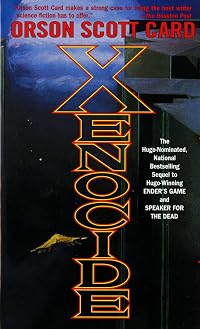
In Lusitania, Ender found a world where humans and pequininos and the Hive Queen could all live together; where three very different intelligent species could find common ground at last. But Lusitania also harbors the descolada, a virus that kills all humans it infects, but which the pequininos require in order to become adults. The Startways Congress so fears the effects of the descolada, should it escape from Lusitania, that they have ordered the destruction of the entire planet, and all show more who live there. The Fleet is on its way and a second xenocide seems inevitable. Until the fleet vanishes. The task of discovering how the ships disappeared falls to Gloriously Bright, the most brilliant analytical mind in a world of people bred for superintelligence. There is little doubt that she can solve the puzzle; but will she choose life or death for the three races who live on Lusitania? show lessTags
Recommendations





Member Reviews
The first two-thirds of the Xenocide consider the ethics of exterminating an intelligent species that poses an existential threat. Are the Ender’s Buggers, the loveable piggies and their trees, clever but dangerous Jane the AI, and the deadly but intelligent Descolada virus equally worthy of our care? Toward the end, the focus shifts less successfully to more purely religious questions—the existence and nature of God and the soul.
It's heavy stuff for a science fiction novel. Ender is often shoved into the background, and talk can bury the plot. However, the nuanced discussion of ethics makes it all worthwhile. I will never think about Star Trek’s Prime Directive in quite the same way.
It's heavy stuff for a science fiction novel. Ender is often shoved into the background, and talk can bury the plot. However, the nuanced discussion of ethics makes it all worthwhile. I will never think about Star Trek’s Prime Directive in quite the same way.
This is one of the most profoundly philosophical science fiction books ever written.
Humans have colonized the planet they call Lusitania, home to the "piggies," intelligent mammal-like animals with no technology. Then Ender Wiggin arrives, with the Hive Queen, the last remaining member of her high-tech species. Now three intelligent species must cohabit one world -- for if they leave it, they will take with them the ultimate biological weapon, the descolada virus.
Human contact with not one but two intelligent alien species sets the scene for a thorough and balanced discussion of some of the most important questions about being human:
What does it mean to be intelligent?
What does it mean to be alive?
Does free will exist?
Where did show more the universe come from?
How can we pursue our own interests while remaining respectful of others'?
My only reservation about this book is that it really only makes sense having read the other two first, Ender's Game and Speaker for the Dead. I tried reading it immediately after Ender's Game, and put it down in frustration after a few pages.
But if you have time to read a great sci-fi trilogy, with interesting characters, a suspenseful plot, and some surprisingly unique ideas, you will be richly rewarded.
Addendum: In light of Card's homophobic statements, I feel obligated to add a few words. It is incredibly disappointing to me that such an imaginative, creative writer as Card sees homosexuality as wrong. He is able to imagine species that reproduce in incredibly innovative and foreign ways, yet is not able to tolerate something as banal as one human loving another human who happens to be of the same sex. I admire Card's creativity, but I am saddened by his narrow-mindedness regarding his own species. show less
Humans have colonized the planet they call Lusitania, home to the "piggies," intelligent mammal-like animals with no technology. Then Ender Wiggin arrives, with the Hive Queen, the last remaining member of her high-tech species. Now three intelligent species must cohabit one world -- for if they leave it, they will take with them the ultimate biological weapon, the descolada virus.
Human contact with not one but two intelligent alien species sets the scene for a thorough and balanced discussion of some of the most important questions about being human:
What does it mean to be intelligent?
What does it mean to be alive?
Does free will exist?
Where did show more the universe come from?
How can we pursue our own interests while remaining respectful of others'?
My only reservation about this book is that it really only makes sense having read the other two first, Ender's Game and Speaker for the Dead. I tried reading it immediately after Ender's Game, and put it down in frustration after a few pages.
But if you have time to read a great sci-fi trilogy, with interesting characters, a suspenseful plot, and some surprisingly unique ideas, you will be richly rewarded.
Addendum: In light of Card's homophobic statements, I feel obligated to add a few words. It is incredibly disappointing to me that such an imaginative, creative writer as Card sees homosexuality as wrong. He is able to imagine species that reproduce in incredibly innovative and foreign ways, yet is not able to tolerate something as banal as one human loving another human who happens to be of the same sex. I admire Card's creativity, but I am saddened by his narrow-mindedness regarding his own species. show less
Ender's Game being an unintentional success seems to be a major problem for Card since his ideas for books really have nothing to do with Ender as a character, and all to do with marketing, which makes him an afterthought and the least interesting participant in the books ostensibly about him. Reintroducing a couple of dead characters just shrinks the universe and is a terrible comic book crutch ("somehow Palpatine returned"). But hey just hang on for another book or two or three and I'm sure it'll pay off. Right?
As Orson Scott Card moves away from the childlike narrative of Ender's Game the series becomes more deeply philosophical. In each subsequent Ender novel, Card questions the argument surrounding free will. Xenocide expands on these ideas as it examines cultural differences, religious ideology and the ethics of destroying a race because of its potential danger. Card takes his readers to the planet Lusitania where humans (including Andrew Wiggin and his family), the Pequeninos (Piggies), and the Hive Queen are all under threat by the Starways Congress. The Congress is hellbent on blowing up the planet because they fear the Descolada virus which is essential to the Pequeninos but deadly to humans. Card keeps Ender and his family mostly in show more the background as he explores these heavier concepts. I found it to be heavy mucking. show less
Ender Wiggen and his family are trapped on Lusitania with an incurable virus that is methodically killing every non-native living thing. The situation is only made worse by the fact that the Congress is sending a fleet to destroy the planet for its recent rebellion. Valentine has agreed to embark on a decades long trip to rejoin her brother and hopefully stop the fleet through political propaganda.
Although the scientists on Lusitania have the ability to destroy the virus, if they do, it will also destroy the local peoples whose entire life cycle is bound up with the virus. Meanwhile, the Hive Queen has started building her civilization on Lusitania as well. She is building ships for her many children to set out for distant planets. She show more will not consent to be slain, and is also building ships for the Lusitania natives. By these means both races might escape extinction, but if they spread the virus to other worlds it could possible destroy all other life in the universe. Ender will need to muster all the great minds at his disposal if he can hope to save these two races from xenocide, not to mention his own family. They cannot be allowed to leave Lusitania either unless the virus is cured.
Meanwhile, on a Chinese colonized world named Path a young woman is learning to serve her society and the gods. On this planet certain special people are singled out by the gods to receive messages. These messages consist almost entirely of commands to purify themselves. These "god-spoken" people are extremely mentally gifted, but also hobbled by the intense protocols required by the gods. The young woman, "Gloriously Bright" has been given a special assignment from her father. She must discover what has become of the Lusitania fleet which was sent to destroy the rebellious planet. It has mysteriously vanished without apparent cause. It will be the determined mind of this gifted child that will eventually reveal to Congress the existence of Jane - a sentient being living in the computer connections of a thousand worlds. Gloriously Bright will bring about Jane's destruction if Ender cannot come up with a way to save her as well.
This book is odd in its format. The greatest part of it consists of extremely detailed moral and philosophical discussions between a cast of essentially interchangeable characters. Many times I would come back to my place in the book and find myself in the midst of a prolonged discussion that might not even have clearly named speakers. Despite this, I found myself entertained - even on the edge of my seat in places. This is a complex story of interplanetary politics, genetic engineering, theoretical physics, and diverse alien groups working together. I liked it, almost against my better judgement. show less
Although the scientists on Lusitania have the ability to destroy the virus, if they do, it will also destroy the local peoples whose entire life cycle is bound up with the virus. Meanwhile, the Hive Queen has started building her civilization on Lusitania as well. She is building ships for her many children to set out for distant planets. She show more will not consent to be slain, and is also building ships for the Lusitania natives. By these means both races might escape extinction, but if they spread the virus to other worlds it could possible destroy all other life in the universe. Ender will need to muster all the great minds at his disposal if he can hope to save these two races from xenocide, not to mention his own family. They cannot be allowed to leave Lusitania either unless the virus is cured.
Meanwhile, on a Chinese colonized world named Path a young woman is learning to serve her society and the gods. On this planet certain special people are singled out by the gods to receive messages. These messages consist almost entirely of commands to purify themselves. These "god-spoken" people are extremely mentally gifted, but also hobbled by the intense protocols required by the gods. The young woman, "Gloriously Bright" has been given a special assignment from her father. She must discover what has become of the Lusitania fleet which was sent to destroy the rebellious planet. It has mysteriously vanished without apparent cause. It will be the determined mind of this gifted child that will eventually reveal to Congress the existence of Jane - a sentient being living in the computer connections of a thousand worlds. Gloriously Bright will bring about Jane's destruction if Ender cannot come up with a way to save her as well.
This book is odd in its format. The greatest part of it consists of extremely detailed moral and philosophical discussions between a cast of essentially interchangeable characters. Many times I would come back to my place in the book and find myself in the midst of a prolonged discussion that might not even have clearly named speakers. Despite this, I found myself entertained - even on the edge of my seat in places. This is a complex story of interplanetary politics, genetic engineering, theoretical physics, and diverse alien groups working together. I liked it, almost against my better judgement. show less
Xenocide is the third book in the story of Ender Wiggin and for me in some ways the weakest so far. Ender is still on Lusitania, the world of the pequeninos. All species on that world are now threatened by a fleet sent to destroy it - the two alien species that live there are threatened with xenocide as they exist nowhere else. A virus, deadly to all worlds exposed to it that cannot adapt or protect themselves is present on Lusitania and it is this that is used for the justification of the destruction of the world. This is the backdrop to a book which deals with questions of religion, of how we characterise sentient life, of where the line should be drawn in cases of self-protection. Still the broken family of Speaker for the Dead show more follow their path to salvation and still Ender continues to age.
My main problem with this book was that it didn't 'live' for me the way Speaker for the Dead did. Card still crafts a good story but the jarring introduction of the world of Path to offer a counterpoint to the religious arguments and a resolution of some of the problems in the book didn't quite sit right for me. Nonetheless, I still whipped through this book and was engaged throughout with the characters and tale. show less
My main problem with this book was that it didn't 'live' for me the way Speaker for the Dead did. Card still crafts a good story but the jarring introduction of the world of Path to offer a counterpoint to the religious arguments and a resolution of some of the problems in the book didn't quite sit right for me. Nonetheless, I still whipped through this book and was engaged throughout with the characters and tale. show less
This is a fairly heavy book; certainly entertaining and quite interesting, but Card addresses some rather major topics. There's a lot of philosophy involved, particularly around how the fictional characters perceive alien species - but everything is obviously applicable to the human race internally as well.
The physics of instantaneous travel, the pre-existence of all intelligence, and the origins of the universe are all also covered, though not nearly to the extent to which philosophy is discussed (and because philosophy is so wide reaching, these other topics are intertwined - sometimes deeply, other times superficially - with the overall philosophical arc of the book).
The plot itself surrounds two planets - one on which humans exist show more (to some extent unknowingly) with three non-human, sentient species - and possibly a fourth pseudo-sentient virus; and one world on which super-intelligent humans believe they commune with the gods. It seems that this book was the ultimate in existential crises, as many characters repeatedly try to figure out who they are, where they came from, and for one of the species whether their intelligence is their own intelligence at all.
Cogito Ergo Sum indeed.
Fans of the Ender Series should enjoy Ender's further adventures here, though it bares hardly any resemblance to Ender's Game itself. Really, Xenocide takes some of the heavier concepts of Speaker of the Dead and expounds on them. If you're looking for some stimulating concepts to wrack your brain over - all wrapped in quite an interesting plot line - this should do the trick. show less
The physics of instantaneous travel, the pre-existence of all intelligence, and the origins of the universe are all also covered, though not nearly to the extent to which philosophy is discussed (and because philosophy is so wide reaching, these other topics are intertwined - sometimes deeply, other times superficially - with the overall philosophical arc of the book).
The plot itself surrounds two planets - one on which humans exist show more (to some extent unknowingly) with three non-human, sentient species - and possibly a fourth pseudo-sentient virus; and one world on which super-intelligent humans believe they commune with the gods. It seems that this book was the ultimate in existential crises, as many characters repeatedly try to figure out who they are, where they came from, and for one of the species whether their intelligence is their own intelligence at all.
Cogito Ergo Sum indeed.
Fans of the Ender Series should enjoy Ender's further adventures here, though it bares hardly any resemblance to Ender's Game itself. Really, Xenocide takes some of the heavier concepts of Speaker of the Dead and expounds on them. If you're looking for some stimulating concepts to wrack your brain over - all wrapped in quite an interesting plot line - this should do the trick. show less
Members
- Recently Added By
Published Reviews
ThingScore 100
Bár a regény korántsem tökéletes, mégis megérdemli, hogy kiemelkedőnek nevezzem, hiszen kétségtelenül az utóbbi évek legötletesebb és legérdekesebb regénye. Card igazi profi, aki új színt hoz a sci-fibe: a pontosan kidolgozott karakterábrázolást, mely - valljuk be - az egész sci-fi műfaj leggyengébb pontja.
added by asalamon
Lists

Series That Jumped The Shark
25 works; 16 members

20th Century Literature
1,161 works; 55 members

Best-selling Books by Latter-day Saints
58 works; 2 members

Unread books
1,063 works; 82 members

Alphabetical Books
211 works; 3 members

Books Read in 2015
3,299 works; 129 members

Titles beginning with X
72 works; 3 members

Science Fiction and Fantasy
63 works; 4 members
Books Read in 2016
4,666 works; 197 members

Florida
366 works; 3 members
Speculative Fiction to Read
706 works; 32 members

Space Colonization
100 works; 26 members

Best Science Fiction Novels
816 works; 430 members
Author Information

575+ Works 213,935 Members
Orson Scott Byron Walley Card, was born in 1951 and studied theater at Brigham Young University. He received his B.A. in 1975 and his M.A. in English in 1981. He wrote plays during that time, including Stone Tables (1973) and the musical, Father, Mother, Mother and Mom (1974). A Mormon, Scott served a two-year mission in Brazil before starting show more work as a journalist in Utah. He also designed games at Lucas Film Games, 1989-92. He is best known for his science fiction novels, including the popular Ender series. Well known titles include A Planet Called Treason (1979), Treasure Box (1996), and Heartfire (1998). He has also written the guide called How to Write Science Fiction and Fantasy (1990). His novel Ender's Game and its sequel Speaker for the Dead, both won Hugo and Nebula awards, making Card the only author to win both prizes in consecutive years. His titles Shadows in Flight, Ruins and Ender's Game made The New York Times Best Seller List. He is also the author of The First Formic War Series, which includes the titles Earth Unaware, Earth Afire, and Earth Awakens. (Bowker Author Biography) show less
Some Editions
Awards and Honors
Awards
Distinctions
Series


Belongs to Publisher Series
J'ai lu (4024)
Work Relationships
Common Knowledge
- Canonical title
- Xenocide
- Original title
- Xenocide
- Original publication date
- 1991-08
- People/Characters
- Ender Wiggin (Andrew Wiggin); Jane the A.I.; Novinha Ribeira; Elanora Ribeira; Grego; Quara (show all 16); Quim; Father Estevão; Han Fei-Tzu; Han Qing-jao (Gloriously Bright); Si Wang-Mu; Valentine Wiggin; Miro; The Hive Queen; Demosthenes; Peter Wiggin
- Important places
- Lusitania (planet); Milagre; Path; The Outside
- Dedication
- To Clark and Kathy Kidd:
for the freedom, for the haven,
and for frolics all over America - First words
- Han Fei-tzu sat in lotus position on the bare wooden floor beside his wife's sickbed.
- Last words
- (Click to show. Warning: May contain spoilers.)Path is blessed above all other worlds, they said. For the God of Path is Gloriously Bright.
- Original language
- English
Classifications
Statistics
- Members
- 12,880
- Popularity
- 623
- Reviews
- 127
- Rating
- (3.64)
- Languages
- 18 — Chinese, Czech, Dutch, English, Finnish, French, German, Hebrew, Hungarian, Italian, Japanese, Polish, Portuguese, Romanian, Russian, Slovenian, Spanish, Turkish
- Media
- Paper, Audiobook, Ebook
- ISBNs
- 67
- ASINs
- 30