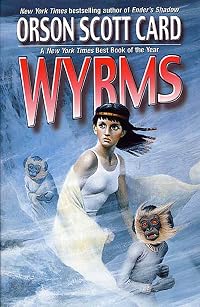
Wyrms
by Orson Scott Card
There is 1 current discussion about this work.
On This Page
Description
Serving a usurper who has destroyed her family and rules their space-dwelling sphere home, Patience journeys to the heart of her world in order to reclaim her crown, a quest that may spell salvation or destruction for the cosmos.Tags
Recommendations













Member Reviews
Cred că la un moment dat Card s-a uitat la filmul horror The Thing în timp ce citea Lumii îi spuneau pădure de Ursula Le Guin și s-a întrebat: ce ar fi dacă le-aș combina și le-aș muta pe un fundal de tip dying Earth, stil Wolfe sau McAuley, la care aș adăuga o supradoză de cruzime și paranoia? Și foarte bine a făcut, fiindcă i-a ieșit unul dintre cele mai bune science fantasy ever, nu ca scriitură (e mult mai prost scrisă decât Ender) dar ca idei fascinante și ca un worldbuilding incredibil de bogat și profund, plus o surprindere mult mai bună decât în Xenocid a dilemei fără ieșire a contactului dintre 2 specii total incompatibile în modul de gândire. Mi-e greu însă să o recomand altora decât show more cititorilor experimentați în cărți bine întunecate și dure. Și cred și eu, ca și alte recenzii, că acest worldbuilding atât de complex merita măcar o trilogie, caz în care (aici zic doar eu) ar fi fost o fascinantă alternativă dark la Helliconia. show less
So far, this gets my 'best book of the year' award. I was thinking that I would have to say I liked it even better than 'Ender's Game,' but I didn't think the ending was handled with quite as much power and finesse. And - like most of Card's books, although I LOVE the writing, I disagree with his conclusions.
Young Patience has grown up on the planet of Imakulata as a slave in the Heptarch's household, the daughter of the ruler's prime assassin, and trained herself in the deadly arts. However, with the help of the biologically preserved head of a deceased court official, she discovers that she is actually the heir apparent - and not only that, but the fulfillment of an age-old religious prophecy - believers think that she is destined to show more be the mother of the Kristos (the second coming of Christ).
Upon the death of her father, Patience is no longer trusted by the usurper, and she flees assassins herself, accompanied only by her childhood teacher, Angel. At first aimless, she soon begins to fall prey to a nigh-irresistible mental call... the call of the Unwyrm, a terrible legend feared by all four sentient races of Imakulata. Answering Unwyrm's erotic summons, Patience realized, would lead to the fulfillment of the prophecy. Perversely, she decides that she will exercise free will, seek out Unwyrm, and destroy him.
Along the road of her quest, she falls in with companions, including a brother/sister pair of geblings (goblin-like, intelligent and telepathic beings considered to be sub-human), their strong and silent servant, Will, and a stout riverboat captain, who is bigoted yet loyal - and meets others - the 'librarian' dwelf, who like others of her race, has perfect memory of actions, but no ability to remember concepts - and gaunts, the beautiful creatures for whom another's desire always takes precedence over their own (meaning that they're often caught in the role of sex workers).
Along the way, the group uncovers much of the history of Imakulata - how the founder of the planet was a starship captain summoned by the same will-subsuming mental call that Patience now feels, and how scientific experiments have revealed the bizarre phenomenon of Imakulata - the native life is capable of mixing genetically with alien life, sexually reproducing and mimicking the new forms perfectly.
However, the first generation always contains genetic screw-ups and 'sports.' The second generation is always superior to the original earth life forms, and then takes over with hybrid vigor.
All sentient life on Imakulata now is first generation after hybridization: the starship captain mated with the alien Wyrm he found on Imakulata, the results were: 'normal' humans, and the 'sports' - dwelfs, gaunts, and geblings. After this incident, the humans kill all the sentient alien life forms, since they're ugly and threatening (a very human-like behavior), preventing a second generation from occurring. Now, IF Patience mates with the alien Wyrm, her offspring will be new, improved, "super-humans." However, Card comes down against this, metaphorically equating the call of Unwyrm with the temptations of Satan. The reason given for this are that these new improved humans would wipe out the existing life on Imakulata (as the prophecy says will happen). OKAY, but the problem is that life on Imakulata is pretty bad. Racism and bigotry are rampant, people are oppressed, etc.. It's not such a good system to be preserving. Even Patience says something to the effect of, "the only reason I can think of to preserve humans is that I'm a human."
And Card specifically points out that all the Unwyrm wanted was what humans wanted - to live and reproduce.
So - why is he equated with Satan?
Why should the planet remain in the 'in-between,' awkward evolutionary state?
It seems to me that the second generation hybridization would have been good for everyone - and the universe in general. Patience deciding to destroy Unwyrm rather than bear his children goes against her main credo - to think of the whole rather than the part, to put the good of the many before the good of the few (or the one). (yeah, yeah, very Vulcan). I mean, she even accepts her mother's murder as OK due to this philosophy! So is not the good of the future better than the good of the present? Are not improvements to be sought? Card DOES portray this as a difficult choice, but his message does seem to be that Patience made the right choice - and I disagree. I'm just not a humans-firster, I guess!
OK, that's the major thing.
The second thing is Will. His subsuming of his "passions" to his will is portrayed as a great spiritual accomplishment. I got the impression that Card really looks up to that sort of thing. The book explicitly speaks poorly of hedonists and others that follow their passions. In the book, Will is rewarded for this great self-control with Patience's love. However Will is really just dull and boring. Who wants a lover with no passion, just this great inner peace? Dull, dull, dull. I'm all about passion. I want good food, good sex, all kinds of sensual experiences. I think they matter, and are the reason for life. I don't think there's any great reward to be reaped through self-denial. Again, this is just me!
However, the third thing is actually a literary criticism and not a philosophical criticism. After doing an Excellent job of portraying the vicious, violent, intrigue-threaded court of the Heptarch, and after going on and on about how violence is sometimes necessary - at the end of the book he has Patience, the true heir, show up and display a show of force. Then, the usurper agrees (instantly) to step down, accepts a minor lord's post, and gives Patience a bloodless coup.
All in about 3 pages.
And we're to believe that he holds no resentment against her after this.
Yeah, right. When in history did that ever happen?
Okay, now I got that out of my system.
So, complaints aside - I did really love, and would recommend this book HIGHLY.
(After all, I thought it was worth wasting this much space on talking about it, right?!?!?) show less
Young Patience has grown up on the planet of Imakulata as a slave in the Heptarch's household, the daughter of the ruler's prime assassin, and trained herself in the deadly arts. However, with the help of the biologically preserved head of a deceased court official, she discovers that she is actually the heir apparent - and not only that, but the fulfillment of an age-old religious prophecy - believers think that she is destined to show more be the mother of the Kristos (the second coming of Christ).
Upon the death of her father, Patience is no longer trusted by the usurper, and she flees assassins herself, accompanied only by her childhood teacher, Angel. At first aimless, she soon begins to fall prey to a nigh-irresistible mental call... the call of the Unwyrm, a terrible legend feared by all four sentient races of Imakulata. Answering Unwyrm's erotic summons, Patience realized, would lead to the fulfillment of the prophecy. Perversely, she decides that she will exercise free will, seek out Unwyrm, and destroy him.
Along the road of her quest, she falls in with companions, including a brother/sister pair of geblings (goblin-like, intelligent and telepathic beings considered to be sub-human), their strong and silent servant, Will, and a stout riverboat captain, who is bigoted yet loyal - and meets others - the 'librarian' dwelf, who like others of her race, has perfect memory of actions, but no ability to remember concepts - and gaunts, the beautiful creatures for whom another's desire always takes precedence over their own (meaning that they're often caught in the role of sex workers).
Along the way, the group uncovers much of the history of Imakulata - how the founder of the planet was a starship captain summoned by the same will-subsuming mental call that Patience now feels, and how scientific experiments have revealed the bizarre phenomenon of Imakulata - the native life is capable of mixing genetically with alien life, sexually reproducing and mimicking the new forms perfectly.
However, the first generation always contains genetic screw-ups and 'sports.' The second generation is always superior to the original earth life forms, and then takes over with hybrid vigor.
All sentient life on Imakulata now is first generation after hybridization: the starship captain mated with the alien Wyrm he found on Imakulata, the results were: 'normal' humans, and the 'sports' - dwelfs, gaunts, and geblings. After this incident, the humans kill all the sentient alien life forms, since they're ugly and threatening (a very human-like behavior), preventing a second generation from occurring. Now, IF Patience mates with the alien Wyrm, her offspring will be new, improved, "super-humans." However, Card comes down against this, metaphorically equating the call of Unwyrm with the temptations of Satan. The reason given for this are that these new improved humans would wipe out the existing life on Imakulata (as the prophecy says will happen). OKAY, but the problem is that life on Imakulata is pretty bad. Racism and bigotry are rampant, people are oppressed, etc.. It's not such a good system to be preserving. Even Patience says something to the effect of, "the only reason I can think of to preserve humans is that I'm a human."
And Card specifically points out that all the Unwyrm wanted was what humans wanted - to live and reproduce.
So - why is he equated with Satan?
Why should the planet remain in the 'in-between,' awkward evolutionary state?
It seems to me that the second generation hybridization would have been good for everyone - and the universe in general. Patience deciding to destroy Unwyrm rather than bear his children goes against her main credo - to think of the whole rather than the part, to put the good of the many before the good of the few (or the one). (yeah, yeah, very Vulcan). I mean, she even accepts her mother's murder as OK due to this philosophy! So is not the good of the future better than the good of the present? Are not improvements to be sought? Card DOES portray this as a difficult choice, but his message does seem to be that Patience made the right choice - and I disagree. I'm just not a humans-firster, I guess!
OK, that's the major thing.
The second thing is Will. His subsuming of his "passions" to his will is portrayed as a great spiritual accomplishment. I got the impression that Card really looks up to that sort of thing. The book explicitly speaks poorly of hedonists and others that follow their passions. In the book, Will is rewarded for this great self-control with Patience's love. However Will is really just dull and boring. Who wants a lover with no passion, just this great inner peace? Dull, dull, dull. I'm all about passion. I want good food, good sex, all kinds of sensual experiences. I think they matter, and are the reason for life. I don't think there's any great reward to be reaped through self-denial. Again, this is just me!
However, the third thing is actually a literary criticism and not a philosophical criticism. After doing an Excellent job of portraying the vicious, violent, intrigue-threaded court of the Heptarch, and after going on and on about how violence is sometimes necessary - at the end of the book he has Patience, the true heir, show up and display a show of force. Then, the usurper agrees (instantly) to step down, accepts a minor lord's post, and gives Patience a bloodless coup.
All in about 3 pages.
And we're to believe that he holds no resentment against her after this.
Yeah, right. When in history did that ever happen?
Okay, now I got that out of my system.
So, complaints aside - I did really love, and would recommend this book HIGHLY.
(After all, I thought it was worth wasting this much space on talking about it, right?!?!?) show less
http://www.saltmanz.com/blog/2006/08/book-read-wyrms.html
Yesterday (8/15/06) I finished reading Wyrms by Orson Scott Card, for the second time.
It has the distinction of being the first Card book I'd read outside the "Ender" series. It was a bit of a departure from those books -- even the "heavier" of the Ender books like Xenocide -- and I decided that it was pretty good, but it really didn't do anything for me.
Fast forward a few years, and now I own almost all of Card's books, and have read most of those, and my impression is still that Wyrms is one of the weakest of the lot. So, wanting to read some more Card, and barely remembering a thing about Wyrms (though still maintaining my opinion on it), I decided to give it another show more read.
Wow.
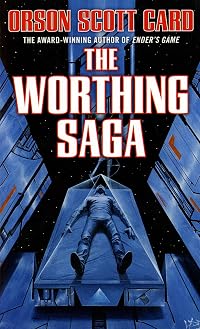
The book hasn't changed any in the intervening 3-4 years, but apparently I've grown a lot as a reader. Wyrms is a great book. I'm a huge fan of early Card (like Treason, Hart's Hope, and The Worthing Saga) and this ranks right up there with those.
The story revolves around the girl, Patience, whose father is the rightful Heptarch, but is slave to King Oruc. This makes Patience the rightful heir to the throne; there's also the matter of a prophecy regarding the seventh seventh seventh daughter of the original Heptarch: which happens to be Patience. It seems that her destiny is to bear the Unwyrm's child which will either save or destroy humanity, and the story essentially chronicles Patience's journey from her home in Korfu to Unwyrm's lair.
Like most of Card's early work, everything about the book smacks of originality. The characters are sharply drawn, and quite memorable (aside from my own inherent forgetfulness) and the dialogue all has a very philosophical bent to it. One of my favorite aspects of the book is that whenever someone speaks, you feel like Card is imparting little nuggets of Truth to you. There's definitely a lot of wisdom in the text, and a lot to think about as a reader. The climactic scene is as disturbing as the buildup leads you to believe it will be, and the denouement by contrast feels just the opposite: rushed and happy.
Though the book is rooted in science-fiction, based in a far-flung future on a colonized planet and concerned with genetic manipulation, reproduction, and evolution, it reads much more like a fantasy. As with most of Card's sci-fi (the later Ender books included) it takes place in a fairly medieval setting, with kings and castles. The story itself revolves around the genre-standard quest or journey. In fact, I couldn't help noticing that the day before I finished Wyrms, I read on Card's website a review of a fantasy series that said:
"Too often, the world of a fantasy novel consists of: Two cities, a mountain range, a forest, and a desert. Oh, and a river here and there that will serve either as transportation or a barrier."
And, sure enough, Wyrms has two cities, Korfu and Cranning; a mountain, Skyfoot; a forest, Tinker's Wood; and though there's no desert, there's the Cranwater river that serves as transportation from the forest to the mountain.
Definitely fantasy. But definitely good. So I'm slightly dissatisfied with the ending; as with most fantasy, it's all about the journey. show less
Yesterday (8/15/06) I finished reading Wyrms by Orson Scott Card, for the second time.
It has the distinction of being the first Card book I'd read outside the "Ender" series. It was a bit of a departure from those books -- even the "heavier" of the Ender books like Xenocide -- and I decided that it was pretty good, but it really didn't do anything for me.
Fast forward a few years, and now I own almost all of Card's books, and have read most of those, and my impression is still that Wyrms is one of the weakest of the lot. So, wanting to read some more Card, and barely remembering a thing about Wyrms (though still maintaining my opinion on it), I decided to give it another show more read.
Wow.
The book hasn't changed any in the intervening 3-4 years, but apparently I've grown a lot as a reader. Wyrms is a great book. I'm a huge fan of early Card (like Treason, Hart's Hope, and The Worthing Saga) and this ranks right up there with those.
The story revolves around the girl, Patience, whose father is the rightful Heptarch, but is slave to King Oruc. This makes Patience the rightful heir to the throne; there's also the matter of a prophecy regarding the seventh seventh seventh daughter of the original Heptarch: which happens to be Patience. It seems that her destiny is to bear the Unwyrm's child which will either save or destroy humanity, and the story essentially chronicles Patience's journey from her home in Korfu to Unwyrm's lair.
Like most of Card's early work, everything about the book smacks of originality. The characters are sharply drawn, and quite memorable (aside from my own inherent forgetfulness) and the dialogue all has a very philosophical bent to it. One of my favorite aspects of the book is that whenever someone speaks, you feel like Card is imparting little nuggets of Truth to you. There's definitely a lot of wisdom in the text, and a lot to think about as a reader. The climactic scene is as disturbing as the buildup leads you to believe it will be, and the denouement by contrast feels just the opposite: rushed and happy.
Though the book is rooted in science-fiction, based in a far-flung future on a colonized planet and concerned with genetic manipulation, reproduction, and evolution, it reads much more like a fantasy. As with most of Card's sci-fi (the later Ender books included) it takes place in a fairly medieval setting, with kings and castles. The story itself revolves around the genre-standard quest or journey. In fact, I couldn't help noticing that the day before I finished Wyrms, I read on Card's website a review of a fantasy series that said:
"Too often, the world of a fantasy novel consists of: Two cities, a mountain range, a forest, and a desert. Oh, and a river here and there that will serve either as transportation or a barrier."
And, sure enough, Wyrms has two cities, Korfu and Cranning; a mountain, Skyfoot; a forest, Tinker's Wood; and though there's no desert, there's the Cranwater river that serves as transportation from the forest to the mountain.
Definitely fantasy. But definitely good. So I'm slightly dissatisfied with the ending; as with most fantasy, it's all about the journey. show less
I am very fond of this novel. I read it first at age 13 and 15 years later, when I visit my old friend, I still find opportunities for introspection, entertainment and appreciation of the world that Card created. It's so strange to me that an author of the Mormon-Borg, would write a book whose central themes involve questions of identity, affirmation of non-human souls, the strength of will (maybe this one isn't so strange for these non-masturbators), and the creation your own identity.
It’s such a fabulous setting too, replete with sympathetic characters. On a world where gene manipulation and integration is the survival mechanism for its native species, we meet a heroine who is intelligent, deadly, beautiful and infinitely strong, show more we meet two monkey-like natives with pride, perseverance and learning, and a Jabba-the-Hut like UnWyrm who, like living thing, only wants to exist and live and propagate. You’ll have to read the book to learn more about the cast and crew. If you like allegories, science fiction and fantasy then you’ll like this Novel. show less
It’s such a fabulous setting too, replete with sympathetic characters. On a world where gene manipulation and integration is the survival mechanism for its native species, we meet a heroine who is intelligent, deadly, beautiful and infinitely strong, show more we meet two monkey-like natives with pride, perseverance and learning, and a Jabba-the-Hut like UnWyrm who, like living thing, only wants to exist and live and propagate. You’ll have to read the book to learn more about the cast and crew. If you like allegories, science fiction and fantasy then you’ll like this Novel. show less
I was so disappointed but read farther than I normally would have because Card is a competent writer even if the story is forced and predictable and the characters are cardboard cut-outs.
I enjoy Orson Scott Card books, but I didn't expect to like it this much. I'm glad I own this book because I will re-read it. I didn't expect the redemption story at the end. I hoped it was a series, but it stands alone. The characters will live on in my heart.
I've had this one on my shelf for a long time and finally got around to reading it. It deals heavily with the concepts of duty versus freedom and identity versus actions. The story, while it did not drag, was not particularly exciting. I had no problem getting through it, but it was not one of those books I absolutely could not put down. Certainly not a bad book, but Ender's Game was better.
Members
- Recently Added By
Talk Discussions
Current Discussions
Wyrms in Good Show Sir! — bad science fiction and fantasy covers (December 2025)
Author Information

575+ Works 214,644 Members
Orson Scott Byron Walley Card, was born in 1951 and studied theater at Brigham Young University. He received his B.A. in 1975 and his M.A. in English in 1981. He wrote plays during that time, including Stone Tables (1973) and the musical, Father, Mother, Mother and Mom (1974). A Mormon, Scott served a two-year mission in Brazil before starting show more work as a journalist in Utah. He also designed games at Lucas Film Games, 1989-92. He is best known for his science fiction novels, including the popular Ender series. Well known titles include A Planet Called Treason (1979), Treasure Box (1996), and Heartfire (1998). He has also written the guide called How to Write Science Fiction and Fantasy (1990). His novel Ender's Game and its sequel Speaker for the Dead, both won Hugo and Nebula awards, making Card the only author to win both prizes in consecutive years. His titles Shadows in Flight, Ruins and Ender's Game made The New York Times Best Seller List. He is also the author of The First Formic War Series, which includes the titles Earth Unaware, Earth Afire, and Earth Awakens. (Bowker Author Biography) show less
Some Editions
Series
Belongs to Publisher Series
Common Knowledge
- Canonical title
- Wyrms
- Original title
- Wyrms
- Original publication date
- 1987
- People/Characters
- Patience; Unwyrm; King Oruc; Angel [scholar]
- Dedication
- To Mark and Rana,
for greatness of heart - First words
- Her tutor woke her well before dawn.
- Last words
- (Click to show. Warning: May contain spoilers.)So also did their children, and their children's children, through all the ages of the world.
- Blurbers
- Yolen, Jane; Bova, Ben; Zelazny, Roger; Datlow, Ellen; van Vogt, A.E.
- Original language*
- English
*Some information comes from Common Knowledge in other languages. Click "Edit" for more information.
Classifications
Statistics
- Members
- 1,647
- Popularity
- 13,724
- Reviews
- 19
- Rating
- (3.37)
- Languages
- 8 — Czech, English, French, German, Hungarian, Polish, Romanian, Spanish
- Media
- Paper, Audiobook, Ebook
- ISBNs
- 29
- ASINs
- 13