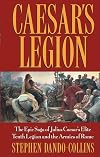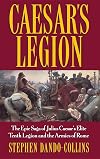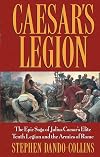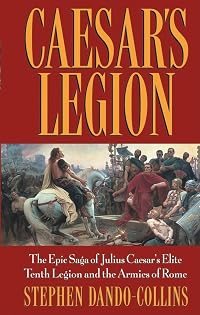
Caesar's Legion: The Epic Saga of Julius Caesar's Elite Tenth Legion and the Armies of Rome
by Stephen Dando-Collins
On This Page
Description
Stephen Dando-Collins paints a vivid and definitive portrait of daily life in the Tenth Legion as he follows Caesar and his men along the blood-soaked fringes of the Empire. This unprecedented regimental history reveals countless previously unknown details about Roman military practices, Caesar's conduct as a commander and his relationships with officers and legionnaires, and the daily routine and discipline of the Legion.From penetrating insights into the mind of history's greatest general show more to a grunt's-eye view of the gruesome realities of war in the Classical Age, this unique and riveting true account sets a new standard of excellence and detail to which all authors of ancient military history will now aspire.
. show less
Tags
Recommendations







Member Reviews
⭐️ ⭐️ ⭐️ ⭐️ for this popular military history of the Legio X Equestris, a Roman legion, that was levied by Julius Caesar in 61 BC during his governance of Hispania Ulterior. Surprisingly, its legionaries were often middle-aged man, even older. Despite, or perhaps because of that, they were able to sustain marathon-sized forced marches day after day, on barely 1500 calories, carrying roughly 80 lbs in armor and weapons and tools, none of it made for comfort like modern equipment is. The legions fighting spirit is best described by the author’s quote:
“It was a great day to die. And before the sun had set, thirty-four thousand men would lose their lives in this valley. The men of the loth Legion would have had no show more illusions. They knew that some of them would probably perish in the battle that lay ahead. Yet, to Romans, nothing was more glorious than a noble death. And if the men of this legion had to die, there was probably not a better place nor a finer day for it, on home soil, beneath a perfect blue sky.”
The Tenth was the first legion levied personally by Caesar and the instrumental tool to Caesar’s martial success. Acting as his shock troops, it was chiefly responsible for not only his greatest victories but also was able to stave off defeat when all but utter disaster seemed imminent for the greatest of all Roman generals.
Dando-Collins manages to put together a magnificent account of the greatest of all legions from various ancient sources, including citations, comments and the well-known texts by Tacitus. So then what are we waiting for get that book for it is a good day to read. show less
“It was a great day to die. And before the sun had set, thirty-four thousand men would lose their lives in this valley. The men of the loth Legion would have had no show more illusions. They knew that some of them would probably perish in the battle that lay ahead. Yet, to Romans, nothing was more glorious than a noble death. And if the men of this legion had to die, there was probably not a better place nor a finer day for it, on home soil, beneath a perfect blue sky.”
The Tenth was the first legion levied personally by Caesar and the instrumental tool to Caesar’s martial success. Acting as his shock troops, it was chiefly responsible for not only his greatest victories but also was able to stave off defeat when all but utter disaster seemed imminent for the greatest of all Roman generals.
Dando-Collins manages to put together a magnificent account of the greatest of all legions from various ancient sources, including citations, comments and the well-known texts by Tacitus. So then what are we waiting for get that book for it is a good day to read. show less
Excellent book on the 10th Legion from its creation to end. Collin's has a way of taking the ancient sources and at times throughout putting you on the ground level of the battles. Unusual for sure given the time period but incredibly effective and entertaining. Well sourced with multiple appendixes as well.
“Caesar’s Legion” is a book with somewhat unexpected topic. Stephen Dando Collins writes about Legio X, famous Tenth Legion that was raised in Spain by Caesar – veteran legion that saw almost every major conflict in Europe at the time, invaded Britain twice and fought in Roman Civil War against Scipio’s own forces.
Story itself is very interesting but I have to say that this is very difficult subject in itself – military units in ancient world were important but they did not have …. Let’s say such importance as in later centuries – e.g. today, when someone mentions Foreign Legion or US Marines or, I don’t know, “Old Ironsides”, it brings up pictures of fierce soldiers, armored vehicles, zooming jets and tanks. In show more those days legion was raised for a [rather] long time – 16 and later 20 years – and then its veterans were relieved of service (normally this mounts up to the 90% of the legion itself). After disbanding such fighting formations they were either totally disbanded (to minimize cost) or renewed via recruitment in areas of their origin.
Only some “military” units from ancient world were remembered to this day – Theban Sacred Company, Persian Immortals and Alexander’s own Companions to name the most known – others weren’t exactly what might be called military outfits [as they are known today] but either warrior bands (Vikings e.g. - although a Viking has its own meaning in a wider context) or simply warrior-like cultures (Spartans and, why not, Romans themselves).
As such very few legions had what today would be called a tradition of their own – they existed as part of a greater war machine and their sole purpose was to enforce the will of Rome. Legions were treated as equal and only quality marker was the age of legionnaires – are they newbie’s, seasoned veterans with still some years left to serve or old veterans just itching to go to retirement. Only few legions were remembered like special by historians and Legio X is one of them.
Although a lot of people found it annoying to have ancient ranks translated to modern army ranks I did not find it that difficult and/or annoying – again this book is meant for broader audience and is a good introduction to those people that previously read nothing from this specific area of history – they can broaden their knowledge at the later times with more scholar works.
Very interesting book. Recommended. show less
Story itself is very interesting but I have to say that this is very difficult subject in itself – military units in ancient world were important but they did not have …. Let’s say such importance as in later centuries – e.g. today, when someone mentions Foreign Legion or US Marines or, I don’t know, “Old Ironsides”, it brings up pictures of fierce soldiers, armored vehicles, zooming jets and tanks. In show more those days legion was raised for a [rather] long time – 16 and later 20 years – and then its veterans were relieved of service (normally this mounts up to the 90% of the legion itself). After disbanding such fighting formations they were either totally disbanded (to minimize cost) or renewed via recruitment in areas of their origin.
Only some “military” units from ancient world were remembered to this day – Theban Sacred Company, Persian Immortals and Alexander’s own Companions to name the most known – others weren’t exactly what might be called military outfits [as they are known today] but either warrior bands (Vikings e.g. - although a Viking has its own meaning in a wider context) or simply warrior-like cultures (Spartans and, why not, Romans themselves).
As such very few legions had what today would be called a tradition of their own – they existed as part of a greater war machine and their sole purpose was to enforce the will of Rome. Legions were treated as equal and only quality marker was the age of legionnaires – are they newbie’s, seasoned veterans with still some years left to serve or old veterans just itching to go to retirement. Only few legions were remembered like special by historians and Legio X is one of them.
Although a lot of people found it annoying to have ancient ranks translated to modern army ranks I did not find it that difficult and/or annoying – again this book is meant for broader audience and is a good introduction to those people that previously read nothing from this specific area of history – they can broaden their knowledge at the later times with more scholar works.
Very interesting book. Recommended. show less
Interesting and novel-like writing style make this an attractive volume although without sources cited and footnotes it becomes frustrating to understand how the authors concludes the points that he asserts. He does provide an appendix of sources but he does not identify where he collects information from. Also, the volume would have been helped with illustrations of campaigns and depictions of the soldiers he describes. There is value in the several appendices.
Spoiler: Caesar dies about tenth of the way in. That was to be expected, after all it's the legion that's the subject but to be honest, turns out its history wasn't all that interesting. Maybe if the book also included some more background on how legions operated, the technology of the day, tactics etc. it could've been more interesting. As it is it's just barely more than summaries of a few big battles the legion took part in.
Worth reading, though the writing needs an uptick in quality. A nice bit of history to learn by reading this book.
Roman empire, military history
Members
- Recently Added By
Author Information

44 Works 1,757 Members
Stephen Dando-Collins is the Australian-born, multi-award-winning author of 45 books, many of which have been published around the world in numerous languages. He is considered an authority on the legions of ancient Rome, with his works covering ancient and modern history, biography, and children's novels. The bulk of his books deal with military show more history ranging from Greek, Persian and Roman times to American, British, and Australian 19th century history and World War Land World War II. He aims to travel roads that others have not, unearthing new facts and opening new perspectives on often-forgotten or overlooked individuals and aspects of history. show less
Common Knowledge
- Canonical title
- Caesar's Legion: The Epic Saga of Julius Caesar's Elite Tenth Legion and the Armies of Rome
- Original title
- Caesar's Legion: The Epic Saga of Julius Caesar's Elite Tenth Legion and the Armies of Rome
- Original publication date
- 2002
- People/Characters
- Julius Caesar; Pompey the Great; Crassus; Marcus Antonius; Legio X Equestris (Roman Tenth Legion); Vercingetorix
- Important places
- Rome, Italy; Gaul; Alexandria, Egypt; Roman Empire; Kent, England, UK
- Important events
- Gallic Wars (58 BCE | 50 BCE); Battle of the Arar (58 BCE); Caesar's invasions of Britain (55 BCE | 54 BCE); Battle of Alesia (52 BCE); Battle of Gergovia (52 BCE); Great Roman Civil War (49 BCE | 45 BCE) (show all 8); Siege of Alexandria (48 BCE | 47 BCE); Assassination of Julius Caesar (44BCE-03-15)
Classifications
- Genres
- History, Nonfiction, General Nonfiction
- DDC/MDS
- 355.10937 — Society, government, & culture Public administration & military science The Military - Land, Air & Sea / Warfare Military life and customs Biography And History Ancient World
- LCC
- U35 .D37 — Military Science Military science (General) History of military science
- BISAC
Statistics
- Members
- 358
- Popularity
- 87,843
- Reviews
- 8
- Rating
- (3.57)
- Languages
- English, Italian, Portuguese
- Media
- Paper, Audiobook, Ebook
- ISBNs
- 15
- UPCs
- 1
- ASINs
- 6