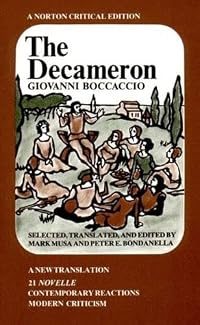
The Decameron : A New Translation, Contexts, Criticism (Norton Critical Edition)
by Giovanni Boccaccio, Wayne A. Rebhorn (Editor)
On This Page
Description
A new translation of the fourteenth-century tales recounted by young citizens of Florence who have fled the city to escape the plague.Tags
Recommendations





Member Reviews
How Giovanni Boccaccio avoided a horrible death at the hands of the Church is amazing. In this selection of 21 of the 100 stories that comprise the Decameron, Boccaccio puts clergymen in scenes of debauchery that would amaze even a modern reader. In one of the excellent pieces of contemporary criticism included in this volume, it is pointed out that the Church was fairly tolerant of non-heretical criticism until the Reformation, whereupon the Decameron was promptly banned. Boccaccio himself became ashamed of the work later in life and would have undoubtedly had all copies burned if possible. Thank goodness he wasn't able to do that because The Decameron is apparently considered one of the most influential early renaissance works (maybe show more even influencing Chaucer to write The Canterbury Tales, for example).
I don't want this review to get flagged, so I won't go into any detail about the stories. Suffice it to say that sex, greed, and general bawdiness, often involving clergy and even cloistered nuns are featured prominently in the stories, which Boccaccio claims that he wrote for the entertainment of young ladies.
Pretty good stuff, but not for the faint of heart. show less
I don't want this review to get flagged, so I won't go into any detail about the stories. Suffice it to say that sex, greed, and general bawdiness, often involving clergy and even cloistered nuns are featured prominently in the stories, which Boccaccio claims that he wrote for the entertainment of young ladies.
Pretty good stuff, but not for the faint of heart. show less
Nice selection of tales from Boccaccio's classic work--I really only wanted to get a taste anyway. I especially liked the stories about Saladin and the three rings; the monk Rustico and putting the Devil in Hell; Isabetta and the Pot of Basil (the basis for Keats' poem); Peronella and the Jar (clearly taken directly from Apuleius); and the Abbess awaking in the dark. The Norton edition has a lot of contemporary and modern criticism, including a final look at the overall meaning of the work, which I agree seems to come down to love leading to fame or earthly glory.
As the Norton edition by Wayne Rebhorn is abridged, I only read the introduction, which is very good, and the sources, which are curious, and the commentary, which is painfully dull, but helpful.
2022
https://www.librarything.com/topic/337810#7797846
2022
https://www.librarything.com/topic/337810#7797846
"This volume contains twenty-one of the hundred novel that compose Boccaccio's masterpiece."
Ratings
Members
- Recently Added By
Lists

Favorite Literary Love Stories
182 works; 101 members

Blue Pyramid 1,276 Best Books of All Time
1,248 works; 32 members
Author Information

753+ Works 15,926 Members
Although Giovanni Boccaccio was born in France and raised and educated in Naples, where he wrote his first works under the patronage of the French Angevin ruler, Boccaccio always considered himself a Tuscan, like Petrarch and Dante. After Boccaccio returned to Florence in 1340, he witnessed the outbreak of the great plague, or Black Death, in show more 1348. This provided the setting for his most famous work, the vernacular prose masterpiece Il Decamerone (Decameron) (1353). This collection of 100 short stories, told by 10 Florentines who leave plague-infected Florence for the neighboring hill town of Fiesole, is clear evidence of the beginning of the Renaissance in Italy. The highly finished work exerted a tremendous influence on Chaucer, Shakespeare, Dryden, Keats, and Tennyson even as it established itself as the great classic of Italian fictional prose. Although Chaucer did not mention Boccaccio's name, his Canterbury Tales are clearly modeled on the Decameron. Boccaccio's other important works are a short life of Dante and commentaries on the Divine Comedy; Filocolo (1340) a prose romance; Filostrato (1335), a poem on Troilus and Cressida; and Theseus (1340-41), a poem dealing with the story of Theseus, Palamon, and Arcite. Boccassio's only attempt at writing an epic was a work that Chaucer rendered as his "Knight's Tale." Boccaccio's last work written in Italian was the gloomy, cautionary tale titled The Corbaccio (1355). The Nymph Song (1346), as a counterpiece for the Decameron, demonstrates that it is possible to read the Decameron as an allegory, with the plague representing the spiritual plague of medieval Christianity, viewed from the vantage point of Renaissance humanism. Many of the Decameron tales are indeed paganized versions of medieval sermons about sin and damnation with the morals reversed. After 1363 Boccaccio concentrated on trying to gain enduring fame by writing, in Latin, a series of lives of memorable men and women and a genealogy of the pagan gods. Boccaccio died in 1375. (Bowker Author Biography) show less

Some Editions
Series
Belongs to Publisher Series
Work Relationships
Contains
Common Knowledge
- Canonical title
- The Decameron: A New Translation : 21 Novelle, Contemporary Reactions, Modern Criticism (A Norton Critical Edition) (A Norton Critical Edition); The Decameron : A New Translation, Contexts, Criticism (Norton Critical Edition) (Norton Critical Edition)
- People/Characters
- Francesco Petrarca; Ser Ceparrello; Andreuccio of Peugia; Masetto of Lamporecchio; Alibech; Rustico, a monk (show all 21); Neerbal, husband of Alibech; Tancredi of Salerno; Alberto, a lecherous monk; Isabetta; Ricciardo Manardi; Lizio di Valbona; Federigo degli Alberighi; Forses de Rabatta; Maestro Giotto; Brother Onion; Archangel Gabriel; Peronella; Calandrino; Buffalmacco; Marquis of Saluzzo
- Dedication
- For
Chandler B. Beall
and
Charles S. Singleton - First words
- Preface
The present edition of selections from Boccaccio's Decameron contains new translations of twenty-one tales, including representative novelle from each of the ten days of storytelling, as wel... (show all)l as the Author's Introduction, the Prologue to the Fourth Day, and the Author's Conclusion, all in their entirety. - Disambiguation notice
- Do Not Combine: This is a "Norton Critical Edition", it is a unique work with significant added material, including essays and background materials. Do not combine with other editions of the work. Please maintain the p... (show all)hrase "Norton Critical Edition" in the Canonical Title and Publisher Series fields.
Classifications
- Genres
- Fiction and Literature, General Fiction
- DDC/MDS
- 853.1 — Literature & rhetoric Italian, Romanian & related literatures Italian fiction Early Italian; Age of Dante –1375
- LCC
- PQ4272 .E5 .A357 — Language and Literature French, Italian, Spanish and Portuguese literatures Italian literature Individual authors and works to 1400
- BISAC
Statistics
- Members
- 380
- Popularity
- 81,515
- Reviews
- 4
- Rating
- (3.88)
- Languages
- English
- Media
- Paper
- ISBNs
- 4
- ASINs
- 1