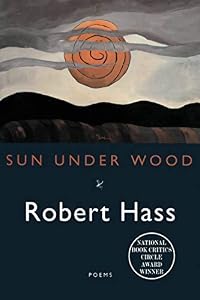
Sun Under Wood
by Robert Hass
On This Page
Description
Sun Under Wood extends and deepens Hass's ongoing explorations of nature and human history, solitude and the bonds of children, parents, and lovers. Here his passion for apprehending experience with language - for creating experience with language - finds supple form in poems that embrace all that is alive and full of joy. Yet Hass's most seductive and indelible lyrics reside in an exquisitely fragile moment: there is a dark undercurrent rising in this text, an increasingly acute sense of show more mortality in a world "so full of pain it must sometimes make a kind of singing." show lessTags
Recommendations








Member Reviews
good stuff: Hass doesn't cross "The Confessional Risk Line" as Tuor puts it because he's a great writer. Lesser writers tell us how they feel. Great writers show us how we feel. More personal opinion: As I read Sun Under Wood, I had to set it down every few minutes to jot down notes for other projects because it's one of those books that set the gears in your head all spinning away toward different ends. A good thing when you need to write.
Lyrical, fluid, spot-on. A small prize.
"A Reader" says this is "More nature stuff," and I always get bristly when I hear that. "More nature stuff" sounds a bit reductive and condescending, don't you think? "A Reader" goes on to say that Hass "seems more resigned than before as to what life brings show more and is not fighting for happiness." Well. I don't think that writing a book of poems qualifies as resignation.
"I had the idea that the world's so full of pain / it must sometimes make a kind of singing. / And that the sequence helps, as much as order helps-- / First an ego, and then pain, and then the singing." show less
Lyrical, fluid, spot-on. A small prize.
"A Reader" says this is "More nature stuff," and I always get bristly when I hear that. "More nature stuff" sounds a bit reductive and condescending, don't you think? "A Reader" goes on to say that Hass "seems more resigned than before as to what life brings show more and is not fighting for happiness." Well. I don't think that writing a book of poems qualifies as resignation.
"I had the idea that the world's so full of pain / it must sometimes make a kind of singing. / And that the sequence helps, as much as order helps-- / First an ego, and then pain, and then the singing." show less
The first edition of Robert Hass' Sun under wood is a fine cloth-bound volume with a paper cover showing a woodcut. Many critics place Hass in the fine tradition of poets writing about nature, together with Wordsworth, Thoreau and Muir. It was with eager anticipation for some excellent nature poetry, that I opened this volume of poetry.
The first poem, Happiness, is indeed a fine example of nature poetry, in free verse. It begins as follows:
Because yesterday morning from the steamy window
we saw a pair of red foxes across the creek
eating the last windfall apples in the rain --
they looked up at us with their green eyes
long enough to symbolize the wakefulness of living things
and then went back to eating --
There are a number of such gems in show more this volume, but unfortunately, not many. In fact, my over-all feeling about this volume is one of some disappointment.
The problem seems to be that Sun under wood is a very unbalanced collection of poems. Besides "nature poetry" there are verses which seem to represent the poet's full life experience, ranging from alcoholism, strained parental relations, family life, activism, etc. Some poems are long, and meditative, while there are also prose fragments, long, free and provocative poems, as well as short poems which read like an afterthought. Some of those "other" poems are also very beautiful. The poem I liked most is called The Gardens of Warsaw.
I was quite startled and seriously frowned at the lines included in the poem English: An Ode:
There are those who think it's in fairly bad taste
to make habitual reference to social and political problems
in poems. To these people it seems a form of melodrama
or self-aggrandizement, which it no doubt partly is.
And there's no doubt either that these same people also tend
to feel that it ruins a perfectly good party
to be constantly making reference to the poor or oppressed
and their misfortunes in poems which don't
after all, lift a finger to help them. Please
help yourself to the curried chicken.
Perhaps there are people who think that nature poetry is the same as ecological poetry. In my opinion, the first celebrates the delight in natural history and is merely descriptive, while the latter has a political agenda. It seems Robert Hass belongs to that category of poets who wants to make poetry instrumental to politics.
Sun under wood (1996) came out while Hass was Poet Laureate of the United States from 1995 to 1997. It seems that Hass was more concerned with presenting himself and his radical agenda than with raising the nation's consciousness to an enhanced appreciation of the reading and creation of poetry. Perhaps it was too tempting to not exploit the opportunity of raising awareness in ecoliteracy, rather that foster a love for poetry. I would certainly like to read a more balanced volume of nature poetry, free from activist sentiments. show less
The first poem, Happiness, is indeed a fine example of nature poetry, in free verse. It begins as follows:
Because yesterday morning from the steamy window
we saw a pair of red foxes across the creek
eating the last windfall apples in the rain --
they looked up at us with their green eyes
long enough to symbolize the wakefulness of living things
and then went back to eating --
There are a number of such gems in show more this volume, but unfortunately, not many. In fact, my over-all feeling about this volume is one of some disappointment.
The problem seems to be that Sun under wood is a very unbalanced collection of poems. Besides "nature poetry" there are verses which seem to represent the poet's full life experience, ranging from alcoholism, strained parental relations, family life, activism, etc. Some poems are long, and meditative, while there are also prose fragments, long, free and provocative poems, as well as short poems which read like an afterthought. Some of those "other" poems are also very beautiful. The poem I liked most is called The Gardens of Warsaw.
I was quite startled and seriously frowned at the lines included in the poem English: An Ode:
There are those who think it's in fairly bad taste
to make habitual reference to social and political problems
in poems. To these people it seems a form of melodrama
or self-aggrandizement, which it no doubt partly is.
And there's no doubt either that these same people also tend
to feel that it ruins a perfectly good party
to be constantly making reference to the poor or oppressed
and their misfortunes in poems which don't
after all, lift a finger to help them. Please
help yourself to the curried chicken.
Perhaps there are people who think that nature poetry is the same as ecological poetry. In my opinion, the first celebrates the delight in natural history and is merely descriptive, while the latter has a political agenda. It seems Robert Hass belongs to that category of poets who wants to make poetry instrumental to politics.
Sun under wood (1996) came out while Hass was Poet Laureate of the United States from 1995 to 1997. It seems that Hass was more concerned with presenting himself and his radical agenda than with raising the nation's consciousness to an enhanced appreciation of the reading and creation of poetry. Perhaps it was too tempting to not exploit the opportunity of raising awareness in ecoliteracy, rather that foster a love for poetry. I would certainly like to read a more balanced volume of nature poetry, free from activist sentiments. show less
This was an incredible book of poetry—the first I’ve read by him. This is not “easy” reading and certainly not relaxing—in fact in many ways it could be seen as taxing. (I couldn’t resist!). He seems to use a stream of consciousness writing style, one thought leading to another and then to another and, usually, finally coming together to see how all the ideas fit into his theme. He creates fabulous images with his words and you can visualize much of what he’s describing. Most of the poems I had to read twice. There is much autobiographical material here. One long poem is about his mother who was an alcoholic and not mentally stable. One of my favorites was “Regalia for a Black Hat Dancer”, a long poem concerning his show more divorce which really explores the feelings that this trauma elicits and how he dealt with them. It also describes the way life changes for all concerned. I’m not sure why this one appealed to me because I have no experience with divorce either in my family or with close friends. Maybe because I have taught many students who come from broken homes.
Other poems are shorter and some have lots of word play—also it pays to have a Spanish dictionary handy. There is a lot of variety of subject matter and style. I plan to reread this book again next year because I know I have not plumbed its depths yet. I also want to see if I can find an overall plan for the book or decide it is just a collection unconnected poems. show less
Other poems are shorter and some have lots of word play—also it pays to have a Spanish dictionary handy. There is a lot of variety of subject matter and style. I plan to reread this book again next year because I know I have not plumbed its depths yet. I also want to see if I can find an overall plan for the book or decide it is just a collection unconnected poems. show less
Hass, Robert. Sun Under Wood. Ecco Press, Hopewell, New Jersey, 1996. A beautiful book of poems. I loved so many, it's hard to single some out. I'd have to say my three favorite are "Faint Music," "Shame: An Aria," and "Interrupted Meditation." But there are so many others! This should be a part of any poetry collection. And it should get people without collections to start!
Ratings
Members
- Recently Added By
Author Information

35+ Works 4,608 Members
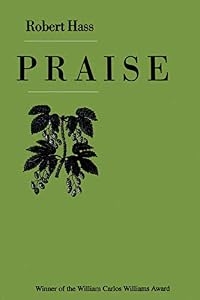
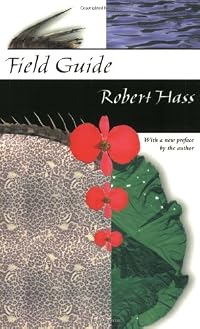
Born in San Francisco, Calif., Robert Hass received his undergraduate degree from St. Mary's College and his masters and Ph.D. from Stanford University. After graduating, Hass wrote his first collection of poetry, Field Guide, which went on to win the Yale Series of Younger Poets Award in 1973. Hass's second collection, Praise, won the Williams show more Carlos Williams Award in 1979. Selected by the Library of Congress as Poet Laureate of the United States in 1995-96, Hass has taught writing at the University of California at Berkeley since 1989. Hass has co-translated several volumes of poetry by Nobel Laureate and fellow colleague Czeslaw Milosz and is the editor of The Essential Haiku. (Bowker Author Biography) show less
Awards and Honors
Awards
Notable Lists
Classifications
Statistics
- Members
- 298
- Popularity
- 107,286
- Reviews
- 4
- Rating
- (4.14)
- Languages
- English
- Media
- Paper
- ISBNs
- 4
- ASINs
- 3