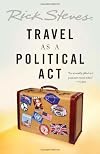
Travel as a Political Act
by Rick Steves
On This Page
Description
Change the world one trip at a time. In this illuminating collection of stories and lessons from the road, acclaimed travel writer Rick Steves shares a powerful message that resonates now more than ever. With the world facing divisive and often frightening events, from Trump, Brexit, and Erdogan, to climate change, nativism, and populism, there's never been a more important time to travel. Rick believes the risks of travel are widely exaggerated, and that fear is for people who don't get out show more much. After years of living out of a suitcase, he still marvels at how different cultures find different truths to be self-evident. By sharing his experiences from Europe, Central America, Asia, and the Middle East, Rick shows how we can learn more about own country by viewing it from afar. With gripping stories from Rick's decades of exploration, this fully revised edition of Travel as a Political Act is an antidote to the current climate of xenophobia. When we travel thoughtfully, we bring back the most beautiful souvenir of all: a broader perspective on the world that we all call home. All royalties from the sale of Travel as a Political Act are donated to support the work of Bread for the World, a non-partisan organization working to end hunger at home and abroad. show lessTags
Recommendations


























Member Reviews
This is clearly Rick Steves' heartfelt memo to the world as he approaches retirement. He wants people to be open-hearted and open-minded, to let travel broaden them and to let go of their prejudices along with their comfort zones. He believes that the world will be a better place to the extent that people are able to do this, and he's not wrong. But as with all idealistic programs, the battle is with human nature. There will always be a majority who want the luxuries of travel and not the adventures, and since Steves started writing in the early '80s, thousands of travel companies have opened promising the luxuries and the illusion of adventure. The streets of the Cinque Terre are overrun by cruise ship passengers clutching their show more plastic wine cups, and the shop owners and restaurateurs have become impatient and cranky under the strain. The real Italy remains only for those travelers who ignore the letter of Steves' guidebooks and appreciate the spirit—who ride the poky, overheated trains to the villages not yet featured on for-profit travel websites.
Steves spends much of his book detailing in patient, kind tones how much better other countries are than the U.S. at so many things, from social support systems to drug laws to attitudes toward work and family. He doesn't have blinders on and he acknowledges the drawbacks of life in those countries, but no matter how he protests that he's a business owner himself and understands the conservative arguments, he's so earnest that he can't help but come off as what people in my home town might call a fuzzy-headed liberal do-gooder. That's a shame. Because travel really should be broadening, and few need broadening so much as the typical American. show less
Steves spends much of his book detailing in patient, kind tones how much better other countries are than the U.S. at so many things, from social support systems to drug laws to attitudes toward work and family. He doesn't have blinders on and he acknowledges the drawbacks of life in those countries, but no matter how he protests that he's a business owner himself and understands the conservative arguments, he's so earnest that he can't help but come off as what people in my home town might call a fuzzy-headed liberal do-gooder. That's a shame. Because travel really should be broadening, and few need broadening so much as the typical American. show less
What a breath of fresh air. Rick Steves manages to discuss many hot topics in this book in a calm and respectful way by stepping outside the rhetoric and stereotypes. If you watch him on public TV or listen to him on NPR or have read any of his guidebooks then you will probably find a familiar anecdote or two in this book – however, this book is political so even if something sounds familiar it is probably woven into a different, perhaps stronger, perspective then his travel guides.
You may not agree with his politics or his religion or even his conclusions but this book will definitely provide for some interesting conversations.
Rick Steves is particularly good at finding the common threads between differing cultures, showing us that show more people are people wherever you go. He reminds us that people are not the same necessarily as their government’s politics while not letting us off the hook of being responsible for our government.
I love that after so many years of international travel he hasn’t lost his curiosity, that he still learns new things, and still finds differences that amuse and perplex him…and that he shares them with us. show less
You may not agree with his politics or his religion or even his conclusions but this book will definitely provide for some interesting conversations.
Rick Steves is particularly good at finding the common threads between differing cultures, showing us that show more people are people wherever you go. He reminds us that people are not the same necessarily as their government’s politics while not letting us off the hook of being responsible for our government.
I love that after so many years of international travel he hasn’t lost his curiosity, that he still learns new things, and still finds differences that amuse and perplex him…and that he shares them with us. show less
Travel guru Rick Steves - who I've actually met (his offspring went to school with my offspring) - gave a keynote speech recently at the 2018 Texas Library Association conference in Dallas. I wasn't able to attend the conference, but I saw some clips of his speech and read numerous tweets about it, so I decided to check out a book he referred to in that speech.
It should be noted that I am reviewing the first (2009) edition of Travel as a Political Act. A revised edition came out in February 2018, and it's clear from its introduction (available on the Kindle preview on Amazon) that the election of Donald Trump as president of the USA inspired the update. The chapter headings are the same in both books, with the exception that 2018 adds a show more chapter called "The Holy Land: Israelis and Palestinians Today."
The first chapter discusses "How to Travel as a Political Act." Tips include choose to travel on purpose, connect with people, take history seriously - don't be dumbed down, overcome fear, get beyond your comfort zone - choose to be challenged, and see the rich/poor gap for yourself. All good advice to truly experience another country and culture.
The other chapters focus on the results of civil war in the former Yugoslavia (Bosnia-Herzegovina, Croatia, and Montenegro), successes and struggles of the formation of the European Union, the aftermath in war-torn El Salvador, economic aspects of Denmark, sampling Islam in moderate Turkey and Moracco, drug policy in the Netherlands and Switzerland, and Iran. The book winds up with a chapter on what one might do with new knowledge gained from travel after coming home.
Steves inserts his political views throughout the book, but is upfront about doing so. I mostly agree with him, although not on everything, and I feel this is a worthwhile book to read regardless. But then, I'm the kind of traveler that likes learn something about the people, history, and culture of places I visit. I wouldn't take a cruise, for example, and just stay on the ship, or only go shopping in the port area. I will note though that there is also value to traveling to various parts of our own country - there's a variety of people, history, culture, and viewpoints within the USA.
© Amanda Pape - 2018
[This book was borrowed from and returned to my university library.] show less
It should be noted that I am reviewing the first (2009) edition of Travel as a Political Act. A revised edition came out in February 2018, and it's clear from its introduction (available on the Kindle preview on Amazon) that the election of Donald Trump as president of the USA inspired the update. The chapter headings are the same in both books, with the exception that 2018 adds a show more chapter called "The Holy Land: Israelis and Palestinians Today."
The first chapter discusses "How to Travel as a Political Act." Tips include choose to travel on purpose, connect with people, take history seriously - don't be dumbed down, overcome fear, get beyond your comfort zone - choose to be challenged, and see the rich/poor gap for yourself. All good advice to truly experience another country and culture.
The other chapters focus on the results of civil war in the former Yugoslavia (Bosnia-Herzegovina, Croatia, and Montenegro), successes and struggles of the formation of the European Union, the aftermath in war-torn El Salvador, economic aspects of Denmark, sampling Islam in moderate Turkey and Moracco, drug policy in the Netherlands and Switzerland, and Iran. The book winds up with a chapter on what one might do with new knowledge gained from travel after coming home.
Steves inserts his political views throughout the book, but is upfront about doing so. I mostly agree with him, although not on everything, and I feel this is a worthwhile book to read regardless. But then, I'm the kind of traveler that likes learn something about the people, history, and culture of places I visit. I wouldn't take a cruise, for example, and just stay on the ship, or only go shopping in the port area. I will note though that there is also value to traveling to various parts of our own country - there's a variety of people, history, culture, and viewpoints within the USA.
© Amanda Pape - 2018
[This book was borrowed from and returned to my university library.] show less
So very different from his usual travel guides, this book is about Steves' view of many parts of the world he has traveled to, especially as they compare to America or Western thinking. He discusses the feelings towards America in Europe and Tehran, the differing attitudes about drugs, economics, nudity, war, religion and quality of life. It's a very personal view of the world, and sometimes he gets on his soapbox, but his point is a humane one.
Rick Steves is a well known travel writer, has his own TV show and writes an amazing selection of tour books of cities and countries in Europe. If you've watched his show, he comes across as very informed, funny, and to be honest, slightly goofy. This book shows a much more serious and thoughtful side to Rick Steves. If you travel internationally, you are well aware that travel changes you and your view of yourself, your society, and your overall worldview. And as you travel, you leave the world an impression of yourself and your country - making travel more than just another vacation, but an action that changes you and the world - or a political act. In this thought provoking book, Steves describes some of the countries he has explored show more and discusses a wide variety of issues and policies pertaining to those countries. Travel in Amsterdam - perfect for a discussion about US policy regarding marijuana. Croatia and Bosnia - the terrible impact of a civil war. If you are looking for a travel book that gives you tips on how to maximize your buffet experience on a Mediterranean cruise, then this is not for you. But if you want a book that will push you to travel differently and open your eyes up to a different world, then give this a shot - it's a great read. show less
Travel writer Rick Steves has an understanding of travel that is much more than seeing sights and buying souvenirs. In this small book he related several trips to different parts of the world and shared how those visits changed him. Travel to Steves isn't just going places, it is meeting people who are different from us and being changed by the experience. He quoted Mark Twain who said "Travel is fatal to prejudice, bigotry, and narrow mindedness". Reading this book made want to see more of the world and meet some of it's people.
The message of this book is: unmediated people to people listening will challenge your preconceptions and may move you to act and join with others who share your beliefs. Steves explains how traveling has increased his empathy for people in other parts of the world and helped to reshape or reinforce his political and religious beliefs. It is a moderately stated call to support understanding of the points of view of people who are not Americans, and tolerance for their points of view, which he calls their “baggage” while, as the cover’s subtitle asks of the reader and traveler to leave your own behind. As he puts it at the beginning of the book: "To get the most value out of your travels, plan to get out of your comfort zone, meet show more the people and view other cultures—as well as our own—with an open mind.” show less
Members
- Recently Added By
Lists

The War on Cars podcast
108 works; 1 member
Author Information

400+ Works 13,027 Members
Rick Steves writes 21 European travel guidebooks and hosts the popular public television series Travels in Europe with Rick Steves. Rick spends several months each year in Europe updating his guidebooks--feeling the fjords, caressing the castles, and learning from the locals. He hangs his rucksack in Seattle, Washington.
Awards and Honors
Awards
Common Knowledge
- Important places
- El Salvador
- Original language
- English
Classifications
- Genres
- Travel, Nonfiction, General Nonfiction, Biography & Memoir
- DDC/MDS
- 910.202 — History & geography Geography & travel modified standard subdivisions of Geography and travel Miscellany; world travel guides World travel guides
- LCC
- G155 .A1 .S6675 — Geography, Anthropology and Recreation Geography (General) Travel. Voyages and travels (General) Travel and state. Tourism
- BISAC
Statistics
- Members
- 476
- Popularity
- 64,006
- Reviews
- 17
- Rating
- (4.07)
- Languages
- English
- Media
- Paper, Audiobook, Ebook
- ISBNs
- 13
- ASINs
- 9