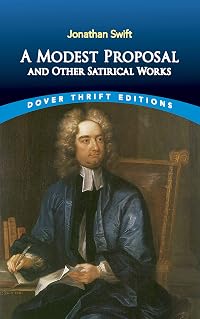
A Modest Proposal and Other Satirical Works
by Jonathan Swift
On This Page
Description
Published anonymously in 1729, Jonathan Swift's satirical essay, A Modest Proposal, puts forth the darkly comical idea that the starving poor of Ireland might alleviate their economic condition by selling their children as food for wealthy gentlemen and ladies. At its core, Swift's Modest Proposal satirizes English exploitation of Ireland in particular and the heartless attitude that rich elites can develop towards the poor in general. Along with Gulliver's Travels, A Modest Proposal is an show more early English example of the black comedic genre. HarperTorch brings great works of non-fiction and the dramatic arts to life in digital format, upholding the highest standards in ebook production and celebrating reading in all its forms. Look for more titles in the HarperTorch collection to build your digital library. show lessTags
Recommendations















Member Recommendations
by BGP
Member Reviews
This 59-page volume includes five of Swift's satirical writings. The well-known "A Modest Proposal" presents a clever plan to cure both poverty and overpopulation in Ireland and supply the rich with some tasty new treats in the process. "A Discourse Concerning the Mechanical Operation of the Spirit" and "An Argument Against Abolishing Christianity in England" deal with various religious topics. "The Battle of the Books" takes aim at the writers and thinkers of Swift's time who would disparage the ancient, classic authors, claiming to have done so much better themselves. There's also the tiny "A Meditation Upon a Broomstick," a deadpan parody that he inserted into a book containing a collection of mini-sermons as a practical joke. (The show more person he played the prank on, we're told, could not actually tell the difference.)
The continued fame of "A Modest Proposal" is unquestionably well-deserved. It's extremely readable, darkly funny, sharply incisive, and still sadly relevant. The other pieces in this collection were somewhat more difficult going, though, partly because Swift's old-fashioned writing style is rather wordy and convoluted, but mostly because the modern reader (or at least this modern reader) lacks a lot of the cultural context with which to properly appreciate them. This edition did include a number of helpful footnotes, but that's not nearly the same thing as watching a contemporary writer jumping into a debate you're familiar with and skewering people you know.
Still, despite all that, Swift's famous scathing wit does shine through. That's particularly true of "The Battle of the Books" in which he pulls no punches, utterly lambasting his targets with a jaw-droppingly impressive combination of highbrow erudition and low-down trash talk. There's no doubt about it: when Jonathan Swift disses you, you are dissed for the ages.
Rating: This one's hard to rate. It's abundantly clear that Swift was a five-star satirist in his time, but most of these pieces haven't aged all that well, and some of the points he's making honestly seem rather wrong-headed and quaint to me at this late date. Let's call it 4/5. show less
The continued fame of "A Modest Proposal" is unquestionably well-deserved. It's extremely readable, darkly funny, sharply incisive, and still sadly relevant. The other pieces in this collection were somewhat more difficult going, though, partly because Swift's old-fashioned writing style is rather wordy and convoluted, but mostly because the modern reader (or at least this modern reader) lacks a lot of the cultural context with which to properly appreciate them. This edition did include a number of helpful footnotes, but that's not nearly the same thing as watching a contemporary writer jumping into a debate you're familiar with and skewering people you know.
Still, despite all that, Swift's famous scathing wit does shine through. That's particularly true of "The Battle of the Books" in which he pulls no punches, utterly lambasting his targets with a jaw-droppingly impressive combination of highbrow erudition and low-down trash talk. There's no doubt about it: when Jonathan Swift disses you, you are dissed for the ages.
Rating: This one's hard to rate. It's abundantly clear that Swift was a five-star satirist in his time, but most of these pieces haven't aged all that well, and some of the points he's making honestly seem rather wrong-headed and quaint to me at this late date. Let's call it 4/5. show less
This is a small collection of essays and letters. It's quite a subjective read as each piece demonstrates Swift's range as a writer of the political, satirical, theological and personal. I would say it is a taster for hunting down further collections depending on what you are interested in. For me, I enjoyed A Modest Proposal, A Meditation Upon a Broomstick, and Thoughts on Various Subjects. The other pieces were interesting but at times rambling. Don't get me wrong, I like rambling writing but find it strenuous when it pertains to political or religious content. He's not as acerbic as I like when it comes to satire, and I personally prefer Chesterton and Shaw in that respect but his writing is enjoyable, not so much when it comes to a show more turn of phrase but in summary of a well turned out opinion. show less
I have been assured by a very knowing American of my acquaintance in London, that a young healthy child well nursed is at a year old a most delicious, nourishing, and wholesome food, whether stewed, roasted, baked, or boiled; and I make no doubt that it will equally serve in a fricassee or a ragout.
With this paragraph, around a quarter of the way through a 1729 text, Swift (originally writing anonymously) detonates the bomb that is at the core of A Modest PROPOSAL For preventing the CHILDREN of POOR PEOPLE From being a Burthen to Their Parents or Country, and For making them Beneficial to the PUBLICK.
But this, of course, is Swift, and we must never take his writings at their word. When he discusses the main advantages of such a policy show more for Ireland (such as fewer Catholics, the introduction of a new dish for gentlemen with refined tastes, an added draw for taverns, an income for the 'breeders' and an economic policy to encourage marriage) his purpose is to criticise social attitudes, but as with all satire, outward appearances are outrageous--but also deceptive.
Swift was Anglo-Irish Anglican clergyman, and his position was to be a signpost always to a via media (as characterises the Church of England itself, being somewhere in the middle of a Christian continuum stretching from Dissenter to Roman Catholic). By taking arguments to extremes, as with A Modest Proposal, he exposed what he saw as inherent ridiculousness, but with such po-faced earnestness that it was sometimes hard to know when he was being serious without close reading of the text.
In this slim volume are also included four other works. The Battle of the Books is the longest, and was essentially a discourse on the three strands of Christianity in the west, with the individuals Peter, Martin and Jack standing for Catholicism, Anglicanism and Nonconformism. (As a digression, I wonder if this piece indirectly influenced R M Ballantyne's famous novel The Coral Island, the leads of which were Peterkin, Jack Martin and Ralph, and which itself directly inspired William Golding's characters Piggy, Jack and Ralph in The Lord of the Flies.)
Also here is the very short A Meditation upon a Broomstick, a mock allegory of the human condition perpetrated as a joke upon a Lady Berkeley. This is followed by A Discourse concerning the Mechanical Operation of the Spirit: in this Swift equates spirit with 'enthusiasm', literally the state of being possessed by a god. The manifestation of enthusiasm Swift calls 'ejaculating the spirit, or transporting it beyond the sphere of matter'; to the three expressions of this manifestation--divine prophecy or inspiration, devilish possession, and the product of the imagination or strong emotions--Swift adds 'the mechanical operation of the spirit', which he at first compares to the ass on which Mohammed is said to have travelled to Paradise. (He also has witty words to say about epistolatory conventions, but there is no space, dear reader, to expand on this.)
That only leaves the last of these papers published before 1729, An Argument Against Abolishing Christianity in England, which, however dry the subject appears to be from the title, is as knockabout a farce attacking all and sundry as any in this collection. Swift's own footnotes, along with the editor's, are included here, as well as a brief biography by way of introduction.
Even allowing for a three-century gap these pieces have a surprisingly relevant contemporary bite, especially in view of recent political events: the shocking satire of A Modest Proposal throws a light on the downsides of utilitarianism, the dangers of cynical commercialism and the human capacity for self-delusion. show less
Ah yes. Jonathan Swift, best known for Gulliver’s Travels (a story based on the corruption he saw around him, in modern times turned into a children's story). And Possibly A Modest Proposal (which I assume is assigned to students as an example of satire). I picked this book up for "A Modest Proposal", which I haven't read since high-school. This Dover Thrift Edition contains a number of other satirical stories - some more known than others. Unfortunately, satire works best when the reader understand the history and politics behind the story - and for me, the stories made logical sense, but I really didn't understand them.
A Modest Proposal, on the other hand - is still a masterpiece in satire. It is worth reading - Jonathan Swift is show more clearly a talented author - he can make Eating Babies sound both reasonable, and terrifying, at the same time. Basically, if you aren't going to help the poor in any meaningful manner, lets think out of the box to solve this problem... show less
A Modest Proposal, on the other hand - is still a masterpiece in satire. It is worth reading - Jonathan Swift is show more clearly a talented author - he can make Eating Babies sound both reasonable, and terrifying, at the same time. Basically, if you aren't going to help the poor in any meaningful manner, lets think out of the box to solve this problem... show less
While I was well aware that Jonathan Swift’s short essay is classic satire, I guess because my own chubby one-year-old was crawling around on the floor as I read, I wasn’t laughing out loud at Swift’s well-known call for cannibalism and infanticide.
I’m glad I reread it, though, because I appreciated reading a literary form that I don’t normally read: a satiric essay. I also learned some things about history that I didn’t know.
More on my blog about the essay "A Modest Proposal"
I’m glad I reread it, though, because I appreciated reading a literary form that I don’t normally read: a satiric essay. I also learned some things about history that I didn’t know.
More on my blog about the essay "A Modest Proposal"
"A Modest Proposal" is definitely the strongest work here. And given how it is written, I can believe that people reading it today might not understand that it is satire--though how they can miss it being announced as satire on the cover of every volume it is in, in the intro, in every short summary, etc etc, is beyond me.
"An Argument..." and "A Discourse..." both have some good bits. "A Meditation" is clever and very short. "The Battle" requires a background in Swift's contemporaries that I simply do not have (even with the brief notes saying who they were). Also, there are parts of it missing, and there is no way to know how long or important those parts might have been to the story itself. I can see this piece being funny to those show more who know the many authors mentioned. show less
"An Argument..." and "A Discourse..." both have some good bits. "A Meditation" is clever and very short. "The Battle" requires a background in Swift's contemporaries that I simply do not have (even with the brief notes saying who they were). Also, there are parts of it missing, and there is no way to know how long or important those parts might have been to the story itself. I can see this piece being funny to those show more who know the many authors mentioned. show less
I can't say I completely followed the other essays, but A Modest Proposal is so biting. I love it, yet hate that it had cause to be written.
Members
- Recently Added By
Lists

1001 Books You Must Read Before You Die
1,448 works; 1,134 members

A Novel Cure
742 works; 23 members

GreatBooks Worldview Academy Lists
133 works; 4 members

Literary Works Read in College
316 works; 15 members

Western World's Greatest Books - Project Gutenberg
295 works; 15 members

A Reading List
100 works; 3 members
Author Information

Apparently doomed to an obscure Anglican parsonage in Laracor, Ireland, even after he had written his anonymous masterpiece, A Tale of a Tub (c.1696), Swift turned a political mission to England from the Irish Protestant clergy into an avenue to prominence as the chief propagandist for the Tory government. His exhilaration at achieving importance show more in his forties appears engagingly in his Journal to Stella (1710--13), addressed to Esther Johnson, a young protegee for whom Swift felt more warmth than for anyone else in his long life. At the death of Queen Anne and the fall of the Tories in 1714, Swift became dean of St. Patrick's Cathedral, Dublin. In Ireland, which he considered exile from a life of power and intellectual activity in London, Swift found time to defend his oppressed compatriots, sometimes in such contraband essays as his Drapier's Letters (1724), and sometimes in such short mordant pieces as the famous A Modest Proposal (1729); and there he wrote perhaps the greatest work of his time, Gulliver's Travels (1726). Using his characteristic device of the persona (a developed and sometimes satirized narrator, such as the anonymous hack writer of A Tale of a Tub or Isaac Bickerstaff in Predictions for the Ensuing Year, who exposes an astrologer), Swift created the hero Gulliver, who in the first instance stands for the bluff, decent, average Englishman and in the second, humanity in general. Gulliver is a full and powerful vision of a human being in a world in which violent passions, intellectual pride, and external chaos can degrade him or her---to animalism, in Swift's most horrifying images---but in which humans do have scope to act, guided by the Classical-Christian tradition. Gulliver's Travels has been an immensely successful children's book (although Swift did not care much for children), so widely popular through the world for its imagination, wit, fun, freshness, vigor, and narrative skill that its hero is in many languages a common proper noun. Perhaps as a consequence, its meaning has been the subject of continuing dispute, and its author has been called everything from sentimental to mad. Swift died in Dublin and was buried next to his beloved "Stella." (Bowker Author Biography) show less
Some Editions
Awards and Honors
Notable Lists
Series
Belongs to Publisher Series
Work Relationships
Contains
Common Knowledge
- Canonical title
- A Modest Proposal and Other Satirical Works
- Original title
- A Modest Proposal and Other Satirical Works
- Original publication date
- 1729
- People/Characters
- Jonathan Swift; Merlin; Esther Johnson
- Important places
- Ireland
- First words
- It is a melancholy object to those, who walk through this great town, or travel in the country, when they see the streets, the roads and cabbin-doors [sic] crowded with beggars of the female sex, followed by three, four, or s... (show all)ix children, all in rags, and importuning every passenger for an alms.
- Last words
- (Click to show. Warning: May contain spoilers.)I have no children, by which I can propose to get a single penny; the youngest being nine years old, and my wife past child-bearing.
- Disambiguation notice
- Contains: The battle of the books (1697) --
A meditation upon a broomstick (1701) --
A discourse concerning the mechanical operation of the spirit (1704) --
An argument against abolishing Christianity in England (1... (show all)708) --A modest proposal (1729).
[This volume] include[s] some of [Jonathan Swift 's] pieces against organized religion and the English oppression of Ireland: "A Tale of a Tub"; "A Tritical Essay"; "A Meditation upon a Broomstick"; "Thoughts on Various Subje... (show all)cts" ... "A Character, Panegyric, and Description of the Legion Club"; and "A Modest Proposal." -Back cover.
A tale of a tub --
The battle of the Books --
An Argument against abolishing Christianity --
A Modest Proposal --
A True and Faithful Narrative --
A meditation upon a Broomstick --
Notes.
Classifications
Statistics
- Members
- 1,485
- Popularity
- 15,627
- Reviews
- 20
- Rating
- (3.97)
- Languages
- 6 — English, Finnish, French, Italian, Spanish, Turkish
- Media
- Paper, Ebook
- ISBNs
- 32
- UPCs
- 2
- ASINs
- 9