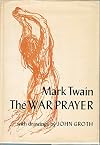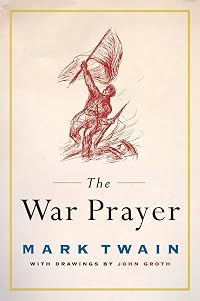
The War Prayer
by Mark Twain 
On This Page
Description
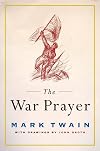
Written by Mark Twain during the Philippine-American War in the first decade of the twentieth century, The War Prayer tells of a patriotic church service held to send the town's young men off to war. During the service, a stranger enters and addresses the gathering. He tells the patriotic crowd that their prayers for victory are double-edged-by praying for victory they are also praying for the destruction of the enemy... for the destruction of human life. Originally rejected for publication show more in 1905 as "not quite suited to a woman's magazine," this antiwar parable remained unpublished until 1923, when Twain's literary executor collected it in the volume Europe and Elsewhere. Handsomely illustrated by the artist and war correspondent Philip Groth, The War Prayer remains a relevant classic by an American icon. show lessTags
Recommendations






















Member Reviews
In this very short work, Twain creates a scathing indictment of war, the hawks who rally the masses to their cause, and the people who thoughtlessly let their bloodlust and patriotism intertwine into an engine of destruction. The art is raw and serves the prayer well.
It continues to amaze me, the wonders one can find sitting on a library shelf if you just take a moment to look.
p.s., Reading this book reminded me of a favorite Peanuts strip, reprinted here:
https://www.gocomics.com/peanuts/2016/10/23
It continues to amaze me, the wonders one can find sitting on a library shelf if you just take a moment to look.
p.s., Reading this book reminded me of a favorite Peanuts strip, reprinted here:
https://www.gocomics.com/peanuts/2016/10/23
A clear poem with no artifice whatsoever, but it's perhaps the most searing piece of writing I've ever read - an indictment of war itself but also more specifically, certain religious attitudes toward war that were prevalent in his time and unfortunately, still exist in many corners today. The straightforward way he whisks the veil off the too-easy hypocrisy is shockingly affecting. I feel a little stunned. Everyone should read this. I was tempted to give it 5★ based on sheer power alone, but I settled on 4★ in the end.
John Groth's ink drawings that accompany the poem are crudely drawn but appropriate. Like the poem itself, they're forceful, expressive, and unadorned.
John Groth's ink drawings that accompany the poem are crudely drawn but appropriate. Like the poem itself, they're forceful, expressive, and unadorned.
A short, simple, powerful indictment of war and religion, published after Twain’s death at his request. He knew the horror of war, and that even in victory one side would be inflicting unspeakable cruelty on innocents (“…help us wring the hearts of their unoffending widows with unavailing grief; help us turn them out roofless with their little children to wander unfriended the wastes of their desolated land…). Unspeakable? Better to speak it, says Twain. Better to recognize it, and avoid it altogether. Amen.
Just this quote, on anti-war sentiment in a time of war:
“It was indeed a glad and gracious time,
and the half-dozen rash spirits
that ventured to disapprove of the war
and cast a doubt upon its righteousness
straightway got show more such a stern
and angry warning
that for their personal safety’s sake
they quickly shrank out of sight
and offended no more in that way.” show less
Just this quote, on anti-war sentiment in a time of war:
“It was indeed a glad and gracious time,
and the half-dozen rash spirits
that ventured to disapprove of the war
and cast a doubt upon its righteousness
straightway got show more such a stern
and angry warning
that for their personal safety’s sake
they quickly shrank out of sight
and offended no more in that way.” show less
I used to think I didn’t like the classics—as a small kid, loathing Alice; as a young reader in despair at the Ice Queen; and as a teenager bored by the Hobbit. I’m not sure how old I was when I was first introduced to Mark Twain, but I do know Tom Sawyer and Huckleberry Finn inhabited a world as alien as Middle Earth from my point of view. For me, someone whose skin was dark was interesting in the same way as someone whose hair was fair, and I had nothing to relate to.
Then I was sick one summer, unable to go out, and I devoured every book I was permitted to touch. I met Jane Eyre, Little Women, David Copperfield, grew accustomed to their worlds, and somewhere along the way became reacquainted with Huck Finn. I decided the show more classics weren’t so bad after all, just a little too slow and long-winded for everyday healthy entertainment.
Recently our book club decided to read Mark Twain’s Letters from the Earth. Is it heresy to say that still found him overly wordy? I enjoyed the perspective of his interpretation of Genesis though—the slightly irreverent logic and the invitation to engage brain in the search for meaning. But I skipped quite a few of the other essays and probably missed a lot.
So I wasn’t looking for another Mark Twain when I wandered round Powell’s book store the other day. But I was browsing the sales table and was surprised to spot a very slender volume bearing his name—the War Prayer. The fact that it was slender attracted me as much as the price—a short classic? Then I opened the book and found that, true to its size, it's really just a short story, or story poem, published after his death because Mark Twain said “I have told the whole truth…and only dead men can tell the truth in this world…” And it’s about a church service held to pray for young men about to go to war.
I guess Mark Twain never saw the illustrations by John Groth. They complement the tale perfectly; I think he would be pleased. The white space on the sparsely written pages leaves time for the reader to think; one page contains only one word, “Listen!” and issues its challenge. Then on the final written page, just before the last, most devastating illustration, “the man” is called insane. I stood there in the store, wondering which man, or all of us.
Yes. I read the whole book in the store. And then I wondered if I should buy it or leave it for someone else. But there were several copies, so I purchased one to bring home. Maybe my sons will pick it up, or visitors.
Apparently when Dan Beard heard Samuel Clemens read the tale, he asked if he was going to publish it. “No,” said Clemens. “It can be published after I’m dead.” I’m glad it’s been republished. I’m glad it’s in print. And I’m sad that it’s still so very relevant.
If you find a copy, open it, read it, and see if you can say who’s insane by the time you reach the end. show less
Then I was sick one summer, unable to go out, and I devoured every book I was permitted to touch. I met Jane Eyre, Little Women, David Copperfield, grew accustomed to their worlds, and somewhere along the way became reacquainted with Huck Finn. I decided the show more classics weren’t so bad after all, just a little too slow and long-winded for everyday healthy entertainment.
Recently our book club decided to read Mark Twain’s Letters from the Earth. Is it heresy to say that still found him overly wordy? I enjoyed the perspective of his interpretation of Genesis though—the slightly irreverent logic and the invitation to engage brain in the search for meaning. But I skipped quite a few of the other essays and probably missed a lot.
So I wasn’t looking for another Mark Twain when I wandered round Powell’s book store the other day. But I was browsing the sales table and was surprised to spot a very slender volume bearing his name—the War Prayer. The fact that it was slender attracted me as much as the price—a short classic? Then I opened the book and found that, true to its size, it's really just a short story, or story poem, published after his death because Mark Twain said “I have told the whole truth…and only dead men can tell the truth in this world…” And it’s about a church service held to pray for young men about to go to war.
I guess Mark Twain never saw the illustrations by John Groth. They complement the tale perfectly; I think he would be pleased. The white space on the sparsely written pages leaves time for the reader to think; one page contains only one word, “Listen!” and issues its challenge. Then on the final written page, just before the last, most devastating illustration, “the man” is called insane. I stood there in the store, wondering which man, or all of us.
Yes. I read the whole book in the store. And then I wondered if I should buy it or leave it for someone else. But there were several copies, so I purchased one to bring home. Maybe my sons will pick it up, or visitors.
Apparently when Dan Beard heard Samuel Clemens read the tale, he asked if he was going to publish it. “No,” said Clemens. “It can be published after I’m dead.” I’m glad it’s been republished. I’m glad it’s in print. And I’m sad that it’s still so very relevant.
If you find a copy, open it, read it, and see if you can say who’s insane by the time you reach the end. show less
A very thought-ptovoking story about how actions have unintended consequences - in this the people pray for the victory of their country, but are reminded that for someone to win, someone else must lose.
O Lord our God,
help us to tear their soldiers to bloody shreds with our shells
A brief, bitter protest against unjust war. Mark Twain wrote it when his country was engaged in suppressing the Philippines — an ugly episode you won’t find in school textbooks.
It was not published during his lifetime.
The book has had an instructive history. The author’s estate renewed the copyright during the Korean War. The grisly line drawings by John Groth date from 1968, the height of the Vietnam War. This particular edition came out in 1984 as the country flirted with war in Central America.
help us to tear their soldiers to bloody shreds with our shells
A brief, bitter protest against unjust war. Mark Twain wrote it when his country was engaged in suppressing the Philippines — an ugly episode you won’t find in school textbooks.
It was not published during his lifetime.
The book has had an instructive history. The author’s estate renewed the copyright during the Korean War. The grisly line drawings by John Groth date from 1968, the height of the Vietnam War. This particular edition came out in 1984 as the country flirted with war in Central America.
"For it is like unto many of the prayers of men, in that it asks for more than he who utters it is aware of―except he pause and think...
"Ponder this― keep it in mind. If you would beseech a blessing upon yourself, beware! lest without intent you invoke a curse upon your neighbor at the same time. If you pray for the blessing of rain on your crop which needs it, by that act you are possibly praying for a curse on some neighbor's crop which may not need rain and can be injured by it."
―The War Prayer
"Ponder this― keep it in mind. If you would beseech a blessing upon yourself, beware! lest without intent you invoke a curse upon your neighbor at the same time. If you pray for the blessing of rain on your crop which needs it, by that act you are possibly praying for a curse on some neighbor's crop which may not need rain and can be injured by it."
―The War Prayer
Members
- Recently Added By
Author Information

2,774+ Works 209,534 Members
Mark Twain was born Samuel L. Clemens in Florida, Missouri on November 30, 1835. He worked as a printer, and then became a steamboat pilot. He traveled throughout the West, writing humorous sketches for newspapers. In 1865, he wrote the short story, The Celebrated Jumping Frog of Calaveras County, which was very well received. He then began a show more career as a humorous travel writer and lecturer, publishing The Innocents Abroad in 1869, Roughing It in 1872, and, Gilded Age in 1873, which was co-authored with Charles Dudley Warner. His best-known works are The Adventures of Tom Sawyer, Mississippi Writing: Life on the Mississippi, and The Adventures of Huckleberry Finn. He died of a heart attack on April 21, 1910. (Bowker Author Biography) show less
Mark Twain has a Legacy Library. Legacy libraries are the personal libraries of famous readers, entered by LibraryThing members from the Legacy Libraries group.
Some Editions
Work Relationships
Is contained in
Common Knowledge
- Canonical title
- The War Prayer
- Original publication date
- 1905
- Important events
- Spanish-American War (1898)
- Epigraph
- To Dan Beard, who dropped in to see him, Clemens read the "War Prayer," stating that he had read it to his daughter Jean, and others, who had told him he must not print it, for it would be regarded as sacrilege.
"Still... (show all), you are going to publish it, are you not?"
Clemens pacing up and down the room in his dressing-gown and slippers, shook his head.
"No," he said, "I have told the whole truth in that, and only dead men can tell the truth in this world.
"It can be published after I am dead."
--Mark Twain, A Biography by Albert Bigelow Paine
Harper & Borthers, 1912 - First words
- It was a time of great and
exalting excitement. - Last words
- (Click to show. Warning: May contain spoilers.)It was believed afterward
that the man was a lunatic,
because there was no sense
in what he said. - Original language
- English
Classifications
Statistics
- Members
- 605
- Popularity
- 48,435
- Reviews
- 16
- Rating
- (4.45)
- Languages
- English
- Media
- Paper, Ebook
- ISBNs
- 14
- ASINs
- 12