On This Page
Description
With the birth of triplets, King Babar and Queen Celeste experience the pleasures and pains of parenthood.Tags
Recommendations























Member Reviews
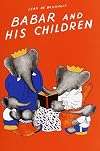
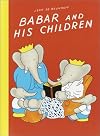
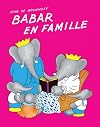
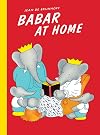
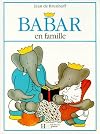
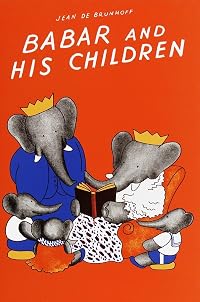
Royal pachyderms Babar and Celeste become parents to triplets in this sixth original Babar picture-book from Jean de Brunhoff, originally published in 1938 as Babar en famille. As Babar paces and frets, finally going on a bicycle ride, the queen delivers not one, not two, but three little elephants, much to the joy of Babar, and all the other residents of Celesteville. Naming their offspring Alexander, Pom and Flora, the proud parents embark on an adventure of a different kind, finding that keeping their little ones safe - from rattles, cliffs and alligators - is a full-time job. Still, as Babar observes at the end, "how nice the babies are! I wouldn't know how to get along without them any more..."
I found this entry in the series quite show more amusing, although I suspect that this was not the intent of its creator. Some of the parenting issues felt rather outdated to me (not surprising given the publication date), but then, I also found some of the adventures rather sweet. The artwork is charming, as usual - I find de Brunhoff's stylized elephants quite appealing, visually speaking - and there is nothing to offend, as there was in The Travels of Babar. I'm still not a great Babar fan, but Babar and His Children, along with its direct predecessor, Babar and Zephir, seems like one of the better offerings, when it comes to this character. show less
I found this entry in the series quite show more amusing, although I suspect that this was not the intent of its creator. Some of the parenting issues felt rather outdated to me (not surprising given the publication date), but then, I also found some of the adventures rather sweet. The artwork is charming, as usual - I find de Brunhoff's stylized elephants quite appealing, visually speaking - and there is nothing to offend, as there was in The Travels of Babar. I'm still not a great Babar fan, but Babar and His Children, along with its direct predecessor, Babar and Zephir, seems like one of the better offerings, when it comes to this character. show less
#44 in my 365 Kids Books challenge and multi-year effort to get Goodreads to fix the Top Readers, etc. lists. For a fuller explanation see my review for [b:101 Amazing Facts about Australia|21332402|101 Amazing Facts about Australia (Countries of the World)|Jack Goldstein|https://i.gr-assets.com/images/S/compressed.photo.goodreads.com/books/1394253825l/21332402._SY75_.jpg|25417728] You can see all the books on their own shelf.
Now Babar is colonizing his wife. I am a tad concerned about the accidents for Alexander and Flora: I fear primogeniture encourages murder. Interesting how thoroughly Babar picked up a foreign culture and how quickly he's disseminated it, down to nuances like appropriate baby gifts. Wonder where one finds a show more perambulator on a scale to hold three toddler elephants, which is probably immediately after birth if they're still like quadrupeds and haven't become incapable humans with a little culture. Now I'm remembering why I didn't ever buy these.
Sometimes books are classics because they're good, and sometimes because they were just around, like the way I feel about decades of pop songs. I don't love them, I never did, but I do know the words and I will sing along in the car if I was not wise enough to make other arrangements.
Library copy show less
Now Babar is colonizing his wife. I am a tad concerned about the accidents for Alexander and Flora: I fear primogeniture encourages murder. Interesting how thoroughly Babar picked up a foreign culture and how quickly he's disseminated it, down to nuances like appropriate baby gifts. Wonder where one finds a show more perambulator on a scale to hold three toddler elephants, which is probably immediately after birth if they're still like quadrupeds and haven't become incapable humans with a little culture. Now I'm remembering why I didn't ever buy these.
Sometimes books are classics because they're good, and sometimes because they were just around, like the way I feel about decades of pop songs. I don't love them, I never did, but I do know the words and I will sing along in the car if I was not wise enough to make other arrangements.
Library copy show less
It's the illustrations that really make these books. I could not fail to enjoy the deadpan treatment of the children's predicaments. The baby elephant is accommodated in a squirrel hole when he is ejected from his pram and hurled over a cliff. That is truly remarkable.
I loved this as a child, and my daughter is still pretty fond of it. I, on the other hand, find myself peppering it with editorial asides (that's not how you save a baby from choking! That's terrible breastfeeding advice!) and suppressing my internal questions, like why are those baby elephants so small when they're already walking? Why does it mentioning a rabbit running away when the rabbit has not previously been discussed? Why do the ducks fly away when a child is in danger, but happily rescue a hat?
In this fantasy picture book, Babar and his wife, Celeste have triplets. It is a joy throughout the village and everyone comes by to grant the family luck and happiness. Between getting caught in treetops and being chases by a crocodile, the three children keep Babar on his toes. This book is great for couples becoming parents soon. The illustrations are very realistic and simple. Simple colors were used and it was nice and neat. The text is usually long amounts on each page and the book is very long. A teacher can use this book not just for students who love babies, but parents who are expecting. It's a heartwarming salute to parenthood.
Babar and his queen Celeste are having a baby, turns out to be three. Pom, Flora and Alexander are growing. Flora swallows a rattle, luckily Zephir gets the rattle out to save her. Arthur, the big brother, lets go of the carriage and Alexander almost flies into a deep ravine, luckily the squirrels and the giraffe saves him. Then Alexander almost floats into a crocodile, luckily Babar saves him. The babies snug in bed and Babar and Celeste have time to think how lucky they are that everyone is fine.
Cute story but there is several times that it gets confusing. They used a different word to describe the baby carriage, they made a reference to a rabbit we knew nothing about, the squirrels seemed to enjoy ticking little Alexander and the show more ducks would only help retrieve the crown and hat, not the baby elephant out of the middle of the lake. Overall a cute story but the flow of the storyline was broken by some of these petty things. show less
Cute story but there is several times that it gets confusing. They used a different word to describe the baby carriage, they made a reference to a rabbit we knew nothing about, the squirrels seemed to enjoy ticking little Alexander and the show more ducks would only help retrieve the crown and hat, not the baby elephant out of the middle of the lake. Overall a cute story but the flow of the storyline was broken by some of these petty things. show less
This children's book is not one of my favorites. I think it is very long, and a little creepy. The story moves on very quickly and many things happen within the book. In this book, he prepares for the birth of his new child, but ends up with three. Then they aren't growing faster enough, and later one gets thrown over the edge of a hill and stuck in a tree. It is just plain weird. It is possible i don't like it because it is an older book, but I would not read it to my students.
Members
- Recently Added By
Author Information

181+ Works 8,628 Members
Jean de Brunhoff 1899 - 1937 Jean de Brunhoff (born December 9, 1899) was a French writer and illustrator known for creating the Babar books, the first of which appeared in 1931. He was the fourth and youngest child of Maurice de Brunhoff, a publisher. After the first book Histoire de Babar (The Story of Babar), six more titles followed before show more Jean de Brunhoff died of tuberculosis at the age of 37. He was buried in Père Lachaise Cemetery in Paris. Many people credit Jean's wife, Cécile de Brunhoff, as the real creator of Babar. After Jean's death, his brother Michel de Brunhoff, who was the editor of French Vogue, oversaw the publication in book form of his two last books, Babar and His Children and Babar and Father Christmas. The Babar series continues to be an international bestseller. Babar the elephant is an iconic character who has also been paid tribute by many museums worldwide. (Bowker Author Biography) show less
Some Editions
Series

Work Relationships
Common Knowledge
- Canonical title
- Babar and His Children
- Original title
- Babar en famille
- Alternate titles
- Babar at Home; Les enfants de Babar
- Original publication date
- 1938
- People/Characters
- Babar; Celeste; Pom; Flora; Alexander; Zephir (show all 7); Arthur (elephant)
- Important places
- Celestville
- First words
- One morning Babar said to Cornelius: "Old Friend, you who have been my constant companion through good times and bad, listen now to my wonderful news."
- Last words
- (Click to show. Warning: May contain spoilers.)"But how nice the babies are! I wouldn't know how to get along without them any more."
Classifications
Statistics
- Members
- 928
- Popularity
- 28,831
- Reviews
- 13
- Rating
- (3.72)
- Languages
- 10 — Chinese, Danish, English, Finnish, French, German, Hungarian, Italian, Spanish, Swedish
- Media
- Paper, Ebook
- ISBNs
- 42
- ASINs
- 15