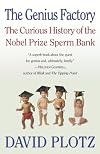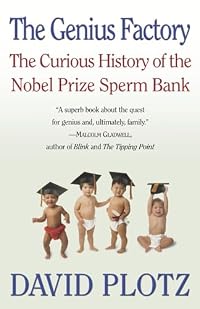
The Genius Factory: The Curious History of the Nobel Prize Sperm Bank
by David Plotz
On This Page
Description
Describes the recruitment of Nobel Prize winners and other accomplished men as donors to a sperm bank, whose mission was to breed brilliant scientists and leaders, profiling both the donors and the children fathered through the sperm bank.Tags
Recommendations

























Member Reviews
I found this journalistic inquiry into the infamous Repository for Germinal Choice a quick and interesting read. Plotz goes into the sperm bank's eugenics beginnings to the ramifications today now that the Nobel Sperm Bank babies are finally growing up, and nicely rounds it out with some musings on nature versus nurture.
It's not a politically correct thing and wouldn't happen openly today and even then it caused some consternation. But this was in 1980 and the guy has lots of money. That's how 'Nobel Prize sperm bank' was born. Robert Graham was an eccentric American millionaire who thought that humanity needed his help - he thought that modern social welfare programmes had caused people who wouldn't have survived ages ago (in his term: the "imbeciles and incompetents") to survive now. This, in his opinion, caused the degradation of human quality. Hence his attempt to gather the sperms of brilliant men, gifted scientists and great thinkers in a sperm bank, which in his mind would help boost the number of genius in the society and hence better the show more quality of human. It created quite a stir, but then after producing more than 200 'genius babies' it disappeared quietly at the end of the 1990s.
David Plotz was intrigued with what became of the Nobel Prize Sperm Bank kids and tried to find them. He wanted to know whether this could be one of those study to determine the winner in the battle between nurture and nature. The book not only show the touching human story of the identity confusions experienced by the sperm bank kids, but also reveals the workings of the sperm banking industry, then and now. Despite his controversial aspirations apparently Graham's genius sperm bank set about the basis for the modern sperm banking industry, where clients are given a lot of information, unlike in the old days.
And what about the genius babies? Do they turn out to be geniuses like their fathers are supposed to be? Read the book, it's interesting. show less
David Plotz was intrigued with what became of the Nobel Prize Sperm Bank kids and tried to find them. He wanted to know whether this could be one of those study to determine the winner in the battle between nurture and nature. The book not only show the touching human story of the identity confusions experienced by the sperm bank kids, but also reveals the workings of the sperm banking industry, then and now. Despite his controversial aspirations apparently Graham's genius sperm bank set about the basis for the modern sperm banking industry, where clients are given a lot of information, unlike in the old days.
And what about the genius babies? Do they turn out to be geniuses like their fathers are supposed to be? Read the book, it's interesting. show less
A sperm bank that was established for Nobel Prize winners– sounds like science fiction right? But it’s true.
David Plotz writes about the Repository for Germinal Choice, a sperm bank envisioned by its founder Robert Graham to arrest the declining quality of people and instead populate the world with the right kind of people– smart, highly accomplished ones. Plotz sought to find out what happened to the more than 200 children born through the Repository.
Graham, who became rich and famous for inventing plastic eyeglasses, was a firm believer in eugenics. That is, he believed that the world would be a better place if only the best kind of people would breed. He set up the Repository in 1980 and it lasted until 1999, two years after show more his death. It earned the nickname “Nobel Prize sperm bank” because its first donors had been Nobel Prize winners. However, no children were conceived from this batch and no other Nobelists donated after that. Because Nobelists are typically already in their 60’s or 70’s, it was highly unlikely that their sperm would result to successful conceptions. This and the difficulty in getting the Nobelists to donate in the first place drove the Repository to recruit younger men who were accomplished in their own right– businessmen, mathematicians, scientists. To Graham, intelligence meant analysis and logic and he didn’t give much credit to artistic or musical intelligence.
So did the children turn out to be geniuses? Plotz was able to get in touch with a few of them and he narrates their journey as they and their mothers seek to find the truth about the donors. It turns out that the Repository did not have a strict standard for the donors and did not check the veracity of the donors’ intelligence claims. They did not have an organized filing system either, so matching children with their fathers proved more difficult. The initial discovery that they were possibly fathered by Nobelists (the exact identities are kept secret and the Repository never really claimed that all their donors were Nobelists) changes one teenager’s view of himself and his family. The stories of the fathers meeting their kids are bittersweet and tragic.
The author tries to understand what made the men agree to donate their sperm to the Repository and how they handled the knowledge that they had fathered children. Some had an exaggerated sense of self-worth, some wanted to be involved in fatherhood while some couldn’t care less about their ‘kids.’ He also tries to figure out what made the women seek sperm banks and this one in particular. In the end, the question about the children’s brilliance is answered by nurture. That is, women who go to sperm banks are those who really want to become mothers, which means that they are highly involved parents who raise confident, intelligent kids. By going to the Repository, they don’t lose anything but instead gain a slight chance of having more intelligent children.
Plotz writes in a very casual way. It felt like reading one long magazine feature instead of a full-length book. (This style he probably gets from writing for Wired magazine.) He keeps the stories interesting by weaving in facts and his personal journey with the mother and kids. Interesting, too, are the anecdotes shared about Robert Graham; somewhere in the book he makes a connection to Gordon Moore of Intel.
The book got me thinking about what a family really is, what a father and fatherhood meant, and how society views reproduction. Plotz also raised the nature versus nurture debate and sides more with nurture but not entirely discounting nature’s contribution.
Rating: 3 out of 5, ok! Recommended for the new things I learned (especially about eugenics and the reproduction business) and for the insights on family and realizing one’s identity. show less
David Plotz writes about the Repository for Germinal Choice, a sperm bank envisioned by its founder Robert Graham to arrest the declining quality of people and instead populate the world with the right kind of people– smart, highly accomplished ones. Plotz sought to find out what happened to the more than 200 children born through the Repository.
Graham, who became rich and famous for inventing plastic eyeglasses, was a firm believer in eugenics. That is, he believed that the world would be a better place if only the best kind of people would breed. He set up the Repository in 1980 and it lasted until 1999, two years after show more his death. It earned the nickname “Nobel Prize sperm bank” because its first donors had been Nobel Prize winners. However, no children were conceived from this batch and no other Nobelists donated after that. Because Nobelists are typically already in their 60’s or 70’s, it was highly unlikely that their sperm would result to successful conceptions. This and the difficulty in getting the Nobelists to donate in the first place drove the Repository to recruit younger men who were accomplished in their own right– businessmen, mathematicians, scientists. To Graham, intelligence meant analysis and logic and he didn’t give much credit to artistic or musical intelligence.
So did the children turn out to be geniuses? Plotz was able to get in touch with a few of them and he narrates their journey as they and their mothers seek to find the truth about the donors. It turns out that the Repository did not have a strict standard for the donors and did not check the veracity of the donors’ intelligence claims. They did not have an organized filing system either, so matching children with their fathers proved more difficult. The initial discovery that they were possibly fathered by Nobelists (the exact identities are kept secret and the Repository never really claimed that all their donors were Nobelists) changes one teenager’s view of himself and his family. The stories of the fathers meeting their kids are bittersweet and tragic.
The author tries to understand what made the men agree to donate their sperm to the Repository and how they handled the knowledge that they had fathered children. Some had an exaggerated sense of self-worth, some wanted to be involved in fatherhood while some couldn’t care less about their ‘kids.’ He also tries to figure out what made the women seek sperm banks and this one in particular. In the end, the question about the children’s brilliance is answered by nurture. That is, women who go to sperm banks are those who really want to become mothers, which means that they are highly involved parents who raise confident, intelligent kids. By going to the Repository, they don’t lose anything but instead gain a slight chance of having more intelligent children.
Plotz writes in a very casual way. It felt like reading one long magazine feature instead of a full-length book. (This style he probably gets from writing for Wired magazine.) He keeps the stories interesting by weaving in facts and his personal journey with the mother and kids. Interesting, too, are the anecdotes shared about Robert Graham; somewhere in the book he makes a connection to Gordon Moore of Intel.
The book got me thinking about what a family really is, what a father and fatherhood meant, and how society views reproduction. Plotz also raised the nature versus nurture debate and sides more with nurture but not entirely discounting nature’s contribution.
Rating: 3 out of 5, ok! Recommended for the new things I learned (especially about eugenics and the reproduction business) and for the insights on family and realizing one’s identity. show less
A full-length treatment of the donors, children, mothers and families who were conceived through the Repository for Germinal Choice, a sperm bank advertised as focusing on Nobel prize winning donors.
David Plotz writes insightfully and colorfully about the history and human relationships created through the sperm bank, about the meaning of family, and the drive to understand the genetic and experiential components of identity. It is an interesting and highly humanized tale, worth reading not by everyone but by the people intrigued by the premise.
David Plotz writes insightfully and colorfully about the history and human relationships created through the sperm bank, about the meaning of family, and the drive to understand the genetic and experiential components of identity. It is an interesting and highly humanized tale, worth reading not by everyone but by the people intrigued by the premise.
This is a non-fiction account of one man's attempt to improve the world by starting a sperm bank whose donors were all Nobel prize winners. I love this kind of thing; it's like a real-life dystopian/utopian story. So, I really enjoyed the beginning of this book, where the author described the reasoning behind the sperm bank, the key figures, the history of eugenics, and so on. Unfortunately, though, the book as a whole didn't quite live up to its beginning. It turned out that the sperm bank founder abandoned the idea of Nobel prize winners pretty early on and sometimes ended up with just average guys, so tracking the children afterwards couldn't really lead to any interesting results. Then the story focused a lot on the stories of show more children and mothers trying to find and connect with the donors, which I did mostly enjoy (some much more than others), but which didn't have the same intellectual interest. Still, I think this was a worthwhile read. show less
In his book, Plotz traces the philosophical origins of what was commonly called “the Nobel Prize Sperm Bank” and explains just how it failed to live up to his vision. He tells fascinating stories of donors, parents, and children and the mystery that surrounds their unusual, invisible relationship. He even shares a bit about his own small adventure in sperm donation.
Although I found the personal stories really interesting, what I enjoyed most about this book was the way Plotz weaved in history, science, and social issues. The Genius Factory may claim to be about a single sperm bank with a unique mission, but it steps beyond that to take in societal attitudes about birth, genes, parenting, and more.
All in all, an enjoyable, quick show more read about a quirky topic. See my complete review at Shelf Love. show less
Although I found the personal stories really interesting, what I enjoyed most about this book was the way Plotz weaved in history, science, and social issues. The Genius Factory may claim to be about a single sperm bank with a unique mission, but it steps beyond that to take in societal attitudes about birth, genes, parenting, and more.
All in all, an enjoyable, quick show more read about a quirky topic. See my complete review at Shelf Love. show less
The book is rather creepy getting both into the entire field of eugenics and one man's idea of a Nobel sperm bank (although most of the donors were not, the original idea was to just have the sperm of prize winners in the fields he thought were important - no literature or peace winners for this guy). As well it details the effects of this on the families involved. This included the stress of hiding the secret as well as the pressure put on some of the kids to be 'genius babies'. Interesting read with both broader historical context and first person narratives.
Members
- Recently Added By
Author Information

5+ Works 863 Members
David Plotz is the editor of State. He has written for The New York Times Magazine, Harper's, Rolling Stone, The New Republic, The Washington Post, and GQ, and is the author of The Genius Factory: The Curious History of the Nobel Prize Sperm Bank. He won the National Press Club's Hume Award for political journalism and has been a National Magazine show more Award finalist. He lives with his wife, the journalist Hanna Rosin, and their children in Washington, D.C. show less
Common Knowledge
- People/Characters
- William Shockley
Classifications
- Genres
- Nonfiction, Science & Nature, General Nonfiction, History
- DDC/MDS
- 362.17 — Society, government, & culture Social problems and social services Social Welfare People with physical illnesses Specific services
- LCC
- HQ761 .P56 — Social sciences The family. Marriage, Women and Sexuality The Family. Marriage. Women The family. Marriage. Home Family size
- BISAC
Statistics
- Members
- 395
- Popularity
- 78,624
- Reviews
- 15
- Rating
- (3.60)
- Languages
- Dutch, English, Polish
- Media
- Paper, Audiobook, Ebook
- ISBNs
- 13
- ASINs
- 5